The macro mechanism
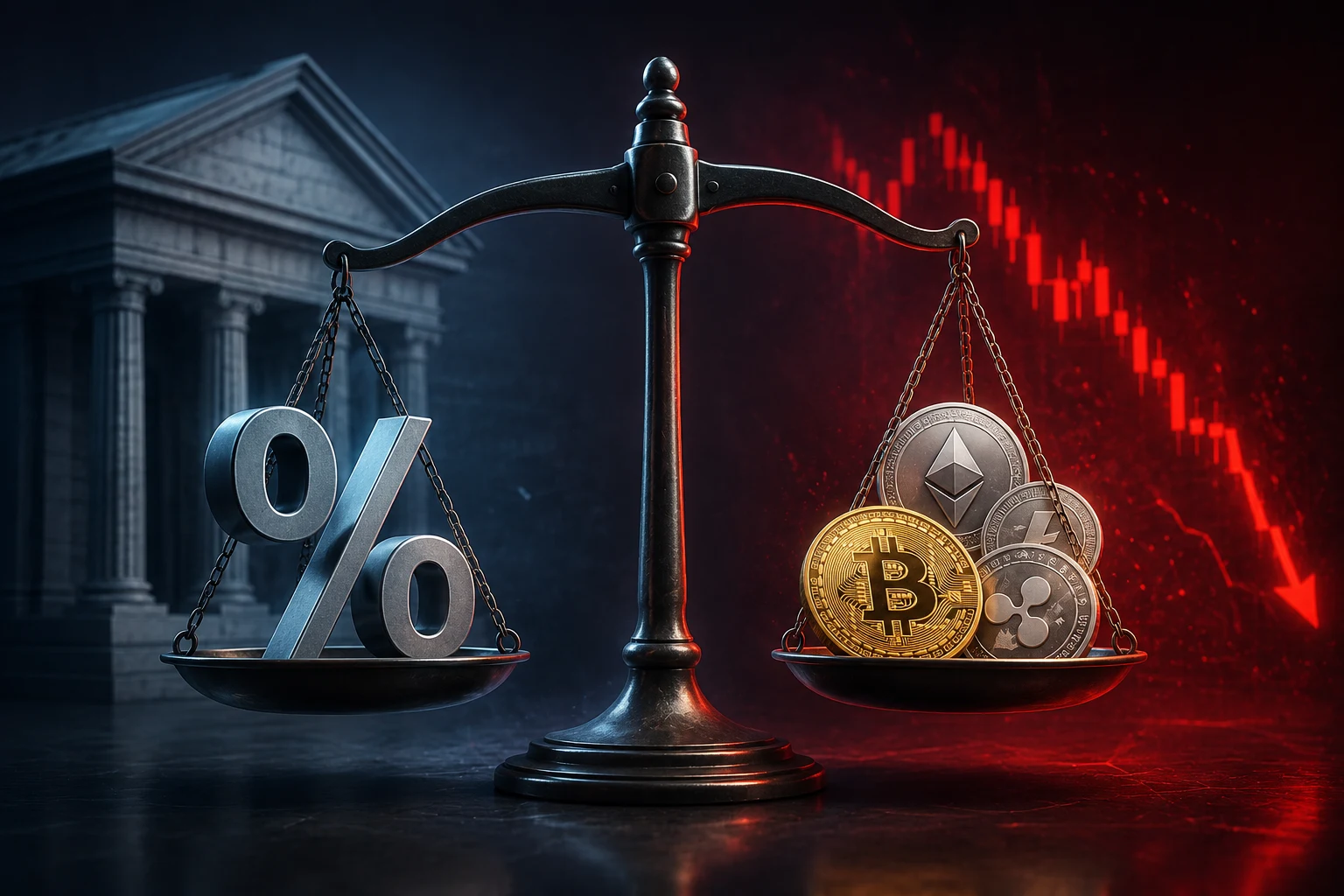
Interest rates are the price of borrowing money. When central banks raise rates, borrowing gets more expensive, savers earn more from safe assets like Treasuries, and investors are less willing to chase risk for extra return. When central banks cut rates, borrowing cheapens, safe yields shrink, and capital looks further out the risk curve — into stocks, real estate, and, in the modern era, crypto.
For a global, USD-denominated asset like BTC, three rate-linked channels matter most:
- Dollar liquidity. Looser policy tends to expand dollar liquidity worldwide; tighter policy drains it. BTC, priced in dollars and traded globally, is sensitive to that tide.
- Risk appetite. When the "risk-free" rate is near zero, holding non-yielding assets has almost no opportunity cost. When the risk-free rate is 5%, every speculative position is implicitly competing with a guaranteed 5% from a Treasury.
- Real yields and the dollar. Higher real yields (rates above inflation) typically strengthen the US dollar, which has historically been a headwind for BTC; lower real yields tend to weaken it, which has been a tailwind.
None of these channels are crypto-specific. They affect every risk asset. Crypto's specific feature is that it tends to react more violently — both ways — than equities at a given turn in the cycle.
The historical pattern
The clearest illustration comes from the last two cycles:
- 2020-2021: emergency easing, asset boom. The Federal Reserve cut rates to near zero in the early pandemic and expanded its balance sheet aggressively. Risk assets — stocks, real estate, BTC — went vertical. BTC ran from roughly $4,000 to almost $69,000 in eighteen months.
- 2022: rapid tightening, asset reset. The Fed raised rates from near zero to over 5% in barely a year as inflation surged. Risk assets cracked. BTC fell from $69,000 to roughly $16,000, the dot-com-bust-sized drawdown that took most leveraged crypto firms with it.
- 2023-2024: pause and pivot, partial recovery. Rates held high then began easing. BTC rebuilt, helped by the spot Bitcoin ETF launches and looser financial conditions, climbing back toward and through prior highs.
The shape is recognisable: easy policy creates the soil; tight policy pulls it back. The exact magnitude and timing are harder to call, but the direction of pressure usually lines up.
What it doesn't tell you
For all the elegance of the story, several things keep the relationship loose enough that "the Fed is the only thing that matters" is wrong:
- Crypto-specific narratives outweigh rates at the margin. The ETF launches, the FTX collapse, the halving cycle and the AI narrative all moved BTC in ways no rate decision could explain.
- Markets price expectations, not announcements. By the time a rate cut is delivered, prices typically already reflect months of anticipation. The headline rate decision often moves the market less than the change in the projected path.
- Crypto can decouple for stretches. Big idiosyncratic moves — a major hack, a regulatory shock, a flagship project failure — can override macro for days or weeks.
- The size of the effect varies by cycle. The 2020-2021 easy-policy boom was extreme partly because liquidity expansion was extreme; not every easing cycle will be that aggressive.
The honest framing is that interest rates are a driver, often a powerful one, but not the driver. As what causes Bitcoin price movements covers, many forces interact at once.
Reading rate decisions in context
When the next big Fed meeting hits, a few questions help separate signal from noise:
- Was the decision a surprise? A move that matched market expectations is mostly already in the price. A surprise — hawkish or dovish — is what tends to move risk assets.
- What changed in the projected path? Forward guidance — the "dot plot" or the press conference tone — often matters more than the headline number. Markets reprice the path, not the point.
- What is happening to real yields and the dollar? If real yields are falling and the dollar weakening, crypto has a fundamental tailwind regardless of the headline rate. If the opposite, the tailwind is missing.
- What other news is around it? A rate cut announced into a regulatory crackdown will be read differently from one into ETF inflows.
Treat rate days as macro inputs whose effect depends on context, not as automatic green or red lights.
Stay ahead of the cycle
Interest rates, the dollar, and risk appetite are the slow currents underneath crypto. They are not always loud, but when they turn, almost everything else turns with them. Zippfeed tracks macro and crypto headlines together — central-bank decisions, inflation prints, ETF flows, and the major crypto-specific stories — across many sources with sentiment and importance scoring. That way the macro context and the crypto reaction land on your feed in the same place, and you can read price action against the forces actually driving it. This is educational, not financial advice.

 CryptoSlate
 Glassnode
 WatcherGuru
 Altcoin Daily
 WuBlockchain