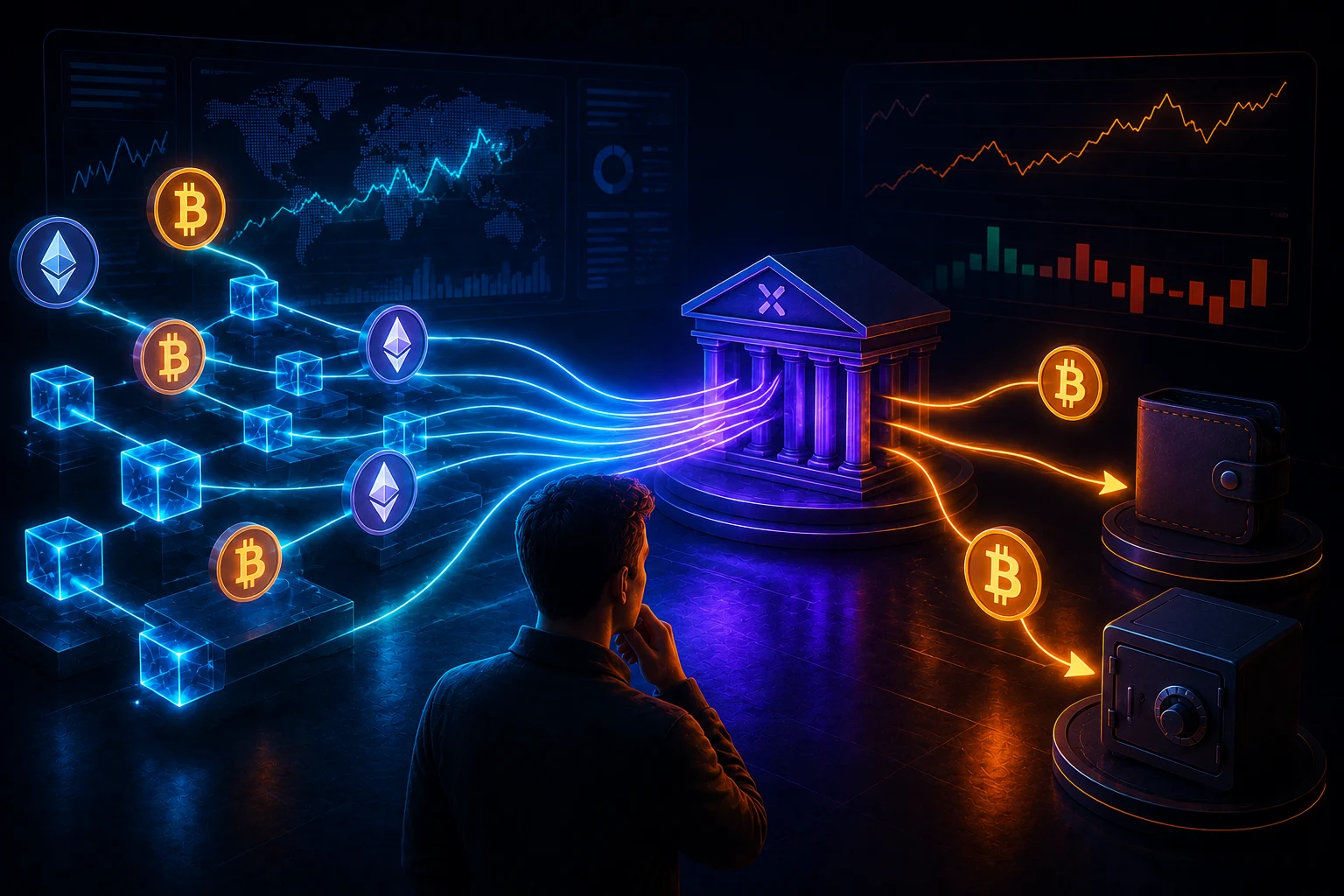
What "on-chain flows" actually means
On-chain flows are the public record of coins moving between addresses on a blockchain. Because Bitcoin, Ethereum, and most major chains are transparent ledgers, every transfer is visible in real time and historically queryable. The data is real. The interpretation is where traders get hurt.
The most-watched flow is the exchange netflow: the difference between coins deposited to exchange-controlled wallets and coins withdrawn from them, measured over a window of hours or days. When more coins flow into exchanges than out, netflow is positive; the market reads that as supply hitting the sell side. When more coins leave than arrive, netflow is negative; that is read as accumulation, coins moving into self-custody. The math is simple. The meaning is not.
An inflow is not automatically a sale. A trader might deposit BTC to a centralized exchange to use it as collateral for a loan, to farm a yield product, to swap into a stablecoin, or simply to rebalance a portfolio. A withdrawal is not automatically HODLing. The same coins can be moved into a lending protocol, into a derivative position, or into a different exchange with better liquidity. The flow is the fact. The motive is the guess.
That is why the best on-chain analysts treat flows as a sentiment proxy layered on top of price action, funding rates, and order-book data. None of these signals is a trade by itself. Stacked together, they paint a directional picture. Read alone, they are noise dressed up in charts.
The real risks of trading raw on-chain data
If you only read exchange netflow and whale alerts, you will be wrong often. The failure modes are predictable and worth naming up front.
Mislabeled exchange wallets. Every analytics platform maintains a database of addresses it believes belong to exchanges, custodians, and market makers. The labels are often wrong, lagged by weeks, or duplicated. When a major exchange migrates its hot wallet infrastructure, its old addresses may keep receiving deposits for days before any platform updates the cluster. Flows attributed to that exchange during the migration window are not signals at all; they are technical debris.
Internal rebalances look like trades. A cold wallet moving 50,000 BTC to a hot wallet to prepare for customer withdrawals is logged as a 50,000 BTC outflow from cold storage. To a naive dashboard, that reads as bullish accumulation. In reality, no decision was made; the exchange is doing its job. The reverse, a hot-to-cold sweep, reads as bearish distribution and is equally routine.
Mixers and privacy tools contaminate the trail. Funds that pass through a mixer, a cross-chain bridge, or a privacy-preserving protocol lose their clean attribution. By the time they emerge on the other side, they may be misclassified as fresh whale activity, exchange outflows, or new accumulation, when in fact they are the same coins you saw yesterday.
Stablecoin mint/burn is misread as buy pressure. A $1 billion USDT mint at the treasury makes headlines. But if those tokens sit at Tether's wallet, or are routed to a non-crypto destination, they never reach an order book. The buy-pressure narrative only holds when the minted stablecoins land on an exchange deposit address.
Stale or recycled addresses. Dormant Bitcoin addresses from 2011 wake up occasionally for coin-join operations, inheritance transfers, or legal seizures. None of these are trades. A naive alert service will scream "whale moves 1,000 BTC after 13 years" and the chart will flicker, but the move is unrelated to price.
The pattern: every on-chain signal has a true positive rate well below 100 percent, and the false positives are not random. They cluster around exchange maintenance windows, custody migrations, and protocol upgrades. If you cannot identify the cause of a flow, treat it as uninformative.
Exchange inflow vs outflow: what the data does and does not tell you
The textbook reading is that exchange inflows are bearish (coins about to be sold) and outflows are bullish (coins moving to cold storage). The reality is more nuanced, and the nuance is where traders make or lose money.
Inflows: three plausible reasons
- Distribution. A holder is sending coins to an exchange with the intent to sell. This is the bearish reading the dashboards assume. It is real, but it is one of several motivations.
- Collateral or lending. A trader is depositing BTC or ETH to a centralized lending desk, to a DeFi protocol's bridge, or to use as margin. The coins are not being sold; they are being put to work.
- Operational liquidity. An over-the-counter desk, a market maker, or a fund is topping up an exchange balance to facilitate customer withdrawals or large block trades. No directional view is implied.
Outflows: three plausible reasons
- Accumulation. A holder is moving coins to self-custody, planning to hold for months or years. This is the bullish reading the dashboards assume.
- Custody migration. A fund is moving coins from a centralized exchange to a qualified custodian, a multisig, or a regulated cold storage provider. Direction is unchanged; venue is different.
- DeFi deployment. Coins are being withdrawn from an exchange to be staked, lent, or used as collateral in a smart-contract protocol. They are still in the market; they have just changed roles.
The honest summary: the same flow can be read as bullish, bearish, or neutral depending on who is moving the coins and why. The dashboards cannot tell you the why. They can only tell you the what.
When the magnitude is extreme, the textbook reading becomes more useful. If 50,000 BTC flows into exchanges in a single day during a macro shock, the bearish case is the most likely explanation, because operational and lending flows at that size are rare. But for everyday flows in the hundreds of BTC, the signal-to-noise ratio is poor, and chasing them is a losing game.
Stablecoin issuance and mint data: the cleaner signal
Of all the on-chain flows traders follow, stablecoin issuance is the one with the highest information content, because the entity doing the issuing is known and the destination is usually trackable.
When Tether mints 1 billion USDT at its treasury address, the supply of dollar-denominated crypto liquidity has just expanded by 1 billion. If those tokens then move to an exchange deposit address, the most likely interpretation is that market participants want to deploy that liquidity into BTC, ETH, or other assets, which is a buy-side signal. If the tokens stay at the treasury or move to a non-exchange address, the signal weakens, because the liquidity is not yet on the order book.
The same logic applies to USDC. Circle's mint events are public on Ethereum, and because USDC is heavily used in DeFi, a USDC mint that lands on a DEX router or a lending protocol is a different signal from one that lands on a centralized exchange. The former is DeFi liquidity expansion; the latter is more direct buy pressure.
The pitfall is treating every mint as bullish. Some mints are treasury rebalancing. Some are redemption-driven, where Tether or Circle mints on one chain to bridge to another. Some are responses to OTC requests from a single large client. The size and the destination wallet are both required to read the signal correctly.
Burns are the mirror image. When USDT or USDC is burned at the treasury, supply is contracting, which means dollars are leaving the crypto ecosystem. A large burn correlated with an exchange outflow of BTC or ETH is a stronger bearish signal than either event alone, because the liquidity to buy the next dip is shrinking.
Whale wallet tracking: why the alerts are mostly noise
"Whale alert" services push notifications whenever a wallet above a threshold (often 1,000 BTC or 10,000 ETH) makes a move. The threshold is arbitrary, and the alerts generate more engagement than insight.
The first problem is identity. A "whale" wallet on a public dashboard is often a labeled exchange cold wallet, a custodian's omnibus account, or a market maker's settlement address. The 5,000 BTC move you just got alerted to is a custodian rebalancing between two of its own wallets. No human made a trade decision.
The second problem is motive. Even when a wallet is correctly attributed to a known individual or fund, a transfer is not a trade. Funds move between hot and cold storage, between exchanges and custodians, and between self-custody and lending protocols constantly. The wallet is active; the trader's view has not changed.
The third problem is the recency bias. Whale alerts fire on every large transfer, including dust consolidations, inheritance transfers, and airdrop claim batches. The 50 alerts you see in a week include maybe two or three events that meaningfully shift the supply-demand picture, and you have no way to know in advance which two or three.
What does work: tracking a small, vetted list of wallets with known identities (publicly labeled funds, known early adopters, protocol treasuries) and watching their behavior over weeks, not minutes. When a wallet in that list makes a move you have not seen before, the signal is meaningful. When an unknown wallet moves coins, the alert is entertainment.
How to use Arkham, Glassnode, and Zipp alongside each other
No single platform is enough. Each tool in the on-chain stack has a different specialty, and the trader who uses two or three together gets a cleaner picture than the trader who pays for the most expensive one.
Glassnode is the workhorse for aggregated metrics: exchange netflow, SOPR, MVRV, realized cap, and the long-term holder supply. Its strength is the time series; you can pull five-year charts of netflow and condition on macro regimes. Its weakness is that its exchange wallet labels can lag real changes at the exchange level, and the free tier is heavily rate-limited.
Arkham Intelligence is the address-level investigation tool. Its strength is entity attribution: connecting a pseudonymous wallet to a real-world fund, exchange, or individual. If you want to know who actually controls the wallet that just moved 20,000 ETH, Arkham is the first place to look. Its weakness is that entity labels are crowdsourced and sometimes wrong, and the platform's UI rewards narrative over statistical rigor.
Zippfeed is not an on-chain explorer. It is a news and sentiment layer that sits above the raw data. Its role is to answer the question that Glassnode and Arkham cannot: why did this flow happen, and does it matter? When a major exchange sees a 15,000 BTC inflow, Zippfeed's sentiment scoring tells you whether the news flow around that exchange is bullish, neutral, or bearish that day, and the importance rating tells you whether this is a routine wallet reshuffle or a response to a genuine market event. The combination is more informative than any single feed.
The practical workflow: open Glassnode to see the flow, open Arkham to identify the wallet, then open Zippfeed to see whether the market narrative supports the textbook reading or contradicts it. If Glassnode says bearish, Arkham confirms the wallet is a known seller, and Zippfeed's sentiment is neutral, you have a high-conviction bearish signal. If two of the three disagree, you have noise.
Putting it together: a practical workflow for the reader
If you want to use on-chain flows without being used by them, the discipline is straightforward. Define your signal before you look at the chart. Decide what flow magnitude, what time window, and what wallet identity would actually change your position. If the data meets all three conditions, act. If it does not, close the dashboard.
Use exchange netflow as a regime filter, not a timing tool. A multi-week trend of negative netflow during a price consolidation is a healthier setup than the same trend during a parabolic move. Inflows that coincide with stablecoin mints landing on exchanges are stronger sell signals than inflows without new dollar liquidity behind them.
Skip single-wallet alerts entirely unless the wallet is on your short, vetted list of known entities. Even then, treat a single transfer as one data point, not a verdict. The wallets that matter are the ones whose behavior changes; a holder who has not moved BTC in two years and suddenly sends 1,000 BTC to an exchange is news. A market maker that moves 1,000 BTC every Tuesday is a schedule.
Finally, separate the data from the story. On-chain flows are facts. The interpretation is a story you tell yourself to justify a position. The story can be right, and often is, but the data is not obligated to confirm it. When the story and the data diverge, trust the data and rewrite the story.
Stay ahead of on-chain flows with the right context
On-chain moves fast and so does the news around it. Tracking exchange netflow, stablecoin mints, and whale wallets manually is a losing game, because the raw feeds are too noisy to act on without a filter. Zippfeed surfaces crypto headlines with sentiment scoring, bullish, neutral, or bearish, plus an importance rating, so you can tell at a glance whether today's 20,000 BTC exchange inflow is a routine custody reshuffle or a response to a real market event. Pair the dashboards with the narrative, and the picture gets sharper.


 WuBlockchain
 CryptoSlate
 Glassnode
 WatcherGuru
 Altcoin Daily