Step 1: Decide your amount and schedule
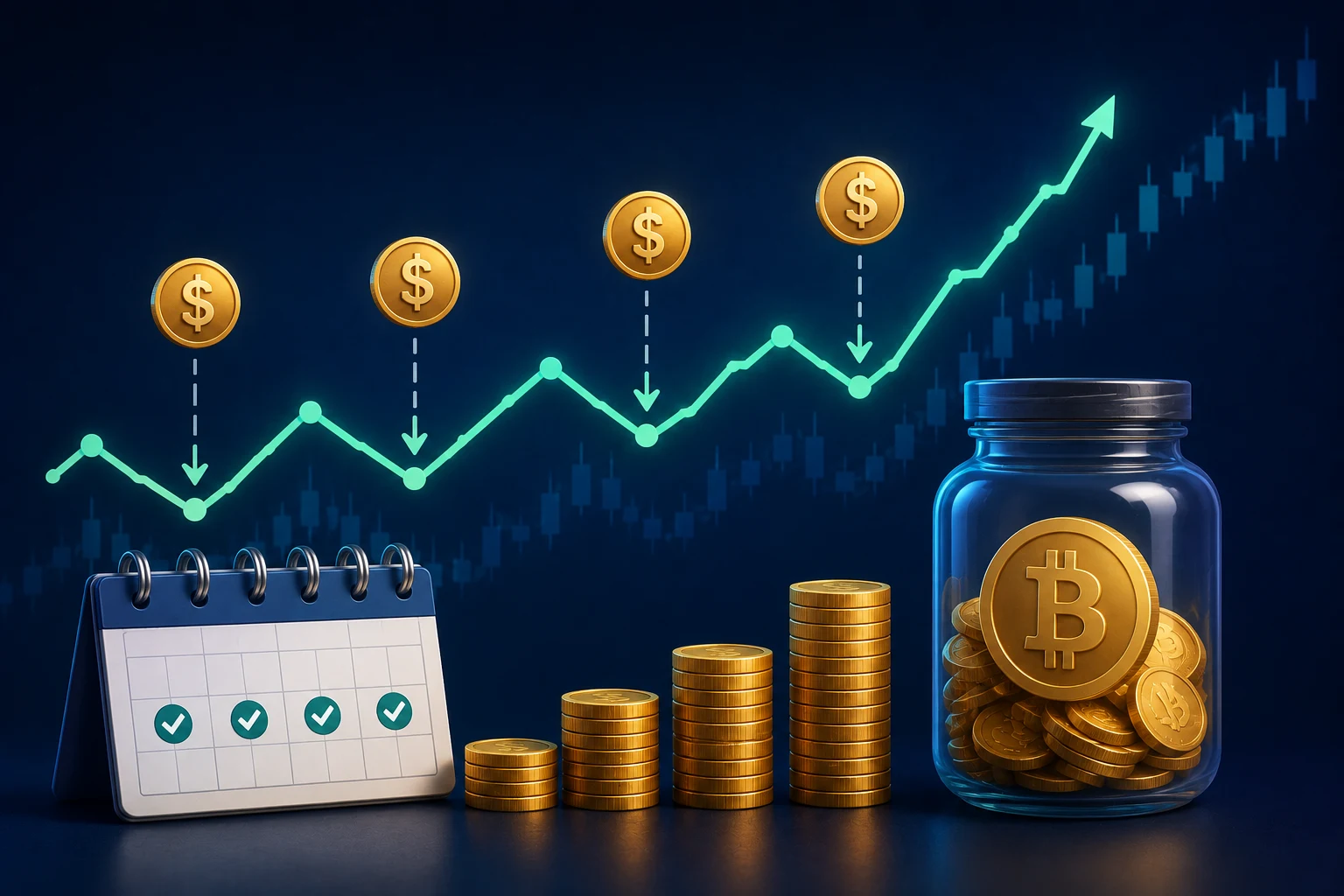
Pick a dollar amount you can sustainably afford to invest, and a frequency. Common patterns:
- Weekly — smooths price the most, lots of transactions, slightly higher fees.
- Biweekly or twice a month — popular because it lines up with paychecks.
- Monthly — fewer transactions, lower fees, less smoothing.
The actual difference in returns between weekly and monthly DCA is usually minor. Pick whichever you'll actually stick to.
Sustainability is the only thing that matters. DCA fails when you stop — and you stop when the amount is too aggressive. $50/week you can hold for years beats $500/week that you abandon in three months.
Step 2: Pick what to DCA into
DCA works best with assets you genuinely want to hold for years and that have enough liquidity and adoption to justify the assumption that they'll still be around. For most beginners that's Bitcoin and Ethereum. Smaller coins have higher upside but also higher chance of going to zero, which breaks the math of DCA entirely — averaging into a falling-to-zero asset just loses you money more efficiently.
If you want exposure to a basket, splitting your monthly buy across 2-3 large-cap assets (e.g. 70% BTC, 30% ETH) is sensible. Splitting it across 15 small caps is not.
Step 3: Automate it (the most important step)
Almost every major crypto exchange (Coinbase, Kraken, Binance, Bitstamp, and many others) supports recurring buys. You set: amount, frequency, asset, payment method. The exchange pulls funds and buys automatically.
Why automation matters: the whole point of DCA is removing yourself from the decision. If you manually buy each time, you'll skip the months when the price is dropping (because it feels scary) and pile in extra during the months when it's rising (because of fear-of-missing-out). That destroys the strategy. Automation enforces discipline.
Some exchanges charge slightly higher fees on recurring buys than spot trading — usually 1-2% vs 0.1-0.5%. For small amounts the convenience is worth it; for larger amounts, consider executing the buys manually on the spot market each period.
Step 4: Decide where the crypto goes
You can leave purchases on the exchange (convenient, but you depend on the exchange's solvency and security), or transfer them periodically to a wallet you control. A reasonable approach:
- Let the exchange accumulate for 1-3 months at a time.
- Withdraw to your own wallet (hardware wallet if amounts are meaningful).
- Repeat.
That keeps your withdrawal fees low while limiting exchange exposure. Our guides on how to store crypto securely and best crypto wallets walk through the storage side.
Step 5: Set the rules in advance
Write down — actually write down — the answers to these questions before you start:
- What event would make me stop? (E.g. "I lose my job" — yes. "Price drops 30%" — no, that's exactly when DCA works.)
- What event would make me increase the amount? (Be careful — chasing into a pump defeats the purpose.)
- When will I sell? (Goal, time horizon, or trigger — having an answer in writing prevents emotion-based exits.)
The hardest part of DCA isn't starting; it's continuing for years and not panicking when the market does what crypto markets do.
The honest case for and against DCA
For DCA:
- Removes timing decisions you'd probably get wrong.
- Smooths your entry price across volatility.
- Builds the habit of regular saving in a volatile asset.
- Reduces the regret of buying right at a top.
Against DCA:
- Mathematical studies (most famously Vanguard's) show lump-sum beats DCA about two-thirds of the time over long horizons, because markets trend up.
- DCA into a falling asset that doesn't recover is just losing money slowly.
- Higher transaction fees if you buy too often.
The honest answer: DCA wins on psychology and discipline, which is where most retail investors actually lose. For someone who'd otherwise sit in cash because they're scared of timing, DCA's true comparison isn't to lump-sum — it's to never investing at all.
Common mistakes
- Stopping when prices drop. Exactly when DCA buys the most coins per dollar. Stopping defeats the point.
- Adding extra during pumps. The exact opposite of what the strategy is designed to do.
- DCAing into junk. Small low-quality coins can go to zero; the average of a falling asset that never recovers is just a slow loss.
- Leaving everything on a sketchy exchange. The cost of moving to a real wallet is much smaller than the cost of an exchange collapse.
The safety checklist
- Is the amount sustainable for years, not months?
- Is the asset something you'd want to hold even if you can't sell tomorrow?
- Is the schedule automated so emotion can't interfere?
- Do you have a written plan for when you'd stop or sell?
- Is the storage plan in place (exchange short-term, your wallet long-term)?
Read crypto markets without breaking your plan
The point of DCA is to stop reacting to news. But context still helps — knowing the difference between a temporary dip and a structurally broken asset matters for long-term holds. Zippfeed tracks crypto news across multiple sources with sentiment and importance scoring, so you can stay informed without becoming reactive. The right level of attention is enough to know when something fundamental has actually changed, and not so much that every weekly candle changes your behavior.


 WuBlockchain
 CryptoSlate
 Glassnode
 WatcherGuru
 Altcoin Daily