Why a perpetual futures contract exists at all
If you buy Bitcoin on a regular exchange, you own actual BTC. You can hold it for a day or a decade. No one forces you to sell. The only thing that can take the position away from you is a hack, a personal decision, or the exchange going bankrupt.
Futures markets were invented long before crypto, in the 1970s, to let farmers, oil companies, and banks lock in a future price. A standard futures contract has an expiry date, after which both sides either deliver the actual thing or settle the difference in cash. The contract has a finite life, and that expiry is the whole point: it lets you hedge a real-world position that will end on a specific date.
Crypto traders wanted something different. They did not want a corn-style expiry. They wanted a way to bet on whether BTC would go up or down tomorrow, next week, next month, forever, without ever touching the actual coin. So derivatives exchanges built a new instrument: the perpetual futures contract, sometimes shortened to "perp" or "perps." The first mainstream version launched on BitMEX in 2016, and the design has since been copied by Binance, Bybit, OKX, Hyperliquid, dYdX, and dozens of others.
The defining feature is in the name: perpetual. There is no expiry. You can hold a BTC perp position open indefinitely, paying (or earning) a small recurring fee to keep it alive. That single design choice is what turned perps into the most-traded crypto product on Earth, with daily volumes routinely in the hundreds of billions of dollars.
How a perp differs from spot and from dated futures
Spot trading is the simplest mental model. You hand over USDC, you receive BTC, and the BTC sits in your account. If BTC goes up 10%, you are up 10% on the dollars you put in. If BTC goes to zero, you lose your USDC and that is the worst that can happen.
A dated futures contract, the kind listed on the CME for institutions, also tracks an underlying asset but it has a fixed expiry, say December 27. As that date approaches, the futures price converges with the spot price. If the futures price is higher than spot on the way to expiry, that gap is called "contango"; if it is lower, that is "backwardation." Convergence is automatic because on expiry the contract is settled against an index price.
A perpetual future throws out the expiry. Because of that, it can drift away from the spot price at will. If everyone is betting long and no one is betting short, the perp price would simply float above spot and stay there forever, which would break its usefulness as a price-tracking tool. Something has to glue it back. That something is the funding rate, covered in the next section.
Two more practical differences matter to a beginner. First, with spot you must put up 100% of the trade's value. With a perp, you put up a small percentage called initial margin and the exchange effectively lends you the rest, so a $1,000 margin can control $10,000, $50,000, or even $100,000 of BTC. Second, perps are settled in stablecoins (USDT or USDC), not in the underlying coin, which is why you can short BTC without ever borrowing or delivering any BTC.
The funding rate: how a perp pretends to have an expiry
Funding is the mechanism that keeps a perpetual contract tethered to spot. Every few hours (most commonly every 8 hours, though some exchanges like Hyperliquid run on 1-hour cycles), longs and shorts exchange a small payment. The side that is "more eager" pays the other side.
How does the exchange know which side is more eager? It compares the perp's market price to a mark price, which is a smoothed version of the underlying spot index, usually an average across several major exchanges. If the perp trades above the mark, funding is positive and longs pay shorts. If the perp trades below the mark, funding is negative and shorts pay longs. A typical rate is something like 0.01% every 8 hours, which annualises to about 10.95%, but during euphoric or panicked markets it can spike to 0.1% or more per cycle, which is over 100% per year.
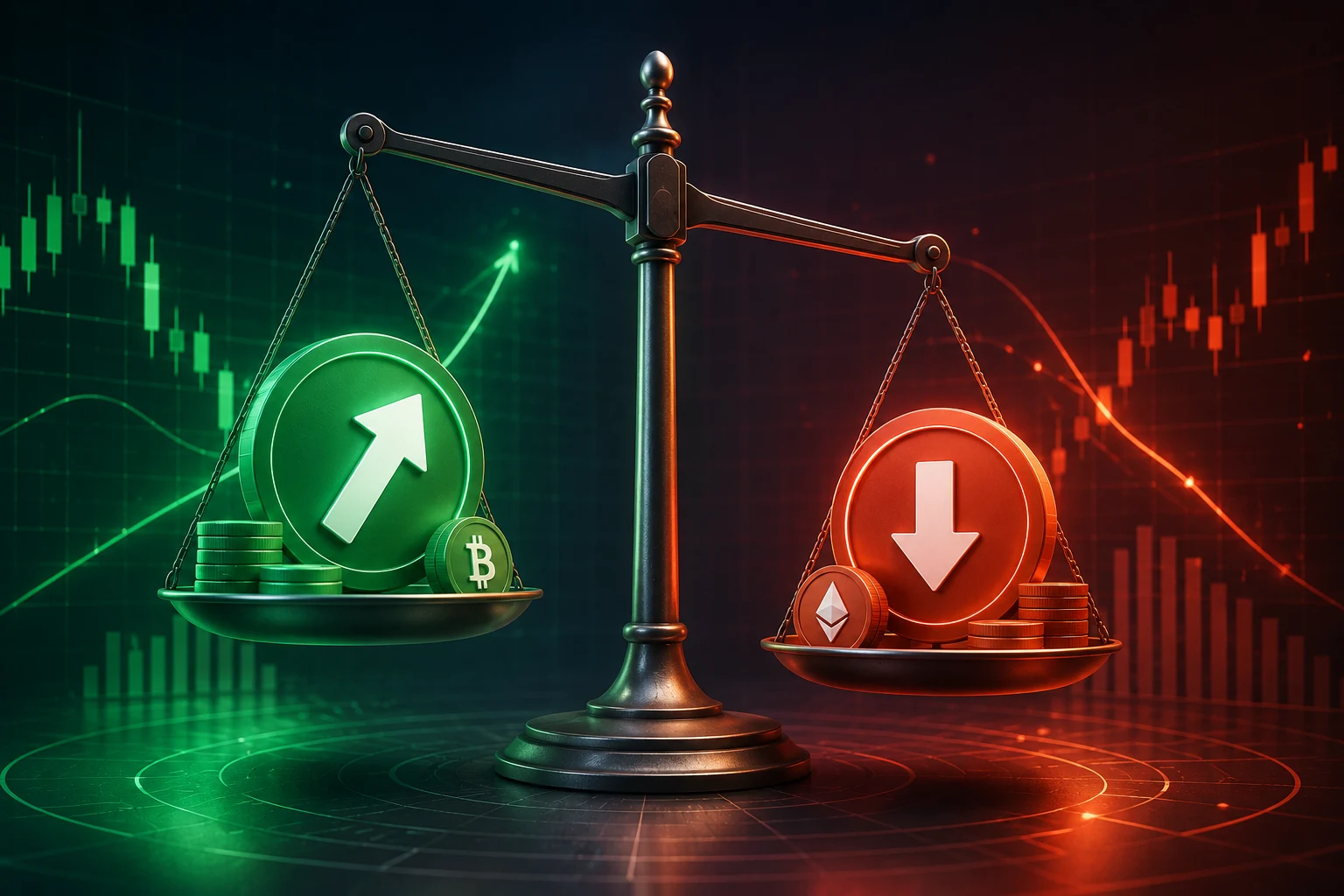
Why does this design work? Imagine funding is positive at 0.05% per 8 hours. Longs are paying shorts a daily tax of roughly 0.15%. Rational traders will be reluctant to open new longs at that price level and happy to open shorts, which pushes the perp price back down toward the mark. Funding is essentially a self-balancing weight on a scale. The more the perp drifts, the heavier the funding becomes, and the harder the market pushes back.
For a trader, the practical lesson is that holding a perp is not free. A 50x leveraged long that survives a month of sideways action can still lose money purely to funding, especially if the trade goes against the prevailing crowd bias. Funding is the closest thing a perp has to a real cost of carry, and it is the reason experienced traders close positions before major macro events rather than ride them out.
Mark price versus last price, and why liquidation math depends on it
Every perpetual futures interface shows two numbers that look similar but are not. The last price is whatever the most recent trade on the exchange happened to be. It can spike or wick wildly on thin liquidity, especially during off-hours or right after a major news headline. The mark price is a calculated fair value, usually derived from the spot index plus a short-term moving average, designed to be hard to manipulate with a single trade.
Liquidation is decided by the mark price, not the last price. That detail has saved and ruined traders in equal measure. If you are long 10x and a wick momentarily prints a price that is 20% below where you entered, the last price on the screen might show you as bankrupt, but if the mark price has not actually moved that far, the exchange will not liquidate you. Conversely, a manipulator who wants to hunt stops will try to push the mark price, not just the last price, because that is the only way to force a real liquidation cascade.
Liquidation price math, in plain English, is simple. With 10x leverage on a long, your position is 10% away from a total loss. If BTC is at $60,000 and you open a 10x long with $1,000 of margin, you are controlling $10,000 of exposure. A 10% drop in BTC wipes out your $1,000 exactly. The exchange starts the liquidation process a bit before that, when your losses eat into your margin buffer (called maintenance margin), usually around 0.5% to 1% before zero. So the actual liquidation trigger is closer to a 9% move against you on a 10x long.
Once you are liquidated, two things can happen. On older exchanges, the exchange takes over your position in a process called ADL, or auto-deleveraging, which can take a few minutes. On most modern exchanges, your position is simply closed at the bankruptcy price and any remaining margin (after fees) is returned to you. Some exchanges also have an insurance fund that covers situations where the market moves so fast the engine cannot close your trade in time, but that fund is not unlimited and has been drained in past crashes.
The real risks: why perps blow up retail accounts
It is worth being blunt here. Perpetual futures are the single most common way individual crypto traders lose money. Not because the instrument is broken, but because the design makes self-destruction the default outcome for anyone who is impatient, leveraged, and undercapitalised. Here are the failure modes that account for the bulk of the damage.
Leverage is symmetric and unforgiving. A 10x long makes a 10% rally worth 100%, but a 10% drop makes it worth zero. A 50x long needs only a 2% move against you to be liquidated. Daily BTC moves of 2% to 5% are not unusual. A routine Tuesday can end a 50x position. The worked example in the previous section is not a worst case, it is a normal case.
Funding drains you while you wait. If you are on the wrong side of a popular trade, you can lose money even when the price does not move. Traders who held short positions during the 2021 bull run or long positions during the 2022 bear market often bled out to funding long before the trend reversed. Hours of boredom punctuated by sudden ruin is the typical perp experience.
Counterparty risk still exists. FTX collapsed in 2022 with billions in customer funds missing. Three Arrows Capital and Alameda Research both failed partly because of unhedged perp exposure. Even on solvent exchanges, a "long" position is a contractual claim on a centralised counterparty, not ownership of an asset. If the exchange halts withdrawals, you have nothing.
Scam-pattern platforms. A persistent slice of the perp market is made up of platforms that manipulate the mark price, refuse to honour profitable withdrawals, or fabricate volume. The phrase "DYOR" (do your own research) exists because exchanges have a long history of exit scams. Stick to venues with years of public proof-of-reserves, regulatory licences, and a track record of paying out large withdrawals under stress.
Behavioural traps. Revenge trading, doubling down on a loss, increasing leverage after a win, and ignoring fees are the four horsemen of perp blowups. None of them are visible on a trading interface, and none of them are fixed by a better strategy. The instrument will faithfully execute whatever you ask of it, including the order that empties your account.
Practical implications if you are considering trading a perp
Start with the assumption that you should not trade perps at all until you have at least a year of spot trading under your belt and a written plan for every position. That recommendation is not paternalism, it is the statistical reality: the majority of retail perp traders lose money, and the losses are concentrated in the first six months.
If you do trade, keep leverage low. A 2x or 3x position is a meaningful bet without being a coin-flip. 10x is high-stakes. 50x and 100x are, functionally, casino bets with a guaranteed house edge baked into the funding rate. Many experienced prop-firm traders cap themselves at 5x and consider that aggressive.
Use limit orders, not market orders, especially on volatile assets. A market order on a thin order book can fill you several percentage points away from where you clicked, and on a leveraged position that slippage can be the difference between a profitable trade and a liquidation. Always set a stop loss before you enter, and treat the stop as a hard ceiling on your loss, not a suggestion.
Track your funding costs explicitly. A position that looks free to hold is not free. On a busy week, funding can eat 0.5% to 1% of your margin, which is meaningful on a leveraged book. If you are paying funding to hold a position, you are paying the market to tell you the trade is overcrowded.
Finally, size for survival. The question is not "what is the most I can bet on this idea?" The question is "if this trade goes to zero, can I still function next month?" If the answer is no, the position is too large, regardless of how confident you feel about the direction.
Stay ahead of perpetual futures market shifts
Perpetual futures are the most reactive part of the crypto market, and funding rates, liquidations, and open interest often move before spot price does. Tracking the BTC, ETH, and HYPE perps, plus the dozens of other listed perps, by hand is not realistic. Zippfeed surfaces perpetual futures headlines with sentiment scoring (bullish, neutral, or bearish) and an importance rating, so you can see whether the market is leaning long or short, whether funding is spiking, and whether a large liquidation event just reset the board, all in one feed.



 CryptoSlate
 CoinDesk
 Crypto Rank News
 WuBlockchain
 Crypto News
 TheBlock