What an NFT royalty was supposed to be
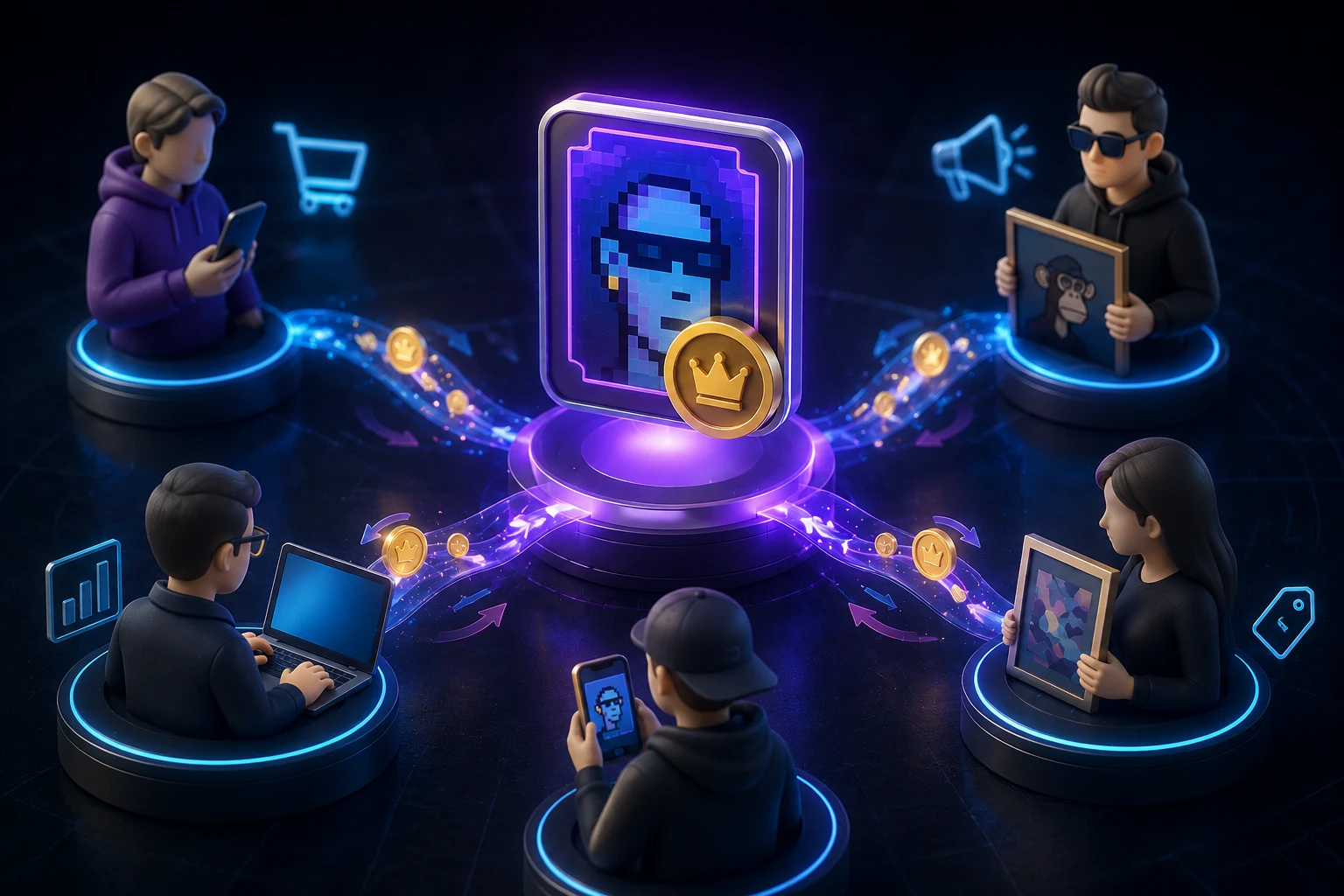
An NFT royalty is a percentage fee that an original creator earns on every future resale of their token. Most collections set it between 5 and 10 percent, paid in the cryptocurrency used for the trade, usually ETH or SOL. The idea was simple: an artist mints a piece once, and every time it changes hands on the secondary market, the original creator receives a cut forever.
Royalties were pitched as the answer to a long-standing unfairness in physical art, where an artist often sees no upside when their work appreciates in the resale market. For digital creators in particular, royalties looked like the first credible way to capture ongoing value from a supply-capped asset. Between 2021 and 2023, projects like Bored Ape Yacht Club, Azuki, and several generative-art collections routed hundreds of millions of dollars of secondary sales to creator wallets, and the term "creator economics" became a fixture of NFT pitch decks.
Almost none of those guarantees were written into the blockchain itself. The token standard that records a royalty is just a signpost. Whether anyone actually pays it is a decision made by the marketplace running the trade, and that decision has drifted steadily against creators since 2023.
The risks creators face in 2026
For any creator still relying on secondary royalties as a meaningful revenue line, the honest summary of the current environment is that the income is fragile and shrinking. Several failure modes are worth naming out loud.
Royalties are a marketplace policy, not a smart contract guarantee. There is no on-chain mechanism that can force a buyer or a marketplace to send the fee. Enforcement lives entirely in the off-chain code that lists and settles the trade. A venue that decides to stop honoring royalties loses nothing on chain, and the creator loses the income silently.
Aggregators route around filters. The biggest single threat is not any one marketplace's policy but the existence of trade aggregators such as Blur and OpenSea Pro, which scan every venue and fill the order wherever the buyer nets the most tokens. Because aggregators almost always land on zero-royalty venues, even strict marketplaces get bypassed in practice.
Optional royalties invite race-to-the-bottom behavior. When OpenSea made creator fees optional in early 2023, other marketplaces quickly followed, on the argument that buyers would simply route around anyone who enforced. The net effect was an industry-wide collapse in average royalty capture, especially on Ethereum mainnet.
Some enforcement tools can be bypassed with one click. OpenSea's Operator Filter Registry was meant to block trades to marketplaces a creator disapproves of, but the filtering happens at the ERC-721 transfer manager level, which a determined seller can work around with a wrapper contract or a direct transfer. It is a deterrent, not a wall.
Historical wipeouts are real. A number of high-profile collections saw their effective royalty rate fall from roughly 7.5 percent to under 1 percent within months of OpenSea's policy change, with the lost income running into eight figures across the ecosystem. Creators who had modeled business plans around a steady stream of secondary sales had to rewrite those plans in 2023.
This is not a reason to walk away from NFTs, but it is a reason to plan around the royalty stream as a bonus rather than the foundation of a project.
How ERC-2981 works, and why it is mostly a hint
ERC-2981 is the Ethereum standard for storing royalty information on a token. When a creator mints a collection that implements the interface, the contract exposes a function called royaltyInfo that takes a token ID and a sale price and returns the address to pay and the amount owed. It is roughly three lines of code and it is genuinely useful as a discovery layer for marketplaces and wallets.
The standard is also deeply limited. Nothing in ERC-2981 actually transfers the tokens. The marketplace has to read the result, calculate the fee, and send it as part of the settlement transaction. If the marketplace does not read royaltyInfo, or chooses to ignore it, no fee is paid and there is no on-chain evidence that a royalty was owed in the first place. ERC-2981 is a polite request to whoever is running the trade.
Most non-Ethereum chains have their own equivalents. SOL has a metadata standard that lets creators specify a creator share, but the same limitation applies: the share is only honored if the marketplace running the trade respects it. Whether your token lives on Ethereum, Solana, Base, or another chain, the enforcement story is identical: it is a marketplace problem dressed up as a protocol feature.
This is also why so many "royalty enforcement" projects raised venture money in 2022 and 2023. Protocols such as Royalty Registry, LooksRare's earlier enforcement layer, and a handful of others tried to add contract-level guarantees on top of ERC-2981. None of them produced meaningful usage at scale. The lesson is that any enforcement layer needs buy-in from the largest marketplaces to matter, and that buy-in is unstable.
How the major marketplaces actually handle royalties today
The three venues that matter most for NFT trading volume are OpenSea, Blur, and Magic Eden. Their policies have converged on optional royalties, with enforcement reserved for curated or whitelisted collections.
OpenSea. In early 2023 OpenSea made creator fees optional across all Ethereum collections, citing competitive pressure from Blur. To give creators some control, the platform launched the Operator Filter Registry, an on-chain allowlist that lets a collection's admin block trades from going through specific operators, typically marketplaces that do not enforce royalties. Operators that are not registered simply cannot execute transfers of those tokens through OpenSea's main interface. The filter is widely respected by other compliant marketplaces, but it can be bypassed, and aggregators that do not respect it sidestep the protection entirely.
Blur. Blur launched in late 2022 with zero royalties by default and built its volume on trader incentives. It does honor royalties for a small number of "royalty-protected" collections, but for the vast majority of NFT trades routed through Blur or its aggregator, no creator fee is paid.
Magic Eden. Magic Eden has oscillated between enforcing and optional royalty regimes. It currently enforces royalties on Bitcoin Ordinals and on curated Solana collections, and leaves royalties optional elsewhere. Like OpenSea, it reserves the right to use registry-style enforcement for collections that opt in.
The common pattern is that enforcement is the exception, applied to a handful of marquee collections whose creators have negotiated it explicitly, while the default for the long tail of NFT volume is zero creator fees.
The Operator Filter, and how it gets bypassed
The Operator Filter Registry is the closest thing the ecosystem has to a working enforcement layer. The mechanic is straightforward: a collection deploys a filter contract that maintains an allowlist of approved marketplace operators, and the NFT contract refuses to process transfers sent by anyone not on the list. From the marketplace's perspective, listing a flagged collection requires registering its operator address, agreeing to honor royalties, and routing settlements accordingly.
For compliant marketplaces this is workable. The problem is that the filter only checks the immediate caller of the transfer function. A determined seller can sidestep the filter by transferring the token through a wrapper contract, a third-party escrow service, or a direct transfer to the buyer's wallet followed by an off-chain payment in stables. None of these paths route through a compliant marketplace, so the filter never fires.
There are also aggregator-level bypasses. A trade aggregator will sometimes split an order across multiple venues, only some of which respect the filter, and the resulting prints can include zero-royalty fills. The token never moves through a non-compliant operator, but the buyer effectively captures the price difference that should have gone to the creator.
The Operator Filter is best understood as a deterrent plus a signaling device. It tells marketplaces which collections care about royalties and gives compliant venues a way to honor that, but it cannot physically prevent a motivated seller from capturing the fee for themselves.
Alternatives creators are actually using
Creators who still want recurring revenue from their NFT work have largely moved away from passive secondary royalties and toward more explicit monetization models. Four patterns are worth understanding.
Creator coins. Platforms like Zora, Rodeo, and a growing list of friend.tech-style apps let a creator launch a personal token that trades on a bonding curve. Holders get access to content, communities, or revenue splits that the creator controls directly. The recurring revenue comes from trading fees on the coin, not from NFT resales. The downside is that the coin's price is highly reflexive and can collapse quickly when attention fades.
Allowlists and gated mints. Many projects now reserve future allowlist access and mint priority for existing holders of their original NFT. The recurring value is access rather than cash flow, but it is real and it is durable because the NFT itself never needs to trade for the benefit to flow.
Derivative-token models. A growing number of collections have launched a "breed" or "evolve" mechanic, where holders can burn their original NFT and mint a new one with updated traits or utility. The mint fee acts as a recurring revenue event that the creator captures at the source, regardless of what happens to the original token's secondary market.
Bake the royalty into the primary price. The simplest fix. If a creator expects to earn roughly 7 percent forever on secondary sales and assumes a 2x turnover per year, the present value of those royalties can be priced into a slightly higher mint cost. Buyers pay once, the creator stops chasing revenue streams they cannot enforce, and the secondary market is allowed to clear at lower friction. For a lot of creators in 2026, this is the cleanest trade available.
What this means if you are a creator or a buyer
If you are minting or holding an NFT in 2026 and treating royalties as a meaningful income line, it is worth modeling what happens if those royalties fall to zero. For most collections outside a curated registry, that is closer to the base case than the worst case. Plan your project economics so the primary mint can stand on its own, treat secondary royalties as upside rather than revenue, and pick at least one alternative monetization layer whether that is a creator coin, a gated allowlist, or a derivative-mint mechanic.
If you are a buyer, the practical implication is that the price you pay is the price the seller wants, and the creator's cut has already been factored into the primary mint. Resale royalty fields in marketplaces are mostly a courtesy. If you are buying a long-tail collection, assume the creator is not earning from your trade. If that bothers you, send the creator a tip directly via their public wallet.
Track NFT royalty news the smart way
NFT royalty policy moves quickly and so does the news around it. New marketplaces launch with different defaults, aggregators add new routes, and the Operator Filter registry gets updated in ways that change which collections actually pay. Tracking all of this manually is a losing game. Zippfeed surfaces NFT royalty headlines with sentiment scoring (bullish, neutral, or bearish) and an importance rating, so you can see at a glance which policy shifts are noise and which ones are about to reshape how creators get paid.