What is a crypto order book, really?
An order book is the public list of open buy and sell orders for a specific trading pair, such as BTC/USDT or ETH/USDT, on one exchange. Every row you see is a real order that someone has submitted and not yet canceled or filled. Because the list updates with every trade, the book is the closest thing a trader has to a real-time photograph of supply and demand at a single venue.
This sounds simple, but it carries a critical caveat that most beginner guides skip. The order book only shows resting orders, not trader intent. A market maker may post a large bid they are ready to cancel in milliseconds. A trader may place a small visible order as part of a much larger strategy. Even a passive holder who just wants to sell 0.1 BTC over a week still shows up the same way as a sophisticated high-frequency desk. Treat the book as raw data about what is currently resting, not a signal about what will happen next.
Two other terms show up everywhere and are worth pinning down now. The pair, like BTC/USDT, tells you the base asset being bought or sold and the quote asset it is priced in. The matching engine is the exchange software that sorts all incoming orders by price and time and pairs buyers with sellers. When you hear traders say the book is healthy, they usually mean the matching engine has a balanced spread and enough resting orders on both sides that large trades do not move the price dramatically.
Risks and failure modes traders actually hit
Before you place your first market order on a thin pair, it helps to know where beginners lose money, because the risks are not abstract. They show up in your fill price within seconds.
Slippage on thin books. On large pairs like BTC/USDT or ETH/USDT on a top venue, the order book can be several million dollars deep on each side, so a $1,000 market order barely moves the price. On a low-cap altcoin or a small exchange, the same $1,000 order can walk through five or more price levels and fill you at a price meaningfully worse than the one you clicked. This is slippage, and it is the single most common surprise for new traders.
Spoofing and fake walls. Spoofing is the practice of posting a large buy or sell order with no intention of letting it fill, then canceling it once other traders react. The visible wall can push the price around briefly and lure retail traders into the wrong side. Wash orders are a related abuse, where a trader buys and sells to themselves to manufacture volume. Both distort the picture of real liquidity.
Stop hunts and liquidity grabs. A visible cluster of stop-loss orders sitting just above resistance or below support acts like a magnet for larger players, who can push price into that zone, trigger the stops, and then fade the move. The order book itself does not show stop orders, but the resting limit orders around those zones often reveal where traders have placed their triggers.
Hidden and iceberg orders. Some venues let you submit an iceberg order, where only a small portion of the total size is visible on the book at a time. A trader who wants to buy 500 BTC may show only 5 BTC on the book, so the visible depth is much smaller than the real intention. Reading only the visible levels can make the book look thinner than it actually is.
Exchange-level risk. The order book lives on one exchange, and that exchange can be hacked, go offline, freeze withdrawals, or misrepresent its own liquidity. The book is only as honest as the venue publishing it.
Bids, asks, and the spread
The bid side lists all the open buy orders, sorted from the highest price at the top to the lowest at the bottom. The highest bid is the most anyone on the book is currently willing to pay for the base asset. The ask side lists all the open sell orders, sorted from the lowest price at the top to the highest at the bottom. The lowest ask is the cheapest price at which anyone is currently willing to sell.
The spread is simply the gap between the best bid and the best ask. If the best bid for BTC is $67,100 and the best ask is $67,105, the spread is $5. A tight spread usually means there is active market making and the pair is liquid. A wide spread usually means liquidity is thin, traders are uncertain, or one side is pulling orders. The spread is also the smallest cost any trader pays when crossing the book, because the moment you take the best ask, you are buying at a price $5 above the price someone was just willing to pay.
A useful mental model: imagine you are at an auction. The bidders in the room are the bids, the sellers in the room are the asks, and the spread is the silence between the highest bid and the lowest ask. Until a trade happens, nothing has been agreed upon. The book is the room, not the deal.
Order book depth and liquidity walls
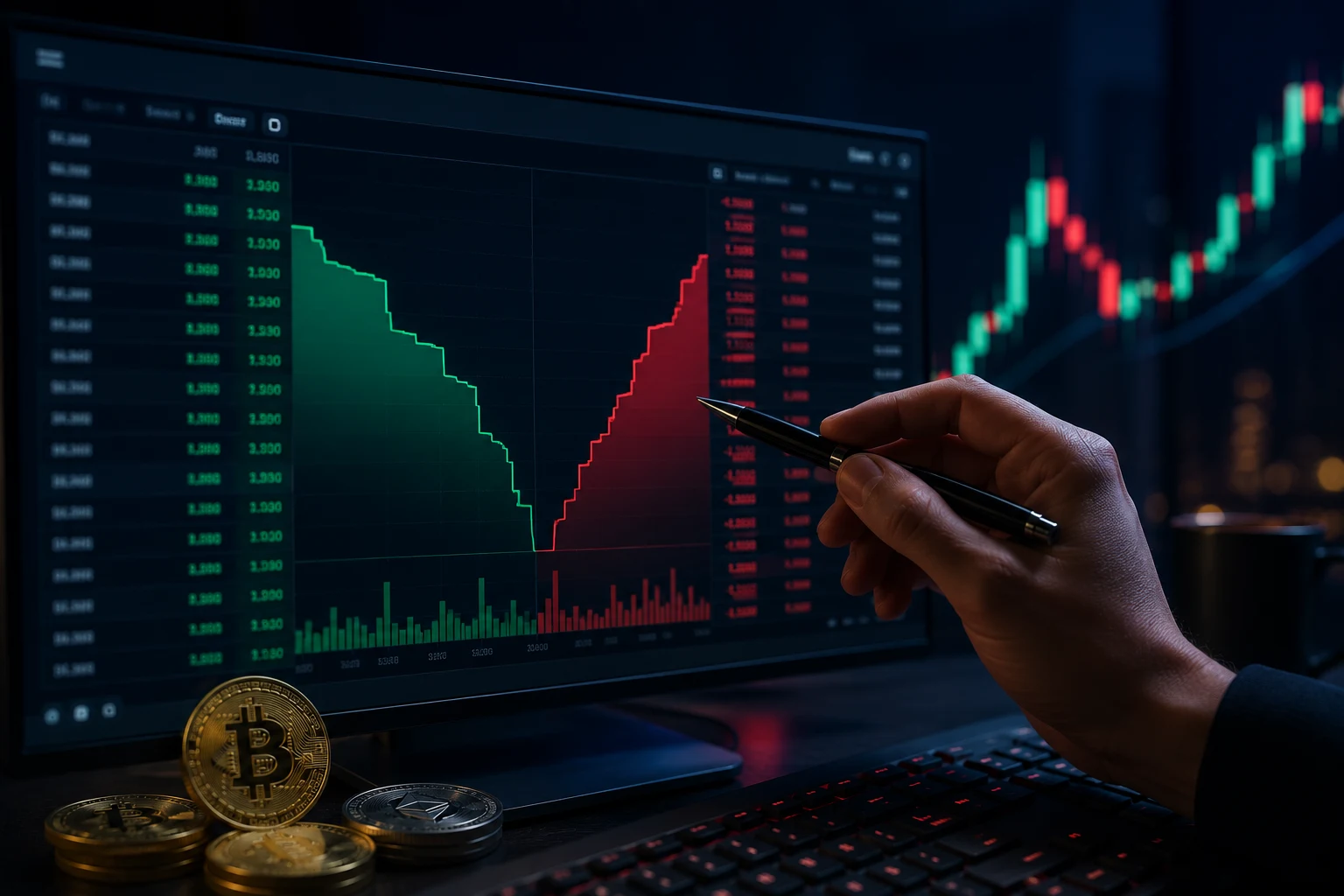
Depth is the cumulative size of resting orders at each price level, and it is the part of the book most beginners underestimate. Most exchanges visualize depth as a green and red histogram on the side or beneath the book. Green bars on the bid side show how many BTC, ETH, or USDT are waiting to buy at each price. Red bars on the ask side show how many are waiting to sell. The taller the bar, the more size is resting there.
A liquidity wall is a price level where a noticeably large amount of size is stacked. A big bid wall might be 2,000 BTC sitting at $67,000, and a big ask wall might be 1,800 BTC sitting at $67,200. These walls do not by themselves predict direction, but they do constrain it. A large market sell order will chew through several price levels before it clears a wall, and that gap between the current price and the next wall is a rough estimate of how much you can trade before price moves noticeably.
This is also where thin books become dangerous. On a healthy BTC/USDT book, you might see hundreds of BTC of resting size within $10 of the mid price. On a small altcoin pair on a regional exchange, you might see 0.2 BTC of resting size at each level, and a $500 market order can blow through 5, 6, or more levels in a single fill. The order book interface will warn you about this in the slippage estimate, but the warning only shows up if you look at depth, not just price.
Depth is also venue-specific. A pair that looks deep on one exchange can look thin on another, and arbitrageurs normally keep them aligned. When a venue goes offline, gets congested, or starts restricting withdrawals, the depth on that venue can dry up in minutes, even for a pair that is liquid elsewhere.
Limit orders vs market orders, and where the book comes in
The two order types you will use most map cleanly onto the order book. A limit order is an instruction to buy or sell at a specific price or better. A buy limit at $67,000 will rest on the bid side at that price until someone hits it. A sell limit at $67,200 will rest on the ask side. Limit orders add to the book and, on most exchanges, earn a maker rebate or at least a lower maker fee.
A market order tells the exchange to fill you immediately at the best available prices, walking up the ask side if you are buying or down the bid side if you are selling. A market order removes liquidity from the book, pays a higher taker fee, and accepts whatever prices your size touches. The bigger your market order relative to the resting size, the more levels you eat and the more slippage you pay.
There are also hybrid tools worth knowing. A stop-market order waits for the price to hit a trigger and then submits a market order, which is why stop hunts are so painful. A stop-limit order waits for a trigger and then submits a limit order, which can fail to fill in a fast move. An iceberg order, mentioned earlier, splits a large parent order into a small visible child plus hidden replenishment. None of these are inherently good or bad. They are just different ways of interacting with the book.
Worked example: a $50,000 market buy on a thin altcoin pair
Imagine a low-cap altcoin, call it TOKEN, trading on a mid-tier exchange. The visible ask side of the order book looks like this:
- 0.85 TOKEN at $0.1000
- 1.20 TOKEN at $0.1002
- 0.60 TOKEN at $0.1005
- 1.50 TOKEN at $0.1010
- 2.00 TOKEN at $0.1020
- 5.00 TOKEN at $0.1050
You place a market buy for $50,000 worth of TOKEN, which at $0.1000 would be 500,000 TOKEN. The exchange fills you by walking up the asks. You will buy the 0.85 at $0.1000, the 1.20 at $0.1002, the 0.60 at $0.1005, the 1.50 at $0.1010, the 2.00 at $0.1020, and so on. Very quickly, your order blows through the top of the book. The average fill price will be far above $0.1000, because most of your size is buying at the higher levels after the cheap liquidity is gone.
If you had read the depth chart first, you would have seen that the entire visible ask side adds up to maybe $1.20 of nominal size within a few cents of the top. Your $50,000 order is roughly 40,000 times the resting size at the best ask. No chart pattern in the world protects you from that math. The book told you, in advance, that this market order was a mistake.
Now imagine the same $50,000 order on a deep BTC/USDT book on a major venue, where the top several levels sum to several hundred BTC. The best ask might move a fraction of a cent, and your average fill would be essentially the price you saw. Same order type, same direction, completely different outcome, all because the depth was different.
What the order book does not tell you
Once you can read bids, asks, spread, and depth, it is tempting to start treating the book like a forecast. It is not one. It is a live inventory of resting orders, and the things it cannot tell you matter as much as the things it can.
It does not show orders resting on other venues. Crypto is fragmented across dozens of exchanges, and the book on one venue is one island in a much larger archipelago. Arbitrageurs usually keep prices close, but during stress events the gaps can widen. It also does not show OTC desks, dark pools, or bilateral negotiations between large players, all of which can move price without ever touching the public book.
It does not show pending orders that have not reached the matching engine yet. It does not show the size of stop-loss or take-profit orders that sit off-book. It does not show the trader behind each resting order, so a passive holder, a market maker, a bot, and a fund rebalancing all look identical. Most importantly, it does not show you when a resting order is about to be canceled. Spoofing, iceberg replenishment, and ordinary market making all involve frequent cancels that you cannot predict from a single snapshot.
None of this makes the order book useless. It makes the order book honest. Read it for what it is: a tool for measuring current liquidity, estimating slippage, choosing between a limit and a market order, and noticing when something looks off, like an unusually large wall or a sudden thinning of one side. Pair that with a price chart, a tape of recent trades, and a sense of overall market context, and you have a far more honest picture than any single tool could give you on its own.
How to follow order book flow and liquidity shifts
Order book shifts move fast and so does the news that drives them. Watching bids, asks, and depth for a single pair by hand is a losing game, because the book can change in the seconds it takes to refresh a page. Zippfeed surfaces crypto headlines with sentiment scoring (bullish, neutral, or bearish) and an importance rating, so you can spot when a story is likely to move liquidity and cross-check what you see on the book before you click buy or sell.


 WuBlockchain
 CryptoSlate
 Glassnode
 WatcherGuru
 Altcoin Daily