Step 1: Set up the right wallet
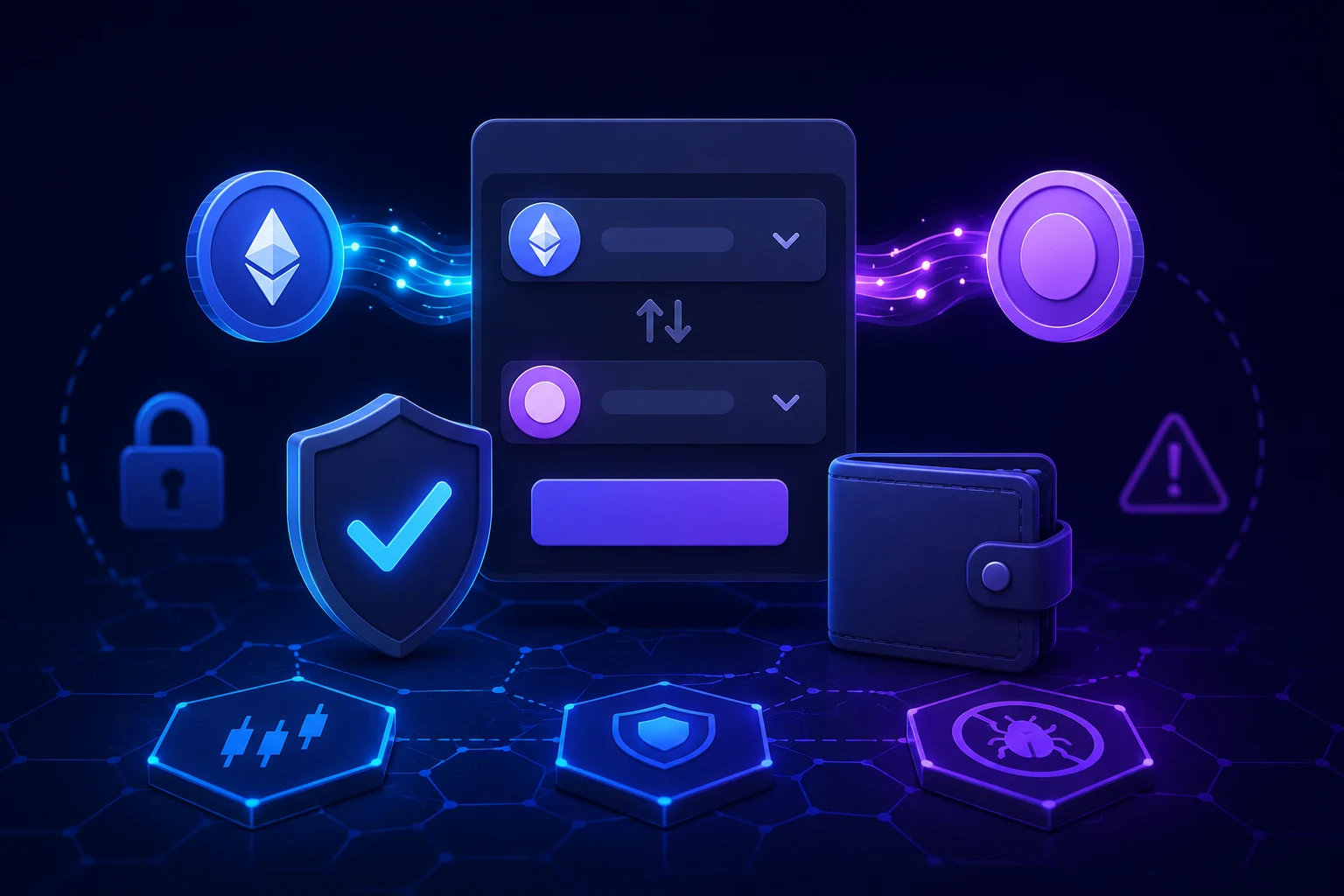
Start with a non-custodial wallet (MetaMask, Rabby, Phantom for Solana, etc.) that supports the chain you want to trade on. If you'll move meaningful value, the wallet should be backed by a hardware device — Ledger or Trezor. Hardware wallets force a physical button press for every signature, which kills almost every remote drainer attack.
For pure exploration with small amounts, a software wallet is fine. Just don't fund the same wallet with your long-term holdings. Use one wallet for storage, a separate wallet for DEX activity. Compromise of the DEX wallet then can't touch the bigger pile.
Step 2: Get to the right URL
Phishing is the #1 way DEX users lose money. Bookmark the real URL of every DEX you use (uniswap.org, app.uniswap.org, raydium.io, etc.) and only go through that bookmark. Never click a DEX link from Twitter/X, Discord, Telegram, or a Google ad. Search-engine ads for DEX names regularly point at drainer clones.
Step 3: Pick a chain and bridge if needed
Each DEX runs on one or a few chains. Make sure the chain you're trading on matches where your tokens live. Bridging tokens between chains has its own risk profile — see our how to bridge crypto guide. The mistake people make is bridging to the wrong chain or sending tokens to an address that doesn't exist on the destination chain. Send a small test amount before bridging the full position.
Step 4: Understand slippage
When you swap one token for another on a DEX, the price isn't fixed at the moment you click — it executes when your transaction lands on-chain, which might be seconds later. Slippage is the maximum % difference you'll accept between the quoted price and the executed price.
- Too low. A normal market move ticks past your tolerance and the transaction fails. You lose only gas, but you didn't get the trade.
- Too high. A malicious actor ("MEV bot") sees your transaction in the mempool, buys ahead of you, dumps after — taking the price difference as profit. This is called sandwich attacking.
Sane defaults: 0.5-1% for highly liquid pairs on busy chains, up to 2-3% for thin pairs. Anything above 5% should make you pause and ask why.
Step 5: Protect against MEV when it matters
MEV (Maximum Extractable Value) bots scan public mempools for profitable trades to front-run. On Ethereum and similar chains, you can route trades through MEV-protected RPCs (like MEV Blocker or Flashbots Protect) that send transactions privately. Most DEX front-ends now offer an MEV protection toggle. Use it for any swap above a few hundred dollars.
Step 6: Read what you sign
Every DEX trade requires one or two on-chain actions, both of which need wallet signatures:
- Token approval — granting the DEX permission to spend a specific token on your behalf. Often defaults to "unlimited."
- The swap — the actual trade.
The biggest mistake: signing a transaction that looks like an approval but is actually a transfer or a permission to drain your wallet. Modern wallets (Rabby, MetaMask with simulation, hardware wallets with screens) show you what a transaction will do before you confirm. Read it. If the readable summary doesn't match what you think you're doing, cancel.
Step 7: Revoke approvals when done
A token approval persists until you explicitly revoke it. If you gave a DEX (or a fake DEX) unlimited approval to spend your USDC and that contract later gets exploited, your USDC walks out without another signature. Use a tool like revoke.cash or your wallet's built-in approval manager to review and revoke approvals you no longer need. Do this every few months as housekeeping.
Common mistakes
- Trading on phishing sites. The site looks identical to the real DEX but the swap drains your wallet.
- Granting unlimited approvals casually. Sign with a per-trade allowance when possible.
- Trading low-liquidity tokens with low slippage. The trade just keeps failing while bots front-run any working setting.
- Buying scam tokens. Anyone can list a token on a DEX. Symbol and name aren't proof of legitimacy.
- Ignoring honeypots. Some scam tokens let you buy but block selling. Check holder distribution and trade history before buying anything obscure.
The safety checklist
Before every DEX trade, run through this:
- Am I on the bookmarked real URL?
- Is the chain right and do I have gas?
- Is slippage set sanely for this pair?
- Is MEV protection on for a meaningful-sized trade?
- Does the wallet-side preview show what I expect?
- Will I revoke the approval after?
Read DEX markets without the noise
DEX prices and pools change with launches, depegs, exploits, and protocol updates — usually faster than the news catches up. Zippfeed tracks DeFi headlines across multiple sources with sentiment and importance scoring, so you can spot a struggling pool, an exploit in progress, or a new high-volume listing before it's the consensus take. On a DEX, being informed early is the best edge you can have.

 WuBlockchain
 Crypto Capital Venture
 Lookonchain
 TheBlock