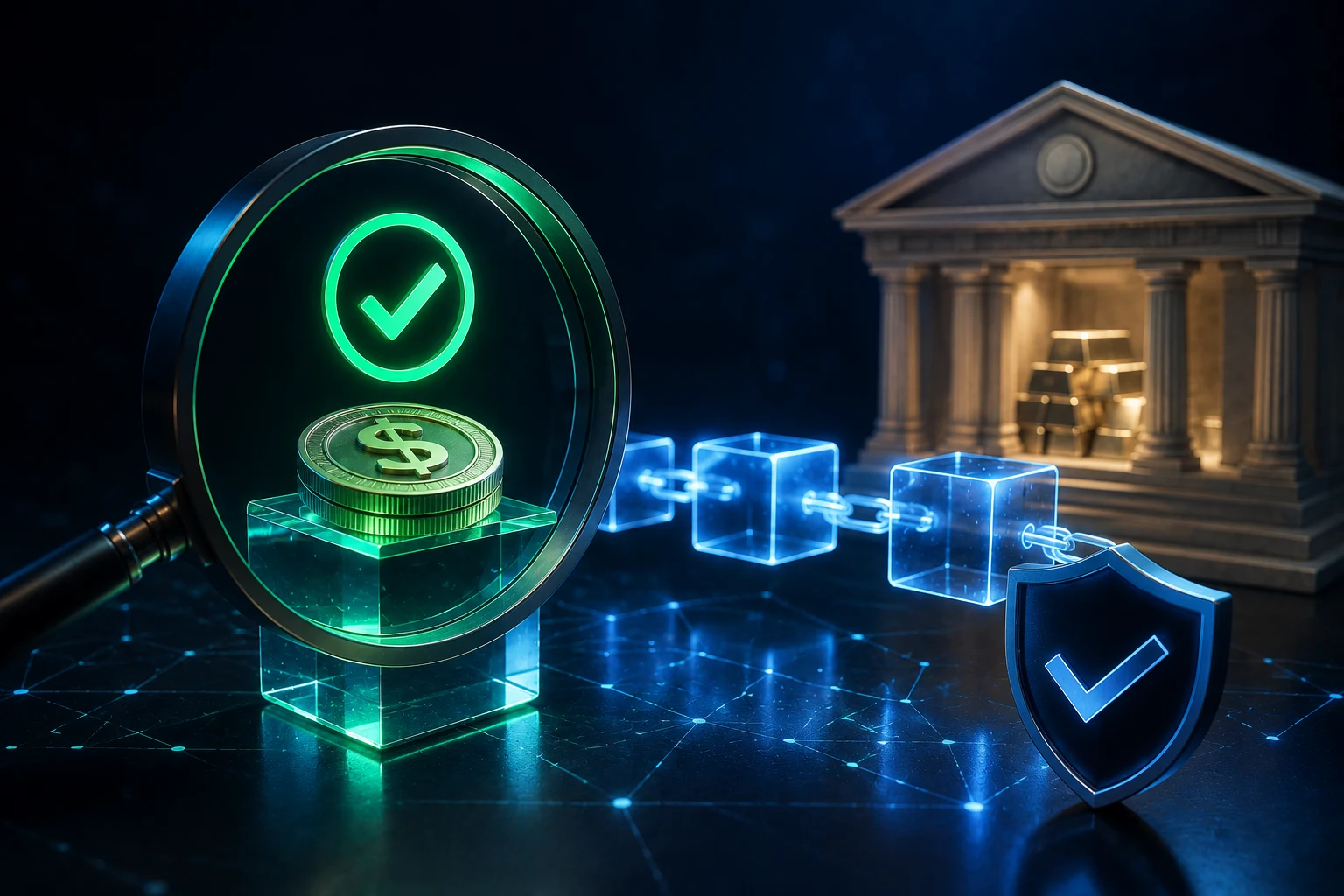
Why on-chain backing is worth checking
The pitch for tokenized assets is simple. A token such as PAXG, XAUT, or a treasury product like BUIDL supposedly represents one gram of gold, one troy ounce, or one US dollar of government bonds, sitting in a vault or brokerage account controlled by the issuer. The token then trades on a blockchain where every transfer is visible.
The risk is that the marketing pitch and the reality can drift apart. In 2022, FTX printed tokens that were supposedly backed one-to-one by customer deposits. The reserves were not there. Roughly $8 billion in customer funds went missing. Earlier, Tether spent years operating without a full audit, only publishing attestations that critics called narrow and easy to game. The pattern repeats: a token claims full backing, an outside event exposes the gap, and retail holders discover the reserves were smaller, riskier, or held somewhere else entirely.
None of this means tokenized assets are a scam by default. It means the only ground truth is the chain itself, and the issuer's marketing deck is not the chain. Anyone who holds PAXG, XAUT, USDT, USDC, BUIDL, or USDY has the technical ability, with a browser and about 20 minutes, to look at the issuer's wallet and see what is actually there. Most people never do, which is exactly why bad actors find the space attractive.
The risks you accept by not verifying
Skipping verification means you are trusting three things at once: the issuer's honesty, the auditor's rigor, and the legal framework around the reserve. Each of those can fail independently.
The most common failure mode is the gap between reserves and liabilities. An issuer holds $5 billion in gold but issues $6 billion in tokens, counting the same bars twice across different products. The chain will not show this directly, but the supply of the token will exceed the issuer's published gold holdings, and a careful observer can spot the drift over weeks.
A second failure mode is custody opacity. The issuer claims reserves sit at a major bullion bank. The wallet that supposedly holds them is actually a smart contract that can be upgraded, or a multisignature wallet controlled by a small group whose identities are not public. If the keys are compromised or the upgrade key is abused, the tokens become unbacked instantly.
Third, attestations and audits are not the same thing, and most readers confuse them. An attestation is a point-in-time report from an accounting firm saying that at one moment, on one date, the reserves matched the supply within a tolerance. An audit is a full examination of the issuer's books, controls, and liabilities over a period. The difference matters because attestations can be structured narrowly, while audits, when they exist, are harder to fake.
Finally, jurisdiction matters. A token backed by US treasuries may be issued by an entity in the Cayman Islands, with a New York bank as custodian, and the legal claim you have against either depends on paperwork most holders have never read. The chain shows custody and balances; it does not show you who wins in a courtroom.
Reserves attestations vs full audits
An attestation is a snapshot, often produced by a mid-tier accounting firm, that says reserves matched liabilities to within a stated percentage on a stated date. The numbers are real, but the scope is narrow. Most attestations for stablecoins and gold tokens look at one wallet, on one chain, on one day. They do not cover off-chain rehypothecation, related-party holdings, or what happens in the gap between attestation dates.
A full audit, in contrast, examines internal controls, signs off on the methodology used to count reserves, and tests whether the issuer can actually withdraw the assets. Audits are expensive, slow, and rare in crypto. When they happen, they tend to be done by a Big Four firm for a stablecoin issuer under regulatory pressure. The audit opinion is the document to read, not the marketing summary.
For most tokenized assets in 2026, the realistic baseline is monthly attestations from a regional accounting firm, not full audits. That is not necessarily a red flag, but it is the floor you should expect. If an issuer claims more than that, ask to see the document.
Walkthrough: checking PAXG reserves on Etherscan
PAXG, issued by Paxos, is one of the easier tokenized assets to verify because the supply is small and the documentation is unusually transparent. The same workflow applies, with adjustments, to XAUT, BUIDL, USDY, and most major tokenized treasury products.
Step 1: find the issuer's official wallet
Start at the Paxos Trust Company documentation, not at a random blog. Paxos publishes the addresses of its reserve wallets. Cross-reference that list with the token contract page on Etherscan. If the wallet you plan to inspect is not on the issuer's official list, you are probably looking at a marketing hot wallet, a market maker, or something else entirely.
Step 2: read the wallet's ETH balance
Open the wallet on Etherscan and look at the holdings tab. For a gold token, you expect to see mostly USDC or cash equivalents, plus occasionally ETH for gas. You should not see large amounts of unrelated tokens, meme coins, or yield-bearing positions that are not described in the attestation. If the wallet holds exotic DeFi positions, that is a question to raise, not a fact to ignore.
Step 3: cross-check the token supply
On the PAXG contract page, note the total supply. Then check how much PAXG sits in the issuer's reserve wallet. The two should not match exactly, because PAXG is held by users, exchanges, and market makers. But the supply minus the circulating amount, as reported by the issuer, should line up with the difference between total supply and the reserves shown on-chain.
Step 4: watch mint and burn events
Open the contract's events tab and filter for Mint and Burn. New mints should appear shortly after inflows to the reserve wallet. Burns should appear shortly after outflows. If you see large mints without corresponding reserve growth, that is a red flag. If you see burns without reserve shrinkage, the issuer may be redeeming tokens without returning customer assets to the customer, which is worse.
Step 5: compare against the attestation
Download the latest Paxos attestation, find the date and the stated reserve figure, and compare that to the wallet balance on or near that date. Numbers should match within a small tolerance for gas and rounding. If they do not, ask why.
How to read mint and burn events
Minting is the act of creating new tokens. Burning is destroying them. For a fully backed asset, every mint should correspond to new reserves coming in, and every burn should correspond to reserves going out to the redeemer.
On Etherscan, open the token contract, click the Events tab, and filter by Transfer events from the zero address (mints) and to the zero address (burns). Most tokenized asset contracts emit these as standard ERC-20 events, which makes them easy to scan.
The pattern to look for is a tight temporal coupling between reserve inflows and mints, and between redemptions and burns. Over weeks, the total value minted minus burned should equal the net change in the issuer's reserve balance. If you see days where mints spike but reserve balances do not, or burns spike but reserves do not move, the issuer is either operating on a fractional model or timing things badly. Neither is comforting.
Third-party proof-of-reserves tools
You do not have to do this work alone. Several services have built dashboards that aggregate reserve data and try to detect mismatches automatically.
Shreds.io publishes reserve tracking for several major tokenized assets, including real-time wallet balances and historical reserve curves. DefiLlama's RWA dashboard tracks the total value locked across tokenized treasuries, private credit, and commodity tokens, broken down by issuer and chain. Both tools rely on the same on-chain data you would read manually, but they save time and let you compare across issuers.
Other useful entry points include the issuer's own proof-of-reserves page if it exists, custody attestations filed with regulators in places like New York or Singapore, and the legal disclosures attached to the token's offering documents. Treat the issuer's own page as one data point, not as proof.
How to spot mismatches between claims and chain data
The most common red flag is a stablecoin or gold token whose on-chain reserves grow more slowly than its circulating supply. If USDC's reported reserves are $40 billion but the balances in Circle's known wallets sum to $38 billion, that gap is worth understanding, not dismissing as rounding.
Other red flags include reserve wallets that hold the issuer's own token (a circular backing structure), wallets that have moved large sums to mixers or privacy chains, sudden upgrades to the token contract that change minting permissions, and attestations that shift the methodology from one period to the next without explanation.
A subtler signal is jurisdictional drift. If the issuer's holding entity changes from a US trust company to an offshore foundation, and there is no public announcement, the legal claim on the reserves has changed even if the on-chain balances look identical. Watch the entity, not just the wallet.
What to check first: a quick flowchart
If you only have ten minutes, do these four things in order.
- Find the issuer's official reserve wallet from the issuer's own documentation, not from a tweet or third-party blog.
- Confirm the wallet is owned by the issuer using Etherscan's contract creator and admin controls.
- Compare the token's total supply against the wallet's stablecoin or commodity balance on the same day.
- Skim the latest attestation or audit, and check whether the methodology actually covers what the marketing claims.
If any of these four steps does not produce a clean answer, that is the moment to reduce your exposure, not the moment to do more research. The chain is supposed to be self-verifying, and when it is not, the gap is the signal.
How to follow tokenized assets the smart way
Tokenized real-world assets move quickly because they sit at the intersection of crypto markets, traditional finance, and regulation. New issuers appear every quarter, and the reserve structures behind them vary wildly. Tracking mint and burn events, attestation dates, and reserve wallet changes manually is unrealistic for most investors. Zippfeed surfaces tokenized asset headlines with sentiment scoring, bullish, neutral, or bearish, and an importance rating, so you can spot when an issuer's reserves stop reconciling before the market does.





 CryptoSlate
 CoinDesk
 TheBlock
 WuBlockchain