What "NFT royalties" actually mean in 2026
When someone buys an NFT, the creator is supposed to receive a percentage of every future sale. That is the original promise: pay a one-time minting fee, then earn a cut forever as the piece moves between collectors. The pitch made NFTs look like a better deal for artists than traditional art, where resales usually pay the artist nothing.
In practice, the word "royalties" covers two very different things. The first is a signal: a piece of data stored in the NFT's smart contract that says "if I am resold, the creator wants 5%." The second is a transfer: actual cryptocurrency moving from the buyer to the creator on every sale. The signal is reliable. The transfer is not, and has not been for most collections since 2023.
That gap is the entire royalties debate. It is also why the question "do NFTs still pay royalties?" has no single answer. Some collections still pay royalties on every trade. Many pay royalties only on certain marketplaces. A large share pay nothing at all once the NFT leaves its original venue.
Where royalties come from: EIP-2981 and the on-chain signal
Most NFT royalties start with EIP-2981, a standard Ethereum proposal that defines a single function a smart contract can expose: royaltyInfo. When called, it returns two values, a receiver address and a basis-points amount, so a marketplace can ask the contract "for this token ID sold at this price, who gets what?"
EIP-2981 is elegantly simple. It does not move money. It does not enforce payment. It is a lookup table that a marketplace chooses to honor. If a marketplace respects the signal, it charges the buyer a royalty, takes its own cut, and forwards the rest to the address the contract names. If a marketplace ignores the signal, nothing happens at the contract level. The sale still settles.
That design choice is deliberate. Ethereum developers wanted a universal way for contracts to advertise royalty terms, but the network has no way to force a buyer to pay a fee on a peer-to-peer transfer. Royalties are a polite request, embedded in code, that a third party can read.
Why most royalties stopped being enforced: the 2023 marketplace wars
For the first NFT boom, marketplaces enforced royalties by default. OpenSea, the dominant venue, charged a 2.5% seller fee on top of the creator royalty, and the creator fee was hard-coded into the trade. If a seller wanted to skip the creator cut, they could not. This made royalties feel like a guaranteed revenue stream, which is part of why creators and investors valued the model.
That changed when a new marketplace, Blur, launched in late 2022 with a different pitch: zero royalties, low fees, and pro-trader tools. Blur did not invent the idea of skipping royalties. It just made it the default for anyone who routed trades through its order book. Within months, a meaningful share of NFT volume moved off OpenSea to venues that did not honor creator fees.
OpenSea responded by making royalties optional in early 2023, and the broader market followed. Within a year, the dominant behavior across most collections was "royalties on some marketplaces, zero on others." For creators, this was not a slow decline. It was an income shock. Some collections that had earned six figures a month in royalties saw those numbers collapse to a small fraction of their prior totals.
The deeper issue is economic. When traders can route around a fee, fees become optional. The only people who pay optional fees are the ones who choose to. Most traders, especially in liquid markets, do not choose to.
Risks and trade-offs creators face in 2026
Royalties are not just an abstract policy debate. They are a meaningful share of income for digital artists, generative-art coders, and small studios. The shift to optional royalties created several concrete risks worth understanding.
Income volatility. A collection that earned 50 ETH in royalties in one month might earn 3 ETH the next, depending on which marketplace handles the trades. Creators who planned around a baseline are now dealing with cash flow that swings with venue choices they do not control.
Race-to-the-bottom dynamics. Every new marketplace has an incentive to attract volume by offering lower fees. The lowest-fee venue tends to win liquidity, and the lowest-fee venues tend to skip creator royalties. The result is a slow but persistent downward pressure on what creators earn.
Scam and impersonation risk. When royalties become optional and markets fragment, fake collections and copy-paste scams proliferate. A buyer who searches a collection name on the wrong aggregator can end up buying a worthless copy. This is not a new problem, but optional royalties made it worse: fewer signals, more noise.
The trade-off with enforcement. Creators can recover some income by switching to contracts that enforce royalties at the smart contract level. The cost is real: enforced royalties restrict where the NFT can be sold, which restricts the buyer pool, which usually lowers the resale price. Enforced royalties are a tax on liquidity.
None of these risks are hypothetical. They are the lived experience of NFT creators since 2023. The market did not break; it simply found a new equilibrium in which traders pay less and creators earn less.
Contract-level enforcement: ERC-721C and operator filters
The most consequential technical response to optional royalties is a family of contract designs that move enforcement from the marketplace to the NFT itself. The leading example is ERC-721C, a standard developed by Limit Break and adopted by several high-profile collections including QQL Mint Pass and Pudgy Penguins.
ERC-721C extends the standard NFT contract with two key features. The first is an operator filter: the contract keeps a registry of approved marketplaces, and refuses to execute transfers through any marketplace not on the list. If OpenSea (or whichever venues the creator approves) is the only registered operator, the NFT can only be sold on those venues. Trades elsewhere revert.
The second feature is a programmable transfer security model. Creators can configure different rules for different stages of the collection's life. Before a public mint, transfers might be blocked entirely to discourage sniping. After the mint, transfers can be limited to allowlisted marketplaces that honor royalties. Some collections even allow the creator to remove the filter after a certain date, once the collection is established.
The trade-off is exactly the one the royalties debate predicts. A collection with a strict operator filter can only be traded on the marketplaces it approves. Buyers who prefer to use Blur, or any other venue not on the allowlist, simply cannot buy. That smaller buyer pool usually translates into lower prices and thinner order books. Some collections accept that trade; others do not.
There is no perfect version of this design. Loosen the filter, and traders route around royalties. Tighten the filter, and the floor price drops because liquidity dries up. The economic question is the hard one, not the technical one.
Other tools creators use to recover royalty income
Operator filters are the most visible tool, but creators in 2026 use a wider kit. None of them is a silver bullet, and most successful collections combine several.
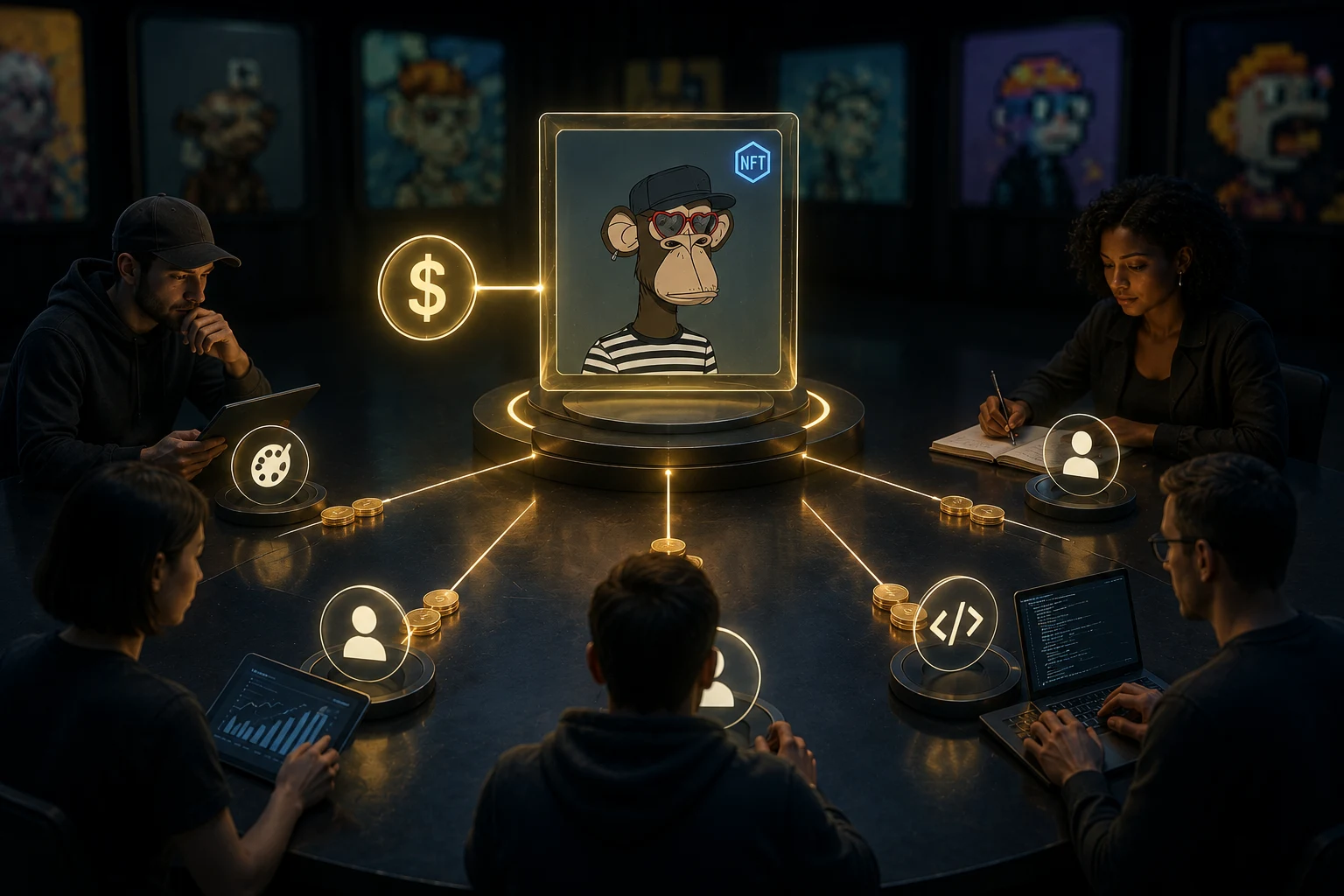
On-chain splits. A creator can configure a smart contract that automatically splits resale income among several parties, including the original artist, collaborators, and a treasury. Splits do not enforce payment, but they make the distribution rules transparent, which can attract buyers who want to support multi-artist projects.
Allowlists and curated marketplaces. Some platforms, including a handful of newer entrants, position themselves as royalty-enforcing venues. They tend to have lower volume than the open marketplaces, but they attract collectors who specifically want to support paying creators. Collections sometimes prefer lower-volume, higher-royalty venues for primary sales and accept that secondary liquidity will be thinner.
Hybrid designs. A growing number of collections start with enforced royalties during the early life of the project, then relax enforcement once a secondary market has matured. The idea is to capture the launch and the early hype, when most royalties would have been paid anyway, and to free up liquidity later, when the alternative is zero royalties forever.
Off-chain revenue. Some creators have moved away from relying on royalties entirely. They use NFTs as access passes to merchandise, events, or community membership, where the NFT's value comes from what it unlocks rather than from resale activity. This is more of a business model shift than a technical fix, but it is part of the realistic picture for artists thinking about royalties in 2026.
What this means for collectors, traders, and creators
For collectors, the practical implication is that the royalty rate you see on a marketplace is closer to a marketing line than a guarantee. If you want to support the creator, you can choose a marketplace that enforces royalties. If you do not care, you can route to whichever venue gives you the best execution. Both behaviors are now normal.
For traders, optional royalties are an advantage. They reduce transaction cost, which is part of why zero-royalty venues grew so quickly. The flip side is that some collections with enforced filters are simply off-limits, which limits the tradable universe.
For creators, the honest summary is this: the days of reliable, automatic royalty income are over for most collections. The 2023 marketplace wars reset the baseline. Some creators have adapted with strict contract-level enforcement; others have accepted the new normal and built revenue models that do not depend on secondary sales; many are still in transition. There is no consensus best practice, because the trade-offs differ by collection, by audience, and by the kind of work being sold.
If you are launching a new project, the realistic options are: (1) accept optional royalties and design a business model that does not depend on them, (2) enforce royalties at the contract level with an operator filter, and accept a smaller buyer pool, or (3) use a hybrid that enforces royalties early and relaxes them later. None of these guarantees a specific income. The market is now mature enough that the answer to "how do I earn royalties?" depends more on the project's economics than on the underlying technology.
How to follow NFT royalty debates the smart way
NFT royalty policy is a moving target. New marketplace fee structures, new contract standards, and shifting collector behavior can change the picture in a single quarter. Tracking it manually is hard, and the loudest voices in NFT Twitter are usually not the most accurate. Zippfeed surfaces NFT headlines with sentiment scoring (bullish, neutral, or bearish) and an importance rating, so you can spot the stories that actually change the math for creators and collectors, and skip the noise.