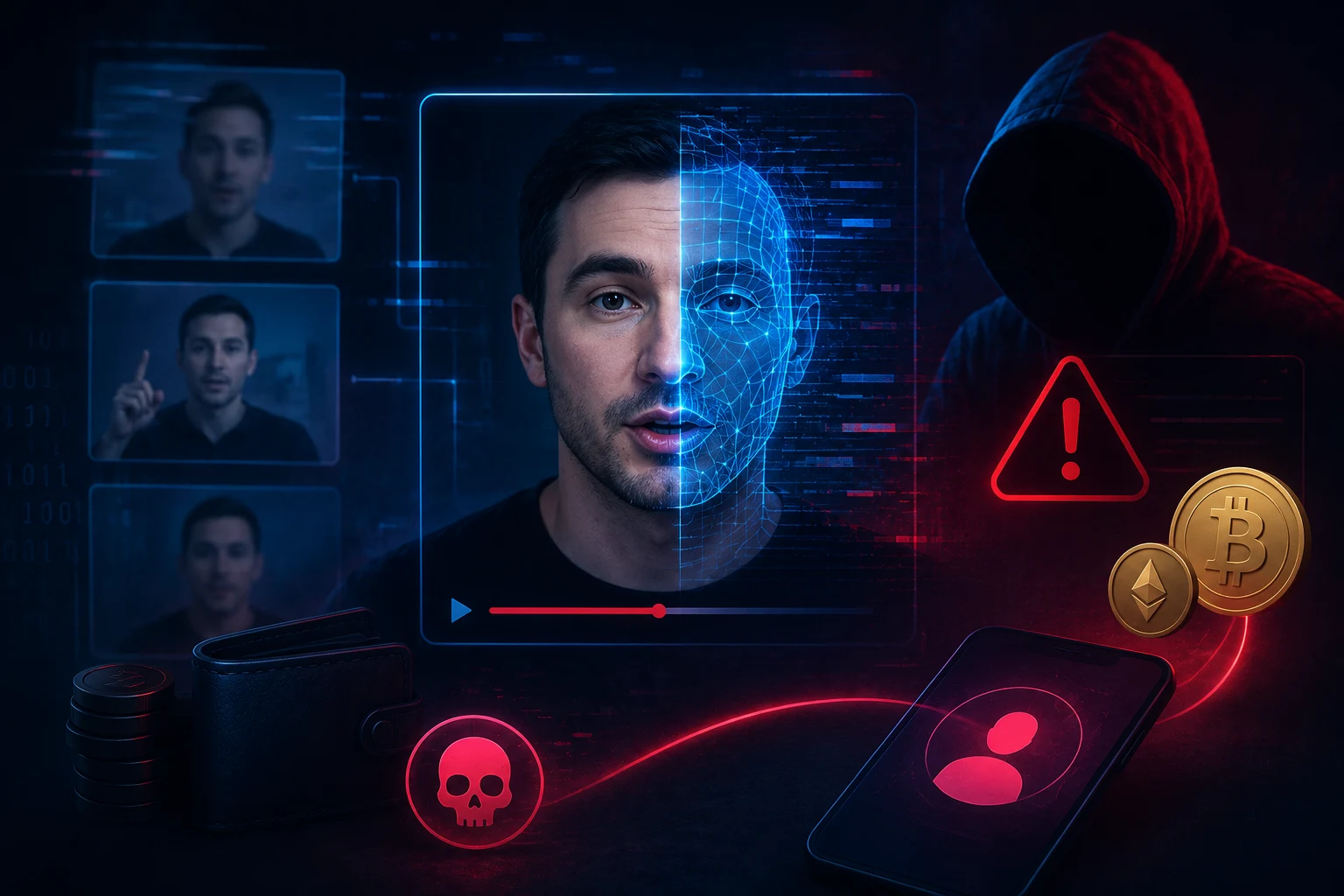
What is an AI deepfake crypto scam, and why is 2026 different?
An AI deepfake crypto scam is a fraud in which the attacker uses generative AI to impersonate a trusted person, brand, or interface, then convinces the victim to send cryptocurrency, approve a malicious transaction, or hand over a seed phrase (the 12 or 24 words that control a crypto wallet). Generative AI is the term for models, such as large language models (LLMs) and diffusion networks, that can produce realistic text, images, audio, or video from a short prompt or a small sample of real material.
What changed between 2023 and 2026 is not the existence of these attacks. Scammers have been stealing crypto since 2011. The shift is in scale and fidelity. Real-time face-swap tools that run on a consumer GPU are now cheap and good enough to fool people in a live Zoom call. Voice cloning from a 30-second sample is a free open-source project. LLMs draft convincing pretexts in any language. The result is a fraud pipeline that used to require a skilled team of native speakers and can now be run by a single operator with a laptop and a Telegram group.
The scale is no longer fringe. Chainalysis, a blockchain analytics firm, reported that crypto-related scam revenue globally crossed $9.9 billion in 2024, a figure that excludes unreported losses. The FBI's Internet Crime Complaint Center logged more than $5.8 billion in crypto investment-fraud complaints in 2023, the latest year with a full public breakdown. Individual victims in pig-butchering cases have reported losses of $1 million or more, and several cases in 2024 and 2025 hit nine figures. This is not a curiosity. It is a large, organized industry.
What are the real risks for crypto users in 2026?
Before walking through the techniques, it helps to be honest about what you cannot know. You cannot know in advance which scam will target you. You cannot know whether the project you are researching is a real product or a polished front. You cannot know, in real time, whether a 30-second video of a founder pitching a token airdrop is genuine. The defense is not vigilance. The defense is a system of habits and tools that fail safely when something slips past you.
The most common failure modes in 2025 and 2026 are predictable. A user copies a wallet address from a transaction history that was actually a poisoning entry, and sends ETH or USDT to an attacker-controlled address. A user joins a video call with someone they believe is a founder, sees a familiar face, and approves a transaction that drains a hot wallet (a wallet connected to the internet, as opposed to a hardware wallet that stays offline). A user installs a browser extension that looks like MetaMask or Phantom and types their seed phrase into a fake interface. In all three cases, the user did not do anything obviously stupid. They were deceived by something designed to deceive them.
The financial damage is also asymmetric. In a bank-fraud case, a wire transfer can sometimes be recalled, and chargebacks exist for card payments. In crypto, a confirmed transaction on Bitcoin or Ethereum cannot be reversed. Funds moved to a centralized exchange can sometimes be frozen if the exchange cooperates, but assets routed through a cross-chain bridge (a service that moves tokens between blockchains) or a mixer (a service that obscures the trail of coins) within minutes are effectively unrecoverable. Treat every wallet interaction as if it is final, because the chain treats it that way.
There is also a social risk that is easy to underestimate. Victims of pig-butchering scams frequently blame themselves, and the trauma is real. A 2024 study from the University of Texas at Austin found that survivors of romance-investment fraud showed PTSD symptoms comparable to survivors of physical assault. This is part of why these scams keep scaling: shame keeps victims quiet, which keeps the schemes profitable.
The six scam techniques in active use right now
The current threat landscape is dominated by six patterns. They overlap in practice, and a single scam may chain several of them together.
1. Real-time deepfake video calls on Zoom and Meet
This is the technique that has changed the most since 2023. The attack works like this: the scammer collects a short sample of a target's face and voice from public sources, often a YouTube talk, a podcast, or a Twitter Spaces recording. They feed that sample into a real-time face-swap tool, then join a Zoom or Google Meet call as the impersonated person. To the victim on the other end, the face moves, blinks, and responds to questions.
The most cited case in crypto is the 2024 attack on a Bitfinex executive's circle, in which deepfake video of multiple team members was used in a live call to authorize a transaction. The incident is also referenced in a 2024 warning from the Wyoming Secretary of State's office about AI impersonation of corporate officers. Similar attacks hit two Hong Kong-based finance employees in early 2024 in a $25.6 million heist that started with a deepfake video conference call, according to Hong Kong police. The crypto industry is not the only target, but it is a high-value one because treasury wallets are large and approvals happen quickly.
How to spot it: the face looks slightly too smooth, lip sync drifts by a few frames, and the person avoids turning fully to the side. They also tend to push the conversation toward a wallet action, because that is the point of the call. A separate, low-tech defense is to ask the person to wave a hand in front of their face on the call, or to switch the call to audio only and ask a callback number you have used before.
2. AI-cloned voice calls impersonating support staff
Voice cloning has been commoditized. Open-source tools such as OpenVoice and commercial APIs from companies such as ElevenLabs can synthesize convincing speech from a few seconds of sample audio. The result is a phone call that sounds exactly like a Coinbase, Binance, or Kraken support agent, complete with hold music and a transfer to a 'fraud team'.
The playbook is consistent. The victim is told that their account has suspicious login attempts and they need to 'verify' their seed phrase or move funds to a 'safe wallet' for protection. A 2024 warning from the FBI specifically flagged 'fraudulent customer support' calls that AI-generate. Several documented cases in 2025 involved elderly victims being told to drain their Coinbase accounts into a Bitcoin wallet 'for compliance', which the caller controlled. The FBI's IC3 logged more than 4,400 complaints of this specific pattern in 2024.
No real exchange will ever ask for your seed phrase, your password, or a transfer to a new address. No real support agent will guide you through a transaction. Treat any inbound contact that does any of those things as adversarial, even if the caller ID shows the exchange's name, which is trivially spoofable.
3. Address poisoning powered by LLMs
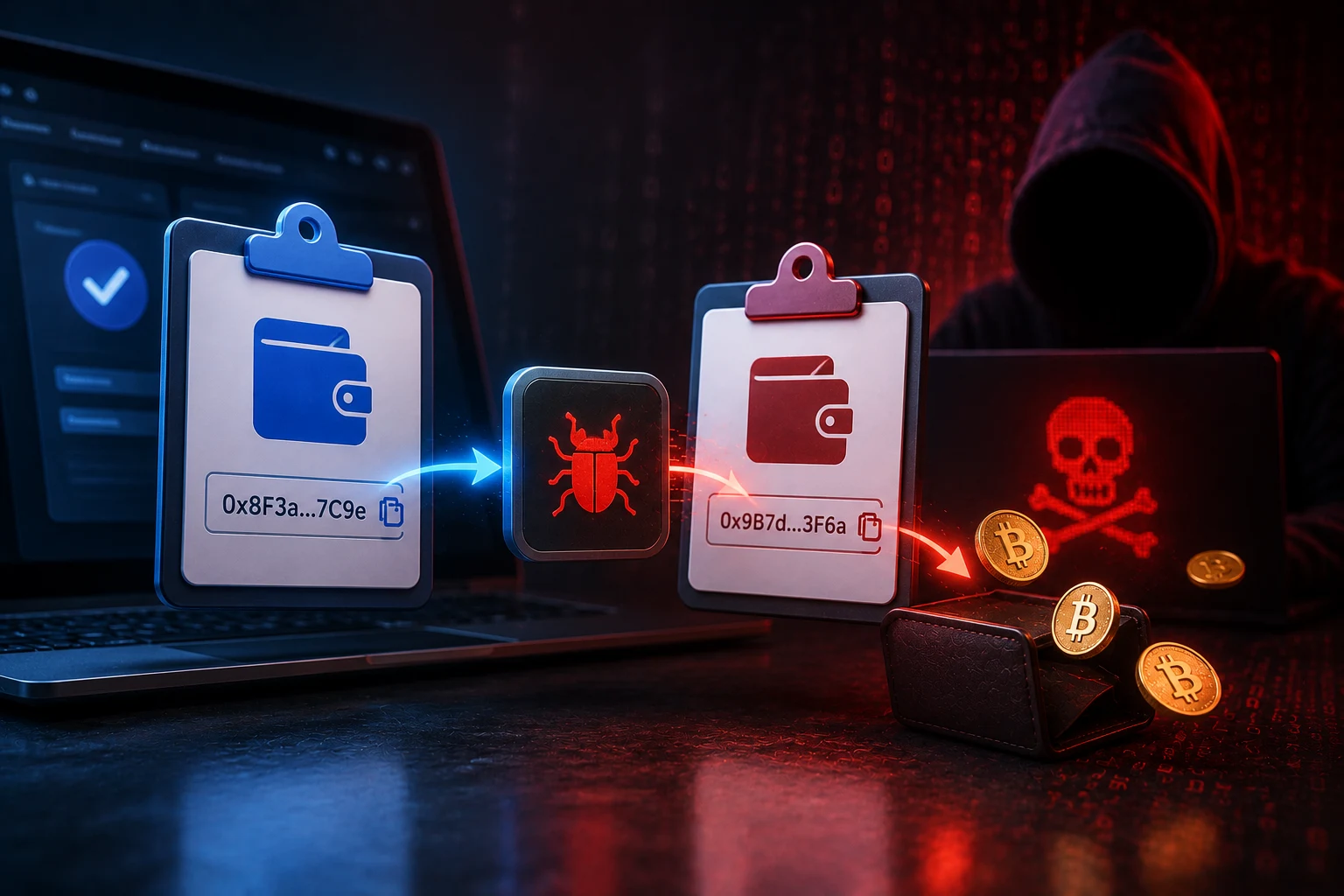
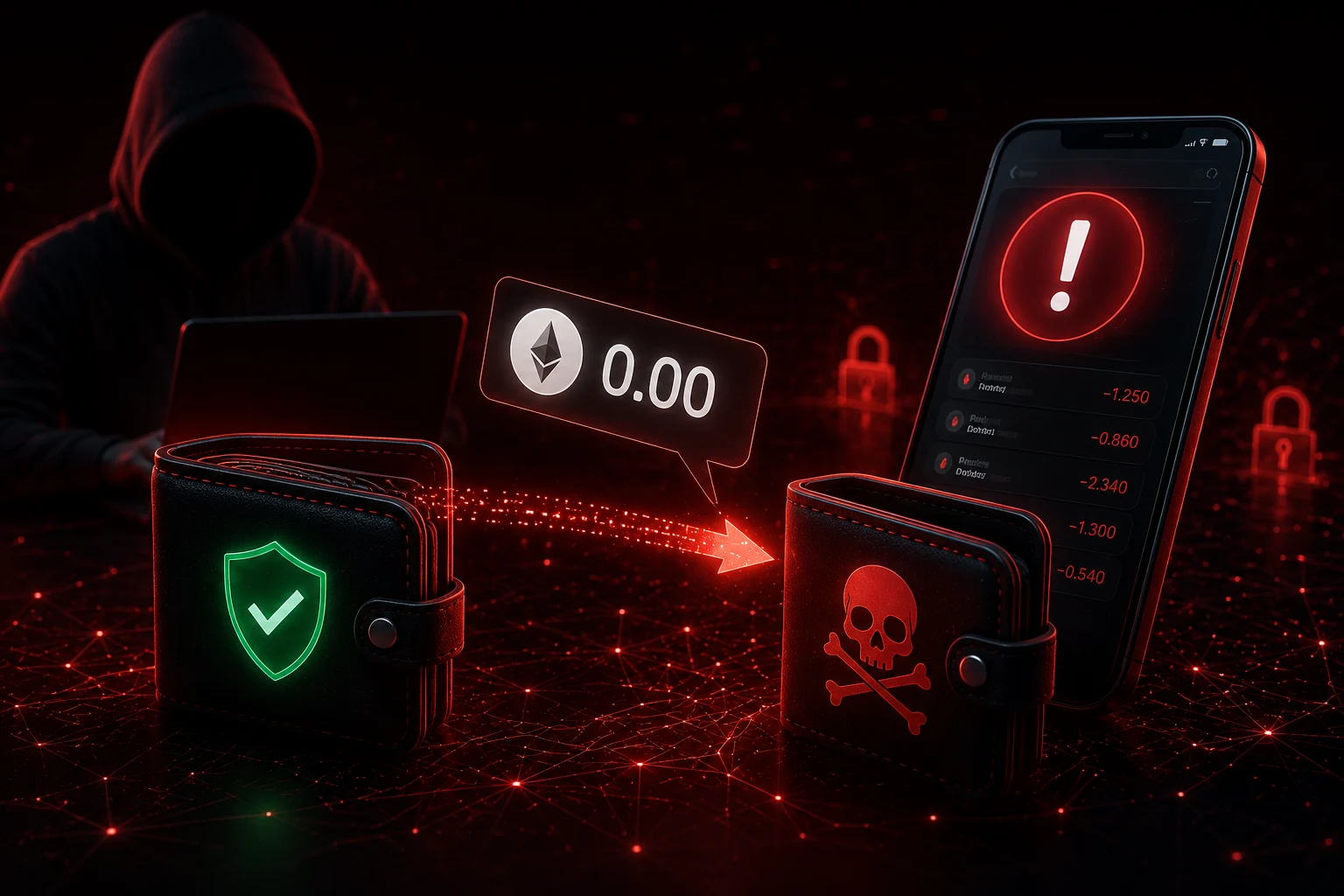
Address poisoning, sometimes called address-spoofing, is an old attack that has been given a 2025 update. The mechanics: the scammer generates a wallet address whose first and last few characters match a victim's real address, then sends a tiny transaction (often a worthless token or $0.01 of USDT) from that look-alike address. The transaction sits in the victim's history. When the victim later copies an address from their history to send ETH or BTC, the clipboard grabs the look-alike. The funds go to the attacker.
What LLMs added is targeting. Scammers now scrape a target's on-chain history and use an LLM to draft a pretext message, often a fake 'airdrop claim' or 'governance vote' instruction, that lands in Discord, Telegram, or X DMs. The message tells the victim to 'use the same wallet you used last time' and provides a near-identical address. A variant in 2025 uses the LLM to generate the look-alike address itself, optimizing for collision with the most common copy-paste window in the victim's wallet UI. Several variants of the EIP-55 checksum (the mixed-case format Ethereum uses to detect typos) have been documented; some wallets now warn on case mismatches, but not all do.
The defense is to never copy an address from transaction history. Always copy it from the source (the exchange, the recipient's official channel), and verify the full string. For large transfers, send a small test transaction first.
4. Malicious browser extensions and fake wallet apps
Browser extensions remain one of the highest-volume attack surfaces. In a typical 2025 campaign, attackers publish a Chrome or Firefox extension that mimics MetaMask, Phantom, Rabby, or Trust Wallet. The extension may pass through the Chrome Web Store's review by behaving normally for weeks, then push a malicious update that captures seed phrases or rewrites withdrawal addresses. A related pattern is the fake wallet app, listed in the Apple App Store or Google Play under a name that is one character off from a real wallet. The K-9 and Rabit wallet incidents in 2024 and 2025 are documented cases of this pattern.
The same technique extends to fake versions of Ledger Live, Trezor Suite, and exchange apps. Apple's notarization process and Google's Play Protect have caught many of these, but the cadence of new uploads means a small number always get through. Once installed, the extension or app can rewrite the address shown on a transaction confirmation screen, so the user thinks they are sending to Alice but the transaction is actually signed for the attacker's address.
Defense: install wallet extensions only from the project's official site, never from a search result. Treat the seed phrase as a 'never type it anywhere' secret. Real wallets will never ask you to type it into a website.
5. Pig-butchering scams: long cons with deepfake video
Pig butchering (from the Chinese sha zhu pan, which roughly means 'pig-raising-and-slaughtering') is a long-horizon fraud in which the scammer spends weeks or months building a romantic or friendly relationship with the victim, then introduces an 'investment opportunity', usually a fake trading platform. The platform is rigged to show fake profits, and the victim is eventually asked to deposit more and more crypto to 'unlock' withdrawals. When the victim tries to withdraw, the platform invents a tax, fee, or verification cost, and the scammer disappears.
What AI has changed is the scalability and the believability. An LLM can maintain convincing text conversations in 20 languages. A deepfake video call, even a short one, can resolve the victim's last doubt about the operator's identity. The UN Office on Drugs and Crime estimated in 2024 that pig-butchering operations in Southeast Asia alone involve hundreds of thousands of people, many of them trafficked and forced to run the scripts. The industry is organized, multinational, and uses the same playbooks across jurisdictions.
The persistence of the pattern comes from three factors. First, the grooming period builds genuine emotional attachment. Second, the fake platform is fully customized, with charts, balances, and even a working withdrawal for small amounts, which builds trust. Third, the social cost of admitting the loss is high, so victims do not report quickly. The average pig-butchering loss reported to the IC3 in 2023 was roughly $210,000 per victim, and individual cases have exceeded $10 million.
6. Airdrop-phishing and wallet-drainer kits
Wallet drainers are off-the-shelf phishing kits, sold on Telegram for a few hundred dollars, that generate convincing 'claim your airdrop' or 'claim your NFT' landing pages. The user connects a wallet, signs a transaction they think is a claim, and the transaction actually grants a token-approval permission (an allowance that lets a third-party contract move the user's tokens) or triggers an immediate transfer. In 2024, Scam Sniffer, a web3 security firm, estimated that wallet-drainer attacks stole more than $295 million from about 324,000 victims.
LLMs have made these kits more convincing. The site copy is fluent, the support chat is responsive, and the fake 'verification' steps feel real. The defenders have improved too: wallets such as Rabby and Frame now simulate transaction outcomes and warn on approval grants, and Blockaid, Blowfish, and Pocket Universe offer transaction-pre-screens that flag drainer signatures before you sign. None of these are perfect, but they catch a meaningful share.
How do these attacks actually unfold in documented cases?
It is one thing to describe a pattern. It is more useful to walk through a real example so the pattern becomes recognizable. Two cases from 2024 and 2025 illustrate the scale and the craft.
Case one, the Hong Kong deepfake CFO. In January 2024, Hong Kong police reported that an employee at a multinational firm's Hong Kong office was tricked by a deepfake video conference call into wiring roughly $25.6 million. The employee was the only real human on the call. The 'CFO' and the other participants were synthetic. The attacker used a publicly available video of the CFO, the firm's other executives, and a voice clone. The employee followed instructions on the call and approved a series of transfers. The funds were moved through multiple Hong Kong bank accounts and partially laundered. The case is the largest publicly confirmed deepfake-video fraud to date.
Case two, the Orinda, California, pig-butchering case. The U.S. Attorney's Office for the Northern District of California prosecuted a 2023 case in which a victim was groomed over several months, then convinced to invest in a fake crypto platform. The victim wired money to the platform, watched the fake balance grow, and lost roughly $1.6 million. Several defendants in the case were charged with money laundering. The case is one of the first U.S. federal prosecutions to specifically detail the use of AI-generated personas in the grooming phase. The defendants are scheduled for trial in 2026.
These two cases are not outliers. They are representative. The 2025 IC3 report lists crypto investment fraud as the highest-loss category in the United States for the fourth year running, and the FBI's 2024 annual report specifically flagged AI-enabled fraud as a growth area. If you use crypto, you are part of a target population that is being attacked at scale by organized groups.
What does recovery actually look like, and what are the limits?
Recovery is the question on every victim's mind, and the honest answer is mostly bad. Let us separate the moving parts.
If the funds went to a centralized exchange, time matters. CEXs such as Coinbase, Binance, and Kraken can freeze addresses if the request is filed within hours and the funds have not been withdrawn. Freezes rely on the exchange's compliance team, which is staffed 24/7 for major platforms, and on cooperation with law enforcement. Reports filed through 911cyber.com, ic3.gov, the FTC's ReportFraud.ftc.gov, and the exchange's own support page are the main channels. A 2024 joint advisory from CISA and the FBI recommended contacting law enforcement before contacting the exchange, because a law enforcement request carries more legal weight.
If the funds were bridged or mixed, the trail is effectively gone. Cross-chain bridges and mixers such as Tornado Cash (sanctioned) and Sinbad (taken down) are designed to break on-chain forensics. The longer the time gap, the more hops the funds have made, the smaller the chance of recovery. There is no crypto equivalent of a chargeback, no FDIC insurance (the U.S. federal deposit insurance for bank accounts), and no central authority that can reverse a confirmed transaction.
There is a secondary fraud built on top of the first. Once a victim posts about their loss on social media, 'recovery agents' contact them, claim to be blockchain investigators, and ask for an upfront fee or a share of the recovered funds. The FBI has issued multiple warnings about this pattern. A legitimate recovery operation does not require an upfront payment and is usually run by law enforcement, not a private DM.
For high-value losses, the realistic options are: (1) a law enforcement report with detailed transaction hashes and counterparty addresses, (2) a civil lawsuit in cases where an identifiable entity is involved, and (3) a private blockchain investigation firm, used with caution and with no upfront fees. None of these will return funds quickly, and none are certain to return funds at all.
A realistic defense checklist for non-technical users
The defenses below are practical, low-cost, and have been used by people who actively trade crypto and avoid being scammed. None of them are perfect, but combined they make most attacks fail before funds move.
- Use a hardware wallet (such as a Ledger or Trezor) for any balance above trivial amounts. A hardware wallet keeps your private keys, the secret codes that authorize transactions, on a physical device that never touches the internet, so a poisoned address on your screen still cannot be signed without a physical button press.
- Use a separate, dedicated browser profile for wallet activity, with no extensions except the wallet itself. Disable JavaScript on unknown sites. This blocks the majority of drainer kits.
- Never copy a wallet address from your transaction history. Always paste it from a fresh source, and verify the full string visually for any large transfer.
- Send a test transaction first. For any transfer over an amount you would not shrug off losing, send a small amount, confirm receipt, then send the rest.
- Treat any inbound contact as adversarial. Real support, real founders, real exchange staff will not call you, video-call you unprompted, or ask for your seed phrase. Hang up, hang up, hang up.
- Use a transaction-pre-screen extension. Blockaid, Blowfish, and Pocket Universe all run a simulation of the proposed transaction and flag known drainer signatures. They are not perfect, but they catch most malicious approvals.
- Revoke token approvals regularly. Revoke.cash and similar tools show which contracts can move your tokens, and let you cancel the permissions.
- Have a 'code word' with people who control your shared funds. If a 'CEO' calls asking for a transfer, the code word proves the voice and the video are real. Cold War spy tradecraft works in 2026.
- If you have been scammed, document everything (transaction hashes, chat logs, wallet addresses) and report to ic3.gov and your local FBI field office within 24 hours. Speed is the only edge you have.
How to follow crypto scam news the smart way
Crypto scam tactics move faster than any single person can track. A new drainer kit, a new deepfake tool, or a new address-poisoning variant can become a widespread threat in a week, and the long tail of variants runs into the thousands. Tracking this manually across Telegram, X, Discord, GitHub, and on-chain analytics is a losing game. Zippfeed surfaces crypto security headlines with sentiment scoring, bullish, neutral, or bearish, and an importance rating, so you can spot the attacks that are actually scaling before they reach you.



 WuBlockchain
 CryptoSlate
 Glassnode
 WatcherGuru
 Altcoin Daily