What is a hardware wallet supply chain attack, really?
A supply chain attack against a hardware wallet is any compromise that happens to the device, its packaging, or its software between the moment it leaves the factory and the moment you finish setup. The attacker is trying to learn your seed phrase, the master secret from which every private key on the device is derived, so they can drain your BTC, ETH, and any other assets the wallet supports, usually the moment you fund it.
This category is wider than most people realize. It includes a reseller swapping a sealed box for a tampered one, a customs agent opening a package and reflashing the firmware, a counterfeit device that looks identical to a real one, and even malicious software updates pushed from a hijacked vendor server. The unifying idea is that the hardware you trust to generate and store your keys was touched by an adversary before you ever powered it on.
The good news is that for most buyers, this is a low-probability event. The bad news is that it is also a high-consequence one: a successful attack typically ends in a complete, unrecoverable loss, with no chargeback, no insurance, and no customer support line that can reverse an on-chain transaction. That asymmetry is why the topic deserves a clear head and a tiered defense, not paranoia and not dismissal.
Real failure modes, not theoretical ones
The most useful way to think about supply-chain risk is to separate the attacks that have actually happened from the ones that only appear in security conference slides. Both matter, but they should change your behavior in different ways.
The most cited real-world data point is the 2020 Ledger breach. Attackers compromised Ledger's marketing database, exposing the names, addresses, and phone numbers of roughly 272,000 customers, plus the email addresses of about 1 million newsletter subscribers. The breach itself was not a supply chain attack on the devices, but it created a wave of follow-on attacks: physical mail scams, fake devices shipped to known Ledger customers, and phishing calls where attackers posed as Ledger support and walked victims through entering their seed phrase into a fake "firmware update" site. Several users have publicly reported losing their BTC as a result.
Beyond that, there have been credible tampering reports, including isolated cases where devices arrived with packaging that looked resealed, and at least one well-documented case involving a Trezor-like device that had its firmware swapped for a malicious version before delivery. Researchers at the wallet-testing firm Kraken Security Labs have also published findings showing that all major hardware wallet models have, at some point, had supply-chain weaknesses that required a physical attacker with specialized equipment and significant time to exploit. The 2020 "wallet.fail" research and later disclosures showed that even devices with secure elements could be glitched in ways that leak seeds, given lab access.
The pattern across these incidents is informative. Mass-produced, pre-backdoored wallets for thousands of users do not appear to exist on the open market, and there is no public evidence that any major manufacturer's device has shipped with a deliberate backdoor. What does exist is a long tail of smaller incidents: stolen customer data used for targeted phishing, occasional tampering at retail, and research-grade attacks that require an adversary who has already physically taken your device. That long tail is real, but it is also manageable.
What a hardware wallet does and does not protect
It helps to be precise about what a hardware wallet is actually defending against, because the device is excellent at some things and irrelevant to others. Once you understand the boundary, the supply-chain question becomes much easier to reason about.
A hardware wallet's core job is to keep your private keys inside a small, hardened device and to sign transactions without ever exposing the keys to your computer or phone. Against remote malware, clipboard hijackers, malicious browser extensions, and infected operating systems, this model works extremely well. Even if your everyday laptop is fully compromised, an attacker generally cannot extract a seed phrase from a properly functioning hardware wallet that they do not physically possess.
What the device does not protect against is the entire category of problems where the attacker is in physical possession of the device, or in a position to influence what arrives at your door. That includes a tampered device from a compromised reseller, a counterfeit that imitates the real one, a "support agent" who convinces you to type your seed into a website, and any situation where a person or process between the factory and your setup line had a chance to swap, modify, or inspect the hardware. The wallet's secure element and attestation features are designed to detect some of these cases, but they are not a substitute for your own setup-time verification.
How interdiction attacks actually work
Interdiction is the formal name for an attack in which someone intercepts a package, modifies or replaces the contents, and repackages it before it continues to the buyer. In the hardware wallet context, the goal is usually to learn the seed phrase at setup time, either by harvesting it as the user types it or by exfiltrating it later through modified firmware.
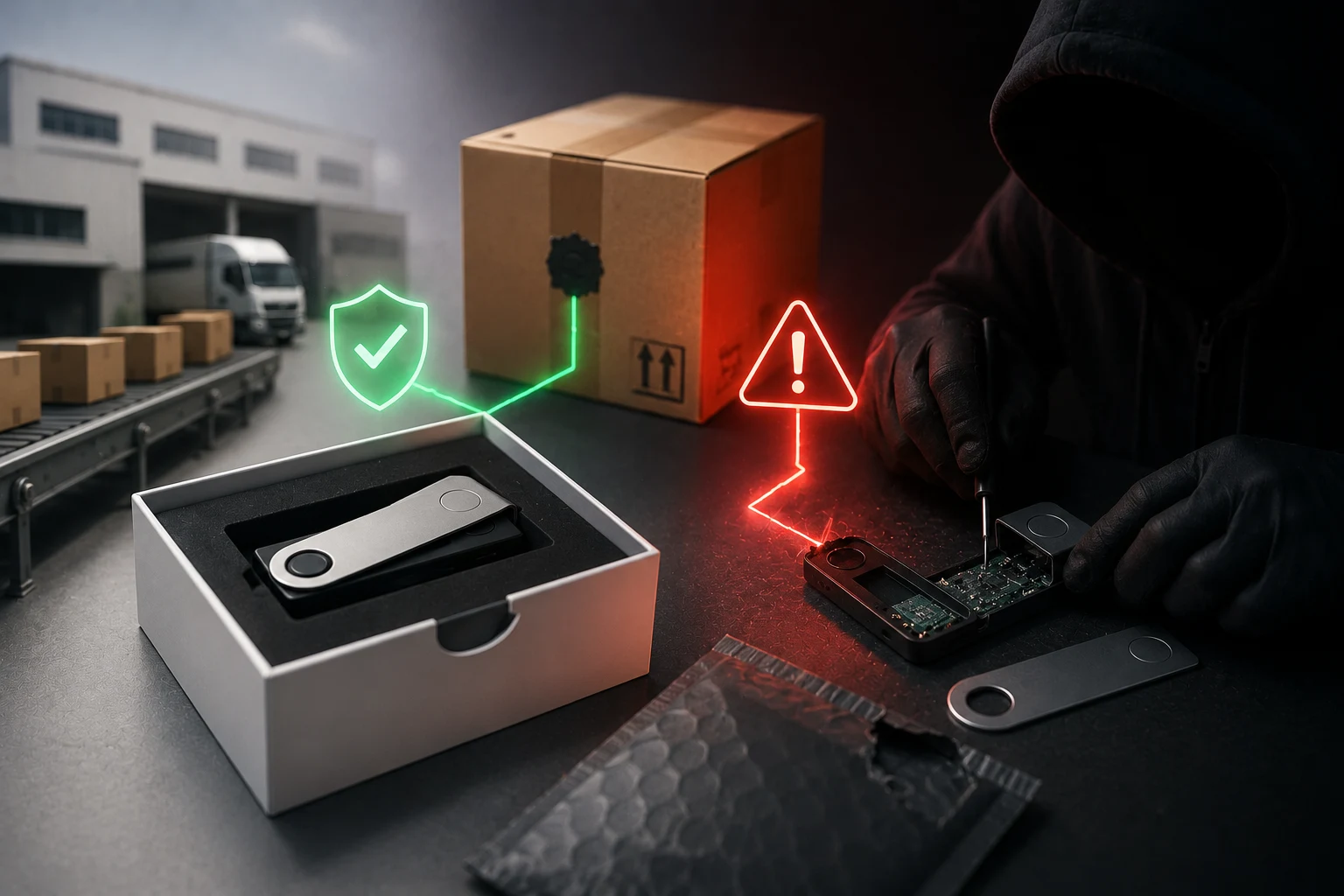
The most common interdiction vector in practice is the package itself arriving with obvious signs of resealing, such as misaligned shrink wrap, broken or missing holographic stickers, swapped USB cables, or instruction cards that look slightly off. Sometimes the device inside is genuine but its firmware has been replaced with a malicious version. Sometimes the device is a near-perfect counterfeit, often a cheap microcontroller in a cloned case, that will happily accept a seed phrase and then display a fake "balance" while quietly sending the real seed to the attacker over Bluetooth or Wi-Fi.
Customs and freight forwarding are the other commonly discussed interdiction points. In some jurisdictions, packages can be opened and inspected, and there is a long-running concern, especially among high-net-worth holders, that sophisticated state-level actors could tamper with devices in transit. There is no widely confirmed public case of this happening at scale to consumer hardware wallets, but the theoretical risk is one of the reasons serious holders buy multiple devices from different batches and seed them separately, so that no single interdiction event can compromise the entire stack.
Verification steps that actually reduce risk
You do not need to be a security researcher to make a hardware wallet supply chain attack a non-event in your life. You do need to follow a few specific steps at setup time, every time, regardless of how trustworthy the box looks.
Buy direct from the manufacturer
This is the single highest-leverage action on the list. Authorized resellers and third-party marketplaces add handling and storage steps that you cannot audit, and they have historically been a vector for both tampering and outright counterfeits. The major manufacturers, including Ledger, Trezor, and the various Trezor-derived devices, all run direct-to-customer stores. Yes, you may pay a little more or wait a little longer than a marketplace listing. That cost is the price of dramatically reducing the largest category of supply-chain risk.
Inspect tamper-evident packaging before opening
Each major manufacturer publishes photos of what genuine, factory-sealed packaging looks like. Compare what you received against those references. Look for intact shrink wrap, aligned seams, and any holographic or tamper-evident seals in their expected positions. Resealed boxes are usually identifiable on close inspection, and the manufacturer's own documentation will tell you exactly what to look for. If anything looks off, stop and contact the manufacturer's official support channel, the one you find by typing the URL yourself, not the one printed on a card inside a box you did not expect.
Run the genuine-device check at setup
Every reputable hardware wallet now includes a way to verify that the device and its firmware are genuine. For Ledger devices, this takes the form of a "Genuine Check" inside Ledger Live, which checks the secure element's attestation against the manufacturer's published keys. For Trezor, the equivalent is verifying that the firmware shown in the device's bootloader matches the version published on the official site. Do not skip this step. It is the one moment where the device can cryptographically prove it is what it claims to be, and it is your last line of defense before generating a seed.
Generate the seed on the device, never on a computer or phone
Once the device passes its genuine check, generate the recovery phrase using the device's own screen and buttons. Never enter a seed that was generated anywhere else, never "import" a seed from a piece of paper that arrived in the box, and never type a seed into a software wallet and then "move" it to a hardware device. A genuine device generates entropy itself. Anything that contradicts that is a red flag.
Practical implications: a tiered defense for real users
Not everyone needs the same level of protection, and pretending otherwise is a good way to either overspend or undersleep. A tiered approach matches the controls to the value being secured.
Minimum tier: typical holders
If you hold a modest amount of BTC and ETH, treat the basics as non-negotiable. Buy from the manufacturer's official store, inspect the packaging, run the genuine check, generate the seed on the device, and never share the seed with any person, site, or "support agent" under any circumstances. Add a firmware PIN, and write the seed on paper or, ideally, stamp it into metal. This stack costs nothing extra, takes about 20 minutes, and eliminates the realistic supply-chain scenarios for the overwhelming majority of users.
Enhanced tier: meaningful balances
Once the dollar value on a device justifies a few hours of work, add a passphrase. A passphrase is an extra word or string of words that is combined with your seed to derive a different set of wallets. A compromised seed alone is then worthless without the passphrase, which lives in your head. The trade-off is that losing the passphrase is just as catastrophic as losing the seed, so it needs to be backed up separately and tested before any meaningful funds are stored. Pair this with a second hardware wallet from a different manufacturer, kept in a separate physical location, holding a copy of the same seed, so that a single device failure or single interdiction event cannot lock you out.
High-value tier: treasury and long-term storage
For serious holdings, multisig becomes the strongest compensating control. A typical 2-of-3 setup uses three hardware wallets from at least two different manufacturers, each with its own seed, any two of which must sign a transaction. An attacker would need to physically intercept and compromise two of the three devices, plus any passphrases, before they could move funds. Add geographically separated backups, ideally on metal stored in different physical locations, and the remaining attack surface is small enough that most rational adversaries will move on to easier targets. This setup is more complex and more expensive, but it is the practical ceiling for self-custody without trusting a custodian.
How to follow hardware wallet security the smart way
Hardware wallet security moves slowly, but the news around it moves fast, especially after incidents like the Ledger data breach and the periodic publication of new research findings. Tracking which vendors have reported tampering, which firmware versions are safe, and which scams are currently in circulation is a job by itself. Zippfeed surfaces hardware wallet and self-custody headlines with sentiment scoring (bullish, neutral, or bearish) and an importance rating, so you can spot real risks early and avoid burning out on noise. Pair that signal with the tiered setup above, and you have a defense that fits how you actually hold your BTC and ETH, not just how a security researcher would.


 WuBlockchain
 CryptoSlate
 Glassnode
 WatcherGuru
 Altcoin Daily