What a crypto phishing attack actually is
A crypto phishing attack is a social engineering attempt designed to get a user to sign a blockchain transaction, approve a token allowance, or hand over a seed phrase. The attacker rarely needs to find a software bug. The blockchain itself, whether it runs on Bitcoin, Ethereum, or Solana, works exactly as designed. The victim simply authorizes a transaction they do not fully understand.
This is the part that confuses newcomers. If the chain is secure and the wallet is encrypted, how does money disappear? The honest answer is that cryptography protects a wallet's private key, but it cannot protect a person from voluntarily signing the wrong message. Phishing exploits the gap between what a transaction looks like and what it actually does on chain.
Phishing in crypto is also unusually final. A bank can reverse a fraudulent transfer. A blockchain cannot, by design. That is the whole point of decentralized money, and it is exactly why scammers love it. Once a drainer transaction confirms, the funds move into the attacker's wallet, and recovery depends on the goodwill of centralized services that may or may not exist downstream.
The real risks: what actually goes wrong
Before talking about how phishing works, it is worth being blunt about what is at stake, because the failure modes are not abstract.
Full wallet drain. A successful signature can authorize a smart contract to move every token and NFT in your wallet, not just one token. This is the worst-case outcome, and the most common one in 2024 and 2025. Victims often log in expecting to see their portfolio and find an empty wallet within minutes of signing.
Token-specific theft. Some approvals are scoped to a single ERC-20 token. The user may keep most of their balance, but lose the specific high-value asset the attacker targeted, often a stablecoin like USDT or USDC, or a popular token like ETH or SOL.
Repeat thefts from the same approval. This is the part beginners miss. An approval is not a one-time event. Once you sign setApprovalForAll on an NFT collection, for example, the attacker can call that approval again and again until the approval is revoked. Many victims get drained a second time because they never revoked the original signature.
Sealed-seed loss. A smaller, but more catastrophic, category of phishing targets the seed phrase itself. Fake wallet apps, fake "support" agents, and malicious browser extensions can all capture the 12 or 24 words that fully back up a wallet. With those words, the attacker does not need any signatures. They simply restore the wallet on their own device and sweep it.
Reputation and account compromise. On chains like Ethereum, signing a malicious message can publish a statement on chain, like "I am a scammer," or it can grant an attacker a token that lets them impersonate you in certain apps. These are rarer, but they show how flexible signature abuse can be.
The honest summary: phishing is the single most common cause of individual crypto losses, and the losses are usually total and irreversible. It is not a niche threat.
The anatomy of a modern crypto phishing attack
Modern crypto phishing is sold as a product. Drainer kits like Pink Drainer, Inferno Drainer, and Angel Drainer have been offered on dark-web forums as subscription services, complete with dashboards, customer support, and profit-sharing arrangements. The barrier to entry for a would-be scammer is shockingly low, which is why the volume of attacks keeps climbing.
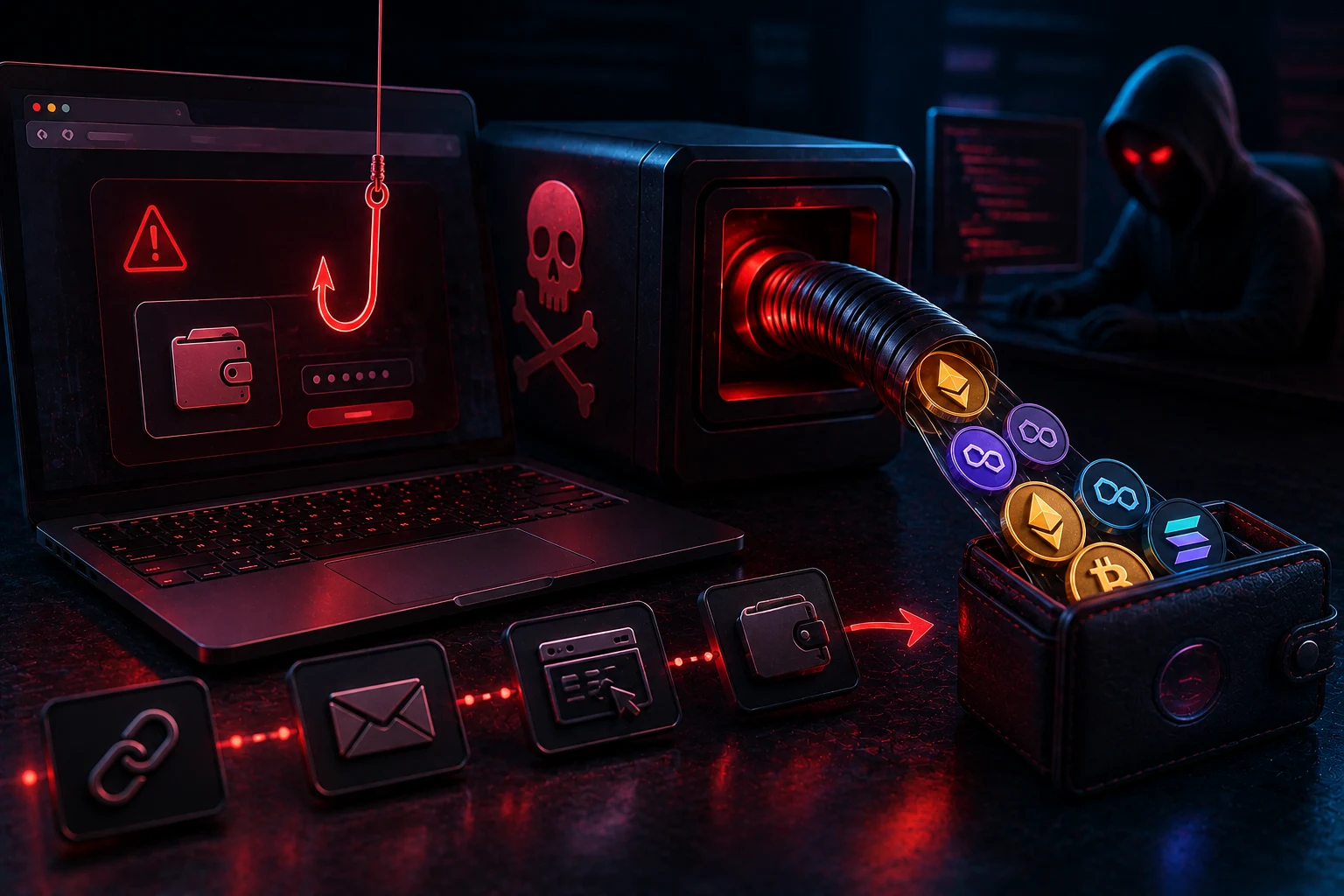
Despite the variety, the kill chain follows a predictable sequence. Understanding each step is the only reliable way to break it, because attackers win or lose at the moment of signing.
Step 1: the lure
Every attack starts with a reason for you to click. The most common lures in the current cycle are:
- Fake airdrops. A message claims you are eligible for a free token drop from a real project. The link takes you to a site that looks identical to the project's real site. Fake airdrop sites and drainer kits are often bundled together, so a single phishing kit can spin up a "claim" page, a token contract, and a drainer in one go.
- Address-poisoning attacks. You send crypto to a familiar address, then later receive a tiny "dust" transaction from an address that starts and ends with the same characters. The attacker hopes that, when you copy the address from your history to send a larger payment, you copy the poisoned one. The chain itself is not compromised, your own transaction history is weaponized.
- Malicious browser extensions. Extensions that pretend to be wallet helpers, MEV protectors, or price trackers can read everything on the pages you visit. When you connect a wallet, the extension can rewrite transaction data in flight, swapping the destination address or the contract you are approving before you sign.
- Compromised Discord, Telegram, or X accounts. Real projects get hacked. When a project's official account posts a "claim your airdrop" link, even cautious users click. The link is real, the post is real, and the site is fake.
- Search-engine ads. Attackers buy ads for queries like "Uniswap login" or "MetaMask support." The ad sits at the top of Google, above the real result. The link in the ad points to a lookalike domain.
Step 2: the lookalike site
The lure delivers you to a website that is visually identical to a real one. The domain is the only differentiator, and it is engineered to fool a quick glance. uniswаp.org uses a Cyrillic "a". metamask-io.com adds a hyphen and a suffix. The page prompts you to connect a wallet, which feels normal because every legitimate dApp does the same thing.
At this stage, no funds have moved. Your wallet is not yet compromised. The attacker has only put a fake door in front of you. Whether you walk through it depends on what happens next.
Step 3: the signature request, where the kill chain lives
This is the moment everything is decided. Connecting a wallet to a site does not move funds. What moves funds is signing a transaction or a message. Drainers are designed to make that signature look routine, so the user signs without thinking.
The most common signature types abused in 2024 and 2025 are:
- permit and permit2. An off-chain signature that lets a contract pull a specific token from your wallet later, without you signing another transaction. The wallet UI often shows this as a "gasless approval" and hides the technical details. The signature is valid indefinitely and is hard to revoke.
- setApprovalForAll on ERC-721 or ERC-1155. This grants a contract permission to move every NFT in a collection from your wallet. The wallet UI usually describes it plainly, but most users do not know what setApprovalForAll means, and attackers count on that.
- increaseAllowance on ERC-20 tokens. The classic "infinite approval." You sign once, and a malicious contract can drain that specific token from your wallet at any future time.
- eth_sign and personal_sign. A blank signature request. The wallet shows a human-readable warning, but the user is asked to sign a hash. The signed message can sometimes be replayed as a transaction, depending on the chain and the wallet version.
This is the sign-what-you-see (or sign-what-you-do-not-see) problem. Wallet interfaces have improved, but they still cannot fully translate a smart contract call into plain English. A request that says "set approval for all tokens in collection X to address Y" is technically accurate. It is also exactly what an attacker needs. A habit of reading the method name, the spender address, and the contract being called is the single most useful defense a user can build.
Step 4: the drain
Once the malicious signature is in, the attacker calls the approved function. In a single block, the wallet's contents move to the attacker's address. The victim may not even see the outgoing transaction before it confirms. On chains like Solana, where transactions can bundle many actions, the drain can sweep a wallet in one signature that looks like a simple "claim."
After the drain, the attacker typically runs the funds through a mixer or a cross-chain bridge, then through a no-KYC exchange, and the trail goes cold. Some funds do get frozen when they touch a regulated exchange, but most do not. This is why prevention is the entire game.
Why phishing works so well, even on experienced users
The reason phishing keeps succeeding in crypto is not that users are careless. It is that the defenses are genuinely hard.
Visual deception is easy. A perfect clone of a real site costs a scammer a few hundred dollars. The asymmetry is brutal: a user has to be vigilant 100% of the time, an attacker has to win once.
Wallet UI is not the same as a bank statement. When you sign a transaction, you usually see a method name, a gas estimate, and a hex data field. The hex data is the part that actually describes what you are authorizing, and almost no one reads it. The wallet shows you enough to sign, not enough to understand.
Addresses are not human-readable. An Ethereum or Solana address is a long string of hex characters or base58 noise. Address-poisoning attacks work precisely because nobody can visually distinguish two addresses that differ by one character in the middle.
Social context is exploited. Phishing often arrives inside a real conversation, in a real Discord, from a real friend's compromised account. The trust is borrowed.
FOMO and urgency. "Claim in the next 2 hours or your allocation is gone" is a classic pressure tactic. It works on crypto users because airdrop deadlines are real, and the muscle memory is to act fast.
The fix is not to be smarter than the scammer. The fix is to design habits that do not depend on you having a good day.
How to defend yourself, habit by habit
Below is a set of habits that, together, break the kill chain at one of several points. None of them require special tools or expertise.
Verify the URL before you click, and again before you sign
Type the project's URL yourself, or reach it from a bookmark. Never trust a link in a DM, an ad, or a search result, even if the page looks identical. Look at the domain in the address bar of your browser, not the text of the link. If you have any doubt, navigate away and re-enter the URL fresh.
Read the signature, not just the wallet prompt
Most modern wallets show you the contract address, the function being called, and sometimes a decoded version. Treat it like reading a contract before you sign. If the function is setApprovalForAll, permit, or increaseAllowance on a contract you do not recognize, do not sign. If the wallet is showing a generic "Sign In With Ethereum" or a blank hash, slow down.
\p>You can also paste the contract address into a block explorer like Etherscan or Solscan before signing. If the contract is unverified, has no name, or was deployed in the last few days, that is a strong signal to walk away.Use a separate "hot" wallet and a "cold" vault
Keep the bulk of your ETH, SOL, or BTC in a wallet that never connects to dApps. Use a second, smaller-balance wallet for trading, airdrops, and DeFi. If the hot wallet gets drained, the loss is bounded. This is the single most effective structural defense against phishing.
Revoke old approvals periodically
Approvals do not expire by default. Tools like revoke.cash and Etherscan's approval inspector let you see and revoke old token and NFT allowances. Revoking is a small gas cost and a one-time cleanup. A quarterly review is a reasonable rhythm.
Watch for address poisoning
Never copy a recipient address from your transaction history. Always copy it from the source, ideally by scanning a QR code, or by using a wallet feature that labels known contacts. If a stranger sends you a tiny amount of ETH or SOL for no reason, ignore it. Do not interact with the address. It is almost certainly a poison.
Audit your browser extensions
Remove any extension you do not actively use. Browser extensions have full access to the pages you visit, and malicious ones can rewrite the data your wallet is about to sign. If you need a wallet, use the official extension from the wallet's own site, not a third-party "helper."
Never enter your seed phrase anywhere
No legitimate wallet, dApp, or support agent will ever ask for your seed phrase. Anyone who asks is attacking you, full stop. This is the one rule with no exceptions.
What to do if you have already signed something suspicious
If you have signed a permit, approval, or setApprovalForAll on a contract you do not trust, the damage is not necessarily done yet. The attacker's contract needs to be called to actually move funds, and there is often a window before that happens.
The first step is to revoke the approval immediately, using revoke.cash or a similar tool. The second step is to move any valuable assets in the compromised wallet to a fresh wallet that has never touched the malicious site. Speed matters, because automated drainers typically run on bots that monitor for new approvals.
If you have already been drained, the funds are almost certainly unrecoverable on chain. What you can do is report the incident to law enforcement, share the attacker's address with block-explorer tagging services, and notify any centralized exchanges that may be downstream. This is a small consolation, but it is the only honest one.
Do not be ashamed. Drainer kits are designed by professional criminal teams, and they catch experienced users. The right response is to learn the habits above, and to design your setup so that the next mistake is a small one.
How to follow phishing threats the smart way
Phishing tactics change every quarter. New drainer kits appear, new lure formats go viral, and old tricks resurface with a new coat of paint. Tracking which scams are active, and which contracts are being reported as malicious, is a real job if you try to do it manually. Zippfeed surfaces crypto phishing attack headlines, security advisories, and community warnings with sentiment scoring, bullish, neutral, or bearish, and an importance rating, so you can spot new threats before they reach your wallet. Combine that feed with the habits above, and you have a defense that is much harder to catch off guard.



 Benjamin Cowen
 CoinDesk
 Altcoin Daily
 WuBlockchain
 TheBlock