What counts as a privacy coin in 2025?
Privacy coins are cryptocurrencies whose primary differentiator is hiding some combination of sender, receiver, amount, or transaction graph from public view. Bitcoin and Ethereum are pseudonymous, not anonymous: every transfer is recorded on a public ledger that blockchain analytics firms like Chainalysis and Elliptic routinely trace. The privacy-coin category exists because that traceability is treated by some users as a feature and by others as a bug.
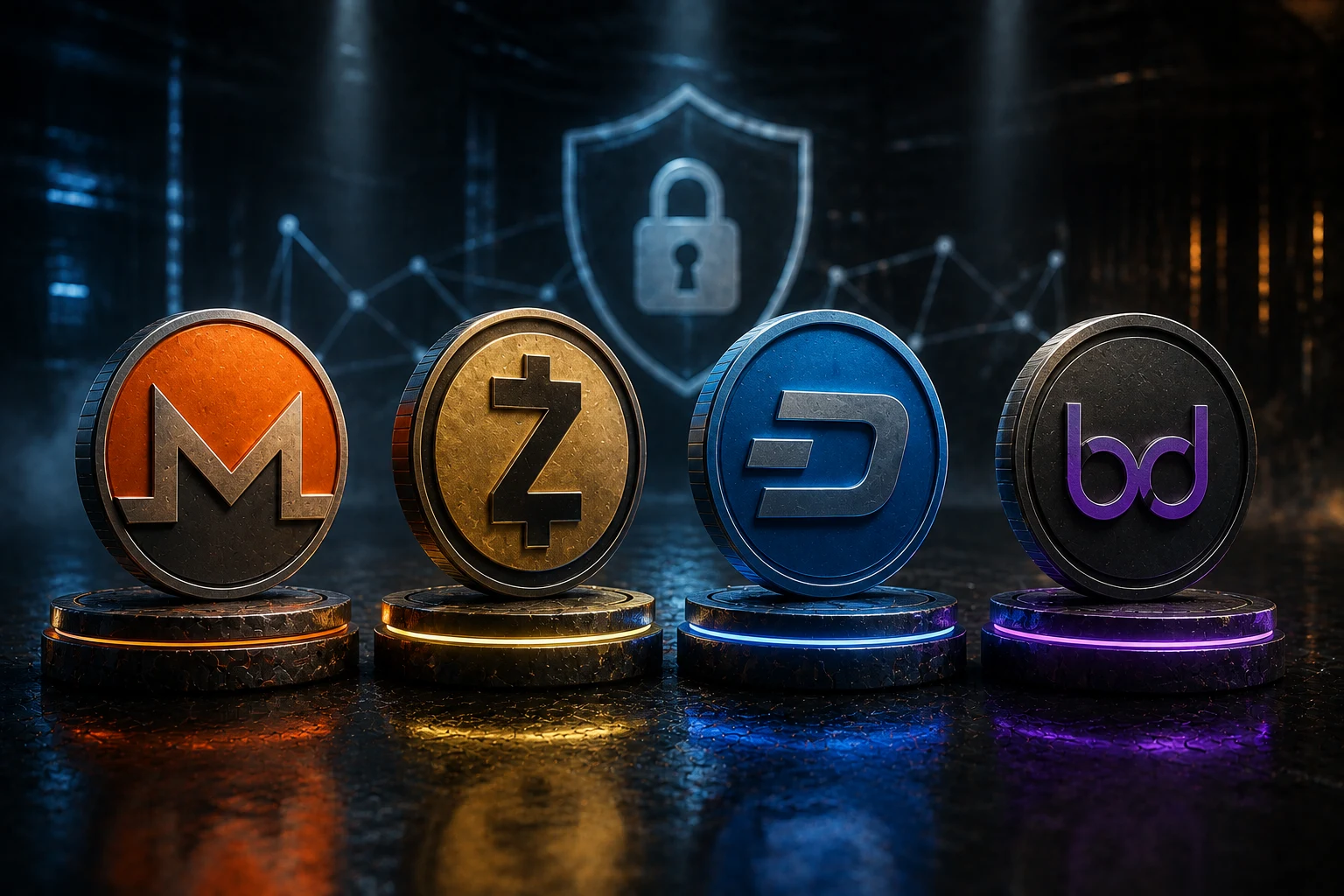
In 2025 the category is narrower and more legally fraught than it was at its 2017 to 2021 peak. The four projects people most often compare are Monero (XMR), Zcash (ZEC), Dash (DASH), and Beldex (BDX). They share a label but very little else. Their privacy guarantees rely on fundamentally different cryptography, and their exposure to regulation, exchange listings, and supply verification differs sharply.
What unites them is also what makes them controversial. In jurisdictions that follow Financial Action Task Force guidance, 'anonymity-enhanced' cryptocurrencies have become an enforcement priority. The European Union's transfer-of-funds rules, Japan's crypto travel rule, and a string of U.S. enforcement actions against mixers and sanctioned chains have turned privacy from a marketing word into an active legal category. Choosing among these coins is no longer a purely technical exercise.
The risks no privacy-coin brochure tells you
Before diving into the technology, it is worth stating plainly: every coin in this comparison carries risks that price charts do not capture.
Exchange delisting risk. The single biggest practical threat. Major venues including Bittrex, Huobi, Kraken (in some jurisdictions), and several large Korean exchanges have removed or restricted XMR, ZEC, or DASH at various points. Once delisted, liquidity fragments across smaller venues, spreads widen, and over-the-counter desks become the only realistic on-ramp. BDX has had a more limited traditional exchange footprint and trades heavily on decentralized exchanges and through cross-chain bridges.
Regulatory pressure. The U.S. Treasury's OFAC sanctioned Tornado Cash in 2022 and has since added other mixing services. Privacy coin issuers are not directly sanctioned, but the policy direction is clear: anonymity-enhancing technology sits on a watchlist. Australia, Japan, South Korea, and several EU member states have moved toward tighter disclosure rules, including for self-hosted wallets. Holding a privacy coin is not illegal in most places, but moving value into or out of one increasingly triggers enhanced due diligence at regulated exchanges.
Historical wipeouts and scams. The privacy-coin niche has produced genuine fraud: HiddenWallet, several 'private Bitcoin' tokens that simply re-laundered BTC, and countless copycat coins that ran premine scams before going to zero. Even legitimate projects have had bugs that briefly broke their privacy guarantees, including Zcash's 2018 counterfeiting vulnerability (patched before exploitation) and a Monero bug disclosed in 2023 that could have inflated supply if unaddressed.
Thin liquidity and price impact. Daily volume for any of these four is a fraction of a top-20 token. A single large market order can move the price several percent, and slippage on larger trades is severe. BDX, in particular, has periods of low volume outside BEP-20 venues.
How each coin actually hides transactions
This is the technical core, and the differences are real.
Monero (XMR). Privacy is mandatory and protocol-level. Every transaction uses ring signatures (which mix the true signer with decoys so an outside observer cannot tell which input spent the funds), stealth addresses (which generate a fresh one-time address per payment so the recipient's public address never appears on-chain), and RingCT, which hides the amount transacted. Since the 2022 activation of the FCMP++ upgrade path, Monero has been moving toward full chain anonymity sets (every transaction indistinguishable from every other) rather than per-transaction ring sizes. The trade-off: transactions are larger and more expensive to verify than Bitcoin, which limits throughput.
Zcash (ZEC). Zcash was the first major coin to use zk-SNARKs, a form of zero-knowledge proof that lets a sender prove they had the funds and authority to spend without revealing addresses or amounts. The catch is that shielded (private) transactions are optional. A user must actively move funds into a 'z-addr' to gain privacy, and historically only a small minority of ZEC sits in shielded pools. The 2024 network upgrade expanded the shielded set and introduced the Zashi wallet defaults, but the practical anonymity set still depends on how many users opt in. Optional privacy is weaker than mandatory privacy because it creates a small, identifiable shielded population.
Dash (DASH). Dash was originally called Darkcoin and pivoted hard toward payments. Its privacy feature, PrivateSend, runs through a masternode network that mixes inputs across multiple rounds. It is functionally similar to CoinJoin, the technique used by Bitcoin wallets like Wasabi and JoinMarket. The reality is more limited: PrivateSend typically uses a fixed mix of a small number of participants (often four across three rounds), which is a far weaker anonymity guarantee than Monero's per-ring decoys or Zcash's zero-knowledge proofs. Most DASH activity is transparent, and Dash's marketing has de-emphasized privacy in favor of Digital Cash branding.
Beldex (BDX). Beldex is the outlier in this comparison because its privacy story is less about the base token and more about an ecosystem. BDX is a BEP-20 token on BNB Smart Chain (with a separate native mainnet chain) used for governance, staking, and as a payment medium inside the Beldex app suite. The ecosystem includes BChat (an encrypted messaging app), BelNet (a VPN service), and the Beldex Browser. On-chain privacy on the Beldex mainnet uses a masternode-based mixing approach similar to Dash, but the BDX token's main circulation is on BSC, which is not private by default. This is a structural trade-off: a privacy ecosystem that runs, by necessity, on a transparent base chain.
Beldex's BDX differentiator: an ecosystem play
BDX deserves a separate look because the comparison is not really 'BDX vs XMR.' They serve different use cases.
Beldex is closer to a privacy-app platform with a token attached than to a privacy-focused currency. The BChat messenger and BelNet VPN are real consumer products with functioning code, audited (to varying degrees) and downloadable. The native Beldex mainnet chain does support masternode-based mixing and confidential transactions, but BDX itself lives primarily as a BEP-20 token, which means most of its visible on-chain activity is fully transparent on BSC.
The differentiator is integration. The pitch is: if you already need a privacy VPN, an encrypted chat, and a payment token to pay for them, BDX gives you all three. That is genuinely novel in this list. The trade-off is that running a privacy business adds regulatory surface area. Operating a VPN under privacy-friendly jurisdictions and running a token on a regulated exchange pull the project in opposite directions, and BDX has had a complicated exchange history with several delistings on smaller venues.
For a user comparing these four, BDX is best understood as 'the privacy-app token,' not 'the Monero alternative.' Confusing the two leads to wrong conclusions about its anonymity guarantees.
Auditability and supply-verifiability: the underrated trade-off
Every privacy coin makes a different bet about whether outside observers should be able to confirm the total supply.
Monero. Supply is verifiable in aggregate, but not per-transaction. The protocol's emission curve is publicly defined, and total XMR can be checked against the schedule. However, no observer can independently confirm that no hidden inflation has occurred, because amounts are encrypted. The 2023 bug disclosed by the Monero research lab was a serious test of the auditing process: a hypothetical inflation bug existed but had not been exploited, and the fix was applied through a coordinated hard fork. That incident is worth remembering; it shows that even mature privacy coins rely on developer coordination to defend supply integrity.
Zcash. Supply is mathematically provable. The original Sprout parameters and later Sapling parameters were set up in trusted-setup ceremonies, which means a small group of participants generated the cryptographic parameters. If all of them had colluded, they could have minted undetectable ZEC. The 'Halo' upgrade (now called Orchard) eliminated the trusted setup entirely, so shielded ZEC post-Halo has no backdoor risk by construction. Transparent ZEC (most of it) is trivially auditable.
Dash. Supply is fully transparent. Dash uses standard UTXO accounting and the chain shows every input, output, and amount. Dash's masternode and treasury systems are visible on-ledger, including the 10% treasury reward. There is no privacy-versus-auditability tension because the privacy feature is optional and narrow.
Beldex. The picture is split. The native Beldex chain uses a masternode-based architecture with publicly visible emission, similar to Dash. The BDX BEP-20 token on BSC is a standard token whose supply and transfers are fully transparent on BNB Smart Chain. So the supply of BDX is auditable, but the privacy the project markets is at the application layer, not the token layer.
The honest summary: if you care most about 'can anyone ever prove my balance,' Monero is the strongest default. If you care most about 'can I mathematically prove the supply has not been inflated,' Zcash post-Halo is the strongest. If you care most about being able to read a block explorer and verify everything yourself, Dash wins.
Liquidity, exchange access, and the practical reality
Technical privacy is necessary but not sufficient. If you cannot get into or out of the asset cheaply and reliably, the privacy guarantees are theoretical.
XMR has the deepest liquidity of the four on privacy-focused venues, but its fiat on-ramps have shrunk. Several major exchanges have restricted or removed XMR pairs, and OTC desks handle most large institutional flows. The Euro, Korean won, and Australian dollar markets have at various points been closed to XMR. ZEC has broader exchange support than XMR, including some regulated U.S. venues, partly because of the optionality model and partly because the issuer (Electric Coin Company) maintains compliance relationships. DASH has the broadest mainstream exchange support of the four, including several large U.S. venues, again partly because it has rebranded away from heavy privacy marketing. BDX is mostly traded on decentralized exchanges, smaller centralized venues, and via cross-chain bridges.
A practical implication: if you are choosing among these based on access, the order is roughly DASH (most accessible) greater than ZEC greater than XMR greater than BDX (least accessible on regulated venues). The opposite order roughly tracks privacy guarantees: XMR greater than ZEC greater than BDX greater than DASH. The two orderings are not coincidences. Regulated exchanges prefer assets they can monitor.
What this means if you actually want to use one
Three honest takeaways for anyone considering these assets.
First, match the asset to the threat model. If the goal is to make every transaction private by default with no configuration, XMR is the only one of the four that does this. If the goal is a credible shielded pool with mathematical supply proofs and broader exchange access, ZEC is the rational choice. If the goal is optional mixing for small everyday spends and you value exchange access, DASH is the only realistic option of the four. If the goal is a privacy-app bundle, BDX stands alone.
Second, plan around the legal reality. In most jurisdictions, owning these coins is not illegal. Spending them on a regulated exchange in a regulated currency triggers disclosure. Moving large sums through mixing services is increasingly scrutinized. None of this means you cannot use privacy coins, but it does mean that the relevant question has shifted from 'is this technically private?' to 'is this legally risky to use?' That is a category change worth respecting.
Third, treat privacy coins as a small, optional, and observable part of a portfolio. Because of thin liquidity, exchange delisting risk, and regulatory exposure, none of the four belongs in a core long-term allocation for most users. The honest framing is: utility tool with non-trivial tail risk, not an investment thesis.
How to follow privacy coins the smart way
Privacy-coin news moves fast, and most of it is noise. A new wallet release, an OFAC advisory, a delisting rumor, a chain upgrade proposal, or a price spike on a thin market can each appear to be the same thing to a casual observer. Zippfeed surfaces privacy-coin headlines with sentiment scoring (bullish, neutral, or bearish) and an importance rating, so you can tell the regulatory actions from the marketing from the genuine protocol upgrades before the rest of the market does. That is the difference between reacting to a headline and understanding the category.



 WuBlockchain
 CoinDesk
 CryptoSlate
 Lookonchain