Zcash in context
Bitcoin's blockchain is famously transparent. Anyone can look up any address and see its entire history of transactions. For some users this is a feature; for many others it is a problem. Salaries become visible, business relationships exposed, payment histories permanent. The privacy gap on public chains was obvious from early on.
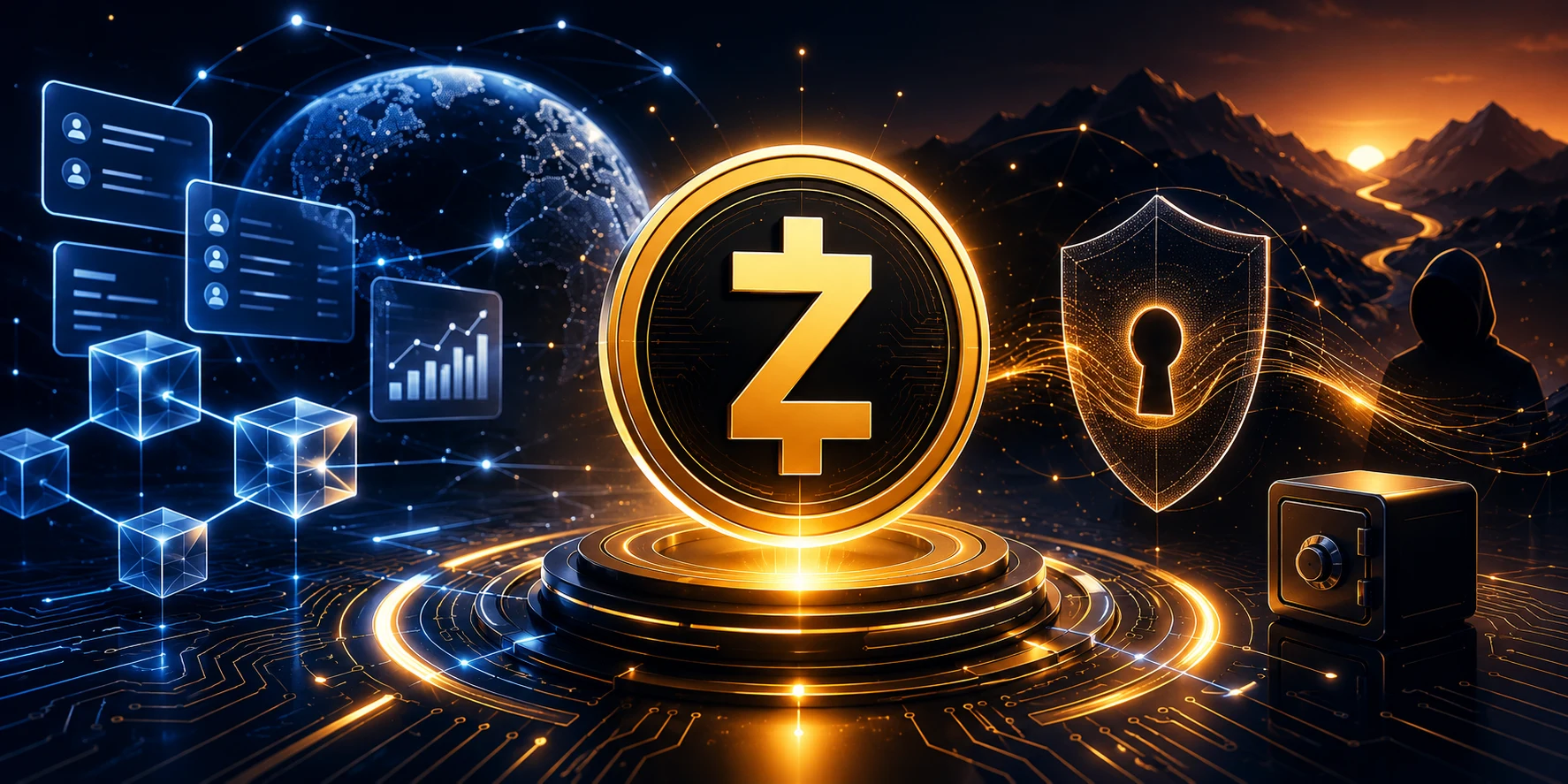
Zcash launched in 2016 as the most technically ambitious answer to that problem. Built on a Bitcoin-derived codebase, Zcash added zero-knowledge proofs — cryptographic constructions that can prove a statement is true without revealing why it is true. Applied to transactions, this means a user can prove they own funds and are spending them correctly, without anyone learning the sender, recipient, or amount. That is the entire point of Zcash.
How Zcash actually works
Zero-knowledge proofs in plain English
A zero-knowledge proof (specifically the zk-SNARK variant Zcash uses) lets one party prove to another that a statement is true without revealing any information beyond the fact of that truth. For a payment, the statement is something like: "I own X amount of funds, I'm sending Y of them to a valid address, and my balance updates correctly." The validator verifies this is true without seeing any of the underlying values.
The math is unforgiving. The cryptography is real. Implementing it correctly is one of the harder engineering problems in crypto. Zcash's team — including cryptographers who shaped the field — were among the first to deploy zk-SNARKs to a public production blockchain.
Shielded versus transparent addresses
Zcash addresses come in two flavors:
- Shielded (z-addresses) — transactions hide sender, recipient, and amount. These are the privacy-preserving addresses Zcash was built for.
- Transparent (t-addresses) — transactions are public, similar to Bitcoin. These exist for compatibility and for users who do not need privacy.
For years most exchange-handled Zcash sat in transparent addresses, undercutting the privacy thesis. Recent upgrades (Orchard, Unified Addresses) have pushed default behavior toward shielded usage and made shielded transactions faster and cheaper.
The trusted setup story
Early zk-SNARK constructions required a trusted setup ceremony — a one-time event where parameters were generated and the toxic byproducts had to be destroyed. If even one participant kept their secret, they could in theory mint Zcash from nothing. Zcash's first ceremonies involved multiple participants and elaborate destruction procedures, but the requirement was a real point of weakness.
Subsequent upgrades reduced or eliminated that requirement: the Halo Arc upgrade introduced proof systems that do not need a trusted setup at all. That is one of the cleaner improvements in modern cryptography deployment.
What the ZEC token is for
ZEC is the unit of value on the Zcash chain:
- Payments and store of value. ZEC functions as a Bitcoin-like asset that can be transacted privately or transparently.
- Transaction fees. Every Zcash transaction pays a small fee in ZEC.
- Mining rewards. Zcash uses proof of work; miners earn newly issued ZEC for producing blocks.
- Dev fund. A portion of block rewards goes to a development fund that supports protocol research and infrastructure.
Zcash's monetary policy mirrors Bitcoin's — a hard cap of 21 million ZEC with halvings every four years. The economics are intentionally Bitcoin-like, with privacy as the differentiator.
The Zcash ecosystem
Zcash's ecosystem is narrower than smart-contract chains by design:
- Privacy-preserving payments — the core use case.
- Cross-chain shielded transfers — projects building bridges that let other assets pass through Zcash's privacy guarantees.
- Privacy-related infrastructure — wallets, ecosystem tools, and the broader privacy research community.
- Adjacent projects — Zcash's cryptography has influenced many other zero-knowledge projects across the industry.
Zcash versus other privacy approaches
Zcash is not the only privacy approach. Monero uses ring signatures and stealth addresses for default-on privacy; Mimblewimble-based chains use a different model. The trade-offs are real: Monero's privacy is on by default but harder to audit; Zcash's privacy is opt-in but cryptographically stronger when used; mixers and Layer 2 privacy add-ons on Ethereum offer privacy as a feature but on a non-private base chain.
Picking between them depends on whether you want default privacy (Monero), strong opt-in privacy with optional auditability (Zcash), or privacy as a layer on a smart-contract ecosystem.
The risks worth knowing
- Regulatory pressure. Privacy coins face the heaviest regulatory headwinds in crypto. Multiple major exchanges have delisted Zcash in jurisdictions including Japan and parts of the EU. Tighter rules anywhere can shrink legal access.
- Trusted-setup history. Even though newer proof systems eliminate the trusted-setup requirement, the historical ceremonies remain part of the protocol's security story.
- Adoption depth. Despite strong technology, Zcash's user base and transaction volume sit well below Bitcoin and Ethereum.
- Token volatility. ZEC is a volatile asset and has gone through long drawdowns from its highs.
- Privacy is not anonymity. Network-level metadata, wallet UX choices, and exchange KYC can all leak information that the cryptography itself preserves. Strong privacy requires user discipline.
None of this is investment advice. Treat any crypto position as money you can afford to lose. Privacy-preserving tools should be used in accordance with local law.
Following Zcash without the noise
Zcash news spans protocol upgrades, exchange listings, regulatory developments, and zero-knowledge research moves. Zippfeed surfaces Zcash headlines with sentiment scoring (bullish, neutral, or bearish) and an importance rating, so you see what actually moves the network instead of every privacy-coin think piece. That is the difference between reading the signal and chasing privacy-policy noise.
 WuBlockchain
 CoinDesk
 CryptoSlate
 Lookonchain
 TheBlock