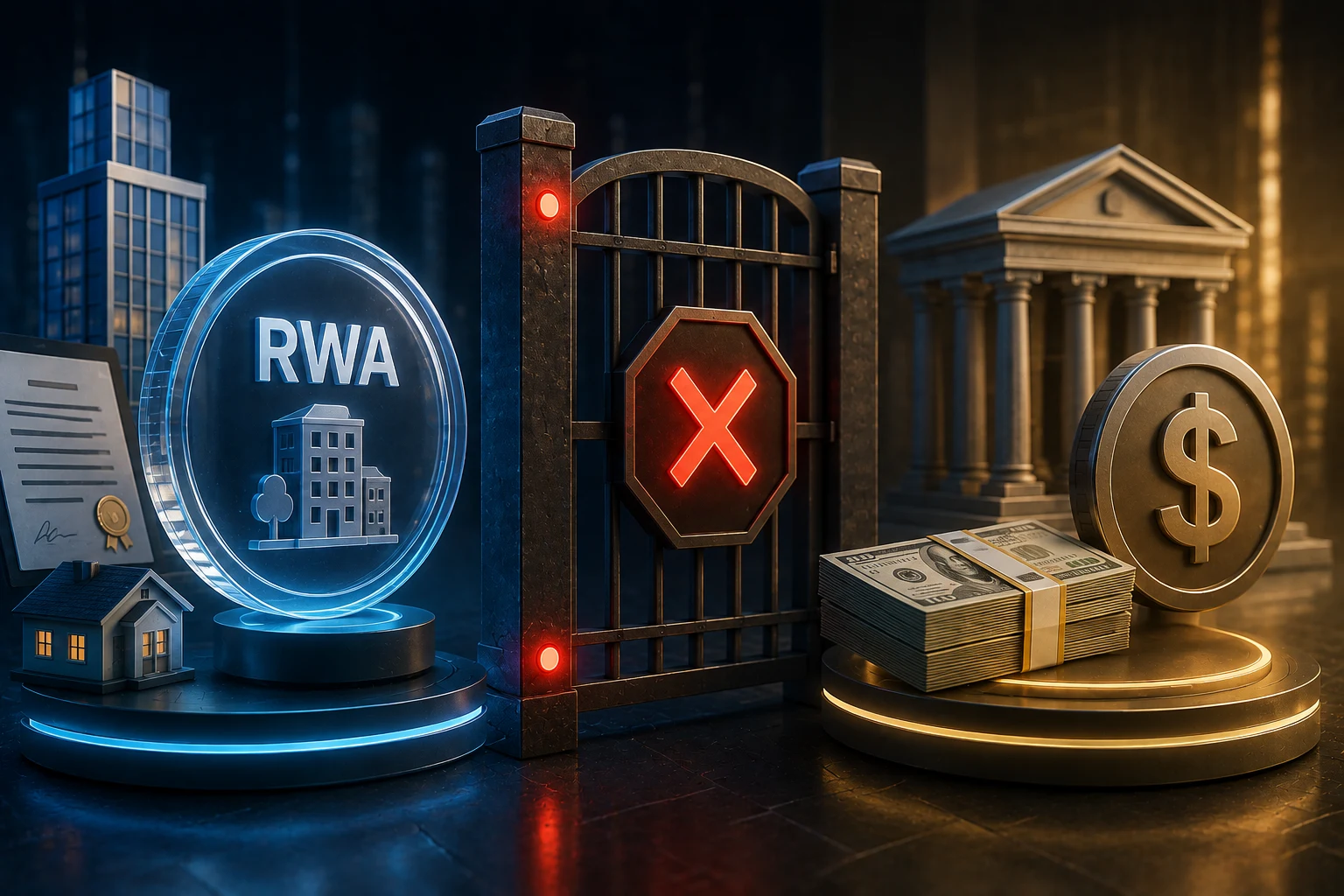
Why cash-out at par can stop working
A tokenized Treasury bill fund or money-market fund may describe its shares as redeemable at par. Par usually means the target value is close to one dollar per share, subject to the fund's rules, eligible holders, cut-off times, settlement process, and available liquidity. It does not mean every holder can receive cash immediately in every market condition.
The overlooked detail is that redemption is a process, not a button. A holder may need to submit a request, pass KYC and AML checks, wait for a dealing window, and receive money after the fund sells or settles assets. If many holders ask for cash at once, the vehicle may not be able to meet all requests without selling assets quickly or creating losses for remaining holders.
An RWA redemption gate is one way a fund or its governing documents can restrict the pace or amount of withdrawals during stress. The restriction can protect the remaining portfolio from forced sales, but it also transfers liquidity risk to holders who expected to exit. That trade-off is central to products associated with tickers such as BUIDL, OUSG, USDY, USYC, and JAAA. Their structures, assets, eligibility rules, and protections are not identical, so a general explanation should not be read as an assessment of any particular product.
This is why the phrase cash-out at par needs a second question: under what conditions, through which counterparty, and on what timetable? A guide to tokenized Treasury funds can help explain the normal process, but stress terms are usually found in offering documents, fund rules, smart-contract controls, and service-provider disclosures.
What triggers an RWA redemption gate?
Gates are normally tied to an event that could make unrestricted withdrawals unfair, impractical, or unsafe. The exact trigger depends on the legal wrapper and governing documents. A token contract alone may not reveal the complete policy because the off-chain fund administrator, custodian, transfer agent, or issuer can control the actual redemption workflow.
NAV pressure
NAV, or net asset value, is the value of a fund's assets minus its liabilities, divided among its shares. A fall in NAV can be a trigger or a warning that the fund cannot maintain its target price without realizing losses. A money-market fund can experience a break below its intended one-dollar value when credit losses, interest-rate moves, or forced sales exceed its buffers.
A small NAV movement is not automatically a gate. Some products have floating NAVs, accrued interest, or valuation rules that make their price behave differently from a stable-value fund. The relevant question is whether the fund's documents treat a NAV drop, a valuation uncertainty, or a failure to maintain a target value as a reason to limit redemptions.
Liquidity buffer breach
A liquidity buffer is a reserve of cash or assets expected to be sold quickly with limited price impact. If withdrawals consume that reserve or the fund's liquid-asset ratio falls below a required level, the manager may restrict redemptions. The aim is to avoid selling less-liquid holdings at distressed prices and spreading those losses across all holders.
Liquidity is not the same as total asset value. A portfolio can own valuable Treasury bills, private credit, or other short-duration instruments while still lacking enough same-day cash. Settlement delays, market holidays, banking cut-offs, and limited secondary markets can all turn a solvent portfolio into a temporarily illiquid one.
Regulatory or operational events
A regulatory event can also matter. A change in eligible investors, sanctions exposure, a custodian problem, a required wind-down, or a decision by an authority can restrict transfers or redemptions. The trigger may have little to do with the market price of the underlying assets.
Operational failures can have a similar effect. If a transfer agent cannot verify holders, a bank cannot process payments, or a custodian cannot deliver assets, the fund may delay settlement. A smart contract may continue to display balances while the real-world redemption rail is unavailable.
Read the terms for words such as liquidity event, extraordinary circumstances, suspension, redemption limitation, dealing day, and gate. Those clauses describe who can act, what evidence is required, how long the restriction may last, and whether investors receive notice. How tokenized funds settle is useful background, but it does not replace the current product documents.
Gate, fee, or suspension: what is the difference?
These terms are often mixed together, but they create different outcomes for a holder. A gate limits access. A fee preserves access but reduces the amount received. A suspension stops the relevant activity altogether, at least temporarily.
A redemption gate
A gate may cap the percentage or dollar amount that can be redeemed on a dealing day. For example, a fund could process only a portion of total requests and defer the rest under its stated allocation method. A gate can also mean that redemptions are available only during specified windows or to certain categories of holders.
A gate does not necessarily mean the assets have lost all value. It means immediate liquidity is being rationed. However, a gate is still a serious risk because the holder cannot assume that a later request will be filled at the same value or that the restriction will end quickly.
A redemption fee
A redemption fee charges the exiting holder for withdrawing during a stressed period. The fee may be designed to pass trading costs to sellers rather than to holders who remain. Unlike a gate, it does not necessarily reduce the amount that can be redeemed.
A fee can still make par redemption economically untrue. If a token is worth one dollar before the fee and the holder receives less after it, the holder has not received a full dollar of cash. The fee may be temporary, conditional, or set by a fund board or other authorized party.
A suspension
A suspension pauses redemptions, transfers, or both. It is usually the strongest restriction because a holder may be unable to submit or complete an exit at all. A suspension can follow a valuation problem, a legal order, a failed service provider, or a decision that continuing transactions would harm investors.
The practical distinction matters. A fee tells you the price of liquidity. A gate tells you the quantity or pace of liquidity. A suspension tells you that liquidity is unavailable through that channel. These measures can appear together, and a gate can escalate into a suspension if conditions worsen.
What past money-market fund stress teaches RWA holders
Tokenized cash products are newer than traditional money-market funds, but the liquidity problem is not new. The historical record shows that assets intended to behave like cash can face runs when investors doubt their ability to preserve value or access money quickly.
The 2008 Reserve Primary Fund break
In September 2008, the Reserve Primary Fund became the most prominent example of a money-market fund breaking the one-dollar level. The fund held debt issued by Lehman Brothers, which failed during the global financial crisis. Losses pushed the fund's NAV below one dollar, and investor withdrawals surged.
The fund then faced a mismatch between the pace of redemption requests and the time needed to liquidate assets. Redemptions were suspended, and the fund was later liquidated. The episode showed that a stable target price does not remove credit risk, valuation risk, or run risk. It also prompted major changes in money-market fund regulation and strengthened the perceived importance of liquidity buffers.
The analogy for an RWA product is limited but useful. A tokenized fund might hold safer or shorter-duration assets than the Reserve Primary Fund, yet it can still depend on banks, custodians, transfer agents, settlement venues, and legal procedures. A failure in any link can delay cash-out even if the securities themselves remain valuable.
The 2020 market shock
In March 2020, the pandemic-driven market shock caused intense selling and cash demand. Some money-market funds, especially those holding commercial paper and other short-term instruments, faced heavy redemption pressure. The market for certain assets became less liquid just as investors wanted cash most urgently.
The Federal Reserve created facilities that helped restore liquidity and reduce pressure on money-market funds. The lesson was not that every fund failed. The lesson was that even instruments designed for cash management can require extraordinary market support when redemptions, dealer capacity, and asset liquidity move in the wrong direction at the same time.
The 2023 banking stress
The 2023 failures and forced resolutions involving several banks renewed attention on deposits, custodians, payment rails, and money-market liquidity. Money-market funds were not all affected in the same way, and the episode did not produce a repeat of the 2008 Reserve Primary Fund break. It did, however, demonstrate how quickly confidence can shift and how a bank problem can threaten the operational path between a fund and its investors.
For tokenized products, the 2023 stress was a reminder that on-chain visibility does not guarantee off-chain cash access. A token can transfer on a blockchain while the bank account used for settlement is restricted, the fund is closed for a dealing day, or a compliance review blocks a payment. The blockchain may show ownership accurately while the investor still waits for dollars.
These events also show why a gate can be rational from a fund's perspective and painful from a holder's perspective. Slowing withdrawals may prevent a disorderly fire sale, but it cannot make every investor liquid at once. Money-market fund risks explained provides useful historical context for evaluating this trade-off.
How on-chain and off-chain money-market funds can gate differently
On-chain and off-chain money-market funds may own similar real-world assets, but their control points differ. An off-chain fund usually records ownership in a traditional register and processes subscriptions and redemptions through an administrator, broker, bank, or transfer agent. An on-chain fund adds a blockchain token and smart-contract rules to that process.
Off-chain control points
An off-chain fund can restrict dealing at the fund or administrator level. The manager may close a dealing window, delay valuation, apply a fee, or suspend redemptions under the fund rules. Investors may see an updated NAV only after the administrator confirms prices and liabilities.
This process can be slower and less visible to the public. A holder may need to rely on notices, statements, and intermediary communications. The advantage is that the legal and operational process is familiar to traditional fund infrastructure. The disadvantage is that a holder may not see stress developing until a formal notice arrives.
On-chain control points
An on-chain product can encode transfer restrictions, whitelist checks, pause functions, or mint and burn controls in a smart contract. An issuer may be able to block transfers, restrict new subscriptions, or stop token redemptions while the off-chain fund handles a crisis.
That can make the restriction technically fast, but it does not make the underlying liquidity instant. The token may be transferable only among approved wallets, and a transfer may not equal a redemption for dollars. A smart contract can enforce a rule, but it cannot sell a Treasury bill, settle a bank payment, or resolve a valuation dispute by itself.
On-chain data can also create false confidence. A visible balance, reserve address, or transaction history may show that tokens exist without showing all liabilities, pending redemption requests, bank cash, accrued fees, or the legal claim attached to the token. Conversely, a token price on a secondary venue can move below its stated NAV because that venue is pricing immediate liquidity, not necessarily the value of the underlying portfolio.
Compare the token contract documentation with the offering memorandum, custody terms, redemption schedule, and issuer disclosures. Ask whether the token can be frozen, who controls that function, which investors can redeem, and whether secondary transfers remain possible during a gate. On-chain versus off-chain fund transparency can help frame the comparison.
On-chain warning signs before a redemption gate
No public signal predicts a gate with certainty. The most useful approach is to watch several indicators and then confirm them against official documents. A single unusual transaction may be routine, while several deteriorating signals can indicate that immediate liquidity deserves closer scrutiny.
Widening bid and ask prices
The bid is the price a buyer offers, and the ask is the price a seller requests. The gap between them is the bid/ask spread. A widening spread in a tokenized cash product can mean market makers are demanding more compensation for inventory, uncertainty, or exit risk.
A token trading below its reported NAV is not automatic proof of a problem. It may reflect thin volume, a delayed NAV update, a weekend or holiday, or a buyer who needs immediate settlement. But a persistent discount combined with falling volume and fewer firm bids deserves attention because it suggests that secondary liquidity is weakening.
A falling deposit cap or subscription limit
Some products set a deposit cap, capacity limit, or maximum issuance amount. A falling cap can reflect ordinary portfolio management, a change in distribution strategy, or a decision to stop accepting new money. It can also signal that the issuer is preserving capacity while it assesses liquidity or operational exposure.
Do not treat a cap change as proof of impending distress. Instead, compare the timing with changes in redemption terms, supported chains, bank partners, asset disclosures, and official notices. A cap that falls while redemption windows lengthen is more informative than a cap change by itself.
Stale NAV data
NAV data is stale when the displayed value has not updated in the expected period or continues to show the same figure despite major market and operational developments. A stable number can look reassuring, but it may simply mean that the valuation process is delayed.
Check the timestamp, valuation frequency, holiday calendar, and source of the number. A stale NAV matters most when the token's secondary-market price is moving, the underlying rates are changing, or official communications mention delayed calculations. In a crisis, the gap between a displayed NAV and a realizable cash price can widen quickly.
Other signals worth checking
- Redemption processing times become longer or the next dealing day moves further away.
- Official documents add new transfer restrictions, fees, eligibility checks, or pause language.
- Liquidity providers reduce quoted size or disappear from the secondary market.
- Transfers accumulate in pending states or fail more often than normal.
- The issuer changes custodians, banks, administrators, or legal entities without clear operational detail.
- Reserve or portfolio reporting becomes less frequent, less specific, or difficult to reconcile.
These are monitoring clues, not investment signals. A warning sign tells you to verify facts and reassess your ability to wait. It does not tell you that a fund is safe, unsafe, solvent, or insolvent.
What this means for a tokenized cash holder
Start by separating three questions: what is the underlying asset worth, what is the token legally entitled to, and how quickly can you receive dollars? Those answers may come from different entities. A fund can own high-quality assets, a token can accurately record ownership, and the redemption process can still be delayed by a gate or a banking interruption.
Before holding a tokenized Treasury or money-market product, find the normal redemption timetable and the stress provisions. Look for minimum amounts, cut-off times, eligible wallets, KYC and AML requirements, fees, dealing holidays, notice procedures, and the authority to delay, limit, or suspend redemptions. Confirm whether a secondary sale is available and whether it can occur during a formal gate.
Keep a record of official sources and check them during stress rather than relying on social posts or a single dashboard. Compare the displayed NAV with actual executable bids, not just a last-traded price. Check whether the token contract has pause or freeze functions and whether the issuer or another administrator controls them.
Manage concentration risk as well. A product that looks like cash may still expose you to issuer, custodian, bank, legal, settlement, technology, and liquidity risks. Do not place money needed for near-term bills into a vehicle whose redemption timetable you have not tested or understood. This article is educational, not financial advice, and no ticker mentioned here is an endorsement.
If a gate is announced, read the notice for the trigger, scope, effective time, expected review date, allocation method, fee treatment, and communication channel. Avoid assuming that a discount on a secondary venue is either a bargain or a permanent loss. The right response depends on your legal rights, liquidity needs, tax position, and tolerance for delay.
Stay ahead of RWA redemption gate risk
RWA markets move quickly, but their most important risks often appear in ordinary-looking updates about NAV timing, redemption capacity, custody, or bank access. Manually tracking every disclosure, market quote, and sentiment shift is difficult. Zippfeed brings together relevant RWA headlines, sentiment scoring labeled bullish, neutral, or bearish, and an importance rating so you can distinguish routine product news from developments that may affect liquidity and access.
Use that signal as a research aid, not as a substitute for fund documents or professional advice. Follow the warning signs, verify material claims, and keep the difference between a quoted value and an available cash redemption in view.





 CoinDesk
 TheBlock
 Crypto News