Why stablecoin users compare Tron and Solana at all
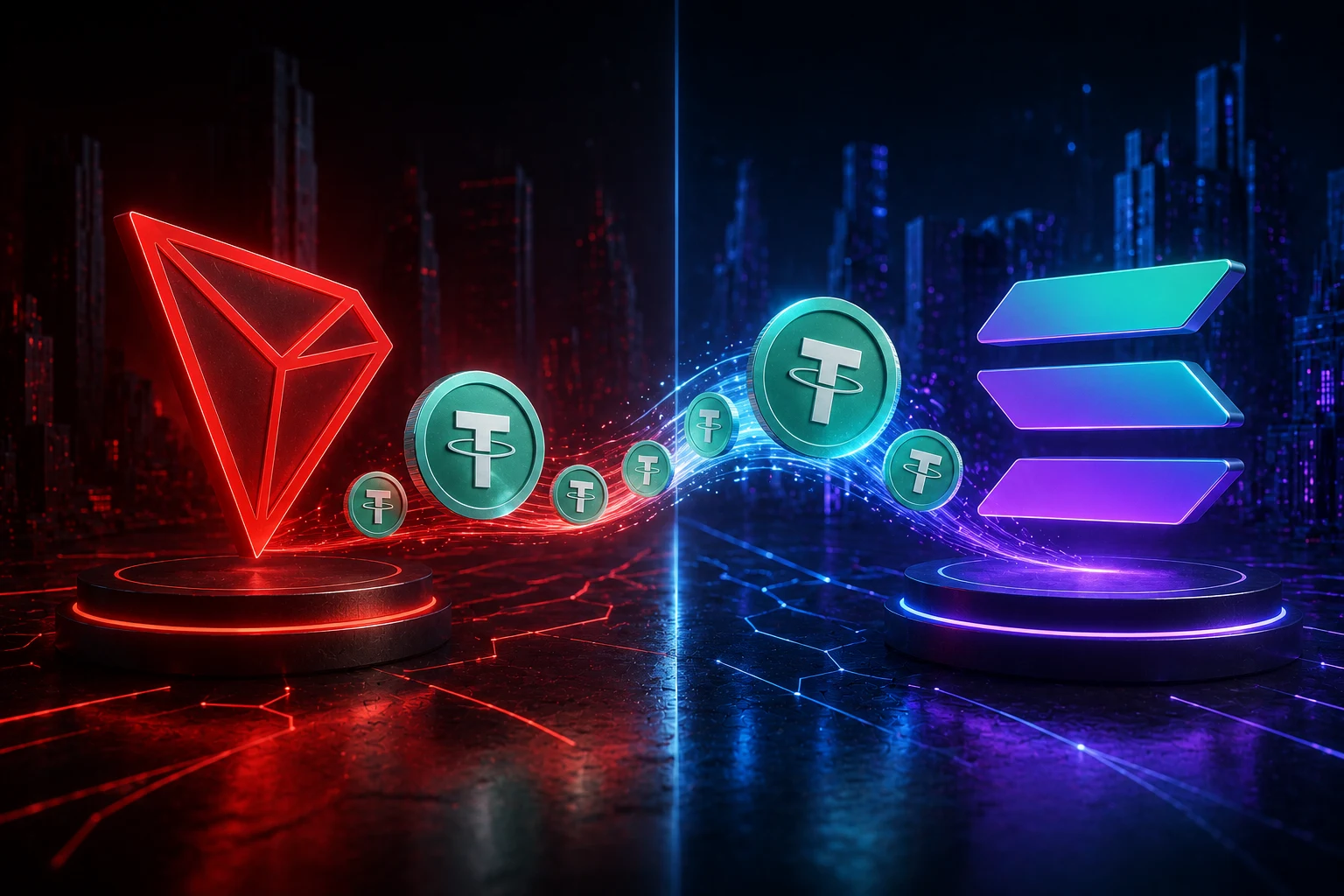
If you send USDT, you have almost certainly noticed that the network you choose changes everything. The same dollar of stablecoin can cost a few cents to move on one chain, several dollars on another, and settle in anywhere from five seconds to several minutes depending on congestion. Tron and Solana have emerged as the two retail-heavy rails for USDT, and they have done so for very different reasons.
Tron was designed for high-throughput, low-fee transfers and adopted USDT early. That decision, made in 2019, locked in a network effect that has only grown. Tron now settles more USDT by raw dollar volume than Ethereum on many days, despite hosting a fraction of the developer activity. The reason is simple: a one-dollar transfer that costs a few cents and confirms in under a minute is hard to beat for retail remittances, especially across emerging markets where banking rails are slow or expensive.
Solana arrived later to stablecoins but built a payments-friendly profile from the start. Sub-cent fees, sub-second finality in many cases, and a token standard that supports both SPL and wrapped assets made it attractive to wallets, fintech apps, and merchant processors. The chain has also attracted a parallel USD stablecoin ecosystem, including USDC, which gives merchants and developers a regulated alternative to USDT when they need it.
The comparison matters because stablecoins are no longer a niche crypto use case. They are a working layer of global payments, with monthly transfer volumes running into the trillions of dollars. Choosing the wrong rail can mean higher costs, slower settlement, or exposure to legal risk that you did not sign up for.
The real risks of building on either chain
Before diving into fees and volumes, the risks deserve a clear-eyed look, because both chains carry failure modes that are easy to overlook until something breaks.
Regulatory risk on Tron. The most discussed risk around Tron is its association with Justin Sun and the broader Tron ecosystem. The United States has sanctioned individuals and entities connected to the Tron network, and there have been repeated reports of illicit use of TRX and USDT on Tron for sanctions evasion, scam revenue, and mixer services. Tether itself has faced fines and ongoing scrutiny from US regulators over compliance. None of this means Tron is illegal to use in every jurisdiction, but it does mean that any business routing stablecoin volume through Tron inherits a compliance headache that may get worse, not better.
Centralization risk on Solana. Solana has historically suffered from partial outages and elevated client complexity. The chain has improved dramatically, but the validator set and token supply are more concentrated than on Ethereum, and a meaningful share of stake sits with a small number of operators. For payments, this matters less than for DeFi, but it is a real consideration if you are routing payroll or merchant settlements through a single network.
Stablecoin counterparty risk. Both chains depend on the issuer behind the stablecoin. USDT on either chain means exposure to Tether's reserves and disclosures, which have improved over time but still draw criticism. USDC on Solana means exposure to Circle, which is regulated in the US and publishes attestations but has frozen addresses on request from law enforcement. Neither stablecoin is fully decentralized, and either can be censored at the smart-contract level for sanctioned addresses.
Congestion and fee spikes. Tron fees are usually predictable, but on-chain activity surges can push them up. Solana has famously handled large bursts of activity, but memcoin trading has occasionally clogged the network and raised fees temporarily. Neither chain offers the steady, low-volatility fee profile that a CFO wants to see on a Friday afternoon before payroll.
USDT issuance and where it actually lives
The single most important number in this comparison is where USDT lives. As of 2025, the majority of USDT supply by issuance sits on Tron, followed by Ethereum, with a growing but still smaller share on Solana and other networks such as TON and Liquid. This is not a marketing claim; it is visible on-chain and reported by the issuer.
Why does Tron dominate? The history is older than most users realize. Tether chose Tron as a scaling partner in 2019, when Ethereum fees were high and gas costs made small transfers impractical. By offering an EVM-compatible environment with low fees, Tron became the default venue for USDT outside of Ethereum. Once liquidity concentrated there, exchanges, OTC desks, and remittance corridors all routed through it because that is where the counterparties were.
Solana has gained ground by offering the same low-fee profile with a more modern developer experience. Its USDT issuance has grown sharply since 2023, helped by integrations with major wallets, merchant processors, and DeFi venues. Some of this growth has come at Ethereum's expense, but a meaningful slice is new issuance that did not previously exist on chain.
The practical implication is that a one-dollar USDT transfer is most likely to find liquidity, counterparties, and inexpensive routing on Tron today. That advantage erodes slowly, because network effects in payments are sticky, but it is not permanent. Solana is the only chain that has shown a credible path to parity for retail USDT flows.
Fees and confirmation times for a one-dollar transfer
If you care about payments, this is the section to read carefully. The cost and speed of moving one dollar of stablecoin differs more between chains than between almost any other metric.
Tron. A typical USDT transfer on Tron costs roughly one to three dollars of TRX in energy and bandwidth, depending on the wallet. In practice, many wallets absorb this cost or estimate it at under one dollar per transfer. Confirmation is typically finalized in under a minute, often closer to thirty seconds. For a merchant receiving twenty small payments, the fee per transfer is a rounding error compared to card network fees.
Solana. A USDT transfer on Solana typically costs a fraction of a cent in SOL, plus a small priority fee during congestion. Finality is usually under five seconds, sometimes close to instant, because Solana produces blocks continuously rather than on a fixed cadence. For high-volume merchants and remittance businesses processing thousands of transactions per day, the fee savings add up.
Ethereum mainnet. By comparison, an Ethereum mainnet USDT transfer can cost anywhere from a few cents to several dollars depending on congestion, and confirmation under the best conditions takes around twelve seconds plus finality time. This is why Ethereum is rarely used for small retail USDT payments, even though it holds a large share of total USDT supply.
The fee and speed picture flips depending on transaction size. For a ten-thousand-dollar transfer, all three chains look similar in absolute terms. For a ten-dollar transfer, Solana is clearly cheaper than Tron, which is clearly cheaper than Ethereum. For a ten-cent transfer, Ethereum is essentially unusable for retail, Tron works fine, and Solana is the cheapest option.
Where each chain wins for payments versus DeFi
The honest answer to "which chain is better" depends on what you are building. Both chains serve stablecoin traffic, but they serve different use cases well, and pretending otherwise leads to bad architecture decisions.
Tron wins for:
- Retail remittances in markets where USDT is treated as a dollar substitute, including parts of Latin America, Africa, and Southeast Asia.
- High-volume OTC settlement between exchanges and desks that already hold TRX balances.
- Use cases where the counterparty only has USDT on Tron and moving it elsewhere would incur additional cost.
- Stablecoin treasury operations for entities that already operate primarily in the Tron ecosystem.
Solana wins for:
- Merchant payments where sub-cent fees and near-instant finality matter more than liquidity depth.
- Card-rail and fintech integrations, where modern APIs and wallet SDKs make integration simpler.
- DeFi applications that want to combine stablecoin payments with trading, lending, or yield strategies.
- USDC-heavy use cases, where Circle's compliance posture is preferred to Tether's.
Neither chain wins for:
- Institutional treasuries that need predictable, audited compliance pathways and the deepest liquidity. Ethereum mainnet is still the default here.
- Use cases that require true decentralization or censorship resistance at the validator level.
- Long-term store-of-value applications that benefit from the broadest validator set and the longest security track record.
The regulatory pressure you cannot ignore
The elephant in the room when comparing Tron and Solana is regulation, and it deserves its own section because the two chains face very different pressures.
Tron has been under sustained scrutiny from US authorities. The Treasury's OFAC has sanctioned addresses and individuals associated with the Tron ecosystem, and there have been reports tying a meaningful share of TRX and USDT-on-Tron volume to illicit finance. Tether itself, the issuer of USDT, has been fined by regulators and continues to face questions about its reserves, its compliance program, and its willingness to freeze sanctioned addresses. For a US-based business or a regulated financial institution, this is more than a background risk. It is a reason not to build on Tron without deep legal review.
Solana has not been the direct target of comparable enforcement action, though it has faced scrutiny over token classifications, memecoin fraud, and wash trading on its DEXs. The Foundation has engaged more openly with US regulators, and major US-based issuers like Circle have built significant infrastructure on the chain. That does not make Solana risk-free, but it shifts the regulatory conversation from "is this chain sanctioned?" to "is this token a security?"
OFAC sanctions risk applies to issuers and to chains broadly. Any entity, including a stablecoin issuer, that does not implement adequate sanctions screening faces direct legal exposure. For users, the practical implication is that receiving funds from a sanctioned address can put a wallet on a watchlist and complicate off-ramping through regulated exchanges.
The honest read is that Tron carries a regulatory cloud that Solana does not. That cloud may clear over time, or it may not. Anyone integrating USDT-on-Tron at scale should treat compliance as a first-class engineering problem, not an afterthought.
How to follow the stablecoin rails the smart way
Stablecoin economics move fast, and the chain that dominates USDT volume today may not be the one that dominates it next year. New issuance, regulatory action, merchant partnerships, and fee changes can shift the picture in a single quarter. Tracking these signals by hand is a losing game. Zippfeed surfaces Tron and Solana stablecoin headlines with sentiment scoring (bullish, neutral, or bearish) and an importance rating, so you can see which changes actually matter and which are noise.


 Lookonchain
 WuBlockchain
 TheBlock
 CryptoSlate