Why corporate structure matters for a stablecoin holder
A stablecoin is only as good as the entity that promises to redeem it. The token itself is just a line of code on a blockchain, but the line says it is backed by real money somewhere, and that 'somewhere' is governed by corporate law, accounting rules, and the regulators with authority over the issuer. When you choose between USDT and USDC, you are picking one set of those rules over another.
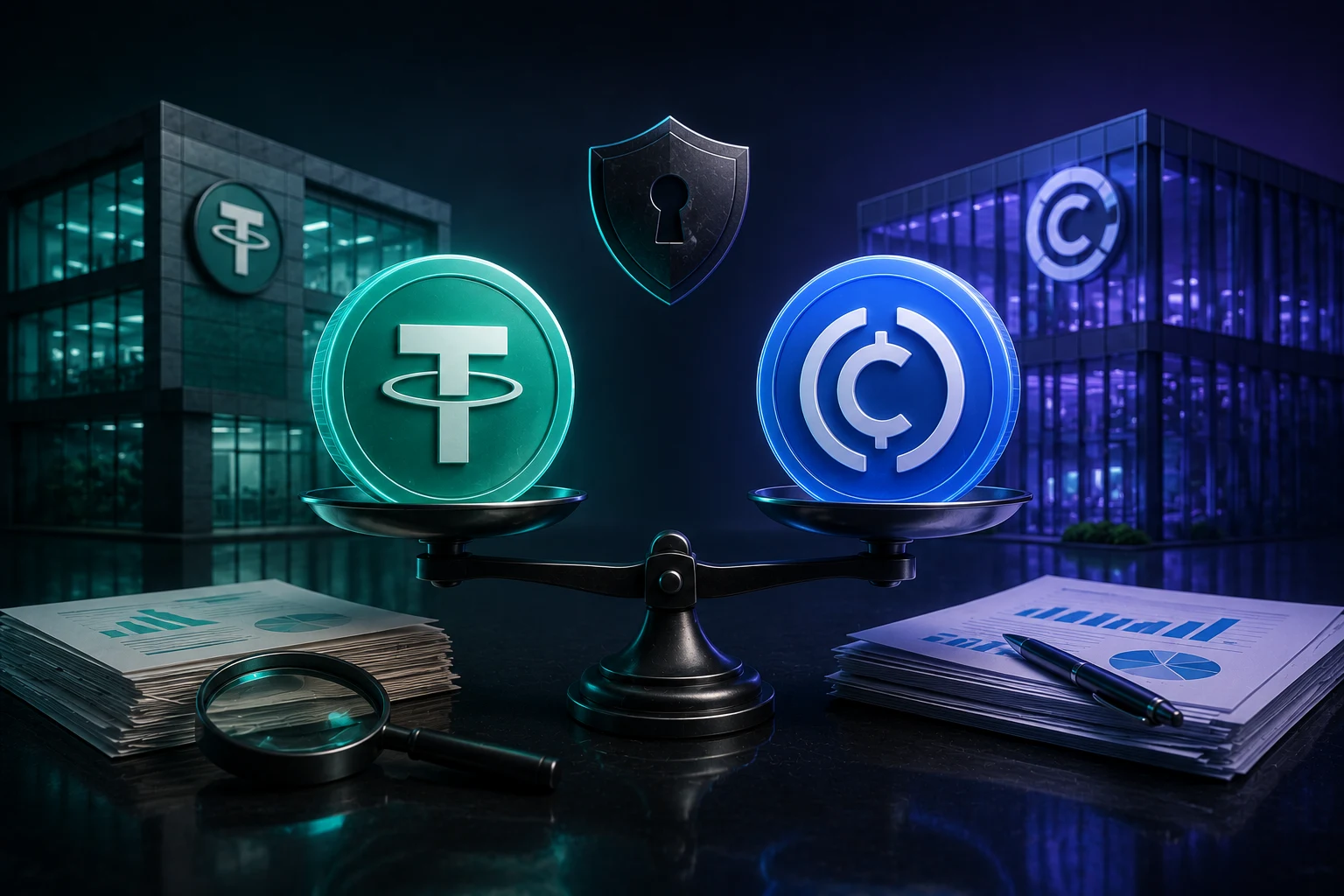
This is why 'Tether vs Circle corporate structure' is more than a curiosity for compliance teams. For a retail holder, the structure determines who you can sue, what disclosures you are entitled to, and how quickly a token can be redeemed at par if the issuer runs into trouble. Two stablecoins can both claim to be pegged 1:1 to the US dollar and have very different risk profiles underneath.
The two issuers also live in different jurisdictions and answer to different regulators. That difference is not symbolic. It shapes which audits get published, how often they are published, and what kinds of assets the issuer is allowed to hold against outstanding tokens. Before comparing the reserves, it helps to look at the companies themselves.
The two issuers, side by side
Tether Holdings Limited is incorporated in the British Virgin Islands, with operating subsidiaries in places including Hong Kong, El Salvador, and Italy. The group is privately held, has never gone through an IPO, and discloses limited information about its ownership and governance. Tether has repeatedly stated that it is moving toward more transparency, but its primary regulator is the BVI Financial Services Commission, and the bulk of its reserve reporting is contractual rather than statutory.
Circle Internet Group is a Delaware C-corporation that completed its initial public offering on the New York Stock Exchange in 2025 under the ticker CRCL. Circle also operates a regulated New York trust company, Circle Internet Financial, which issues USDC under a virtual currency license from the New York State Department of Financial Services (NYDFS). The dual structure means USDC issuance is supervised by a US banking-style regulator, while the parent is subject to public-company disclosure rules at the SEC.
The practical effect is that a USDC holder sits in front of an issuer that files quarterly 10-Qs and an annual 10-K with the SEC, while a USDT holder sits in front of an issuer whose main published document is a quarterly attestation report from an accounting firm. Neither setup makes the token risk-free, but the information environment is genuinely different.
What each issuer actually publishes
USDC publishes monthly reserve reports, sometimes called attestation reports, from Circle's auditor. These reports state that as of a specific date, USDC's reserves were equal to or greater than the supply of USDC in circulation. They cover cash, short-dated US Treasuries, and reverse repurchase agreements held at US-regulated banks and custodians. On top of the monthly cadence, Circle publishes an annual financial statement audit from a Big Four firm, currently Deloitte, which covers the entire company's books.
USDT publishes reserve attestations on a quarterly cadence. The current attestation partner is BDO Italia, a member of the BDO global network. The quarterly report covers the same kind of dollar-peg claim, but the underlying reserve composition is more varied and includes categories like secured loans, precious metals, Bitcoin holdings, and other investments alongside cash and Treasuries. The BDO opinion is an attestation, not a full audit of financial statements in the way a Big Four audit covers a public company.
An attestation and an audit are not the same product. An attestation is a limited-scope review where the auditor checks specific assertions against evidence, while an audit is a broader examination designed to give reasonable assurance that financial statements are free of material misstatement. Both have value, but they answer different questions, and that gap is a structural feature of the two issuers rather than a temporary shortfall.
Reserves composition: what is actually backing the tokens
USDC's reserves, as reported in monthly attestations, sit almost entirely in cash and US Treasuries with maturities of three months or less. Circle keeps most of this cash and these Treasuries at BlackRock, in US-regulated money market funds, and at a small group of US banks. The reserve mix is intentionally narrow, which means USDC's risk is concentrated in two places: the creditworthiness of the US government on Treasuries, and the solvency of the bank and custodian counterparties.
USDT's reserves, as described in quarterly attestations, include cash and Treasuries but also a wider bucket. Tether has historically disclosed categories such as secured loans (often to large customers, secured by crypto collateral), precious metals, Bitcoin and other crypto assets, and corporate bonds and other investments. The exact allocation shifts between quarters. This wider mix gives Tether more flexibility to earn yield on reserves, but it also means more moving parts that can revalue or fail during a stress event.
From a holder perspective, the USDC reserve profile is closer to a regulated money market fund, while the USDT reserve profile is closer to a diversified short-duration credit book with crypto on the side. Both have existed through major market shocks, including the March 2023 US banking crisis when Circle disclosed a $3.3 billion cash position trapped at Silicon Valley Bank. That episode showed how concentrated USDC's banking exposure was, but also showed how quickly the issuer communicated and how redemption resumed once funds were recovered.
Regulator relationships, past and present
Circle's main regulator is the New York State Department of Financial Services, which supervises the issuance of USDC through Circle's New York trust company charter. NYDFS has required regular reporting and has the power to compel reserve changes or restrict operations if it sees problems. As a public company, Circle is also under SEC oversight for financial disclosures and under banking and sanctions regulators like FinCEN and OFAC for compliance matters.
Tether's regulator relationships are more scattered. The BVI Financial Services Commission supervises the holding company. Tether has previously been fined by the US Commodity Futures Trading Commission and the Office of Foreign Assets Control, including a notable CFTC settlement over misrepresentations about reserves. Tether has also faced allegations around its banking relationships, including historical claims about controlled bank accounts that Tether has denied. None of this is the same as ongoing supervision by a US banking regulator, and that distinction is the point.
The relevant comparison for a holder is not 'who has more fines on paper' but 'who has a regulator with continuous authority to look inside the reserve books today'. On that question, Circle's setup under NYDFS gives a clearer chain of supervision, while Tether's relationship with US regulators is largely shaped by enforcement actions rather than ongoing charter-style oversight.
What this means when you actually hold the tokens
In a stress scenario, what matters is whether you can redeem, in dollars, without a long delay or a haircut. USDC's narrower reserve mix and US regulator oversight mean a stressed holder would in principle be dealing with a public company under SEC and NYDFS supervision, with monthly attestations showing the asset side and with cash and Treasuries that are by design highly liquid. The Silicon Valley Bank episode was a real-world test: USDC depegged briefly, Circle communicated daily, and full par redemption resumed within days.
With USDT, a stressed holder would be dealing with a BVI company publishing a quarterly attestation, holding a more diverse reserve mix including secured loans and crypto assets. Some of those assets are less liquid than cash or short Treasuries, and the redemption process has historically been gated by minimum amounts, KYC checks, and fees. Tether has weathered stress events too, including the Terra collapse in 2022, but the path from 'holder wants out' to 'holder is whole in dollars' involves more discretion on the issuer's side.
Neither structure is a guarantee. A holder of USDC accepts the risk that Circle's banking or Treasury counterparties fail, or that a regulatory action restricts redemptions. A holder of USDT accepts the risk that a less-liquid reserve bucket underperforms in a panic, that redemption terms tighten, or that a regulator takes action against the issuer. The honest framing is that you are choosing one risk profile over another, not picking the 'safe' one.
How to follow USDT and USDC news the smart way
Stablecoin news moves fast and the headlines rarely explain which structural fact actually changed. Tracking attestations, regulator statements, and reserve composition by hand is a losing game. Zippfeed surfaces stablecoin headlines for USDT and USDC with sentiment scoring (bullish, neutral, or bearish) and an importance rating, so you can see whether a new disclosure is a real shift or just noise, and decide which risk profile still fits your situation.


 CoinDesk
 CryptoSlate
 Crypto Rank News
 TheBlock