Why "always redeemable" is a marketing line, not a fact
The phrase "1:1 redeemable" appears on the websites of nearly every US-dollar stablecoin issuer. It sounds like a promise. In practice, it is a summary of a much longer legal contract that defines who can redeem, in what size, on which days, and under which conditions the issuer can refuse or delay. The history of stablecoins between 2018 and 2024 is, in large part, a history of those contracts being tested under real stress.
For retail users, the practical meaning is that the dollars behind a stablecoin are not sitting in your wallet the way cash in a checking account sits at a bank. They sit with the issuer, behind a corporate entity, inside banking and legal systems that can fail, freeze, or change rules without notice. The redemption contract is the only thing standing between you and a frozen balance.
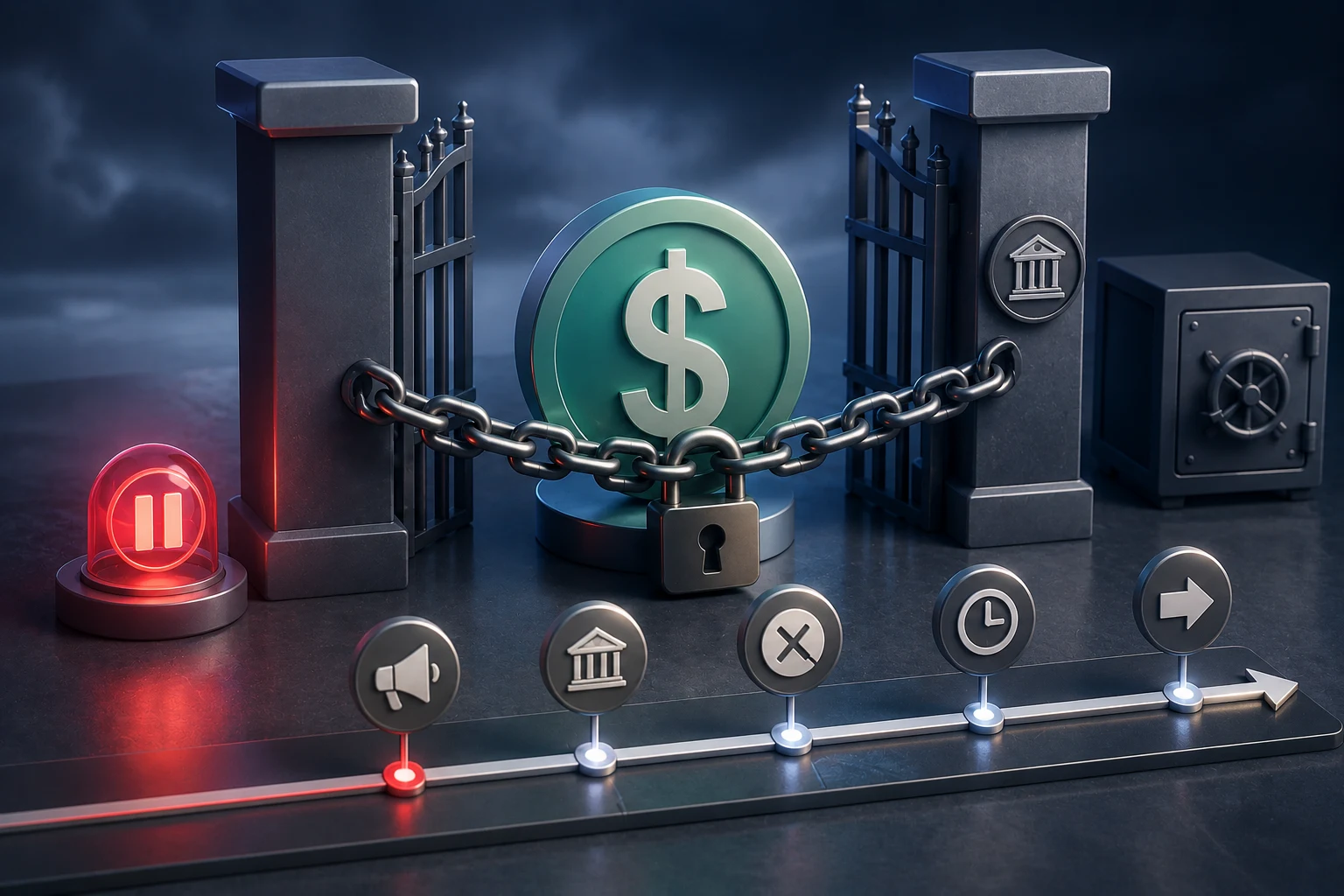
This article walks through every major documented case where an issuer limited, paused, or shut down redemptions. The goal is not to pick winners. It is to show, with dates and numbers, what "redemption paused" has actually looked like in this market so you can read current marketing with clearer eyes.
Tether's 2018 banking restrictions
The earliest widely-cited case of a major issuer losing banking access is Tether, the company behind USDT. In mid-2018, Tether publicly acknowledged that its correspondent banking relationships were unstable. The company's then-lawyer told the New York Times that a Taiwanese bank involved in Tether's transfers had faced difficulties sending US dollars, and Tether warned users that future fiat withdrawals could be delayed.
The practical effect in 2018 was not a formal "gate." It was a slow, noisy degradation. Customers trying to redeem USDT for dollars through certain banking rails reported multi-day delays. Tether at the time published a terms-of-service update stating that it could delay the redemption of tokens, freeze funds, or refuse service to anyone. In other words, the right to pause was written into the contract long before the company needed to use it.
Tether has never publicly confirmed a blanket pause. What is documented is that banking friction caused delays, and that during the same period the company lost its relationship with Wells Fargo, the bank it had previously named as its correspondent. Critics, including a 2021 CFTC settlement, later concluded that Tether's reserves were not fully backed at certain points in this era, which is the underlying reason any of those redemption rails were shaky.
Terra UST bank run, April-May 2022
Terra UST was an algorithmic stablecoin, meaning it was not backed by dollars at all. It maintained its $1 peg through a mint-and-burn mechanism with a sister token called LUNA. When confidence broke, the mechanism worked in reverse until both tokens were effectively worthless.
The unraveling began on May 7, 2022, when a large withdrawal from Terra's Anchor Protocol (which had been paying around 20% yield) caused UST to depeg below $1. Over the next four days, minting more LUNA to defend the peg drove LUNA's price from roughly $80 to near zero. By May 12, UST was trading around 13 cents and LUNA was effectively dead. The Luna Foundation Guard's $3 billion Bitcoin reserve, deployed to defend the peg, was exhausted.
For holders, there was no redemption gate to wait out. The algorithmic "redemption" was the LUNA mint itself, and once LUNA collapsed, the system had no other door. An estimated $40 billion in value was destroyed. Several class-action lawsuits followed, and in 2024 Terraform Labs and its founder Do Kwon were found liable for fraud in a US jury trial.
UST is the cleanest case study of why "stablecoin" and "redeemable" are not synonyms. Algorithmic stablecoins redeem through code, not dollars, and code that depends on a floating token can fail.
BUSD shutdown, February 2023
In February 2023, the New York Department of Financial Services ordered Paxos, the issuer of Binance USD (BUSD), to stop minting the token. The order came alongside a Wells notice from the Securities and Exchange Commission, which alleged that BUSD was an unregistered security. Paxos did not admit wrongdoing but complied.
Redemptions were not paused outright. Existing BUSD holders could still redeem through Paxos, and Binance converted user balances to other assets. But new mints stopped, and over the following months BUSD's circulating supply fell from roughly $22 billion in November 2022 to under $2 billion by the end of 2023. For practical purposes, the issuance was shut down.
The BUSD case is a useful counterpoint to the others. There was no bank run, no depeg, and no liquidity crisis. The gate was imposed by a regulator acting on securities law. It shows that an issuer's ability to redeem can be cut off by an external authority, even when the issuer itself is solvent and willing to pay.
USDC rate limit, March 2023
In March 2023, Circle, the issuer of USDC, became the highest-profile case of a US-regulated stablecoin issuer hitting a redemption wall. The trigger was the failure of Silicon Valley Bank (SVB), where Circle held a portion of the reserves backing USDC.
On Friday March 10, 2023, Circle confirmed that roughly $3.3 billion of USDC's cash reserves were stuck at SVB. Over the weekend, USDC depegged on crypto markets and traded as low as 87 cents. On Monday March 13, Circle announced that automated USDC redemption through its normal partner bank rails would not be available, and that it had "initiated contingency plans" to use Bank Provident and other institutions once they opened.
Once SVB's bridge bank reopened and the Federal Reserve announced a backstop for uninsured deposits, Circle completed a 1:1 switchover. By Monday evening USDC returned to par, and over the following week Circle processed a reported $14 billion in redemption requests, roughly 30% of its supply, as holders chose to leave.
Two details often missed in the retelling. First, Circle's stated rate limit during the crisis was that automated redemption was paused, and manual redemptions were prioritized but slow. Second, the episode was a narrow escape rather than a confirmed ability to pay. If SVB's uninsured deposits had been haircut rather than backstopped, USDC holders would have been directly exposed. The history is what it is because a government decision went one way, not the other.
TrueUSD reserve disputes and 2024 delistings
TrueUSD (TUSD) had a smaller profile than USDC or USDT, but its history shows another flavor of redemption friction: disputes over reserves and counterparty changes. In January 2024, the attestation firm that audited TUSD's reserves, Chainalysis's former accounting partner, was replaced after questions about the quality of attestations. New attestations later that year showed a sharp drop in reserves and changes in the mix of cash, equivalents, and short-term Treasuries.
By mid-2024, several exchanges, including Binance and OKX, began delisting TUSD trading pairs or migrating users to other stablecoins. While TUSD itself did not formally halt redemptions, the effective outcome for many users was the same as a gate: they could not freely trade the token at par across major venues.
TUSD's case is important because it does not involve a dramatic collapse or a single bad weekend. It is an example of redemption risk arriving through slow erosion of trust, opaque reserve reporting, and counterparties choosing not to honor the implicit promise of frictionless 1:1 conversion.
What this means if you hold stablecoins
If you keep meaningful balances in any stablecoin, the lessons from the timeline above are practical. First, read the issuer's redemption terms, not just its marketing. Look for minimum redemption size, KYC requirements, supported jurisdictions, hours of operation, and any force-majeure or delay clauses.
Second, understand who holds the reserves and where. Most fiat-backed stablecoins hold reserves at one or more US banks, money-market funds, or short-dated Treasuries. Each of those has its own failure mode. SVB showed that a regional bank failure can directly affect a token's peg. Money-market fund gates, used during the March 2020 Treasury market dislocation, are another risk that flows back to stablecoin holders.
Third, think about concentration. Holding all of your stablecoin balance with one issuer means that issuer's specific risks are your risks. Across USDC, USDT, BUSD, UST, and TUSD, every single one has had some form of redemption event in the last seven years. Splitting balances across issuers is the simplest hedge against the next one.
Fourth, watch for regulatory gates even if the issuer is healthy. The BUSD case showed that an external authority can halt minting at any time. Future action by the SEC, NYDFS, or other regulators could affect other issuers in similar ways, and the rule book for which stablecoins count as securities or e-money is still being written.
How to follow stablecoin events the smart way
Stablecoin events move fast and the news cycle is noisy. Tracking which issuer is in trouble, which bank holds reserves, and which regulator is asking questions, all in real time, is a losing game if you do it manually. Zippfeed surfaces stablecoin headlines with sentiment scoring, tagged bullish, neutral, or bearish, and an importance rating, so you can spot the next redemption event before it becomes one you have to explain to your accountant.



 CoinDesk
 CryptoSlate
 WuBlockchain
 TheBlock