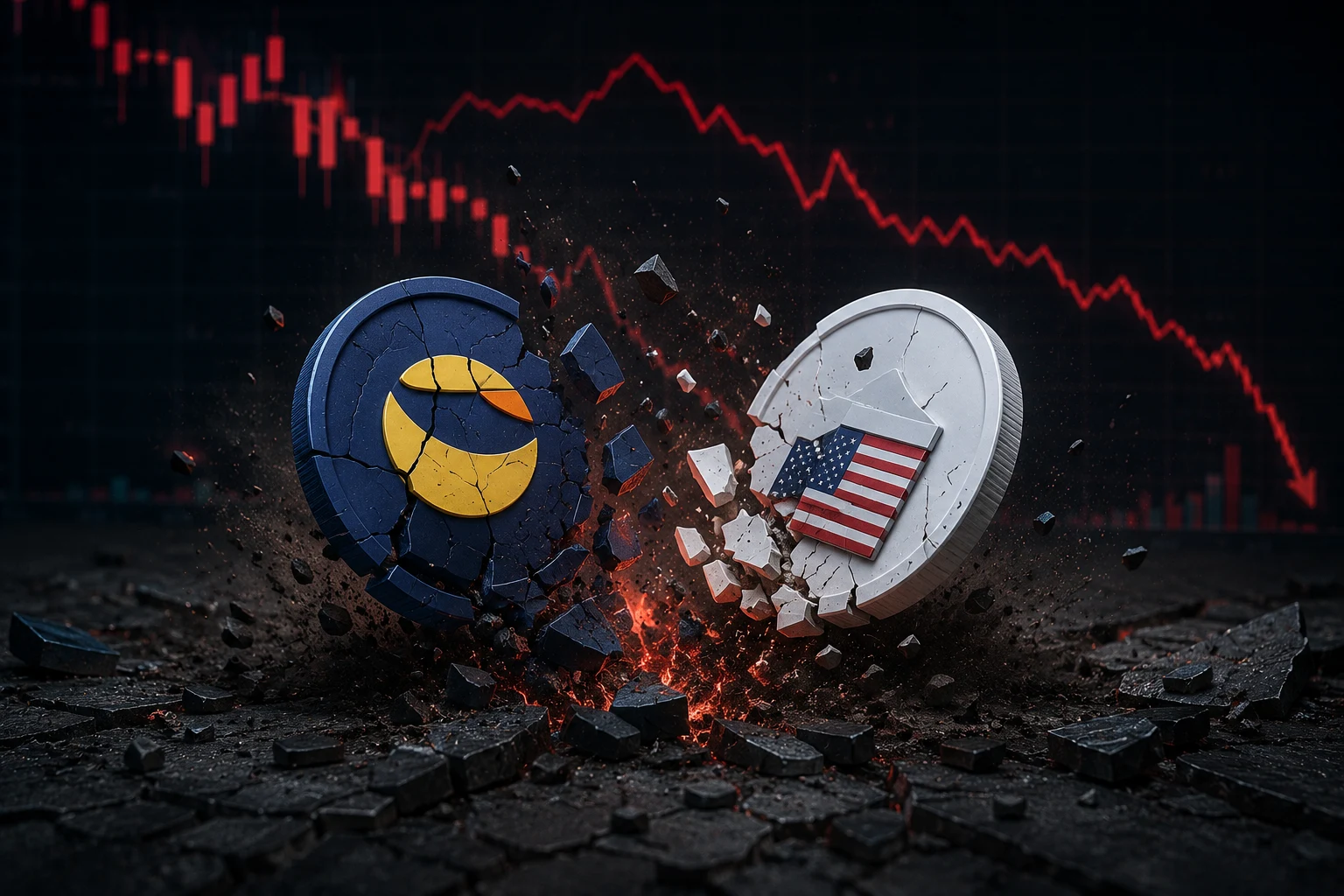
The setup: a 20%-yield stablecoin and the people who believed it
Terra was a Cosmos-based blockchain built by Terraform Labs, founded by South Korean entrepreneur Do Kwon and Daniel Shin in 2018. Its central product was UST — TerraUSD — an algorithmic stablecoin designed to track the US dollar. Unlike fiat-backed stablecoins, UST held its peg through an arbitrage mechanism: every 1 UST could always be burned to mint $1 worth of LUNA, Terra's native token, and vice versa. The mechanism worked in calm conditions and was tested only mildly through 2020 and 2021.
The product that brought UST to scale was Anchor Protocol, a Terra-native lending market that offered roughly 20% annual yield on UST deposits. That headline number was the gravitational pull of the ecosystem — billions of dollars of UST flowed into Anchor for the yield. By spring 2022, UST was one of the largest stablecoins in crypto by market cap, and the Terra ecosystem was a top-ten chain by total value locked.
This is educational, not financial advice. The reason the Terra story is worth telling is that the underlying design — an algorithmic stablecoin backed by its own subsidised yield — was structurally vulnerable in ways the marketing materials did not surface.
What actually happened: a death spiral in days
The collapse unfolded over roughly a week in May 2022. The mechanics are clearer in retrospect than they were at the time.
- Early May 2022. Macro conditions were already deteriorating — rising rates, falling crypto prices, broad de-risking. Multiple large wallets began withdrawing UST from Anchor and Curve, weakening the liquidity that supported the peg.
- 7 May. A large UST sell-off on Curve's 4pool drained one side of the pool. UST briefly traded at 98 cents instead of $1. In a normal regime, arbitrageurs would have absorbed this — but the imbalance was too large and the confidence too brittle.
- 8–9 May. Selling intensified. The Luna Foundation Guard (LFG) — Terra's foundation, which had accumulated around 80,000 BTC as a reserve to defend the peg — began selling BTC for UST to support the price. The market absorbed the BTC and kept dumping UST.
- 10–11 May. The mint-and-burn mechanism started its death spiral: as panicked UST holders redeemed for LUNA, the LUNA supply expanded explosively. LUNA's price collapsed from around $80 a week earlier to under $1, then to fractions of a cent. As LUNA's market cap fell below UST's outstanding supply, the arbitrage was mathematically broken — there was no longer enough LUNA value to redeem UST at the peg.
- 12–13 May. The Terra blockchain was halted twice to stop the LUNA inflation. UST traded under 20 cents. LUNA traded at fractions of a cent — a near-total wipeout of value. The Luna Foundation Guard exhausted nearly all of its BTC reserves trying to defend the peg.
- Late May 2022. Terra's chain was rebooted as Terra 2.0 with a new LUNA token (and the original renamed LUNA Classic / LUNC). The new chain never approached the original's relevance.
Roughly $60 billion of market value across UST, LUNA and connected assets evaporated in days. Many of the worst-hit holders were retail users who had treated the 20% Anchor yield as a savings account.
Who was involved
- Do Kwon. Co-founder and CEO of Terraform Labs and the public face of Terra. After the collapse he fled South Korean authorities, was arrested in Montenegro in March 2023 on travel-document charges, and was eventually extradited to the United States in late 2024 to face fraud charges.
- Daniel Shin. Co-founder of Terraform Labs; was less publicly prominent during the collapse but faced separate Korean charges.
- Terraform Labs. The Singapore-based company behind Terra, Anchor and the LFG. Filed for bankruptcy in 2024 and reached settlements with the SEC.
- The Luna Foundation Guard (LFG). A Singapore non-profit that controlled the BTC reserve. Spent nearly all of it defending the peg, with limited effect.
- Three Arrows Capital (3AC). A major crypto hedge fund with significant Terra exposure. Its collapse weeks later was one of the first knock-on failures.
- Anchor Protocol depositors. Hundreds of thousands of UST holders worldwide who lost their deposits in days. Many treated Anchor as a yield-paying bank, not a structurally subsidised programme.
The aftermath: contagion and a wider winter
Terra did not just damage its own holders; it set off a cascade that defined the 2022 bear market.
- 3AC's collapse. Three Arrows Capital had large UST and LUNA positions and substantial leverage. Within weeks it was insolvent. Its bankruptcy triggered margin calls across crypto lenders.
- Celsius, Voyager, BlockFi. Crypto-yield platforms that had lent to 3AC or held exposed positions began freezing withdrawals in June and July. Several entered bankruptcy.
- FTX's first lifeline role, then its own collapse. Sam Bankman-Fried's FTX initially extended credit to some distressed firms — masking its own structural problems. By November 2022 FTX itself collapsed, in part because its sister firm Alameda Research had taken heavy hits in the Terra and 3AC fallout.
- A multi-year regulatory backlash. The Terra collapse accelerated stablecoin regulation in major jurisdictions. In the United States, it shaped subsequent SEC actions and legislative proposals. In Korea and Singapore it triggered direct criminal investigations.
- An end to most algorithmic stablecoin experiments. The dominant survivors in stablecoins post-Terra were collateral-backed — USDC, USDT, DAI. Pure algorithmic designs were widely treated as structurally suspect.
The lessons
It is tempting to read Terra as a story of a single bad founder or one bad protocol. The lessons are more general.
- Yield that comes from subsidy is not yield from earnings. Anchor paid 20% in part by spending Terra's own reserves. That kind of yield is sustainable only as long as the reserves last. "Risk-free 20%" is a near-perfect description of a structural red flag.
- Algorithmic pegs depend on reflexive confidence. A peg held by arbitrage works when the supporting token has more value than the stablecoin in circulation. Under stress, that ratio inverts, and the mechanism becomes a death spiral rather than a stabiliser.
- Reserves help only against shallow stress. The LFG's BTC reserve looked huge in calm times. Against the scale of the actual run, it disappeared in days. Reserve buffers are a feature, not a guarantee.
- Contagion is real. A blow-up the size of Terra does not stay contained. Lenders, funds and exchanges with exposure follow within weeks or months. Watching where contagion could spread is a useful exercise after every major collapse.
- Marketing materials understate structural risk. Terra's communications presented UST as a stable, safe yield product. The underlying design was a leveraged bet on the LUNA market cap staying above UST's float. Reading the design honestly was the only defence.
The honest extension to today: anytime you see a protocol offering returns dramatically above safe baseline rates, the question to ask is where the money is actually coming from. If the answer is "the protocol's own incentives" or "a token that will appreciate forever," you are looking at the same shape as Terra.
Watch the next stablecoin and yield experiment
New stablecoin designs and high-yield protocols continue to launch in every cycle. Some are conservative and collateralised; some recycle the same algorithmic patterns under new branding. The early signals — opaque reserves, yields that are not transparently sourced, reliance on a single token's market cap — are visible before the run. Zippfeed tracks stablecoin and DeFi protocol headlines across many sources with sentiment and importance scoring, so you can watch how the next one unfolds — and reduce exposure before the run that ends the design starts. This is educational, not financial advice.