What 'real-world traction' actually means for an RWA token
Most lists of RWA tokens sort by total value locked (TVL) on a chain or by the dollar value of tokenized assets an issuer claims. Both numbers can be inflated. TVL can include the same dollar looping through a pool several times. Issuer-reported AUM can include off-chain book entries that never touch a blockchain. Neither tells you whether the token itself has economic rights to the cash flow.
A useful ranking has to separate four things that the marketing pages blur together. First, the size of the real-world asset pool backing the token. Second, the revenue the issuer actually books from fees on that pool. Third, the share of that revenue that flows back to token holders through buybacks, distributions, or burns. Fourth, how much of the underlying yield simply pays the issuer, an institutional partner, or a treasury managed by the project team.
That last point is the one retail buyers miss most often. A token can sit on top of $500 million of tokenized T-bills and still not give holders any claim on the T-bill yield. In that case, the token is effectively a governance or utility token that happens to live in the RWA category. It is not a fractional share of the income stream.
The risks of buying RWA tokens in 2026
RWA tokens look safer than meme coins and that perception is itself a risk. It pulls in buyers who skip the due diligence they would do on a normal small-cap crypto asset. The most common failure modes are not dramatic exchange hacks. They are slow, structural, and easy to miss.
The first risk is the issuer revenue versus protocol revenue gap. An issuer like a regulated asset manager can book several million dollars a year in management fees on a tokenized fund. The associated governance token may or may not capture any of that. If the token only governs parameters and never receives a fee share, its price is tied to speculation, not cash flow. Several 'RWA protocols' in the top of the rankings fall into this bucket.
The second risk is KYC gating that locks retail out. Tokenized funds issued under US securities law typically require investors to pass KYC and accreditation checks. A non-US retail buyer can still purchase the token on a DEX, but legally they may be an unpermitted holder. Distribution of yield can be paused for those wallets, and redemption rights may not be honored. This is not a theoretical problem; it is the default for BUIDL, OUSG, USYC, and similar products.
The third risk is insider allocation risk. Early backers, venture funds, and team wallets frequently hold a large share of the token supply with low cost bases. When lockups end, even a small monthly distribution can swamp organic demand. Reading the allocation schedule is as important as reading the whitepaper. The fourth risk is settlement risk across chains. The same RWA may exist as a token on Ethereum, Polygon, Avalanche, and a Layer 2. Each wrapper carries a different redemption path, a different oracle, and a different bridge risk. If a chain halts or a bridge is exploited, the token on that chain can trade at a discount to the same token elsewhere, and arbitrage may not close the gap quickly.
How the ranking is built
Each token below is scored on five factors. Asset coverage is the dollar value of real-world assets the token is directly linked to, taken from on-chain proof-of-reserve feeds and issuer disclosures rather than marketing pages. Revenue capture is the share of fees on those assets that the protocol retains and routes to token holders. Settlement breadth is the number of production chains where the asset actually settles, weighted toward chains with real institutional usage. Access is a negative score: the more KYC-gated and the smaller the eligible buyer pool, the lower the score. Insider concentration is also a negative score, drawn from token unlock schedules and disclosed treasury wallets.
Ties are broken by how long the product has operated without a failed redemption or a material oracle incident. Marketing narrative and social-media sentiment are explicitly excluded from the score. A token that trends on Crypto Twitter can still rank low here if the underlying product is thin or if the token does not share in the economics.
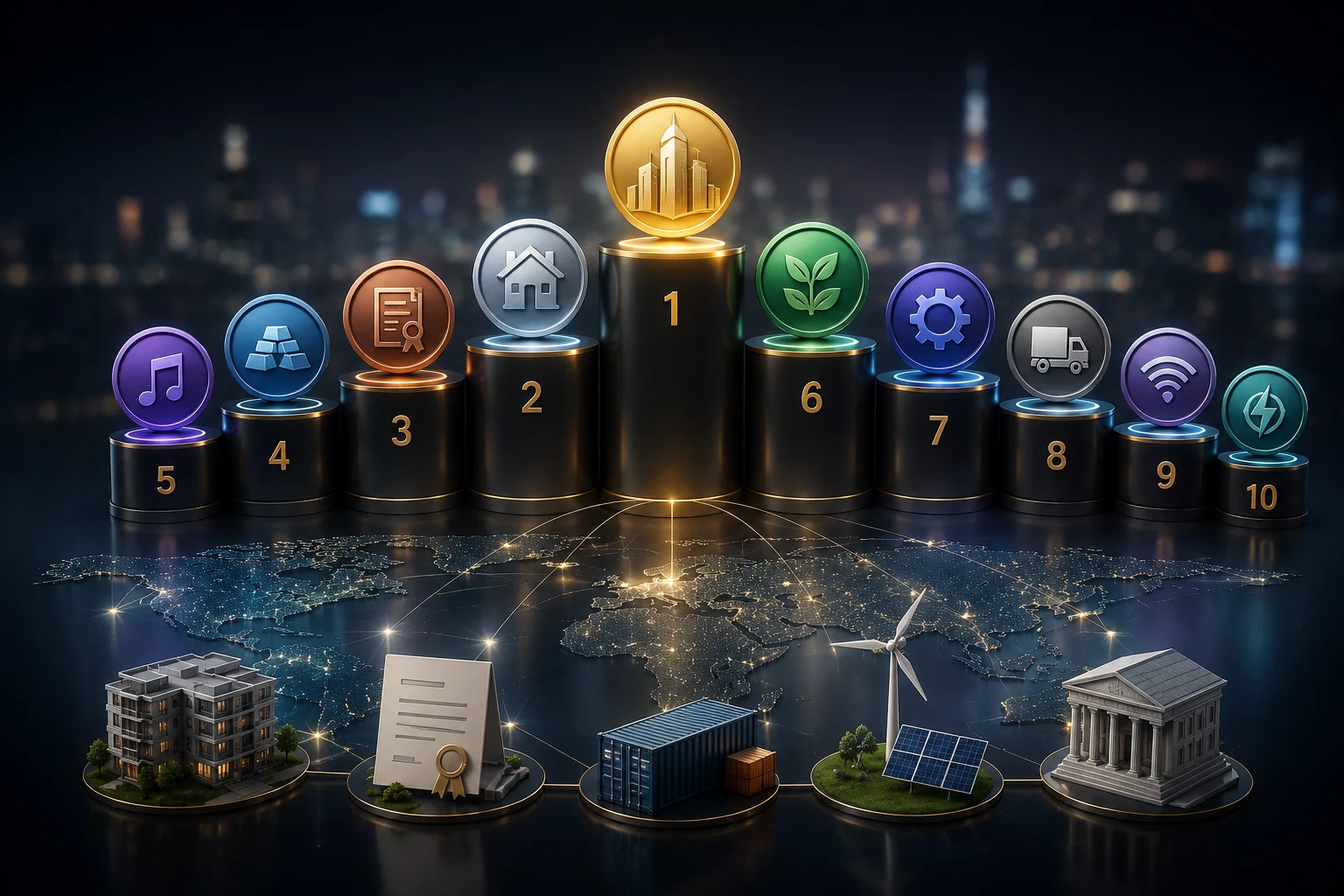
The 2026 ranking, from most to least traction
1. BUIDL (BlackRock USD Institutional Digital Liquidity)
BUIDL is the largest single tokenized money-market fund on a public chain, with multiple billions in AUM invested in short-duration US Treasuries and reverse repos. It runs on Ethereum with selected Layer 2 deployments and settles through a permissioned structure run by Securitize. For retail, the relevant fact is that BUIDL itself is not a freely tradable governance token; it is a fund share. It ranks first because it is the clearest example of real assets actually sitting on-chain, with daily attestation reports and a known issuer. Access is restricted to qualified purchasers, which limits retail usefulness but also limits speculation.
2. OUSG and USDY (Ondo Finance)
Ondo runs two flagship products. OUSG is a tokenized short-term US Treasury fund accessible to non-US institutional and accredited investors through Ondo's own KYC stack, with several hundred million in AUM. USDY is a yield-bearing token designed for a broader (but still KYC-gated) audience, paying yield from a Treasury and bank-deposit portfolio. Ondo also issues the ONDO governance token, which is the part retail can actually buy on a DEX. ONDO ranks high because Ondo captures real protocol-level revenue and has started directing a portion of it to the token, though the bulk of issuer economics still flows to Ondo the company and its backers. KYC gating remains the main friction for retail holders.
3. SKY (formerly MakerDAO's MKR)
Sky is the rebrand of MakerDAO, the on-chain lending system behind the DAI stablecoin. Its RWA exposure is in tokenized Treasuries and short-duration bonds held directly in Maker vaults, on the order of several billion dollars. That makes it one of the largest non-issuer RWA pools in crypto, and unlike most RWA tokens it does not depend on a third-party asset manager. The SKY token captures protocol revenue through a buyback-and-burn mechanism funded by stability fees. The risk is concentration: a small number of large vault operators and PSM partners handle most of the RWA flows, and changes in US monetary policy directly affect the protocol's earnings.
4. ENA (Ethena)
Ethena runs USDe, a synthetic dollar backed by a mix of spot crypto and perpetual futures funding, and it is expanding into tokenized Treasuries through its reserve fund. ENA is the governance and revenue token. It ranks high because Ethena books real revenue from the funding-rate arbitrage and is now layering in traditional yield, and a meaningful slice of that revenue is used to buy back ENA from the market. The risk is that the funding-rate trade is cyclical, the synthetic structure depends on derivatives venues, and insurance funds have not been tested through a long crypto winter with sustained negative funding.
5. LINK (Chainlink)
Chainlink is not itself an RWA. It is the oracle and cross-chain messaging layer that almost every tokenized asset on the list depends on. It ranks here because protocol fee revenue from enterprise data feeds, CCIP (Cross-Chain Interoperability Protocol), and the new RWA-focused data services is now a meaningful slice of total revenue. LINK holders benefit indirectly through the network's pricing power rather than through a direct cash-flow claim. Anyone holding tokenized assets on-chain is implicitly relying on Chainlink's infrastructure working correctly.
6. POL (Polygon)
Polygon hosts more tokenized Treasuries, private credit, and real-estate tokens than any other chain outside Ethereum mainnet. POL replaced MATIC as the gas and staking token. Polygon earns revenue from sequencer fees and from enterprise deployments with payment processors, banks, and asset managers. A meaningful share of that revenue now accrues to POL stakers, though the team still controls a large treasury. The ranking reflects settlement breadth rather than a single flagship product: Polygon is where most of the BUIDL, OUSG, and several smaller RWAs actually settle.
7. USYC (Hashnote)
Hashnote's USYC is a yield-bearing short-duration Treasury product aimed at institutional and qualified investors, with on-chain attestations and several hundred million in AUM at times. It settles primarily on Ethereum and has expanded to other chains. There is no native retail governance token attached to USYC itself. It appears here because it is one of the cleaner institutional RWA products in terms of reserve transparency, and because so many protocols use it as collateral, which makes its redemption mechanics critical to DeFi liquidity.
8-10. The contested middle
Below the top seven, the ranking gets noisy. Avalanche's AVAX is a settlement hub for several tokenized funds but its own cash flow to holders depends on broader chain usage, not a dedicated RWA product. Centrifuge's CFG token governs a real on-chain private-credit platform with tens of millions in active loans, but the AUM is small relative to the Treasury products above. Goldfinch, Maple, and Clearpool operate similar credit pools with real borrowers and real loan books, yet each trades with low liquidity and concentrated insider holdings.
Several other tokens frequently appear on 'best RWA tokens' lists that do not make the top ten here. Some are governance tokens for protocols whose 'RWA' component is mostly a stablecoin wrapper with a tokenization theme. Others are synthetic-dollar tokens whose backing is mostly other crypto assets, not real-world debt. They may be good trades; they are not what most readers searching for 'best RWA tokens' actually want.
What this ranking means if you already hold one of these tokens
If you already hold ONDO, SKY, ENA, or LINK, the ranking is a sanity check, not a recommendation to sell. The practical questions to ask are straightforward. Does the protocol publish on-chain proof of reserves, or only off-chain attestations? Does the token capture any of the fees generated by the underlying product, and if so through what mechanism? What is the unlock schedule over the next 12 to 24 months, and what share of supply is held by early backers?
For BUIDL, USYC, and OUSG specifically, the more relevant question is whether you are legally allowed to hold them. Buying these on a DEX without going through the issuer's KYC flow does not give you the same legal status as a registered investor, and several issuers have reserved the right to restrict yield or block redemptions for non-eligible wallets. Treating these tokens as freely tradable is a mistake the courts have not yet sorted out.
For SKY and ENA, the underlying pools are large enough that a single fund outflow would not break the protocol, but they are still exposed to US monetary policy. If the Fed cuts rates aggressively, both the absolute yield on the Treasury backing and the demand for yield-bearing crypto tokens will shift at the same time. Holding a yield-bearing RWA token through a rate cycle is a different trade from holding a memecoin through the same window.
Common questions about RWA tokens in 2026
Most retail buyers discover the same three or four problems the hard way. The questions below cover the ones that come up repeatedly in 2026, and the answers are deliberately blunt.
How to follow RWA tokenization the smart way
RWA tokenization is moving from pilots to production, and the news flow around it is noisy. Issuers announce partnerships that never ship, protocols rebrand to add 'RWA' to their marketing, and stablecoin wrappers get relabeled as tokenized assets. Tracking which headlines actually move on-chain AUM and which ones are just press releases is hard to do manually. Zippfeed surfaces RWA headlines with sentiment scoring (bullish, neutral, or bearish) and an importance rating, so you can filter for the few announcements that genuinely change the underlying economics and ignore the rest.







 Crypto News
 Lookonchain
 Crypto Capital Venture
 WuBlockchain