What a prediction market actually is
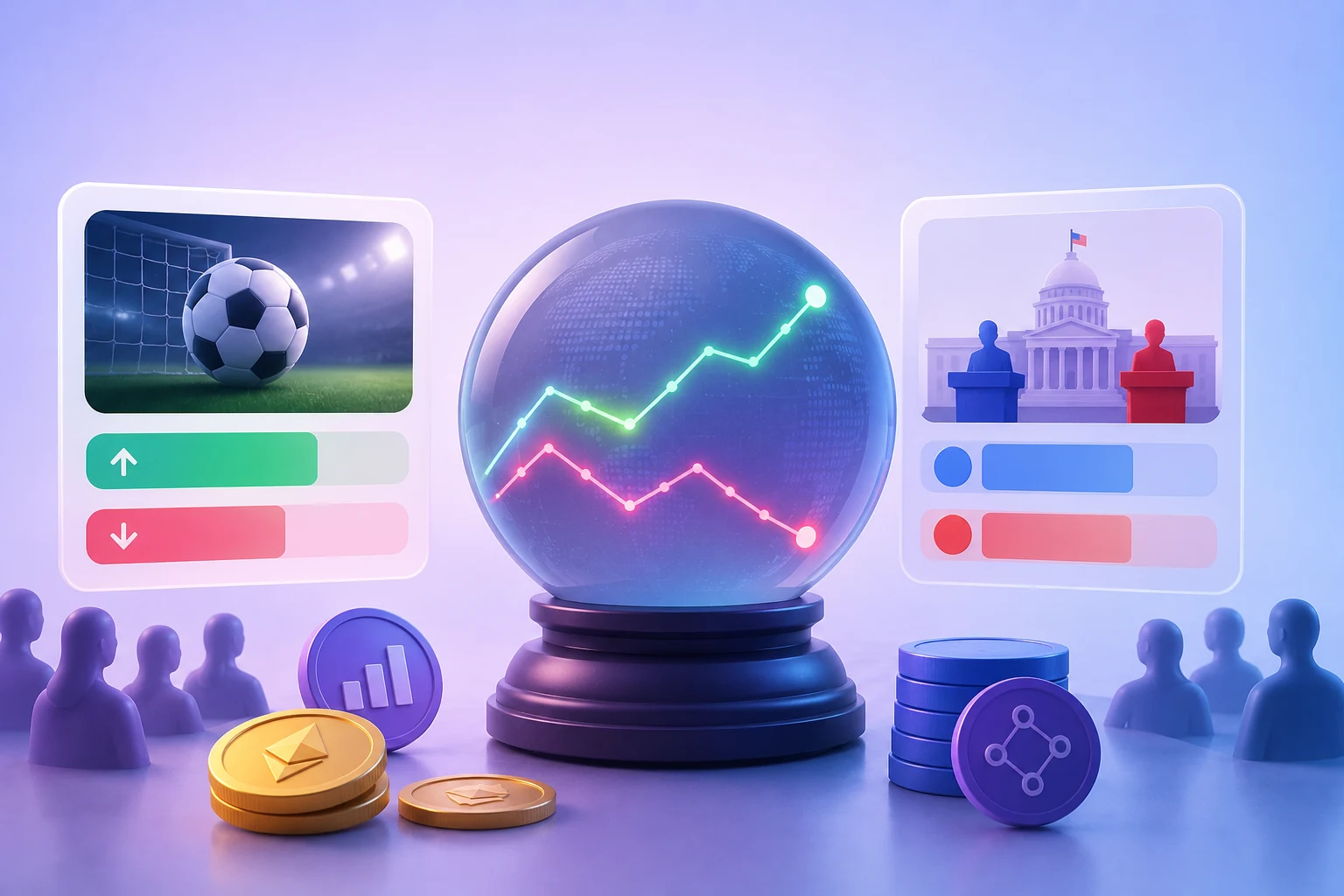
A prediction market is an exchange whose product is not a stock, a token, or a commodity, but a contract on whether something specific will happen. The simplest version is a YES or NO question. Will the Federal Reserve cut rates in March? Will a given candidate win a state? Will a token reach a price target? For each question, the market mints or lists two complementary shares. A YES share pays 1 if the event occurs, and 0 if it does not. A NO share is the mirror, paying 1 when the event does not occur and 0 when it does.
Because the payoff is fixed at either 1 or 0, the current trading price of a YES share is naturally read as a probability. If YES trades at 0.62 in USDC, the crowd is effectively saying there is about a 62% chance the event happens. If you think the real chance is higher, you can buy YES cheaply; if you think it is lower, you can buy NO. Either way, your maximum profit is the gap between your entry price and 1, and your maximum loss is the full stake you paid in. That structure is why prediction markets are often called information markets: the price is the signal, and trading is the way of expressing a view on the probability of a future event.
The crypto variant does the same thing but settles on a blockchain, usually in a stablecoin such as USDC. A user connects a self-custody wallet, swaps into YES or NO tokens, holds them until the event resolves, and redeems winning shares for 1 stablecoin each. Losers redeem for nothing. The whole flow is visible on-chain, which is why reporters and analysts increasingly treat these markets as a live alternative to opinion polls.
How prices form: AMMs, order books, and the implied probability
Crypto prediction markets generally use one of two mechanisms to set prices. The first is a constant-function Automated Market Maker, or AMM, similar in spirit to the math that powers token swaps on Uniswap. A pool holds reserves of YES and NO tokens and quotes prices so that their product stays roughly constant. When a trader buys YES, YES becomes scarcer in the pool and its price rises, while NO gets cheaper as a mirror. The implied probability is simply the YES price. Liquidity providers deposit capital on both sides of every market and earn a share of the trading fees, but they also take the other side of every trade, which is why AMM-based markets can be efficient for popular questions and thin or wide for niche ones.
The second mechanism is a traditional central limit order book, the same design used in stock and futures exchanges. Independent buyers post bids and sellers post offers, and trades happen when prices cross. Order-book markets tend to give tighter spreads for popular contracts and let more sophisticated participants post limit orders at their own price. The visible mid-price on a deep order book is the cleanest expression of the crowd's probability, and the spread around it is a useful proxy for uncertainty. Most regulated platforms use order books; most crypto-native ones have leaned on AMMs for simplicity, though hybrid models are appearing.
Either way, the practical reading is the same. A YES share at 0.30 with one week to go tells you the crowd puts roughly a 30% probability on the event, and that the implied chance moves as new information arrives. The market is, in a sense, a continuously updated forecast. It is also a venue where you can lose your entire stake if you are wrong, so treating the implied probability as fact, rather than as one noisy estimate, is a common beginner mistake.
How does a prediction market actually resolve
Resolution is the part that separates prediction markets from regular betting. Every contract has a clear written rule about what counts as the outcome, what the source of truth is, and what the cutoff time is. Good markets spell this out in advance. The market for a US election might say it resolves on the Associated Press or the official state result. A market on a token price might specify a specific reference exchange, a specific time window, and what happens if the exchange is offline. The rule set is the contract.
In an order-book exchange, the operator's resolution team reads the rule and posts the result. In a blockchain-native market, the platform cannot safely trust any single reporter, including itself, so it uses an oracle. The most discussed design in crypto is UMA's optimistic oracle. The default answer is proposed by anyone willing to post a bond and stake their reputation. If nobody challenges that answer within a dispute window, usually a few hours or days, it becomes the official result and the market settles. If somebody does challenge it, the question is escalated to UMA's token holders, who vote on the correct answer and slash the bond of whoever was wrong. The 'optimistic' part means the system assumes proposals are honest and only pays the heavy cost of full token-holder voting when there is active disagreement.
This is the meaning of an oracle-resolved market. A piece of software, not a person in a customer-support chat, reports the answer. The trade-off is speed and censorship resistance on one side, and the small but real chance of a contested, delayed, or plainly wrong resolution on the other. Oracles have been manipulated, ruled on in surprising ways, and held up during ambiguous real-world events. Any beginner should assume that at some point, in some market, the final answer will be disputed.
Risks every beginner should understand first
The single biggest risk in this category is regulatory. In the United States, the Commodity Futures Trading Commission treats event contracts as swaps or derivatives. Contracts on politics, war, terrorism, gaming, and certain financial benchmarks are specifically restricted or banned, and a long list of platforms have paid fines, been blocked, or shut down rather than fight the agency. Kalshi operates under a designated contract market license for some non-sporting, non-political event contracts. PredictIt has run for years under a no-action letter that is narrow and could be revoked. Polymarket is blocked for US persons, reached a settlement with the CFTC in 2022 over unregistered trading, and continues to restrict US access. Outside the US, the picture is uneven, with some jurisdictions treating event contracts as lotteries or as regulated gambling, and only a handful treating them as financial products on par with derivatives.
The second-biggest risk is oracle and resolution risk. UMA and similar systems are designed so that the final answer is the result of a defined process, but that process can be slow, expensive to challenge, or simply wrong in edge cases. If a market says 'resolves YES if the price of ETH is above 4,000 USD on CoinGecko at noon UTC on date X', a token-holder vote on what 'above' means when the price flickers is not free. Holders vote in their own economic interest, and large token holders carry a lot of weight. The chance of any single market resolving incorrectly may be small; the chance that something, somewhere, resolves oddly over a year of active use is not.
Third, there is the risk of treating the crowd as omniscient. Prediction markets are good at aggregating dispersed information, but they can be wrong, thin, or dominated by a small number of well-capitalized traders. An illiquid market with one large holder can post a misleading probability that lures retail traders in. A market on a niche question can drift for weeks before anyone with real knowledge shows up. Reading the price as the truth, instead of as one data point, is a common and expensive mistake.
Finally, there is the basic product risk. Unlike buying a token, where you at least hold a tradable asset after the bet, a losing prediction-market share is worth exactly zero. Beginners sometimes fund accounts, place a few small trades, and discover that a long streak of well-reasoned 70% bets still loses money when the 30% outcomes cluster. Betting and information markets are not the same product, and confusing the two is the most common framing error in this space.
Polymarket, POL, and the current crypto landscape
Polymarket is the most visible crypto-native prediction market, and it sits at the center of the recent wave of headlines. The platform runs on a hybrid stack that uses an on-chain order book for settlement and an off-chain matching engine for speed, with USDC as the default collateral. The platform launched its POL token and airdrop in 2025, distributing it to past users and turning the protocol into a fully token-governed system rather than a venture-backed startup. Holding POL gives users governance weight and, depending on the design in effect at any given moment, fee-related benefits, but it does not change the core mechanics of the markets themselves.
Because US persons are barred from Polymarket, the platform is most often used by international traders, crypto-native funds, and journalists looking for a real-time probability on political, economic, and crypto-specific events. Its election markets in 2024 became a frequent citation in mainstream coverage as a non-polling estimate of candidate chances. That visibility is also what attracts regulatory attention. Polymarket's 2022 CFTC settlement, the ongoing restriction on US users, and the broader political climate around event contracts all mean the platform's legal footing can change on a short timeline.
Beyond Polymarket, the category is crowded. Some platforms are regulated and US-facing, focused on sports and economic data. Others are offshore and crypto-native, focused on politics and crypto prices. A few are fully on-chain AMMs, including experimental designs on Solana, Polygon, and other networks. The unifying thread is the same: a YES or NO contract on a real-world event, priced continuously and settled by a written rule and, usually, an oracle.
How to think about prediction markets as a beginner
If you are new to this space, the most useful frame is that prediction markets are a probability gauge first and a trading venue second. Before thinking about position sizing, fees, or potential payout, it helps to ask what the market is actually claiming. A YES price of 0.18 in a thinly traded market with a 5% spread is a very different signal from a YES price of 0.18 in a deep order book with a 0.2% spread. Liquidity, time to resolution, and the clarity of the resolution rule all change how much weight that price deserves.
For most beginners, the safest first step is to read these markets rather than trade them. Watching how a probability moves on breaking news, how it reacts to polls or official data, and how it behaves in the final hours before resolution is genuinely useful context. It is also the cheapest way to learn how oracles, dispute windows, and resolution rules show up in practice. Trading should come later, with money you can afford to lose, on platforms that are legal in your jurisdiction, and with a clear sense of the fee structure and the maximum loss on every position.
It is also worth being honest about the limits. Prediction markets are not a free lunch. They are not guaranteed to be more accurate than polls, expert forecasts, or your own research. They are not a way to make a steady return, and they are not a substitute for understanding the underlying event you are trading on. The 0.62 implied probability is the starting point of an analysis, not the conclusion.
Read prediction-market news the smart way
Prediction markets move fast, and the news around them moves even faster, especially during elections, rate decisions, and major crypto events. Manually tracking every headline, every implied probability shift, and every regulatory update is a losing game. Zippfeed surfaces prediction-market headlines alongside the rest of the crypto news cycle, with sentiment scoring that flags each story as bullish, neutral, or bearish, plus an importance rating so you can separate signal from noise and stay ahead of the next shift in the implied odds.

 Crypto Rank News
 CryptoSlate
 CoinDesk
 WuBlockchain