What it is
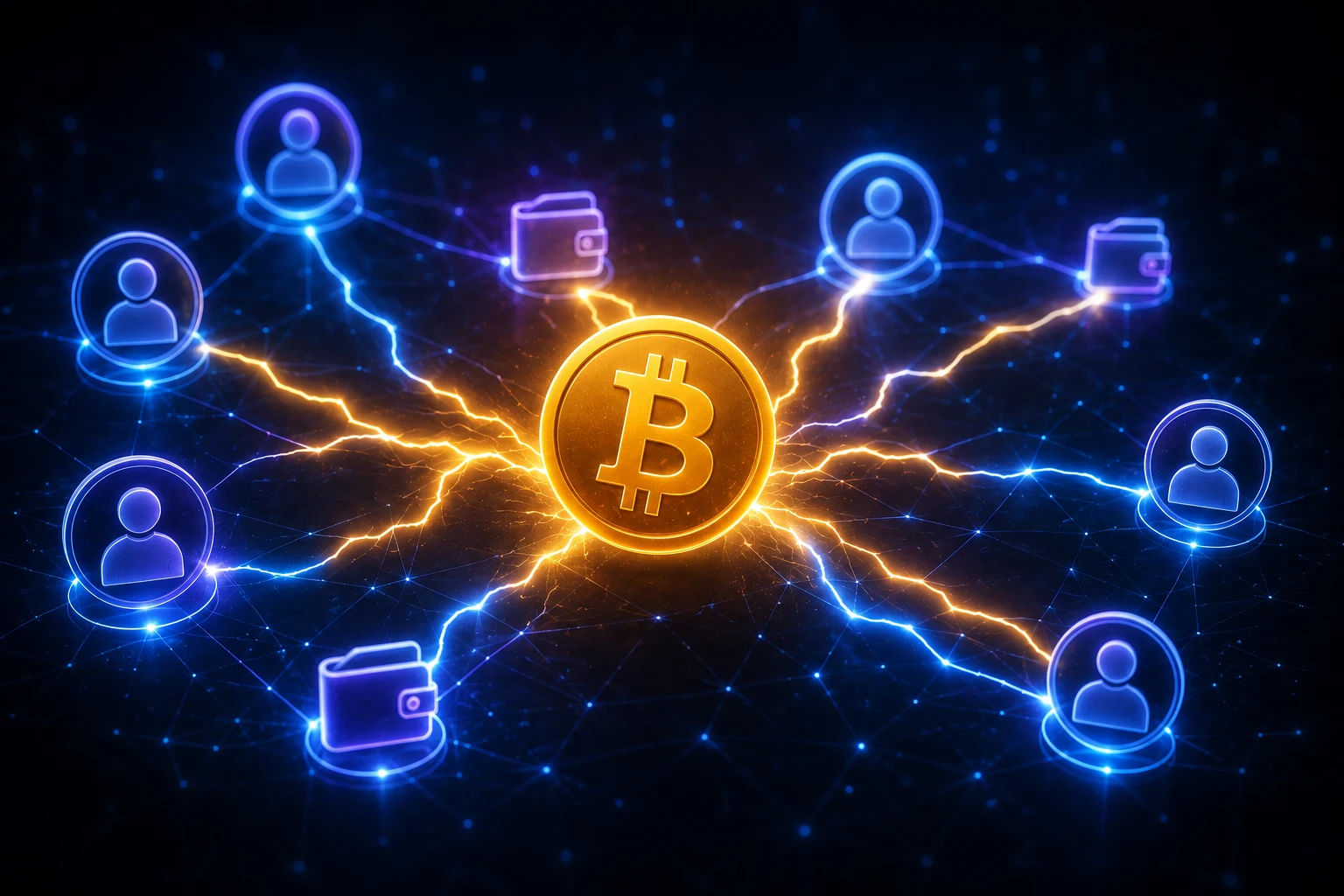
Lightning was proposed by Joseph Poon and Thaddeus Dryja in a 2015 whitepaper as a way to scale Bitcoin without changing the base layer. It went live on mainnet in 2018. Today Lightning carries millions of transactions per month, with public capacity in the thousands of BTC and tens of thousands of nodes.
This is educational, not financial advice.
The problem it solves
Bitcoin's base layer is intentionally conservative: blocks every ~10 minutes, fees set by demand, and finality after several confirmations. That's great for moving large amounts settlement-style, but bad for buying coffee. Lightning solves this by letting parties exchange signed updates of a shared balance off-chain, only writing final state to Bitcoin when the channel closes. It also lets payments route across multiple channels — so you can send to someone you don't have a direct channel with.
How it actually works
- Opening a channel. Two parties lock some BTC into a multisig contract on the Bitcoin blockchain. That commitment is the channel's capacity. The on-chain transaction costs a normal Bitcoin fee.
- Off-chain updates. The parties exchange signed updates that redistribute the channel balance. Each new state invalidates the previous. The Bitcoin network never sees these intermediate states — only the parties hold them.
- Routing. If Alice wants to pay Carol but only has a channel with Bob, the network finds a path: Alice → Bob → Carol. Each hop is a forwarded payment. Bob never holds the funds in custody; he forwards a payment in exchange for a small fee.
- Closing. When parties want to settle, they broadcast the latest signed channel state to Bitcoin. That on-chain transaction reflects the final balance — typically different from the initial open.
- Watchtowers. Because off-chain states can theoretically be cheated (broadcasting an old state in your favour), Lightning includes a counter-mechanism: a punishing-broadcast scheme that lets the honest party seize the cheater's funds. Watchtowers are services that monitor for cheats on your behalf if you're offline.
Real use cases
- Small and instant payments. Tips, micropayments, gaming, streaming, point-of-sale. Lightning's strength is sub-second settlement at sub-cent costs.
- Cross-border remittances. Apps like Strike use Lightning to settle USD-to-BTC-to-recipient-currency conversions across borders quickly.
- Merchant payments. El Salvador and other early adopter regions integrate Lightning POS for everyday transactions. Strike, Bitnob and similar handle the conversion details.
- Application payments. Podcast streaming sats (Podcasting 2.0), Lightning-native apps on Nostr, and machine-to-machine payments use Lightning's speed and low cost.
Risks and limits
- Liquidity layout matters. Sending capacity is the amount of BTC on your side of a channel. You cannot send more than your outbound liquidity. Acquiring inbound liquidity (to receive payments) is a separate problem, often solved by paying for it.
- Routing is not guaranteed. If no path exists between two nodes with enough liquidity, the payment fails. Routing success rates have improved but are still imperfect.
- Online requirement. Non-custodial Lightning users need their node online to receive payments or to defend against channel cheating. Watchtowers help but add complexity.
- Custodial trade-off. Wallets like Wallet of Satoshi or Cash App make Lightning accessible to non-technical users but are custodial — the operator holds the keys. That trade-off is real: convenience for custody risk.
- Privacy is improved but not perfect. Lightning is more private than base Bitcoin in some ways (off-chain payments are not publicly recorded) but worse in others (routing nodes see partial path information).
Follow how Lightning evolves
Lightning continues to develop — channel splicing, taproot upgrades, new routing algorithms, statechain experiments. Adoption shifts as wallets improve and merchants integrate. Zippfeed tracks Bitcoin and Lightning headlines across many sources with sentiment and importance scoring, so you can follow what is actually shipping versus what is still proposal. This is educational, not financial advice.

 CryptoSlate
 Glassnode
 WatcherGuru
 Altcoin Daily
 WuBlockchain