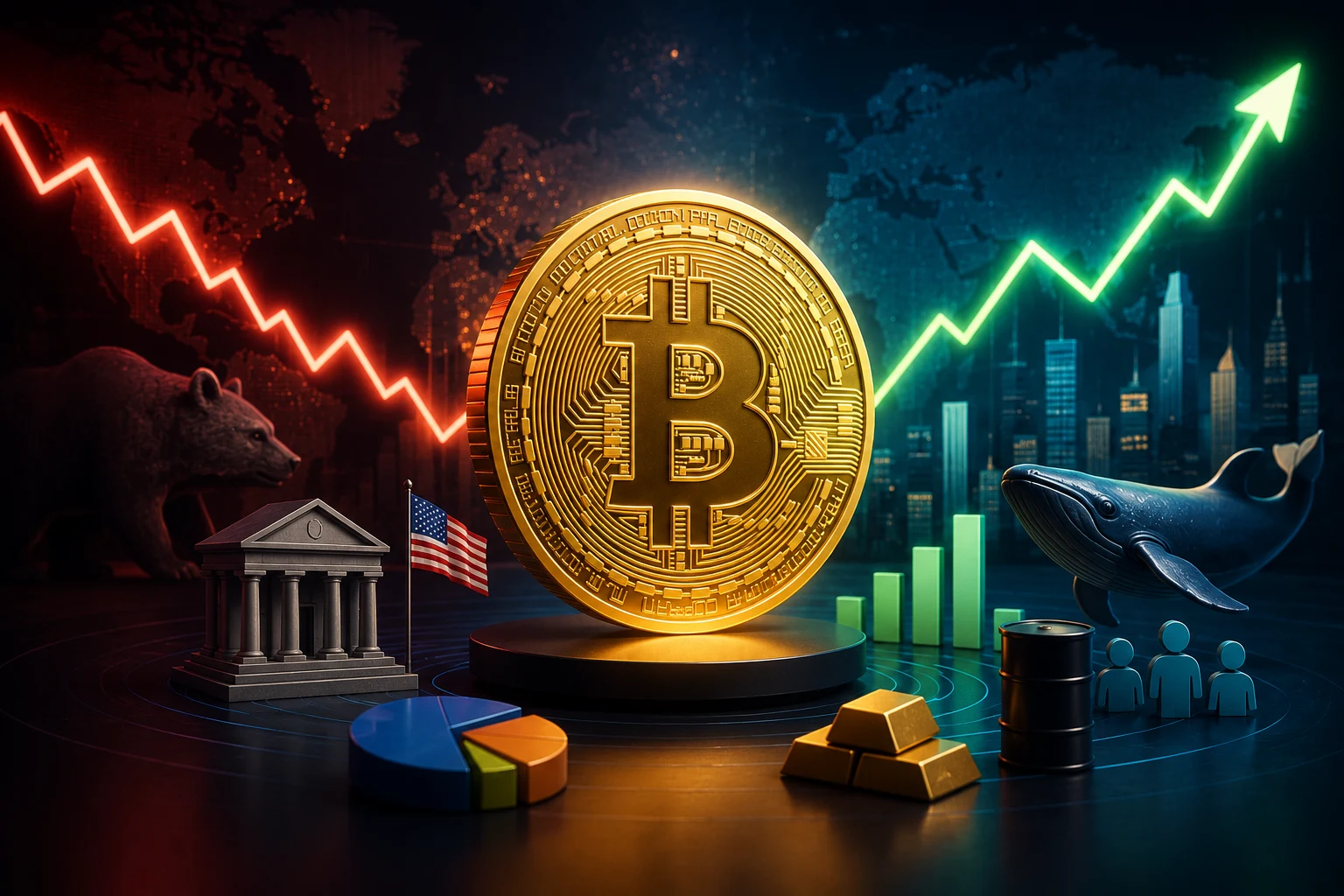
The question everyone asks
"Why did Bitcoin just move like that?" It is the most common question in crypto, and the honest answer frustrates people: usually, several things at once, interacting in ways no one can fully untangle. But that is not a reason to give up understanding — it is a reason to learn the *categories* of forces at play, so you can interpret moves intelligently and, just as importantly, recognize when someone is selling you a too-simple story. This guide maps those forces.
A foundational truth first: like any freely traded asset, Bitcoin's price is set by supply and demand. Every factor below is really a factor because of how it affects what people are willing to buy or sell Bitcoin for. This is educational, not investment advice.
The supply side: engineered scarcity
Bitcoin's supply is unusual — it is fixed and predictable, which makes the demand side the main variable.
- Capped supply. Only 21 million bitcoin will ever exist. This hard scarcity is the backbone of the store-of-value thesis.
- The halving. The rate of new supply is cut periodically through the Bitcoin halving, slowing issuance on a known schedule. Many watch halvings for their potential supply-driven effects — though, as that guide explains, past patterns guarantee nothing.
- Holder behavior. How much existing supply is held tightly by long-term holders versus available for sale affects the effective supply in the market, visible through on-chain data.
Because supply is so predictable, most price action comes from shifts in demand.
The demand side: many interacting forces
Market sentiment and psychology
Crypto is powerfully driven by emotion — fear and greed. Waves of optimism and pessimism, FOMO and panic, can move Bitcoin sharply, sometimes detached from any fundamental change. Reading this is the focus of how to read crypto market sentiment, and extremes often precede reversals.
Macroeconomic conditions
Bitcoin does not exist in a vacuum. Broader economic forces increasingly influence it:
- Interest rates and monetary policy. When money is cheap and plentiful, risk assets like Bitcoin often benefit; tighter conditions can pressure them.
- Inflation and currency concerns. These feed the "digital gold" narrative that draws some buyers.
- Overall risk appetite. In risk-off periods, investors often flee volatile assets, Bitcoin included.
As Bitcoin matures and more institutions participate, these macro links have arguably strengthened.
Regulation and policy
Regulatory developments can move Bitcoin significantly. Positive clarity or new products can boost demand; crackdowns or restrictive rules can dampen it. The contrasting approaches in SEC crypto regulation and what is MiCA shape the environment, and major announcements regularly cause sharp moves.
Institutional flows and ETFs
The entry of large investors and the launch of Bitcoin ETFs added a powerful demand channel. As we cover in how crypto ETFs affect Bitcoin's price and why institutions buy Bitcoin, institutional buying and ETF flows are now closely watched drivers — though never the only ones.
News and events
Specific events — exchange failures, hacks, major adoption announcements, prominent endorsements or criticisms, technological developments — can trigger immediate price reactions as they shift sentiment and expectations.
Liquidity and leverage
Market structure itself matters. Crypto market liquidity affects how easily moves happen, and leverage in crypto futures markets can amplify them through cascading liquidations, turning modest moves into violent ones.
Why prediction is essentially impossible
Here is the crucial takeaway. Because Bitcoin's price emerges from all these forces interacting simultaneously — supply dynamics, mass psychology, global macroeconomics, regulation, institutional behavior, news, and market structure — predicting it reliably is beyond anyone's genuine ability.
- Anyone who claims certainty is overconfident or selling something. Confident price predictions deserve deep skepticism.
- The factors can pull in opposite directions and shift in importance over time. What dominates one month is background noise the next.
- Surprises are constant. The most consequential moves often come from events no one foresaw.
This is not a counsel of despair — it is the foundation of realistic thinking. Understanding the *drivers* lets you interpret what is happening and make sense of moves after the fact, without falling for the illusion that you (or anyone) can foresee them. Combine this with sound crypto portfolio practices and risk management, and you are thinking like someone who respects the market rather than fears or fantasizes about it. None of this is investment advice.
Make sense of the moves
With so many forces driving Bitcoin at once, understanding any given move means seeing the whole landscape of news and sentiment. This is exactly what Zippfeed is built for: tracking Bitcoin headlines with sentiment (bullish, neutral, bearish) and importance scoring across many sources, so you can interpret price action against the events actually driving it — rather than guessing, or trusting someone's overconfident prediction.

 CryptoSlate
 Glassnode
 WatcherGuru
 Altcoin Daily
 WuBlockchain