What a liquidation cascade actually is
A liquidation cascade is a chain reaction. A trader opens a leveraged position, say 20x long on BTC, by posting a small amount of collateral. The exchange or protocol keeps a close eye on that position. When BTC's price falls to a level where the trader's remaining collateral cannot cover the losses, the position is liquidated: it is closed automatically at market to stop the loss from going past zero.
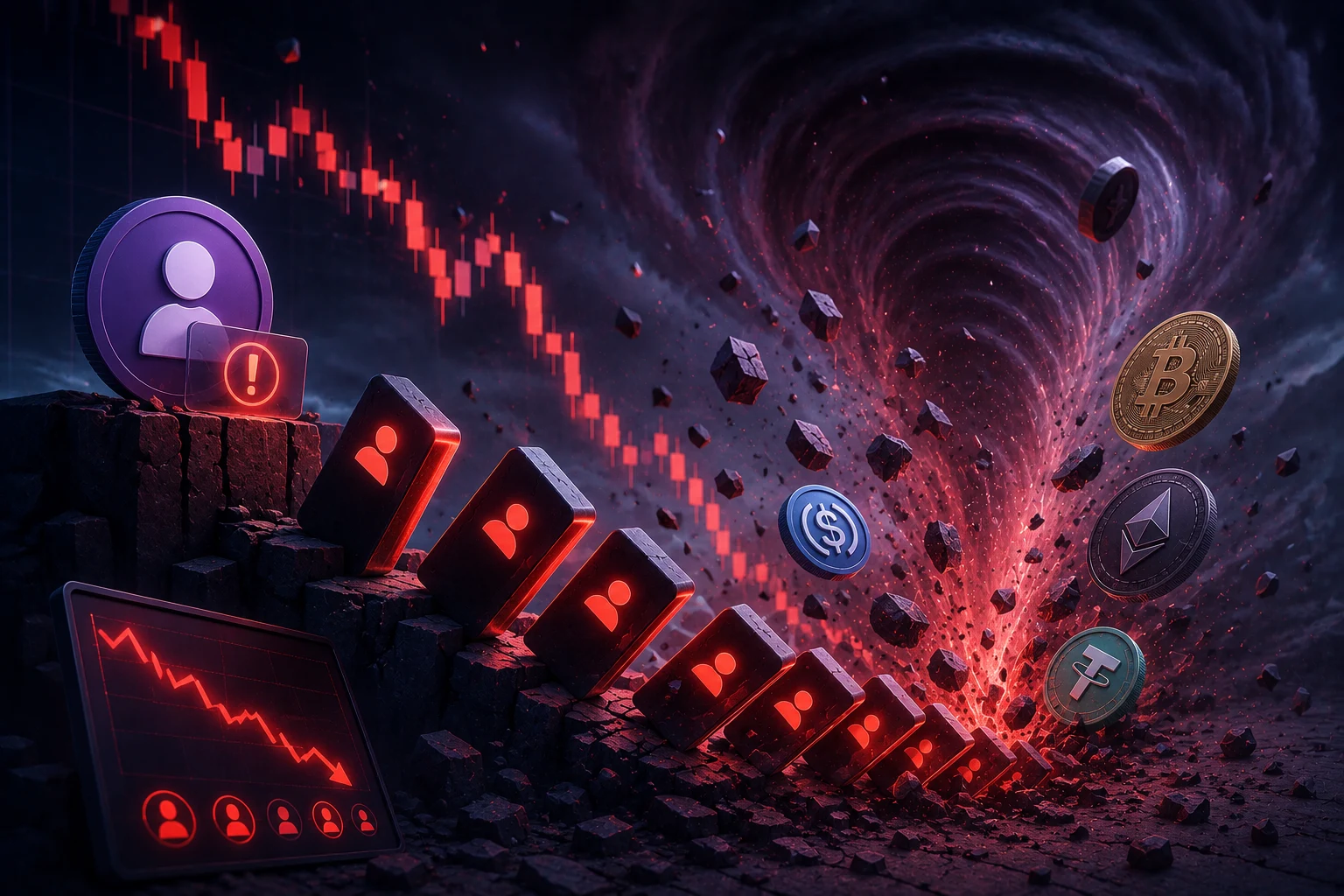
The word "cascade" comes in because a single liquidation rarely matters. What matters is the second-order effect. A forced market sell pushes the price down. That lower price trips the liquidation price of the next leveraged long, which then also gets force-closed. Its market sell pushes the price down again. The third, fourth, and five-hundredth position in line all hit their liquidation thresholds within seconds, and each one adds more sell pressure than the organic market can absorb. The result is a near-vertical wick on the chart and, frequently, a snap-back once the cascade exhausts itself.
This is why a liquidation cascade is best understood as plumbing. The price action looks mysterious from the outside, almost like a "fat-finger" or an attack, but it is the boring, expected behavior of a leveraged market with thin liquidity. The same pattern shows up in traditional futures (the 2010 flash crash, the 2020 oil negative-price event) and in crypto (May 19, 2021; June 2022; the FTX collapse in November 2022). The venue and asset change. The mechanics do not.
How leveraged positions get forcibly closed
To see why cascades form, you have to look at how a leveraged position is held. When you open a 10x long on BTC, you are not borrowing 10 BTC and buying them outright in the spot market. Instead, you post roughly 0.1 BTC of collateral and the platform marks a notional position of 1 BTC against a reference price. The platform tracks an "unrealized PnL" line on your account in real time.
Liquidation happens when your remaining collateral, the maintenance margin, drops below the platform's threshold. Different venues set this differently. On Binance and Bybit perpetuals, the maintenance margin is typically 0.5% to 1% of the notional position depending on tier, which is why 50x and 100x positions can be wiped by moves of under 2%. On Hyperliquid, the on-chain perpetuals DEX, the liquidation threshold is set by the smart contract and is normally a little more generous for the trader, but the function is identical: when the mark price crosses a level the contract computes from your collateral, anyone can call a liquidate function and the position is closed at the prevailing market.
Forced closure is not a single event. It is a workflow. First, the risk engine flags the position. Second, the position is offered to a liquidator at a discount or, on most CEX perps, taken over by the exchange's matching engine and closed with a market order against the order book. Third, the resulting trade prints on the tape and moves the mark. Fourth, the mark moves, and a fresh batch of positions crosses their own thresholds. The "cascade" is just that loop running for as long as there is queued leverage on the same side.
Why cascades amplify small moves into huge wicks
The amplification effect is a direct consequence of leverage ratios and open interest clustering. Suppose BTC is at $60,000 and there is $4 billion of long open interest on perps across the market. A large chunk of that is concentrated around the $58,000 to $59,000 zone because that is where many retail traders set their liquidation prices. The market does not need a fundamental shock to reach that zone. A modest, routine drop driven by macro news or a single large sell can do it.
Once the price hits the first cluster, the first batch of liquidations prints. The combined notional of those positions, plus the slippage on a thin order book, can be enough to drag the price another 1% to 2% lower in a single minute. That puts the next cluster of liquidations into the money, and so on. On May 19, 2021, BTC fell from roughly $43,000 to about $30,000 in a few hours. Roughly $8 billion of long positions were liquidated across exchanges. The fundamental news that day (China FUD, Elon Musk tweets) was real but not catastrophic. The size of the wick was a leverage artifact, not a repricing of fair value.
Three things make amplification worse: leverage concentration at round numbers, low order book depth, and the auto-deleveraging (ADL) fallback that some venues use when they cannot find a counterparty for the closing trade. A cascade does not have to be hostile. It can be triggered by a routine flush that simply has too much one-sided leverage queued behind it.
The role of liquidation engines and insurance funds
Exchanges do not want to be on the hook for a trader's loss, so they run risk engines that try to close positions before the trader's losses exceed their collateral. The classic model is: liquidator buys the position at the bankruptcy price (a worse-than-market price for the trader), then closes it at the current market, and pockets the difference as a fee. On Binance and OKX, much of this is handled by the exchange's own in-house liquidators. On Hyperliquid and other on-chain perps, anyone can run a liquidation bot and compete for the same fee, which is why the HYPE tokenomics discussion is partly about who captures that revenue.
When the liquidator's closing trade moves the market against the position, the trade can leave a small residual loss. The exchange cannot pass that residual to the trader, because the trader's account is already at zero. That is what insurance funds are for. An insurance fund is a pool of capital the venue maintains to absorb bad debt from liquidations that close at a worse price than the bankruptcy price. BitMEX popularized the model in 2018, and it has since become standard.
Insurance funds are not magic. They have been drained before. In the June 2022 cascade, when BTC briefly traded around $20,000 on some venues during the Celsius fallout, several insurance funds were partially depleted. When an insurance fund cannot cover the residual, the exchange falls back on auto-deleveraging, which means it picks profitable traders on the opposite side and forcibly closes some of their positions to neutralize the loss. ADL is the worst-case path: it punishes the winners to cover the losers' overshoot. The FTX collapse in November 2022 was a different beast because FTX's risk engine and customer balances were not operating independently at all, but the cascade mechanics were the same in the broader market.
How on-chain perps differ from CEX risk engines
It is tempting to think that an on-chain perpetual DEX like Hyperliquid removes cascade risk because the code is auditable and the collateral lives in a smart contract. It does not. It moves the risk engine, it does not delete it.
On a centralized exchange, the matching engine, the liquidation engine, and the insurance fund are all operated by the company. Liquidation decisions happen on private servers using the exchange's internal price feed, and the order book is the venue's. On an on-chain perps DEX, the liquidation function is in the smart contract, the position data is public, the liquidators are external bots, and the reference price is usually an oracle (a price feed published on-chain). The mechanics are nearly identical: collateral, mark price, liquidation threshold, forced close, insurance fund (called a "reserve" or "backstop" on most DEXs).
There are real differences. On-chain liquidations are permissionless, so they can be more competitive and often tighter. The transparency means traders can see exactly where crowded liquidation zones sit, which is why a tool like Coinglass's liquidation heatmap is so widely cited. But the underlying physics is unchanged. If HYPE, BTC, or ETH has $500 million of one-sided leverage queued behind a tight price range, a small move will burn through that range, and the venue cannot stop it without intervening in a way that breaks the trust assumptions of the protocol.
The honest framing is that on-chain perps do not eliminate cascade risk, they relocate it. The risk engine is a smart contract instead of a proprietary black box, the insurance fund is a transparent on-chain balance instead of a corporate balance, and the user has more visibility. The cascade itself is a property of the leverage, not of the architecture.
Historical examples you can actually point to
Three events dominate the popular history of crypto liquidation cascades, and they are worth looking at in detail because they all share the same skeleton.
May 19, 2021: BTC fell from about $43,000 to $30,000 in hours. The triggers were a mix of China mining FUD, Tesla-related FUD, and a fast unwind of leveraged longs. Roughly $8 billion in long positions were liquidated. The price recovered most of the move within a week, which is the signature of a cascade rather than a fundamental repricing.
June 2022: A multi-day drawdown took BTC from roughly $32,000 to under $20,000, driven by the Celsius halt, 3AC exposure, and broader risk-off. There were repeated cascade events during the drop, with several exchanges reporting partial insurance fund draws. The episode made clear that insurance funds are not infinite.
November 2022: The FTX collapse. This one is unusual because the cascade was a credit event, not a leverage event. Customer deposits were misallocated, leverage at the exchange level was hidden, and when withdrawals were paused the market lost confidence in market-making depth. The downstream effect on BTC and ETH was a sharp drop with cascading liquidations across the broader market. Hyperliquid and other on-chain venues did not exist yet, but the comparison point is clear: trust and reserve assumptions matter as much as the risk engine code.
Late 2025 also produced a smaller but instructive cascade on Hyperliquid, where a thin order book in a less liquid pair saw a large position auto-liquidate and trigger a chain reaction of follow-on liquidations. The post-event analysis showed insurance fund drawdowns that the protocol handled automatically, but the wick was still 10% to 15% in minutes. The architecture was decentralized. The cascade was not.
What this means if you are trading
The practical implications for a retail trader are uncomfortable, but they are the whole point of understanding cascades in the first place. First, leverage is the variable you control. If you trade 2x instead of 20x, your liquidation price is much further from the current mark and you are far less likely to be part of the cascade. The wick is a feature of the people on the wrong side of the queue, not the people on the right side.
Second, watch the heatmap, not the candles. Coinglass and similar tools show where leveraged positions are clustered. Trading against a heavy cluster is, mechanically, betting that you will be faster than the liquidation engine. The liquidation engine does not sleep, does not panic, and does not need liquidity to print. You are competing against a robot with the entire position's collateral as its fee budget.
Third, understand what the insurance fund can and cannot protect you from. If you are the profitable counterparty, you can be hit by auto-deleveraging on a CEX when the insurance fund is exhausted. If you are the losing trader, the insurance fund's existence does not mean you will be made whole, it means the venue is trying not to absorb your loss itself. On on-chain venues, the equivalent is the backstop, and the rules are usually explicit in the protocol documentation.
Fourth, accept that no venue eliminates cascade risk. Hyperliquid is auditable. Binance has deep books. Neither removes the underlying physics of one-sided leverage on a thin book. The honest answer to "is it safe" is that the venue can be safe in the sense of not stealing your funds, and still expose you to a cascade that costs you your position in seconds.
How to follow cascade risk the smart way
Liquidation cascades move fast and so does the news around them. Tracking open interest, funding rates, and liquidation heatmaps manually is a losing game, because the relevant data is split across dashboards, X feeds, and protocol analytics. Zippfeed surfaces BTC, ETH, and HYPE headlines with sentiment scoring (bullish, neutral, or bearish) and an importance rating, so you can see when a cascade is forming before the wick prints, and tell apart real macro shocks from routine leverage flushes.



 Crypto Rank News
 WuBlockchain
 Crypto News
 TheBlock
 CoinDesk