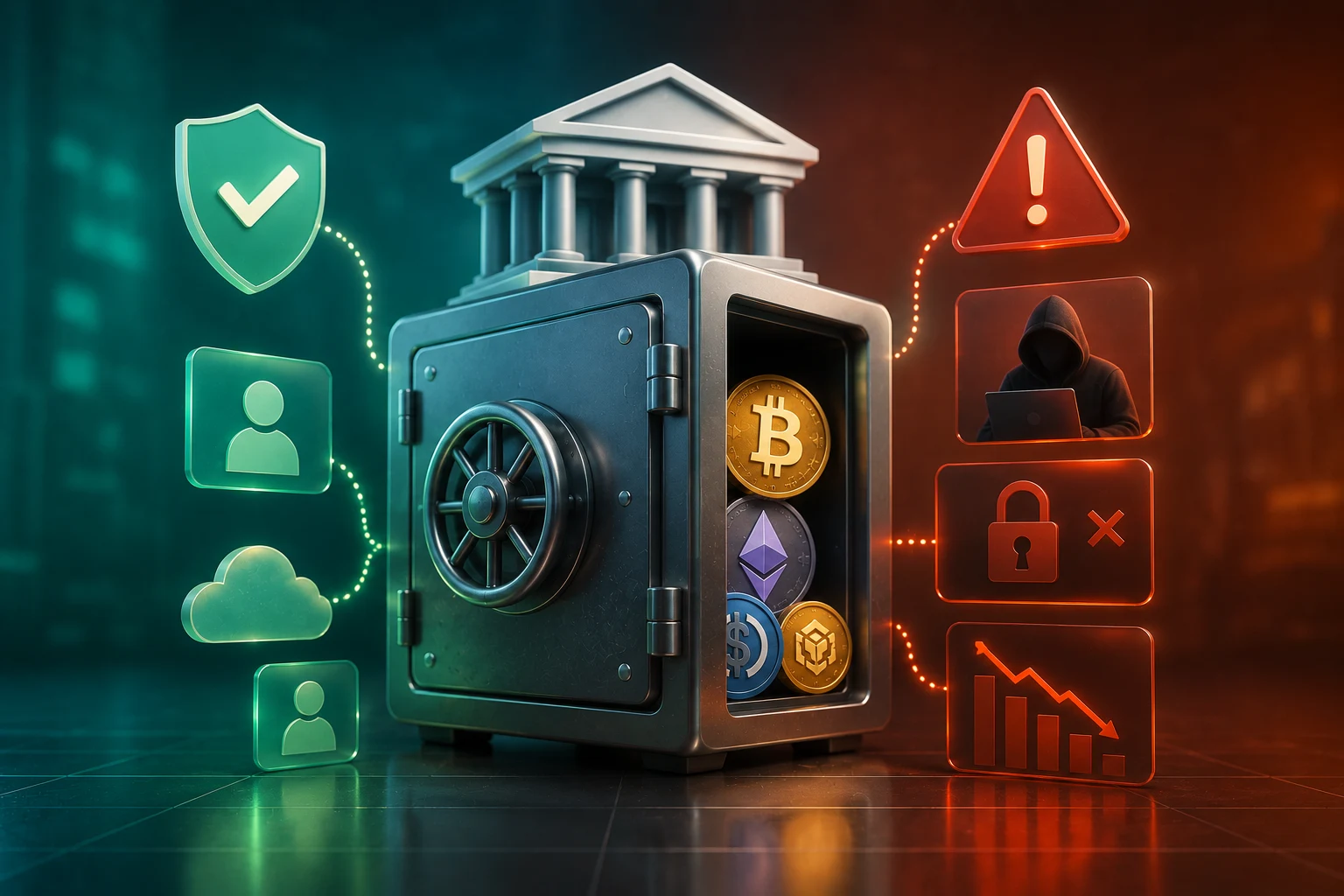
What "custodial" actually means in crypto
A crypto wallet does not really hold coins the way a leather wallet holds cash. It holds private keys, which are long secret strings of numbers and letters that prove you own a balance on the blockchain and let you sign transactions to move it. Lose the keys, lose the coins. Hand the keys to someone else, and you have handed over control of the coins. That is the entire idea behind "custodial" in one sentence.
A custodial wallet is any wallet where a third party creates, stores, and manages those private keys on the user's behalf. You sign in with an email, password, and usually two-factor authentication, the same way you sign into a bank or a stock brokerage. Behind the scenes, the custodian owns the keys and the addresses; you own an account, a balance, and a promise.
This is the default on most major cryptocurrency exchanges. When you deposit BTC, ETH, or USDT into Coinbase, Binance, Kraken, or similar platforms, you are not getting a personal crypto wallet in the strict sense. You are getting an I owe you from a company, recorded on their internal ledger. You can ask them to send your coins somewhere else, and usually they will, but until you do, the private keys are theirs.
The phrase most often used to describe this is "not your keys, not your coins." It sounds like a slogan, but it is shorthand for a real, repeated failure pattern, and the rest of this article is essentially an explanation of why that phrase exists and when it does, and does not, apply to you.
The real risks of custodial wallets
Risk-first, because user money is on the line. None of the failure modes below are hypothetical. Each has cost real people real crypto.
Counterparty risk, the company disappears. In November 2022, the exchange FTX collapsed after it was revealed that customer deposits had been quietly lent to its affiliated trading firm, Alameda Research. Billions of dollars in customer funds were missing. By the time users were told they could no longer withdraw, it was too late. The phrase "not your keys, not your coins" went from a meme to a lesson that people had paid for, sometimes with their entire life savings. FTX was once the second-largest crypto exchange in the world, which is part of why the shock was so severe.
Bankruptcy risk, the company is solvent but court-mired. Custody is a legal arrangement, and when a custodian enters bankruptcy, customers usually end up as unsecured creditors, meaning they are in line behind employees, landlords, and senior lenders. Celsius, a lending platform that held user deposits in custodial accounts, froze withdrawals in June 2022 and filed for bankruptcy a month later. Some users have recovered partial funds over a multi-year process, but years of price exposure were lost in the meantime. Even when money is eventually returned, the time lost is rarely made whole.
Hack and operational risk. A custodian is a giant honey pot of private keys, and attackers know it. Exchanges have been hacked for hundreds of millions of dollars at a time. Even when a platform reimburses users, the reimbursement depends on the company staying solvent and willing to pay, the same assumption that broke down at FTX.
Regulatory and account-freeze risk. Custodial platforms are subject to KYC and AML rules, which means the company knows who you are and is required to act on regulator requests. Accounts can be frozen for sanctions exposure, suspected fraud, or compliance reviews. A non-custodial wallet, by contrast, generally cannot freeze itself because no central party is in a position to do so.
Rehypothecation, your coins get used. Some custodial platforms lend out customer deposits to earn yield, as Celsius and BlockFi did. This can be disclosed and consensual, but it can also be hidden or misunderstood. When lending goes wrong, customers bear the loss even though they thought they were simply holding coins.
The honest summary: a custodial wallet trades the technical difficulty of self-custody for legal and operational trust in a third party. If that trust is broken, your upside is a seat in a creditor queue.
How a custodial wallet works in practice
Mechanically, a custodial wallet hides a lot of complexity, which is exactly why beginners start there.
You create an account on an exchange by submitting an email, a password, and identity documents to satisfy KYC requirements. The exchange generates a private key for you, often as part of a much larger pooled system, and assigns you a balance in their internal ledger. When you "deposit" BTC, the exchange gives you an address that belongs to their hot or cold wallet infrastructure, not a personal address you control. When other people send BTC to that address, the platform credits your account.
To withdraw, you sign in, request a withdrawal, pass any extra security checks, and the exchange signs a transaction from one of its wallets to the address you provide. You never see a seed phrase. You never see a private key. From the user's perspective, it feels like a banking app, and that is the point.
\p>Most exchanges also separate funds by statement. Coinbase, for instance, has publicly stated that customer USD balances are held in segregated cash and cash-equivalent accounts, and that customer crypto is held in segregated wallets. The legal form of that segregation matters enormously if the company fails, and the difference between "we promise to keep your coins separate" and "your coins are legally yours in a bankruptcy proceeding" has been the difference between recovery and loss in past collapses.Hot, warm, and cold custody, what exchanges actually do
- Hot wallets are connected to the internet so withdrawals can be processed quickly. A small fraction of total funds is kept here. They are the most exposed to hackers.
- Cold wallets are kept offline on dedicated hardware, used for long-term storage of most customer deposits. Withdrawals from cold storage are usually delayed and manually approved.
- Warm wallets sit in between, partially online, used to bridge hot and cold during routine operations.
When you read that an exchange holds "98% of customer funds in cold storage," that is the operational picture, but it does not change who legally owns the keys: the exchange does.
Custodial vs non-custodial wallets, the real trade-off
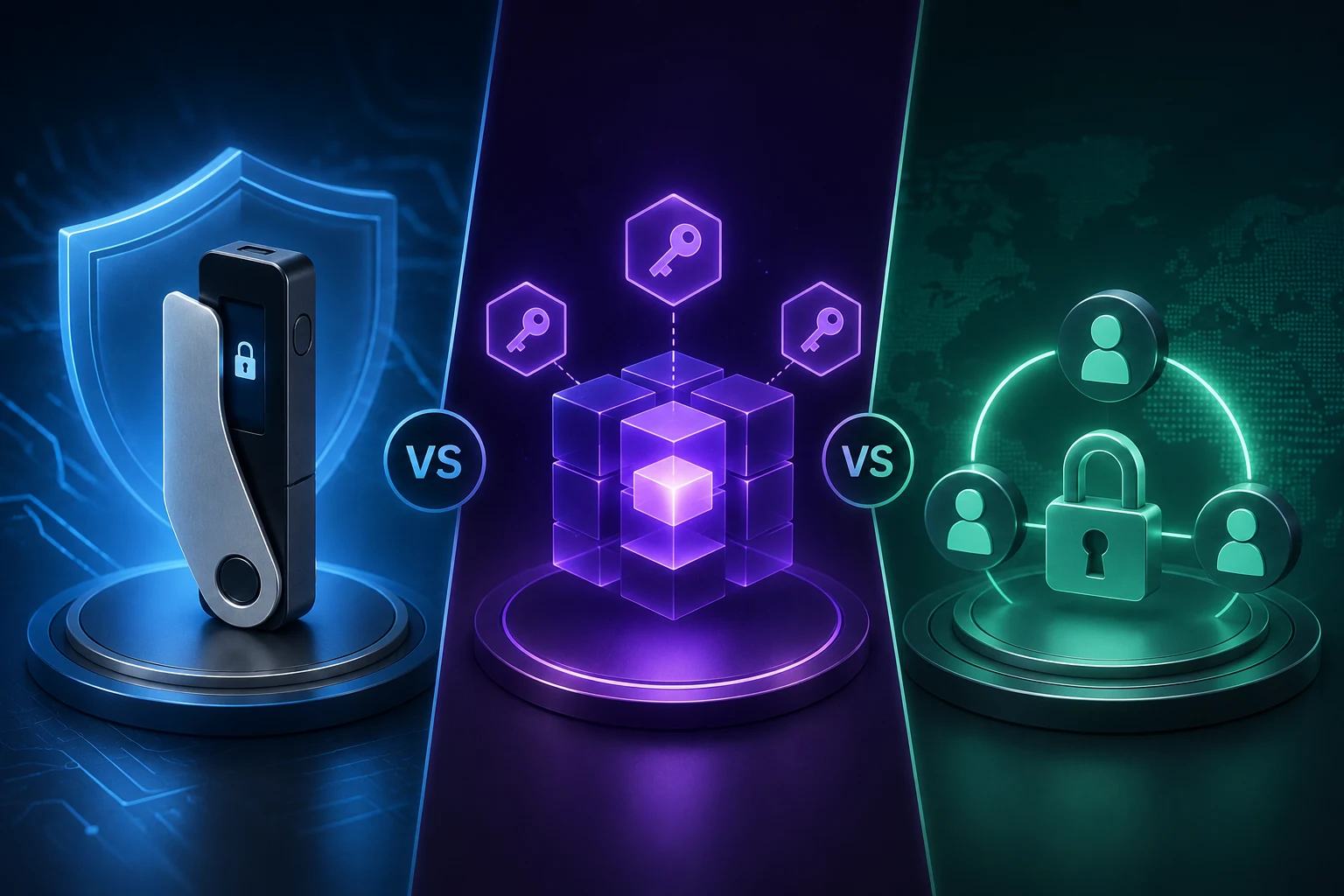
A non-custodial wallet, sometimes called a self-custody wallet, is one where you, the user, hold the private keys yourself. Examples include hardware wallets like Ledger and Trezor, and software wallets like MetaMask, Phantom, and Trust Wallet. The exchange is no longer in the picture. The trade-off changes shape entirely.
With a custodial wallet, you trust a company. You get password resets, fraud monitoring, and the ability to recover access if you forget your login. You give up direct control of your private keys and accept counterparty, bankruptcy, and regulatory risk.
With a non-custodial wallet, you trust yourself. You get direct control of your funds, censorship resistance, and immunity to a specific company going under. You also take on the responsibility of securing a seed phrase, the 12 or 24-word backup that can recreate your private keys. Lose that phrase, and no one can help you. There is no "forgot password" link in self-custody.
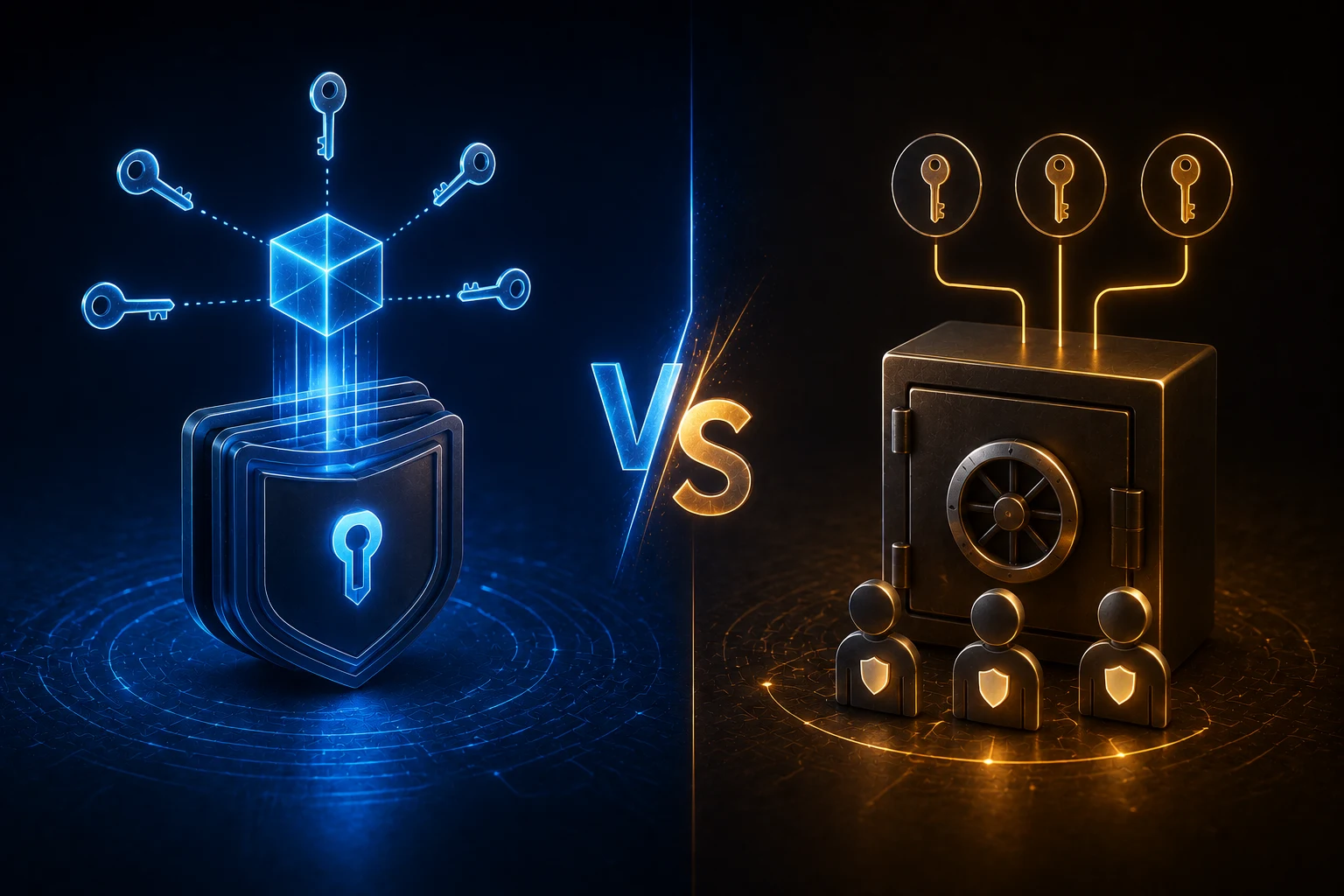
The two are not opposites so much as different answers to the same question: who do you want to be responsible when something goes wrong? For a beginner with $50 of ETH, a custodial wallet is probably fine. For a long-term holder with a meaningful position in BTC or ETH, the calculus looks very different.
When a custodial wallet is actually a reasonable choice
Despite everything above, custodial wallets are not always a mistake. They are a tool, and like any tool, the question is fit for purpose.
A custodial wallet is reasonable when:
- The balance is small. An amount you would feel comfortable leaving on a brokerage app while you figure things out. If losing it would be annoying but not life-changing, custodial convenience probably wins.
- You are actively trading. If your main activity is moving between assets, using DeFi features on the same platform, or taking advantage of staking rewards the exchange provides, custody is the path of least friction.
- You do not yet have the operational security to self-custody safely. Seed phrase management, phishing awareness, and address verification are real skills. A custodial account is safer than a self-custody setup that you cannot yet operate correctly.
- You are using a regulated, audited, well-capitalized custodian. Not all custodians are equal. A U.S.-domiciled, publicly disclosed, regularly proof-of-reserve-audited exchange is a different risk profile from an offshore platform promising 18% yield.
A custodial wallet is a bad idea when:
- It is your long-term savings. Money you cannot afford to lose should not sit in a third party's hands indefinitely.
- The platform is offering unusually high yield. If the only way a custodial product makes sense financially is by lending out your coins, you are now exposed to credit and rehypothecation risk on top of custody risk.
- You have no idea what would happen if the company failed. If you have not read how the platform handles bankruptcy, where it is incorporated, and whether customer funds are legally segregated, you should not park meaningful balances there.
A simple decision rule: keep on a custodial exchange only what you would keep in a checking account, and move long-term holdings into a wallet you control within a reasonable time.
How to reduce risk if you do use a custodial wallet
If, after weighing the trade-offs, a custodial wallet still fits your situation, a few habits materially reduce your risk without giving up the convenience.
Enable the strongest authentication available. Hardware security keys, authenticator apps, and withdrawal allowlists all make account takeover meaningfully harder. SMS-based two-factor authentication is better than nothing but is itself a known attack vector.
Pick a reputable, well-capitalized custodian. Look for platforms that publish regular proof-of-reserves attestations, are registered in a regulated jurisdiction, and have a transparent corporate structure. Coinbase, Kraken, and a small number of others fit this profile. The name on the door is not a guarantee, but it correlates with the resources available to defend customer funds.
Use the exchange as a tool, not a vault. Deposit, trade, withdraw to self-custody. Long idle balances on a centralized exchange are unnecessary exposure.
Understand yield products before you opt in.
If the platform offers staking or lending APY, read what is actually happening to your coins. In some cases, your assets are pooled and lent out, which is rehypothecation. In others, they are staked on-chain through a known protocol and rewards come from the protocol. The risk is not the same.
Keep records. Export your transaction history, save account statements, and keep a record of the platform's legal entity and jurisdiction. If something goes wrong, that information becomes critical in a recovery process.
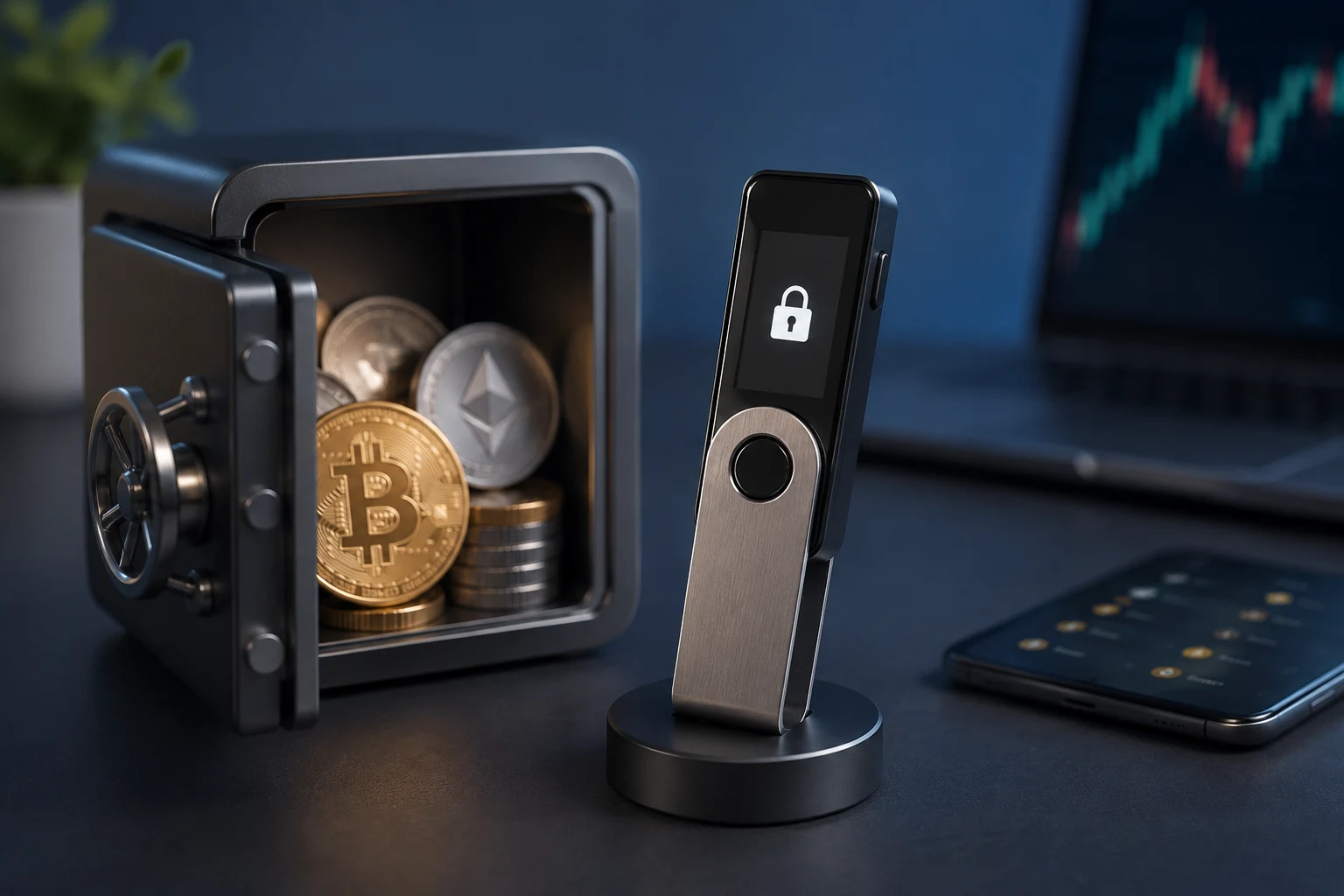
Treat custodial as part of a broader setup. Many experienced users run a hybrid arrangement: a custodial account for trading and on-ramps, plus a hardware wallet for long-term storage. The custodial account is the checking account; the hardware wallet is the savings account.
Stay ahead of custodial wallet risk with the right signal
Crypto custody risk does not arrive in big announcements. It builds up in liquidity reports, regulatory filings, executive changes, and quiet social posts from insiders. By the time a major exchange makes a public statement about withdrawals being limited, the news has usually been in motion for weeks. Reading a single headline at a time is a slow way to keep up.
Zippfeed surfaces crypto headlines tagged by topic, scored for sentiment (bullish, neutral, or bearish), and rated for importance, so that you can track custodial risk, exchange solvency signals, and on-chain developments as they actually unfold. It is a faster way to keep the kind of awareness that FTX and Celsius customers wish they had had, without having to monitor every feed yourself.



 WuBlockchain
 CryptoSlate
 Glassnode
 WatcherGuru
 Altcoin Daily