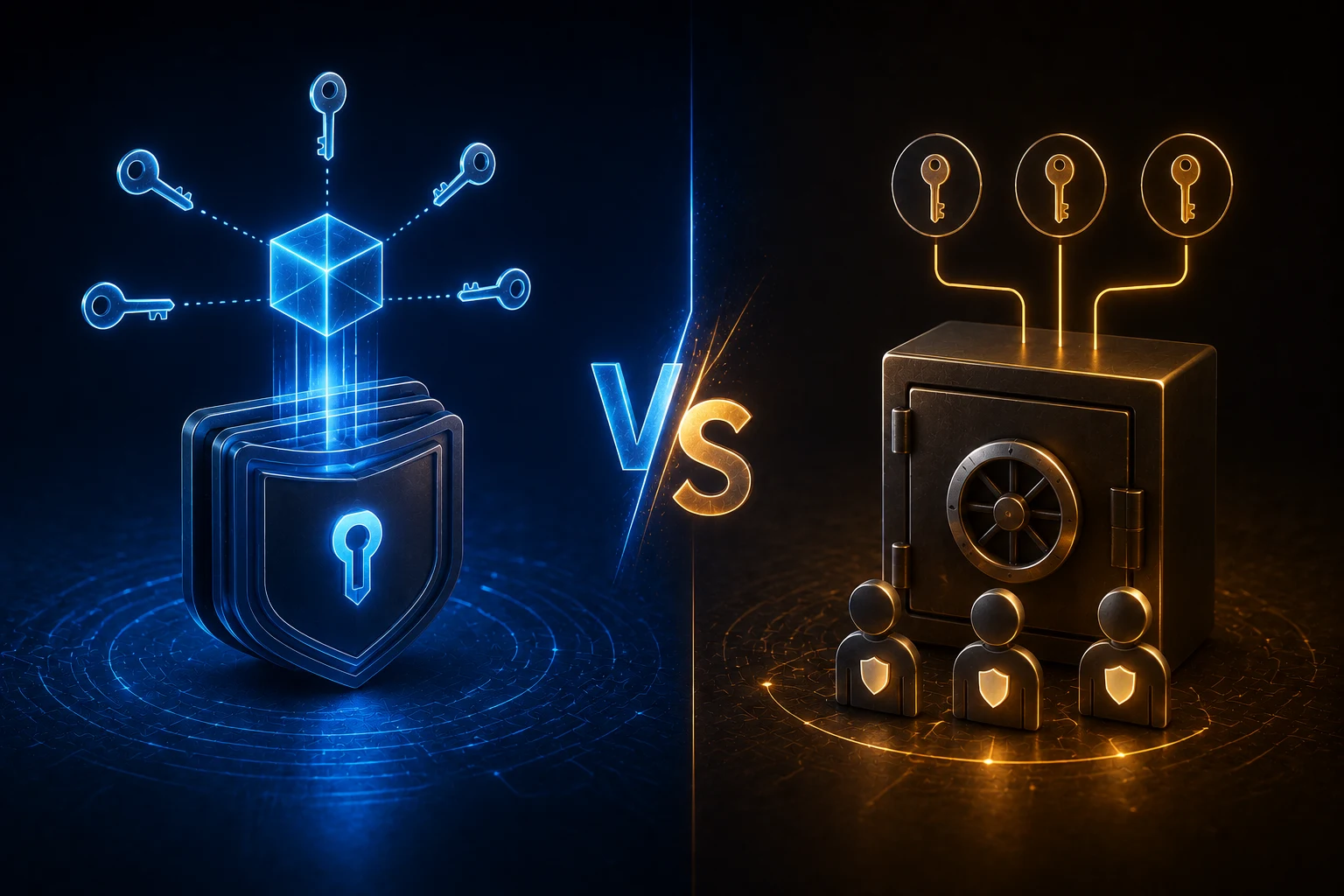
What problem are MPC and multisig actually trying to solve?
If you control a single private key, you control the funds. Lose the key, and the funds are gone. Have the key stolen, and the funds are gone. For a hobbyist holding a few hundred dollars, a hardware wallet and disciplined backups are usually enough. The moment money, business, or shared control enters the picture, that single point of failure becomes uncomfortable. Two questions follow: who is allowed to move funds, and what happens if one of those people is compromised, disappears, or simply makes a mistake?
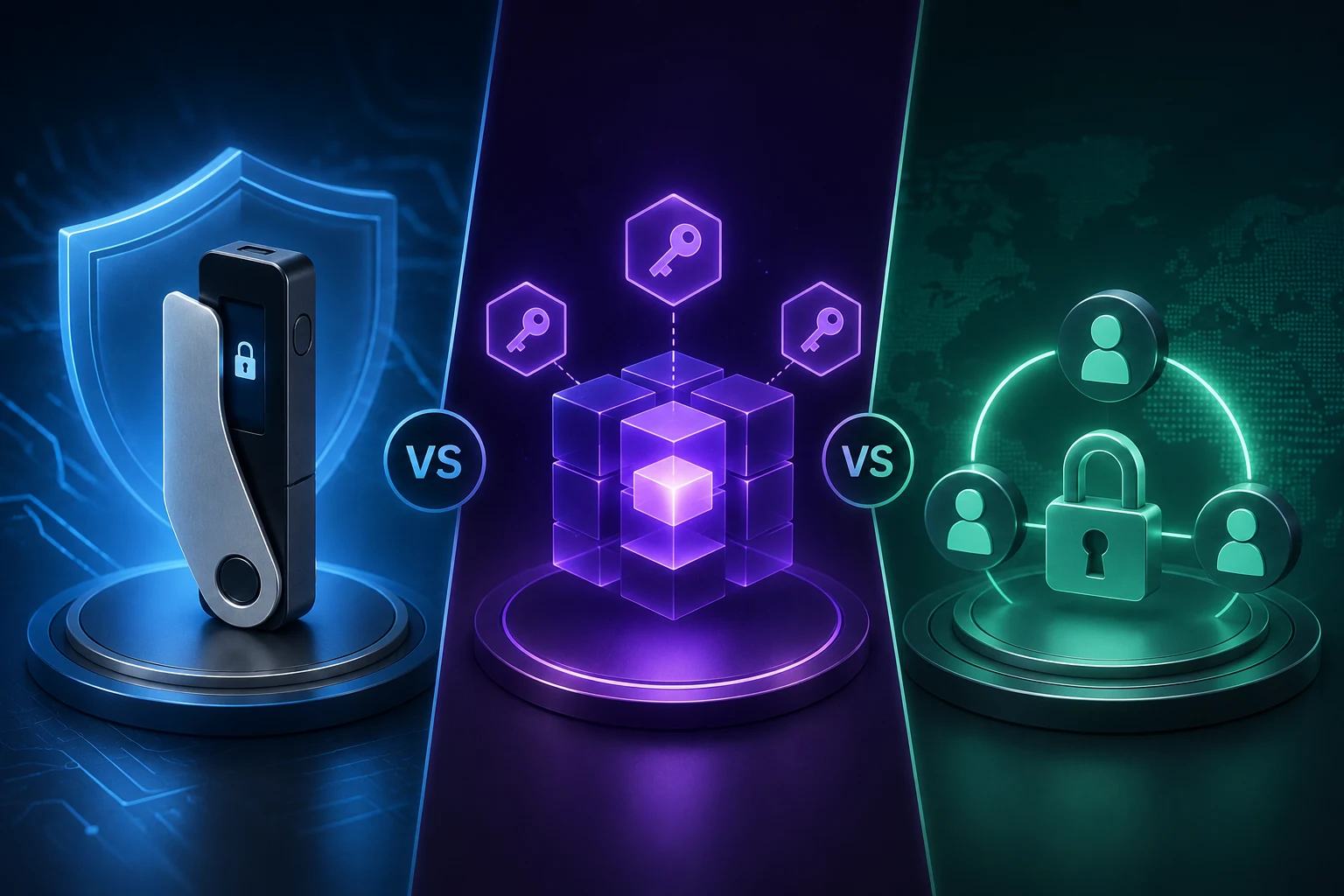
Multisig (short for "multi-signature") and MPC (short for "multi-party computation") are two different answers to those questions. They share the same goal, which is to make a single key, person, or device insufficient to move funds, but they reach that goal through very different mechanics. Understanding those mechanics is what separates a defensible custody decision from a marketing one.
How multisig works, in plain English
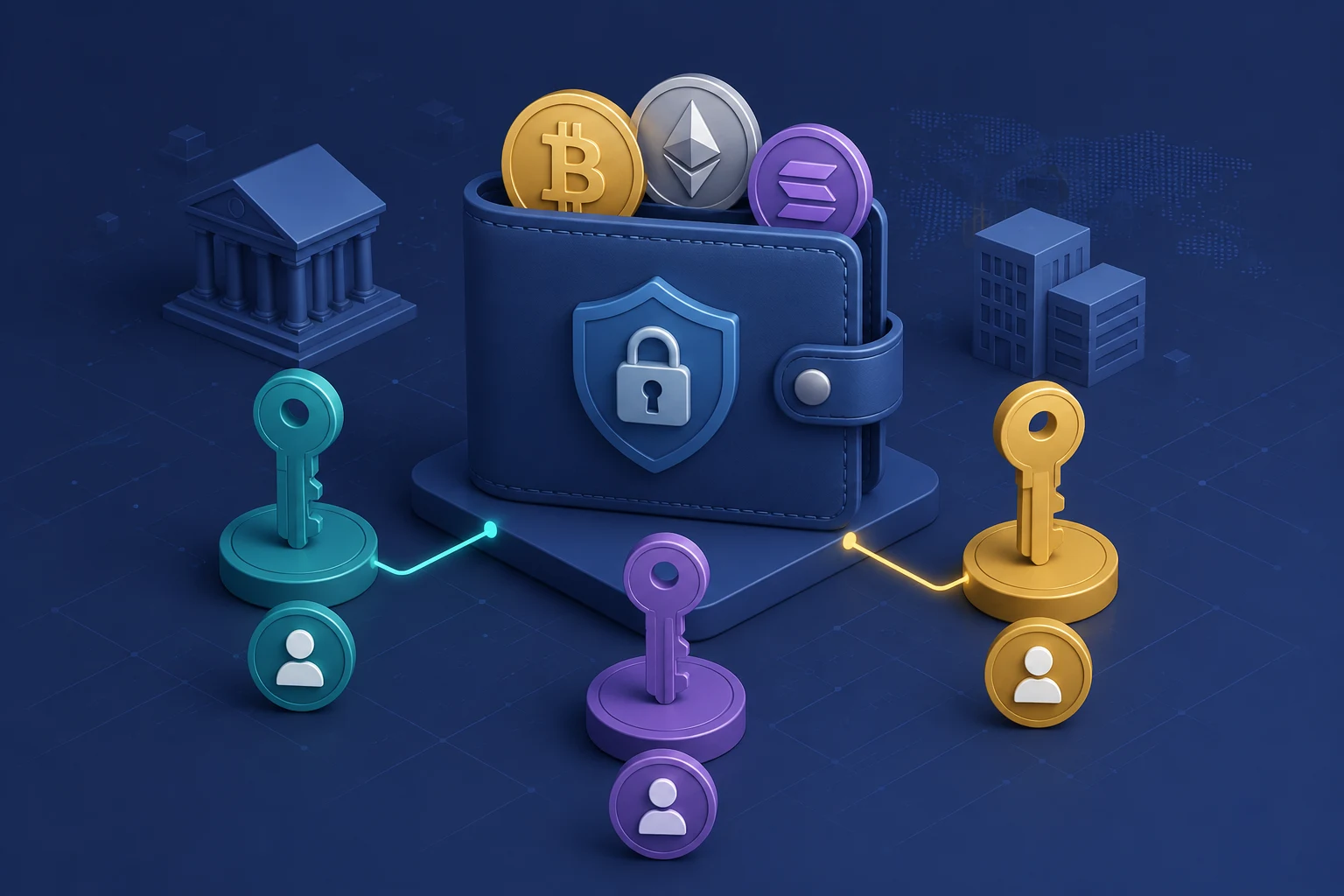
A multisig wallet is a wallet that requires M-of-N signatures to broadcast a valid transaction. For example, a "2-of-3" setup means three independent keys exist, and any two of them must sign before the funds move. The rule is enforced by the blockchain itself: on Bitcoin, the original P2SH (and later P2WSH) script locks funds behind a script that literally checks the signature threshold. On Ethereum, the equivalent is a smart-contract wallet such as Safe (formerly Gnosis Safe), where the spending rules live in audited contract code rather than in Bitcoin Script.
Because each signature comes from a separate, fully formed private key, each signer can be air-gapped, held by a different person, stored on a different device in a different country, and operated on a different operating system. No single device compromise, no single coerced employee, and no single lost seed phrase can drain the wallet on its own. The trade is friction: someone has to coordinate signers, and on-chain transactions are slightly larger and more expensive because the signature data grows with the number of signers.
Rotating signers is also a transparent, on-chain action. Need to fire a treasury manager? Move funds to a new multisig that excludes their key. Lose a hardware wallet? Replace its slot in the threshold using a standard on-chain transaction. Every change is auditable on a block explorer forever.
How MPC works, in plain English
MPC wallets use a branch of cryptography called multi-party computation to split a single private key into multiple "shares" that are distributed across parties (devices, servers, or humans). The clever part: the full key is never reconstructed in any single place, not even during signing. Instead, the parties run a protocol together so that each contributes a partial signature, and the result is a normal-looking signature on-chain. To the blockchain, an MPC-signed transaction is indistinguishable from one signed by a regular single-key wallet.
Most modern wallet MPC schemes are based on threshold signature schemes such as ECDSA's GG20/GG20+, threshold EdDSA for chains like Solana, and Schnorr-based schemes for Bitcoin via protocols such as FROST. The split is invisible to outsiders. There is no multisig script, no smart contract, and no on-chain footprint indicating that more than one party was involved.
For the user, MPC usually feels like a normal wallet app with a familiar recovery flow. Behind the scenes, the provider's servers, the user's device, and sometimes a backup party are cooperating to produce signatures. Recovery and key rotation happen by running a new "resharing" ceremony, which generates fresh shares without ever exposing the underlying key, and invalidates the old shares.
What are the real risks of each approach?
Both setups reduce the single-point-of-failure risk of a normal wallet, but each introduces new risks of its own. Skipping the marketing brochures and looking at what has actually failed in the wild is more useful than any feature comparison table.
Multisig risks you should take seriously
Multisig's biggest non-obvious risk is coordinated signer compromise. The 2022 Ronin bridge hack, which drained roughly $625 million, was effectively a 5-of-9 multisig whose signers were clustered among a small group of validators that an attacker compromised one by one. The threshold design was correct on paper; the operational reality was that too many keys lived in the same organizational blast radius.
Other recurring failure modes include poorly designed signing ceremonies (signers broadcasting partially signed transactions from the same network), signer collusion (especially in small DAOs where the same handful of people control every key), and chain-level bugs in the smart-contract implementation. Safe itself has been heavily audited, but variants and forks inherit less scrutiny. On Bitcoin, the risk is simpler: a poorly constructed script can lock funds permanently, and changing the signer set requires a new on-chain transaction that costs fees and is visible to the world.
MPC risks you should take seriously
MPC's risks live mostly in software and operations, because the cryptography itself does not run on a chain. A flawed implementation can leak key material across shares, and historical schemes have been broken. Early threshold-ECDSA protocols had subtle abort-behavior bugs; some research papers from 2020 to 2022 found ways to extract partial key information by observing protocol messages across many signing sessions. Reputable providers use modern schemes, formal audits, and continuous research, but the burden of proof is on the implementation, not the blockchain.
Then there is the operational risk of the provider itself. MPC is overwhelmingly delivered as a service, which means the customer is trusting the provider's servers, employees, and update pipeline. When a custody provider is breached, the damage is concentrated. There have been multiple incidents in the broader custody industry, including high-profile cases at third-party custody vendors and at exchanges, where attackers specifically targeted the provider's infrastructure rather than individual users. The most catastrophic recent example is the 2022 FTX collapse, where a custody stack that combined hot wallets, multisig, and various internal controls failed because the human and corporate controls around them collapsed, not because the cryptography broke.
Finally, there is a structural issue: with on-chain multisig, the spending rule is public and self-executing. With MPC, the rule lives inside the provider's software stack. If the provider disappears, the user is dependent on the scheme's recovery procedure, the quality of the documentation, and the openness of the underlying protocol. Some MPC systems are open-source and reproducible, but many are not.
How do they compare on chain support, recovery, and rotation?
Chain compatibility is the most visible day-to-day difference. Bitcoin supports native multisig at the script level and now supports Taproot, which makes multisig transactions look like single-sig transactions on-chain (good for privacy and fees) while still requiring multiple Schnorr signatures under the hood. Ethereum does not have a multisig opcode in the same sense; it has smart-contract wallets, of which Safe is the dominant pattern. Other chains vary: Solana, for example, does not have on-chain native multisig in the Bitcoin sense and has historically required either a multisig program at the protocol level or a smart-contract approach.
MPC, by contrast, is chain-agnostic. Because the blockchain only ever sees a standard signature, the same MPC setup can sign for BTC, ETH, SOL, and any other chain that uses a compatible signature scheme. For organizations that need to custody many assets across many chains, this is a real operational simplification. Multisig users often run several different multisig setups in parallel, one per chain, with their own quirks and signer procedures.
Recovery and signer rotation tell the opposite story. With multisig, replacing a lost signer is an on-chain action: a new transaction moves funds to a new wallet that recognizes the new set of keys. It is visible, auditable, and self-contained. With MPC, rotation requires the parties to run a fresh distributed key-generation or resharing ceremony, then invalidate the old shares. Done well, it is invisible and fast. Done poorly, or with a provider that has changed its software in ways that break the old ceremony, it can be a fragile, manual, offline process that depends on documentation that may or may not exist two years later.
Which setup fits which kind of user?
There is no universally "safer" answer. The right choice depends on whose threat you are most worried about and how much operational complexity you can actually absorb.
Solo users and small holders. For an individual moving beyond a single hardware wallet, MPC is often the pragmatic default: it is easier to use, supports more chains, and tends to integrate with mobile and browser wallets where on-chain multisig would be clunky. The single biggest caution is to pick an MPC provider whose scheme is documented, audited, and ideally open-source, and to understand exactly how recovery works before any funds go in.
DAOs and small treasuries. A Safe on Ethereum (or a native multisig on Bitcoin) is usually the most defensible option for a treasury that wants every spending rule to be visible on a block explorer. Independent signers in different jurisdictions, on different devices, with no shared employer or vendor, give you the maximum blast-radius separation. The Ronin failure is the lesson: the cryptographic threshold is not the hard part; the operational independence of the signers is.
Active trading desks and institutional treasuries. Here MPC often wins on policy expressiveness: roles, spending limits, time-locks, allowlisted addresses, automatic key rotation, and approval workflows are all easier to express in a custody product than in a static on-chain script. The trade is that you are now trusting a vendor stack, so the procurement checklist looks more like an enterprise software review (SOC 2 reports, penetration tests, key-management certifications, insurance, business continuity) than a crypto-native one.
Users with strict sovereignty requirements. If "no third party can ever move my funds, under any legal or technical circumstance" is a hard requirement, on-chain multisig is closer to that ideal. The rule is enforced by the chain, not by a company that could be subpoenaed, acquired, or shut down.
How to choose without falling for vendor marketing
The most useful exercise before picking a custody setup is to write down three things: what assets, on which chains, controlled by whom, with what recovery story if a signer is lost. The answers usually make the decision obvious. A multi-chain treasury with frequent transactions and active policy needs will struggle with on-chain multisig's friction. A long-term Bitcoin or Ethereum cold-storage setup will struggle to find any reason to take on MPC's software-and-vendor dependencies.
It is also worth pressure-testing vendor claims. "Non-custodial" is a marketing word more than a technical one. The meaningful questions are: who can run the signing ceremony, what happens if the provider disappears tomorrow, is the underlying MPC protocol open and reproducible, and have the implementations been independently audited and studied over time. A provider that can answer all four with specifics is rarer, and more trustworthy, than a sales deck that uses the word "institutional" on every slide.
Finally, treat custody as defense in depth. Neither multisig nor MPC removes the need for hardware-wallet-level key isolation, transaction review, address allowlists, and human procedures around signing. The cryptography sets the floor. The operational discipline of the people using it sets the actual ceiling.
How to follow custody changes the smart way
Custody technology moves quickly: new threshold signature schemes, new Safe modules, new MPC vendors, and new high-profile breaches all land in the news cycle, and most of the coverage is either vendor-funded or surface-level. Tracking which developments actually matter, and which are repackaged marketing, is a job in itself. Zippfeed surfaces wallet and custody headlines with sentiment scoring, bullish, neutral, or bearish, and an importance rating, so you can tell the meaningful protocol upgrades and breach disclosures apart from the noise before they affect your own setup.


 WuBlockchain
 CryptoSlate
 Glassnode
 WatcherGuru
 Altcoin Daily