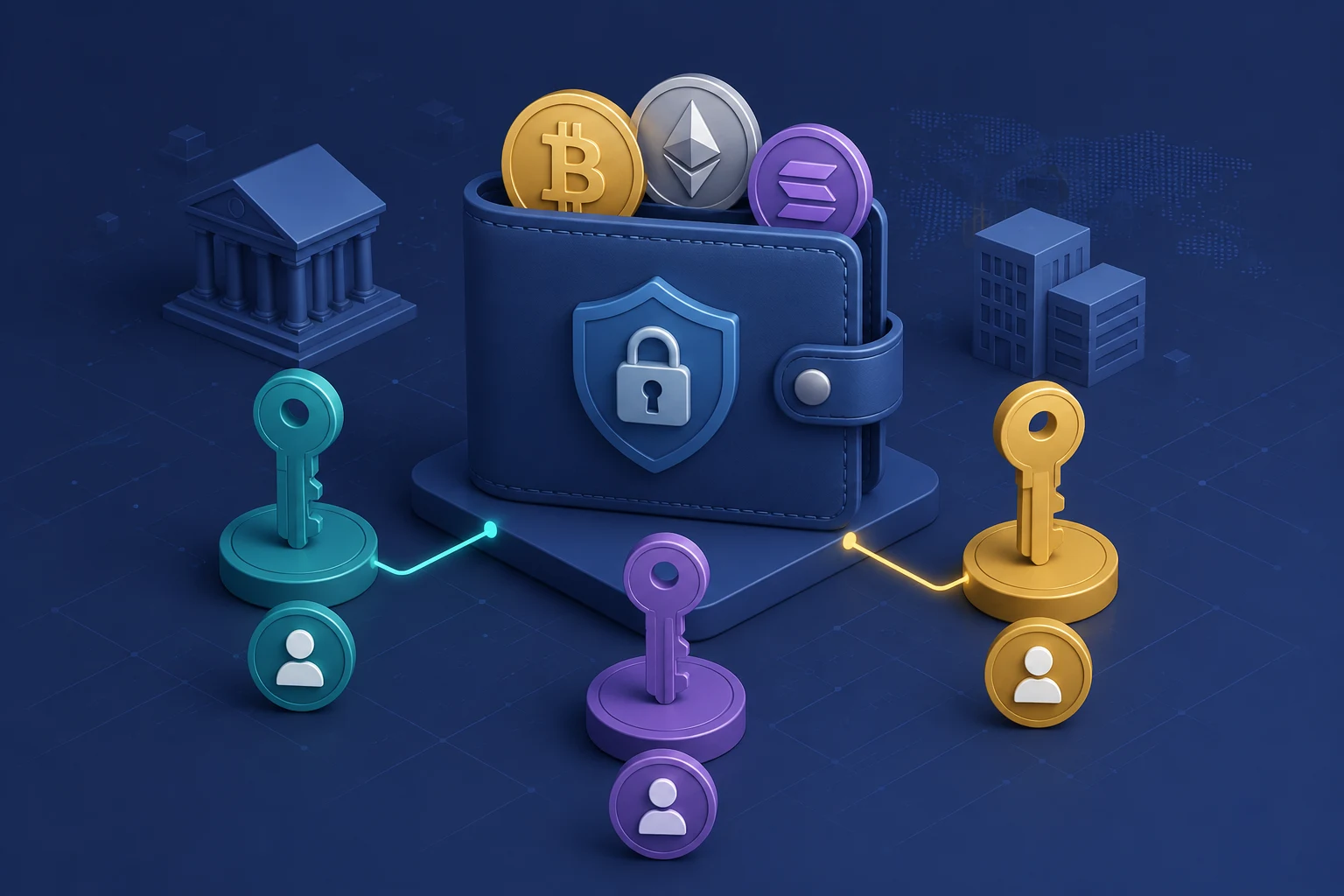
What a multisig wallet actually does
A normal crypto wallet, whether it holds BTC or ETH, is controlled by a single private key. Anyone with that key can move the funds. Lose the key, and the funds are gone forever. Have the key stolen, and the thief can drain the wallet in one transaction. That single-key model is what most beginners use, and for small balances held on a hardware wallet it is perfectly reasonable.
A multisig wallet changes that model. Instead of one key controlling the funds, several keys exist, and a fixed number of them must sign every transaction before it goes through. The standard way to describe this is an M-of-N signature scheme: out of N total keys that exist, M of them must sign for any spend to be valid. A 2-of-3 setup has three keys total and needs any two to sign. A 3-of-5 setup needs any three out of five. The wallet's on-chain rules enforce this check, so no single key holder can act alone.
This sounds simple, but the practical effect is significant. If one signer is compromised by malware, or loses their device, or even disappears, the funds are still safe as long as the threshold M can still be met by the remaining honest signers. Multisig turns custody from a one-person problem into a coordinated process, which is exactly what you want for shared treasuries, small businesses, DAOs, and anyone holding a balance large enough that a single point of failure feels uncomfortable.
The real risks and failure modes
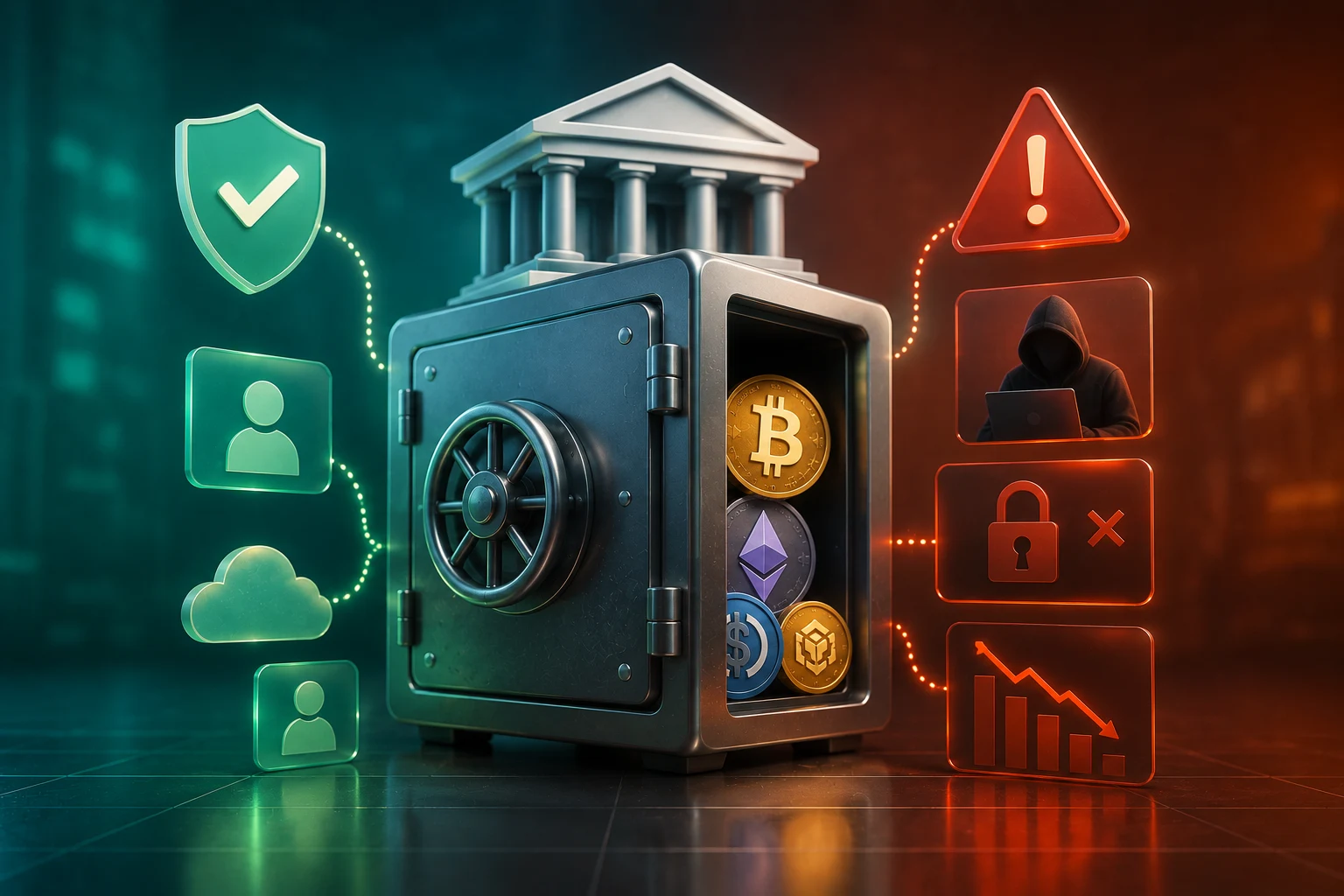
Multisig reduces one category of risk, single-key compromise, and introduces others. The honest picture matters more than the marketing.
Signer coordination and human friction. Every transaction now requires multiple people or devices to act. If signers are spread across time zones, or one is on holiday without their hardware wallet, or a quorum cannot agree on whether a transaction is legitimate, the funds are effectively frozen. There are well-documented cases where DAO treasuries sat untouched for days during emergencies simply because enough signers could not be gathered in time.
Recovery is harder, not easier. With a single-seed wallet, your recovery story is one phrase. With multisig, the recovery story is the full set of keys plus the threshold parameters. Lose track of two out of three keys in a 2-of-3 setup and the funds are permanently locked, even though the third key is safely in your drawer. Multisig replaces the single point of failure with multiple points of failure, and operational discipline becomes critical.
Smart-contract risk on EVM chains. On Ethereum and other EVM networks, the dominant multisig, Safe (formerly Gnosis Safe), is a smart contract. Your funds sit inside that contract, and the contract's code enforces the M-of-N rule. If the contract has a bug, your funds are at risk. Safe has been audited many times and has secured tens of billions of dollars across years of use, which is a strong track record. But it is not the same risk profile as a wallet whose security rests only on Bitcoin's or Ethereum's base-layer cryptography.
Phishing tailored to multisig. Attackers who know a treasury uses multisig will craft scams that target the coordination step rather than the key itself. A fake transaction that looks routine, a malicious wallet interface that displays misleading recipient addresses, and social-engineering attacks against individual signers are all common. Multisig protects against key theft, not against a quorum of signers being tricked into signing something they should not.
Fee and UX overhead. Multisig transactions cost more in gas because more signatures and on-chain checks are involved. For a Bitcoin multisig using legacy P2SH addresses, fees can be noticeably higher than single-sig, although SegWit and Taproot upgrades have narrowed the gap. On Ethereum, a Safe transaction can cost meaningfully more than a plain transfer, though layer-2 networks have made this much less painful.
How multisig works under the hood
Bitcoin and Ethereum implement multisig in very different ways, and understanding the distinction helps you evaluate products honestly.
Bitcoin multisig (native)
Bitcoin supports multisig at the base protocol level. A wallet is constructed as a Pay-to-Script-Hash (P2SH) or, since 2021, a Pay-to-Taproot (P2TR) output that encodes the spending conditions, including the M-of-N threshold and the public keys involved. When someone wants to spend the funds, they produce M signatures, and the Bitcoin network itself verifies that the threshold has been met. There is no smart contract in between, so the security model is exactly Bitcoin's security model.
Taproot-based multisig in particular looks identical to a single-sig transaction on-chain, which improves privacy and reduces fees. Wallets like Sparrow, Electrum, and Nunchuk make this accessible, although the UX is still less polished than a basic hot wallet.
Ethereum multisig (smart-contract wallets)
Ethereum's base layer does not have a native multisig opcode in the same sense. Instead, multisig is implemented through smart-contract wallets, of which Safe is by far the most widely used. The contract holds the funds, stores the list of owner addresses, and checks that any transaction submitted has been signed by at least M of those owners before executing it.
This works well and has been battle-tested at enormous scale. The trade-off is that you are trusting the contract code. Safe has had many audits, a long bug-bounty program, and a multi-year track record with no loss of user funds from a contract vulnerability. Still, the risk category exists, and it is worth knowing about rather than ignoring.
When multisig actually makes sense
Multisig is not a default recommendation. For most users holding small amounts on a hardware wallet, the complexity is not worth it. The honest threshold for considering multisig is roughly the point at which a single mistake, a single compromised laptop, or a single coerced signer would cause damage you could not absorb.
Shared business treasury. If two or three partners control a business's crypto holdings, no single partner should be able to move funds alone. A 2-of-3 setup, with each partner holding one key on a separate hardware device and a third key held in a secure offsite location, is a common pattern. It prevents both theft by a single rogue insider and total loss if one partner is hit by a phishing attack.
DAO and protocol treasuries. Any organization managing community funds should use multisig as a baseline. The exact threshold depends on the size of the treasury and the number of trusted signers available, but 4-of-7 or 5-of-9 patterns are common. The multisig itself becomes a public signal that no small group can abscond with the funds.
Personal holdings above a meaningful threshold. There is no magic number, but a useful mental model is this: if losing the wallet would be life-changing, multisig is worth considering. A 2-of-3 setup with one key on a hardware wallet, one key on a second hardware wallet stored in a different physical location, and one key held by a trusted family member or lawyer gives meaningful protection against both theft and accident.
Inheritance planning. Multisig is a reasonable, if imperfect, way to plan for the case where a key holder is incapacitated. The other signers can still move funds under agreed-upon conditions, and no single heir needs to be trusted with the full balance.
Multisig versus the alternatives
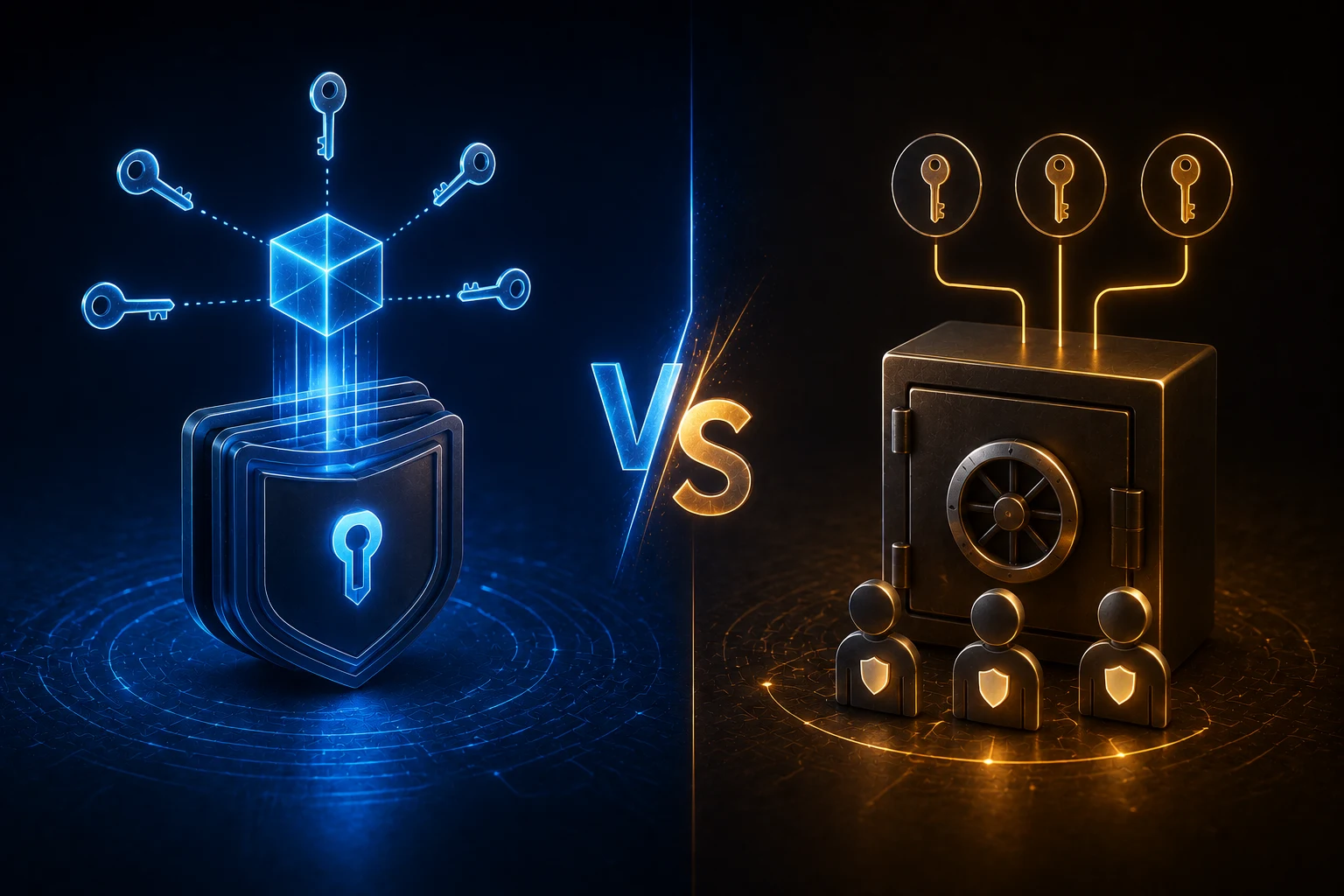
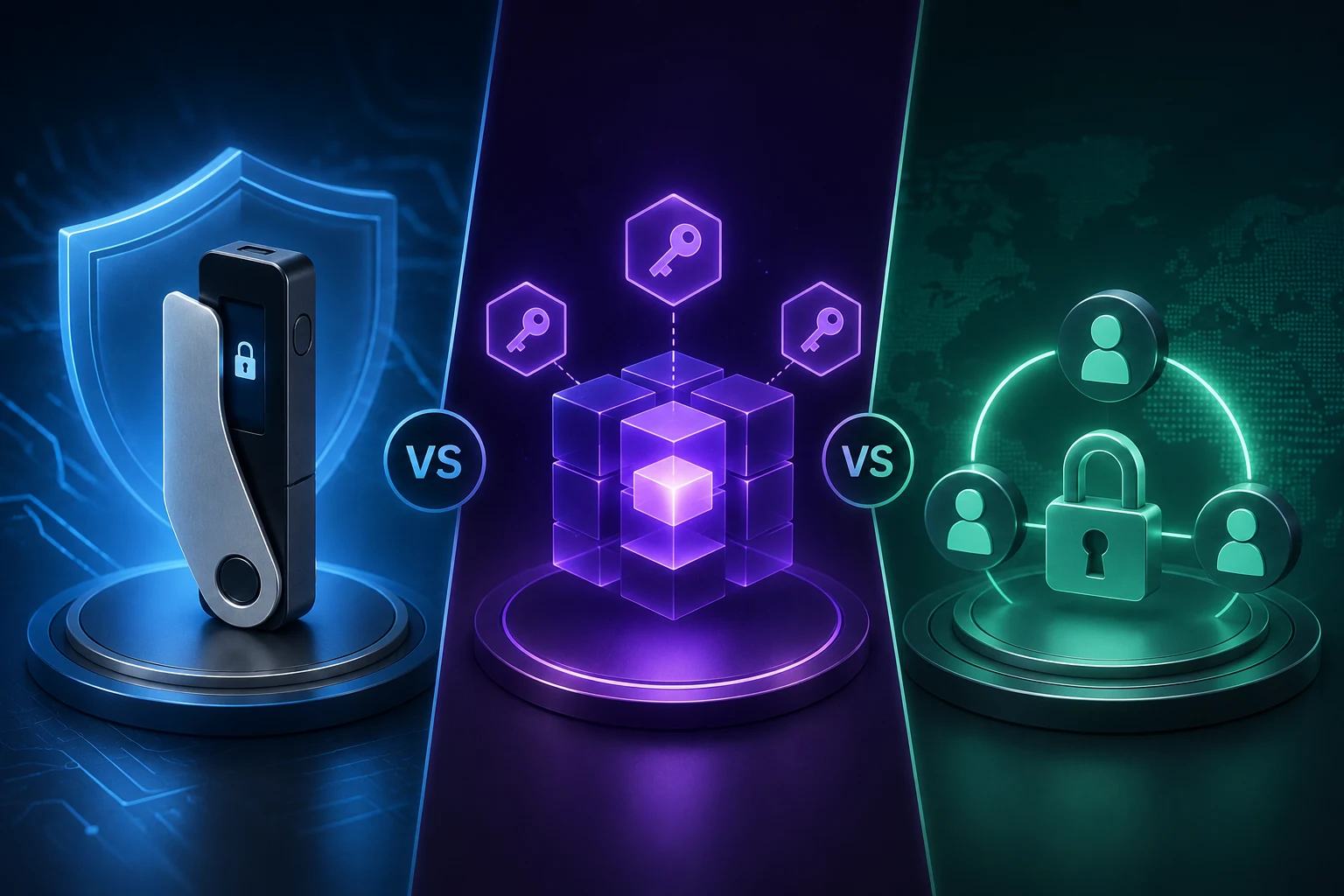
Multisig is one solution to the shared-custody problem, not the only one. Two alternatives deserve serious consideration.
MPC wallets
Multi-Party Computation (MPC) wallets split a single private key into several shares distributed across different parties or devices. The key never exists in one place, even at the moment of signing. From the blockchain's perspective, transactions look like normal single-sig transactions, which is good for privacy and for compatibility across chains. MPC also tends to be cheaper in gas than an EVM multisig contract.
The trade-offs are real, though. The key-generation and signing ceremonies rely on specialized cryptography, and the security depends on the implementation of the MPC protocol by the vendor you use. You are also typically trusting the vendor's infrastructure for part of the operation, which introduces a counterparty risk that pure on-chain multisig does not have. Examples include Fireblocks, Zengo, and various institutional custody providers.
Multi-device hardware wallet setups
For individual users, a simpler alternative is keeping the same seed phrase on two independent hardware wallets, plus a metal backup stored in a separate location. This does not give you multisig's no-single-point-of-failure guarantee, because both devices share the same underlying key, but it does protect against losing a single device and is much simpler to operate than a full multisig setup.
Some users combine both approaches: an MPC wallet for daily use with a hardware-wallet-stored backup share, plus a multisig wallet for long-term cold storage. There is no rule that says you must pick exactly one model.
Common multisig setups in practice
The most common Bitcoin multisig is 2-of-3. It balances redundancy (any one key can be lost without losing access) against collusion risk (two parties must conspire to steal). For larger treasuries, 3-of-5 is common because it lets you lose two keys while still keeping a meaningful quorum requirement.
For Ethereum, Safe's most common configuration is also 2-of-3, though DAOs frequently use higher thresholds. Safe's interface makes it straightforward to add or remove owners over time, change the threshold, and review pending transactions. Signing still has to happen across the owner wallets, which means each signer needs to be using a compatible wallet such as a hardware wallet or a mobile signer.
A practical tip: keep at least one signer on a different device class from the others. If all three signers are the same hardware wallet model from the same batch, a supply-chain compromise of that specific device could affect all of them. Mixing vendors, and keeping one signer as a paper or metal seed stored offline, reduces this risk.
How to follow multisig and wallet security the smart way
Multisig, MPC, hardware wallets, and seed-phrase management are all moving targets. Smart-contract wallets ship upgrades, new MPC protocols launch, and wallet UX improves every quarter. Tracking which wallet to trust, which audits matter, and which exploits have happened recently is a real job, and most people do not have time to do it well. Zippfeed surfaces wallet and custody headlines with sentiment scoring, bullish, neutral, or bearish, plus an importance rating, so you can see which security stories actually matter and which are noise. That makes it easier to decide when your own setup is still appropriate and when it is time to revisit it.


 WuBlockchain
 CryptoSlate
 Glassnode
 WatcherGuru
 Altcoin Daily