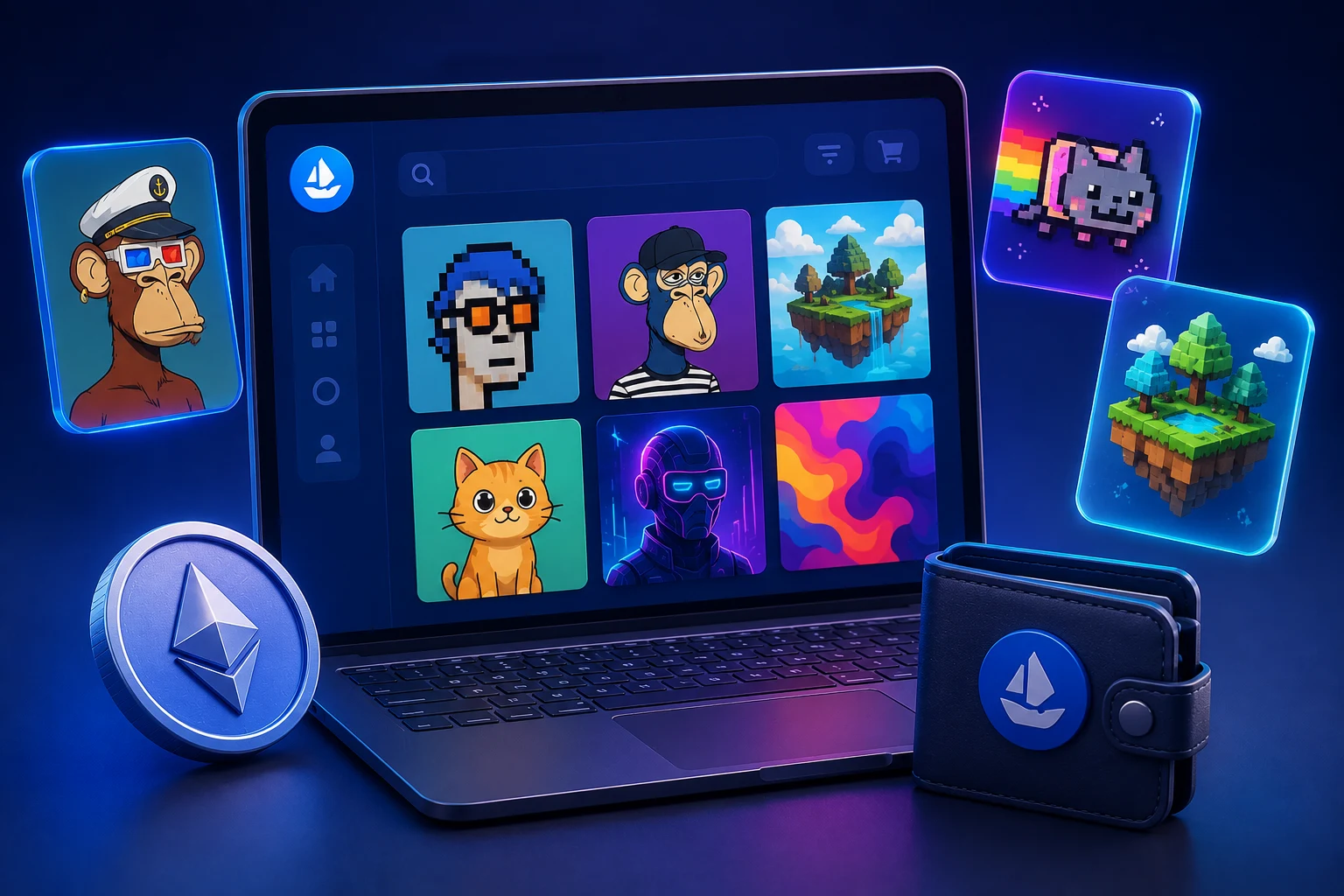
The basics: what OpenSea actually is
OpenSea is a marketplace for non-fungible tokens (NFTs). Think of it as eBay for digital ownership: anyone with a wallet can list items for sale, anyone with a wallet can buy them, and the platform charges a fee for facilitating the trade. It does not hold your NFTs or your money — your wallet is the custodian end-to-end.
OpenSea launched in 2017 and became the default venue when NFTs went mainstream in 2021. At peak it processed hundreds of millions of dollars in monthly volume. It supports multiple chains: Ethereum, Polygon, Solana, Arbitrum, Optimism, Base, and others.
How OpenSea actually works
Connecting and browsing
You visit opensea.io and connect a wallet (MetaMask, Coinbase Wallet, Phantom for Solana, etc.). No password, no email — the wallet is your identity. Once connected, the site shows your NFTs, your watchlist, and lets you browse the rest of the market.
Listing an NFT
To sell an NFT, you set a price (fixed or auction-style) and sign a message with your wallet. That signature is a meta-transaction — it doesn't cost gas yet, and your NFT stays in your wallet. It only moves when someone buys it. If you change your mind, you can cancel the listing (which does cost gas).
Buying an NFT
A buyer accepts your price, signs an on-chain transaction, and the NFT atomically moves to their wallet while the funds (minus the platform fee and any creator royalty) move to yours. The trade is settled by a smart contract; OpenSea never touches the assets.
Minting via OpenSea
You can also mint NFTs directly on OpenSea — uploading an image, naming the collection, and creating tokens. This is "lazy minting": the on-chain mint happens at first sale, so creators don't pay upfront gas.
The royalty wars (and why they matter)
Until 2022, most NFT projects baked a "creator royalty" into their collection — typically 5-10% of every secondary sale, paid to the project. This was a big part of the NFT pitch: artists earn forever, not just on the first sale.
The problem: royalties were never enforced at the smart contract level. They depended on marketplaces voluntarily honoring them. In late 2022, a new marketplace called Blur launched with zero royalties and aggressive trader incentives. Volume rapidly shifted there. OpenSea responded by making royalties optional in early 2023, then defaulted to a small fixed amount.
The result: most NFT projects lost a huge chunk of their economic model. Creator revenue from secondary sales collapsed. Whether royalties come back through new technical enforcement (e.g. on-chain enforcement using restricted transfer extensions) is still unsettled.
OpenSea vs Blur vs Magic Eden
- OpenSea — broad audience, multi-chain, the default for casual collectors. Decent UX, supports collection creation.
- Blur — pro-trader focused, Ethereum-only, aggressive incentives, lower fees. Pioneered zero-royalty trading and bid pools.
- Magic Eden — strongest on Solana historically, now multi-chain. Tends to be the destination for Solana-native collections.
Most active collections list across multiple platforms. Smart buyers compare prices across all three before making a move.
The risks worth knowing
- Phishing. Fake OpenSea sites are everywhere. Always check the URL; bookmark the real one.
- Malicious signatures. A signature that looks like a listing can sometimes be a contract approval that drains your wallet. Read what you sign.
- Wash trading and inflated volume. Some collections have inflated metrics from sellers trading to themselves. "High volume" is not the same as genuine demand.
- Stolen NFTs. Hacked accounts list NFTs cheaply before victims notice. If a price looks too good to be true on a known collection, it might be stolen — and platforms can freeze trades.
- Gas spikes. Buying or canceling on Ethereum during busy periods can cost more in gas than the NFT itself.
How to start (carefully)
If you want to try OpenSea, start by browsing without connecting a wallet — you can see everything. When you do connect, use a separate wallet from your main holdings. For your first buy, pick a low-priced item from a collection you'd be happy to own even if it never went up. Set a small allowance in the wallet, never sign a signature you can't read, and treat your seed phrase as if it's the keys to your house. Our guides on what is an NFT and how to store crypto securely are the right warmup.
Read NFT markets without the noise
NFT marketplaces move on policy changes, exploits, collection drops, and royalty politics — most of which happens at speeds traditional media can't keep up with. Zippfeed tracks NFT and Web3 news across multiple sources with sentiment and importance scoring, so you can spot a shifting marketplace narrative, a drop scam, or a fee change before it's the consensus take. The space rewards being early to the news, not late to the takes.

 WuBlockchain
 Crypto Capital Venture
 Lookonchain
 TheBlock