What staking really is
If you have heard that you can "earn interest" on crypto, staking is usually what people mean. But the comparison to a savings account is misleading in an important way, so let's get it right.
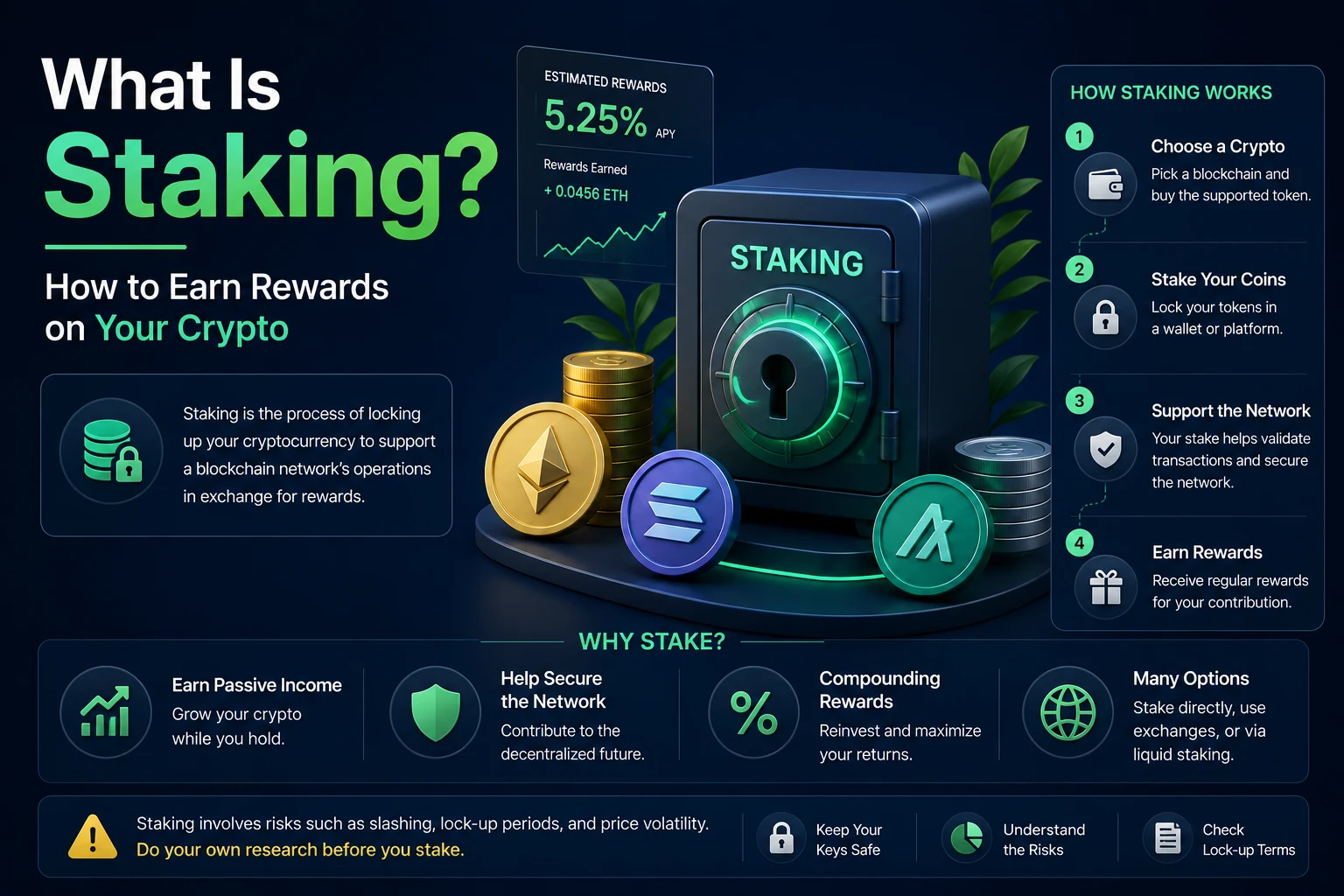
Staking is the act of locking up your cryptocurrency to help operate and secure a blockchain that uses proof of stake. In return for putting your coins to work supporting the network, you earn rewards — typically paid in more of the same coin. You are not lending to a bank; you are contributing to the security of a decentralized system, and the network pays you for it.
Why networks pay you to stake
Proof-of-stake blockchains rely on validators to process transactions and produce blocks honestly. To become or support a validator, you stake coins — putting real value on the line. If validators behave honestly, they earn rewards. If they cheat or fail, they can lose part of their stake. This economic incentive is what keeps the network secure, and staking rewards are the network sharing that value with the people who help secure it.
This is fundamentally different from proof of work mining, which uses electricity and hardware instead of staked capital.
The ways you can stake
Not all staking is equal in effort or risk.
Solo staking
You run your own validator with the full required amount of coins. Maximum control, maximum rewards, maximum responsibility — you need technical skill and reliable uptime, since downtime can cost you. This is the most decentralized option and the most demanding.
Staking pools
You combine your coins with others to meet the validator threshold, sharing rewards proportionally. Far more accessible — you can stake small amounts — at the cost of trusting the pool operator and sharing rewards.
Exchange and custodial staking
Many exchanges offer one-click staking. Easiest by far, but you hand custody to the exchange and accept its terms and fees. Convenient, but "not your keys" applies.
Liquid staking
A newer model: you stake your coins and receive a tradable token representing your staked position, which you can use elsewhere in DeFi while still earning staking rewards. Powerful, but it stacks additional smart-contract risk on top.
Understanding the rewards
Staking rewards are often quoted as an annual percentage yield. Treat these numbers with care:
- They are not guaranteed. Rewards vary with network conditions and total amount staked.
- They are paid in the crypto, not dollars. If the coin's price drops more than your rewards, you can still lose value overall.
- High advertised yields signal high risk. Suspiciously large returns usually hide a catch.
And remember the tax angle from our crypto taxes guide: staking rewards are usually taxable income when received.
The risks worth knowing
- Lock-up periods. Many networks require your coins to be locked for a time, during which you cannot sell — even if the price crashes.
- Slashing. Validators that misbehave or go offline can be penalized, and that loss can flow to those who staked with them.
- Price volatility. Your rewards mean little if the underlying asset falls sharply.
- Custodial and smart-contract risk. Depending on how you stake, you may be trusting an exchange, a pool, or a protocol's code.
None of this is financial advice. Staking can be a reasonable way to earn on assets you already intend to hold long-term — but it is not free money, and it is not risk-free.
Stake with awareness
Staking decisions depend on network health, upgrade schedules, and shifting reward rates — all of which move with the news. Zippfeed tracks staking, protocol, and network headlines with sentiment and importance scoring, so you can stay aware of changes that affect your staked assets — upgrades, slashing incidents, or reward adjustments — rather than finding out after your position is affected.


 WuBlockchain
 CryptoSlate
 Glassnode
 WatcherGuru
 Altcoin Daily