The 4-year cycle in one sentence
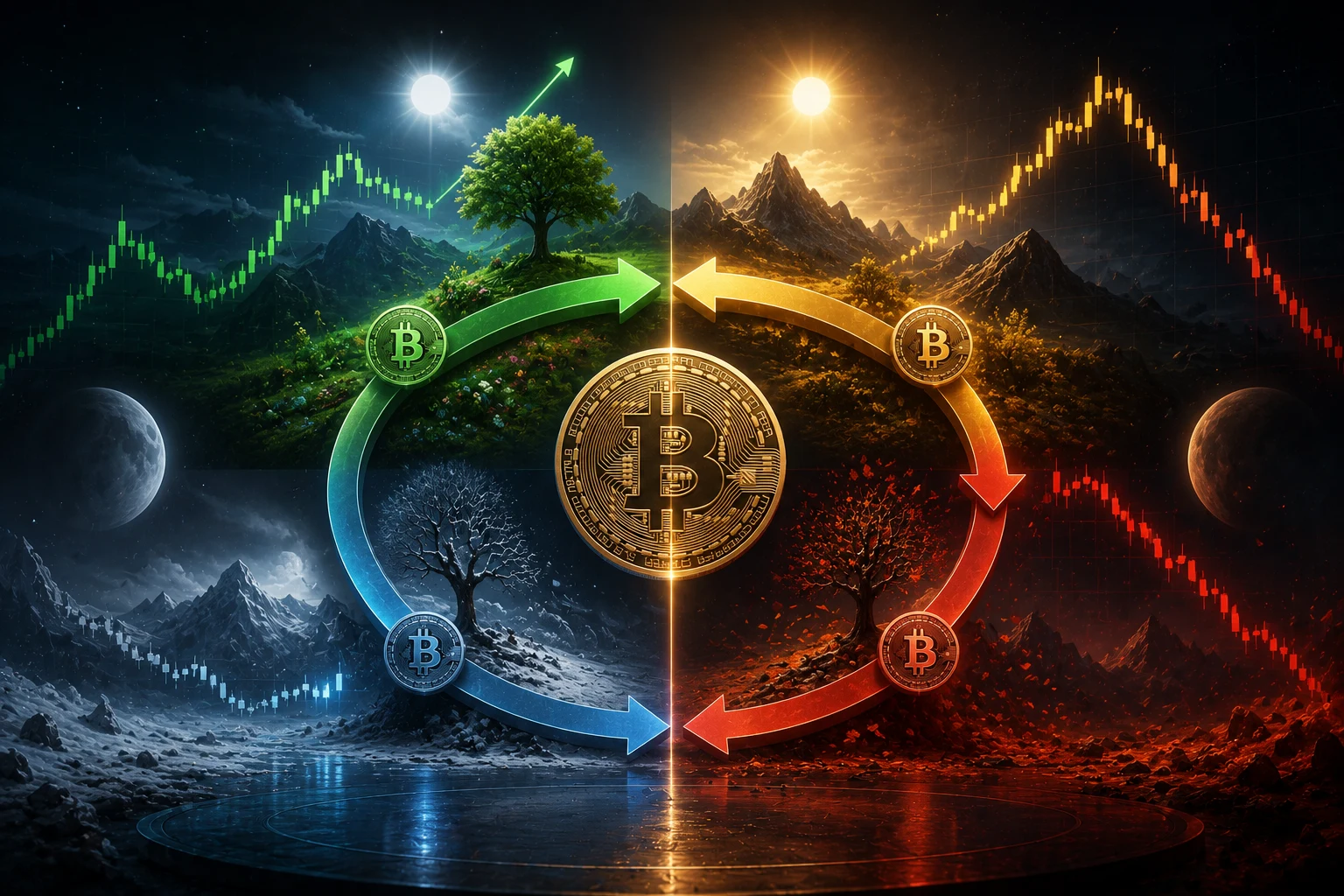
The crypto 4-year cycle is a recurring rhythm of bull and bear markets in which Bitcoin and the rest of crypto tend to bottom, accumulate, run, top and decline over a span of roughly four years, with the timing loosely anchored by Bitcoin's halving — a programmatic event that cuts the rate of new Bitcoin issuance in half every 210,000 blocks. Three cycles have now played out closely enough to this pattern that the framework is part of every serious operator's mental model, even though the next cycle may rhyme less cleanly than the last.
The mental model: treat the 4-year cycle as a tide, not a clock. The tide rises and falls reliably, but the exact timing of any wave varies, and other forces (storms, ships, currents) push the water around inside the tide.
The halving: the cycle's anchor
Every 210,000 blocks — roughly every four years — the reward Bitcoin miners receive for producing a block is cut in half. This is hardcoded into Bitcoin's protocol; it cannot be voted on or skipped. The next halving lowers issuance from the current rate to its successor; the one after that does it again. This will continue until the year 2140, by which point all 21 million Bitcoin will have been mined.
The economic story is straightforward. Bitcoin's supply growth rate halves at each halving. With demand staying the same, less new supply per block means more upward price pressure. With demand growing, the effect is amplified. This is why halvings historically precede strong runs.
The four halvings to date occurred in 2012, 2016, 2020 and 2024. The first three were each followed by major bull markets that peaked roughly twelve to eighteen months later. The 2024 cycle is currently playing out. Each cycle has differed in magnitude — gains have shrunk over time as Bitcoin's market cap has grown — but the directional pattern has held.
For the protocol-level mechanics of the halving itself, see our what is a bitcoin halving guide.
The four phases of a cycle
Across cycles, four phases tend to repeat in roughly the same order.
Accumulation
The quiet phase at the end of a bear market and the beginning of the next bull. Prices are flat to slowly rising. Volume is low. Mainstream interest has evaporated; conferences are small and Twitter is dull. This is when long-term holders quietly add to positions and when most of the next bull's gains are baked in for those who buy. It typically lasts six to twelve months.
Bull market
The reflexive uptrend. New buyers come in, prices rise, gains attract more buyers, narratives flourish, altcoin rotations begin. Bitcoin usually leads early; Ethereum follows; major altcoins next; long-tail altcoins and memecoins peak last. This phase has historically lasted twelve to eighteen months from the start of the obvious run to the cycle top.
Distribution
The choppy phase near the highs. Prices stop rising cleanly and start churning sideways with sharp moves in both directions. Smart money quietly takes profit. Mainstream attention is at its peak — TV, podcasts, your relatives asking about coins. This phase is short and easy to miss because each pullback feels like a buying opportunity. It can last weeks to a few months.
Bear market
The long, painful decline. Bitcoin falls 70-85%, altcoins 90-99%. Sentiment dies, volumes collapse, narratives invert. The bear has historically lasted twelve to eighteen months of falling, followed by another six to twelve months of flat-bottoming before the next accumulation phase begins. We go deeper in our what is a crypto bear market guide.
Why this pattern existed at all
The 4-year cycle was never explicitly designed. It emerged from three reinforcing dynamics.
First, the halving itself. Cutting new issuance in half is a real supply-side change that shifts the marginal balance of new buyers versus new sellers.
Second, attention. A halving is a known event that draws coverage twelve to eighteen months in advance. That coverage attracts new buyers, who attract more, in a textbook reflexive cycle. By the time the bull is obvious, the trade has already worked.
Third, reflexivity. Markets that lack underlying earnings to anchor valuation are extremely sensitive to flows and narrative. Crypto runs on narratives more than most asset classes, and narratives swing in waves. The 4-year cadence happens to fit the typical duration of one narrative arc — the time from a story emerging, becoming consensus, getting overplayed, and dying.
None of these guarantees the pattern continues. They explain why it has worked so far.
How the pattern has bent over time
The first three cycles roughly rhymed but they were not identical, and the differences point to where the pattern is going.
Cycle gains have shrunk. Bitcoin went from low single-digit dollars to about $1,000 in 2013, from ~$200 to ~$20,000 in 2017, from ~$3,000 to ~$69,000 in 2021. Each cycle is a smaller percentage gain than the last, because the asset is bigger and harder to move.
Cycle length has been less precise than the schedule suggests. The 2013 cycle was actually two peaks ten months apart. The 2021 cycle had two peaks separated by a few months. Tops do not arrive on the date a model predicts to the week.
Altcoin behavior has shifted. In earlier cycles, altcoins as a group rotated late and outperformed Bitcoin into the top. In the 2021 cycle, this was less consistent — sectors took turns, and many altcoins peaked months apart from each other. The 2024 cycle so far has favored Bitcoin and a small number of dominant tokens over broad altcoin runs.
External flows now dominate. The 2024 cycle introduced spot Bitcoin ETFs in major markets, bringing institutional flows that did not exist in earlier cycles. These can blunt or amplify the halving effect depending on how they move.
Why the 4-year frame may be loosening
Several serious operators argue the strict 4-year cycle is becoming less useful as a model. The case has merit.
The halving's marginal effect shrinks each cycle. Going from 6.25 to 3.125 new Bitcoin per block is a smaller proportional change than going from 12.5 to 6.25, and far smaller than the original cut from 50. At some point the halving stops being the dominant driver and becomes a side note.
Macro now matters more. Bitcoin and crypto markets have become increasingly correlated with global liquidity, rate cycles and risk-on sentiment. A halving in the middle of a global tightening cycle and one in the middle of a loosening cycle look very different.
Institutional buyers do not follow retail rhythms. A pension fund or sovereign wealth fund that allocates to a Bitcoin ETF has its own decision timeline, not one keyed to Bitcoin's protocol calendar. As these flows grow they smooth out the older retail-driven pattern.
None of this means the cycle disappears. It means future cycles likely look softer — shallower bears, less explosive bull tops, more sensitivity to outside factors. Useful as a frame, less useful as a precise schedule.
How to use the cycle without becoming a slave to it
The framework is a tool, not a prophecy. The pragmatic ways to use it.
As context, not timing. Knowing roughly where you are in the cycle helps you decide how aggressive to be with capital, but precise tops and bottoms cannot be timed reliably. Operate inside ranges, not single dates.
To stay disciplined at extremes. The most useful moment for the cycle frame is at extremes. When you are convinced the bull will never end, knowing you are likely in a distribution phase helps you take some profit. When you are convinced the bear is permanent, knowing you are likely in an accumulation phase helps you keep buying.
For position sizing across phases. Many operators size larger in accumulation, hold through the bull, trim in distribution and stay defensive through the bear. The cycle frame gives a rough map for when each behavior makes sense.
To recognize when the cycle bends. The cycle has held three times; the fourth is in progress. Reasonable confidence does not mean certainty. Hold the framework loosely so you can update when reality diverges.
What about non-Bitcoin assets?
Altcoins do not have halvings, but they have historically moved with the broader cycle because they trade against Bitcoin and respond to the same flows and narratives.
Ethereum tends to follow Bitcoin with a slight lag — peaking weeks to months later. Major altcoins follow Ethereum. Long-tail altcoins move last and most violently. This sequencing has been one of the more reliable patterns within a cycle, though it has weakened in recent cycles.
Stablecoins are the exception. Their supply grows when capital flows into crypto and shrinks when capital leaves, making total stablecoin supply a useful sentiment indicator for the broader cycle. Rising stablecoin float during a bear can be an early sign of accumulation.
Following cycle-level news with the right lens
Cycle-level news — halving countdowns, institutional flows, regulatory clarity, macro liquidity shifts — moves the whole market and not just individual assets. Reading these correctly is what separates operators who survive multiple cycles from those who flame out in one. Zippfeed surfaces cycle-relevant headlines with a sentiment score (bullish, neutral or bearish) and an importance rating, so the news that actually shifts the cycle frame reaches you separately from the daily noise. This is education, not financial advice — but the people who hold positions across multiple 4-year cycles are the ones who read structural shifts early rather than reacting to every wiggle.

 CryptoSlate
 Glassnode
 WatcherGuru
 Altcoin Daily
 WuBlockchain