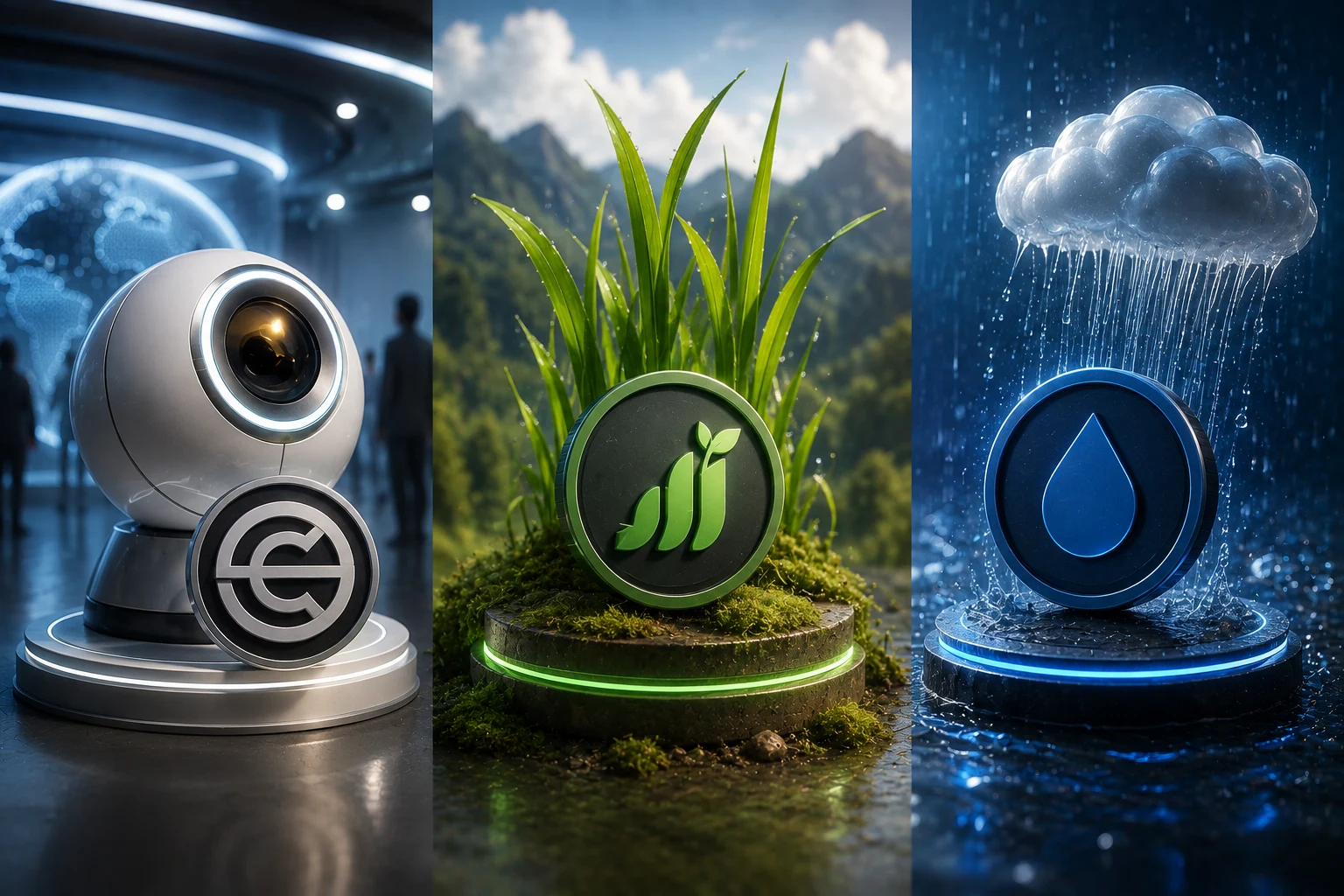
Why these three tokens keep getting compared
Search engines, influencers, and AI-overview tools love neat comparison tables, and the human-verification niche offers a tempting one: three tokens, three slightly different pitches, one shared theme of 'verifying humans in an AI-saturated internet.' That surface-level similarity is exactly why readers need a careful breakdown, because the mechanics, the data being collected, and the risk profile diverge more than the headlines suggest.
WLD, the token of the Worldcoin project founded by Sam Altman and Alex Blania, anchors the group as the oldest and most controversial. Grass, built on Solana, leans into a different pitch: instead of verifying who you are, it pays you for unused internet bandwidth that it aggregates and resells to AI labs training models. Rain is the newcomer, marketing itself as a proof-of-humanity layer with a different verification approach and a separate token (RAIN) that has drawn both curiosity and skepticism since launch.
All three trade on the implicit promise that 'proving you are a human' will matter more as AI agents flood the internet, and that being early to a verification token could capture value. That promise is plausible, but it is not the same as saying any of these tokens will appreciate. A token's price depends on issuance schedules, demand for the underlying service, regulatory outcomes, and whether the verification model survives contact with regulators and competitors.
The biggest risks before you sign up for anything
Before getting into how each project works, it is worth naming the category-level risks, because they apply regardless of which token you are considering.
Biometric data is the headline risk for WLD
Worldcoin's 'Orb' device captures an image of your iris and converts it into a short code called an iris hash. That hash is what proves you are a unique human, and in theory it cannot be reversed into an image of your eye. In practice, you are trusting that the project's cryptography, custody, and corporate governance hold up over decades, because unlike a password or even a phone number, you cannot rotate your iris. If a future breach or policy change exposes that biometric hash, there is no reset button. Several national regulators, including authorities in Kenya, Spain, Portugal, Germany, South Korea, and Argentina, have investigated, suspended, or restricted Worldcoin operations over data-protection concerns.
Token rewards are not a salary
All three projects pay users in tokens, and all three are free to change those payouts. Token rewards are funded by emissions (newly minted tokens entering circulation) and, in some cases, by fees the protocol earns. When emissions are high and the user base is small, daily payouts can look generous. As more users join, rewards per user typically fall. The dollar value of those rewards also depends on the token's market price, which can drop sharply when early insiders or the project treasury sells.
'Proof of humanity' does not equal income or rights
Holding a verified-human credential does not, by itself, entitle you to anything in particular. It may unlock certain app features, airdrops, or governance rights inside a specific protocol, but it is not a passport to universal basic income, a job, or a UBI-style dividend. Treat that framing skeptically when you see it in marketing copy.
Worldcoin (WLD): the iris-scan pioneer
Worldcoin's pitch is the boldest of the three. Visit an Orb operator, look into the device, prove you are a unique human, and receive a World ID plus a starter allocation of WLD. The promise is that, as AI makes it cheaper to fake humans online, a global proof-of-personhood primitive will be valuable infrastructure.
How the token and verification work
The Orb captures an iris image, runs it through on-device models, and produces an iris code. That code is checked against a database to confirm you have not signed up before. The image is deleted by default, and only the hash is stored on-chain or in the project's data layer. You then receive a World ID, which is a zero-knowledge credential you can present to third-party apps to prove you are a unique human without revealing which human.
WLD itself is an ERC-20 token on Optimism, an Ethereum layer-2 network. It is used for governance and for paying Orb operators and certain service providers. Early users in many regions received bonus allocations, which is part of why the project became famous in the first place.
The controversies, in plain language
Regulators in multiple countries have raised concerns about whether informed consent is real when an Orb is operated in a low-income area and users are paid in tokens, whether the project's data-protection practices meet local law, and whether minors or coerced users were enrolled. The project's parent company, Tools for Humanity, has disputed these criticisms, but the investigations themselves are a real risk to WLD's addressable market.
There is also a quieter, more durable concern: a globally unique biometric hash tied to a wallet is an attractive target. Even if the current cryptography holds, the political and commercial pressure on a database of 'every human on earth' is unusual, and the project's history of partially centralized control over the Orb hardware and the World ID database has drawn criticism from crypto purists who would prefer a fully decentralized design.
Grass: bandwidth, not biometrics
Grass pitches itself as the 'data layer for AI.' Instead of asking for your iris, it asks for your unused internet bandwidth. You install a browser extension or a desktop node, and the application routes traffic through your connection, which is then aggregated and resold as scraping or proxy capacity to AI labs and researchers who need large-scale web access.
What you are actually contributing
When Grass is running, your device is acting as a residential proxy node. That means requests from Grass's customers may appear to originate from your IP address, which is what makes residential proxies valuable for legitimate academic and competitive-intelligence research, and also for less legitimate uses like bypassing geo-restrictions. The project's official position is that traffic is filtered, but users should know what they are opting into: a service that depends on their home or work IP being available for routing.
Grass rewards users with points that are expected to map to a token, with the first-generation token having launched on Solana. Reward rates are published, and they change. Like most 'earn' tokens, the dollar value of rewards depends on the token's market price, which in turn depends on whether there is sustained demand for bandwidth aggregation at the price the project sells it for.
Why Grass is structurally different from WLD
Grass is not a proof-of-personhood project in the strict sense. You do not verify who you are to use it, and you do not receive a unique-human credential. The pitch is 'be part of the AI training pipeline and get paid for the resource you contribute.' The risk profile is therefore different: no biometric exposure, but real exposure to your IP being used by third parties, and the usual token-economics risk that the token's price may not match the resource value you are providing.
Rain: the newer entrant
Rain is the most recent of the three and the least battle-tested, which matters. New tokens in the human-verification niche often launch with strong narratives, generous early rewards, and limited disclosure about long-term tokenomics, regulatory positioning, and customer pipeline.
What Rain claims to do
Rain positions itself as a proof-of-humanity and data-network project with a distinct verification mechanism, sometimes involving device or behavioral signals rather than iris scanning. The token (RAIN) is typically used for incentives, governance, and access to certain services inside the Rain ecosystem. As with any newer entrant, the gap between marketing copy and a working, audited product can be large.
Why the newness is itself a risk
With WLD, you can point to years of operating history, multiple regulator actions, and a public token with a long price history. With Grass, you can point to a working bandwidth product, a published token, and real customer-side demand. With Rain, you usually have a whitepaper, a launch announcement, and a chart. That does not mean Rain is illegitimate, but it does mean the discount you should apply to the project's claims is larger. Newer tokens are also more exposed to launch-day volatility, low liquidity, and the risk that early insiders hold a disproportionate share of supply.
Token economics: what you actually get paid
Across all three, the unit economics follow a similar pattern. The project issues tokens to users in exchange for some resource, then tries to build demand for the token and, ideally, for the service that token enables. If the service finds real customers, the token may accrue value. If it does not, the token's price is held up mainly by emissions, which is not a stable foundation.
Comparing the three on a few key dimensions
On data sensitivity, WLD is in a category of its own, because biometric hashes are permanent. Grass collects bandwidth and IP exposure, which is sensitive but revocable by uninstalling. Rain's data footprint depends on its verification method, but newer entrants deserve more skepticism about what they will do with the data later.
On income stability, none of the three can promise a stable payout, because token prices and reward rates move. WLD's signup bonus has varied dramatically by country and time. Grass points change with token price and network demand. Rain's rewards are the least predictable, given the project's age.
On regulatory risk, WLD faces the most documented scrutiny. Grass operates in a gray area around residential proxy use, which is legal in most jurisdictions but restricted by some platforms' terms of service. Rain's regulatory exposure is still being established.
What this means for you as a reader
If you are deciding whether to engage with any of these projects, the useful question is not 'which one will 10x' but 'what am I being asked to provide, what am I being paid, and what could go wrong.' For WLD, the honest answer is that you are providing something you cannot revoke in exchange for a token whose long-term value depends on a global verification market that does not yet exist at scale. For Grass, you are providing bandwidth and IP exposure in exchange for a token that depends on AI labs continuing to pay for residential proxy capacity. For Rain, you are providing whatever data its verification requires, in exchange for a token with the shortest track record of the three.
If you do engage, a few habits reduce harm. Use a dedicated wallet, not your main one. Read the data-retention policy, especially around deletion windows. Do not enroll under time pressure or in a way that looks like coercion, because that is the pattern regulators have flagged for WLD. And treat any 'this is the next 100x' framing as a red flag, because a project that needs that pitch usually does not have the fundamentals to support the price on its own.
How to track proof-of-personhood tokens the smart way
Proof-of-personhood and human-verification tokens move fast, and the news around them moves faster. Regulatory actions, token unlocks, partnership announcements, and reward-rate changes can shift the risk picture overnight. Trying to follow all of that manually across X, Discord, news sites, and on-chain dashboards is a losing game. Zippfeed surfaces proof-of-personhood and human-verification headlines with sentiment scoring (bullish, neutral, or bearish) and an importance rating, so you can separate signal from noise and act only on what actually changes the picture.


 Crypto News