Why two very different projects both claim "proof of personhood"
The pitch sounds similar. As AI agents multiply online, something needs to tell humans and bots apart. Both Worldcoin and RAIN argue their token and identity stack solves the "is this a real person" problem that will define the next decade of internet infrastructure.
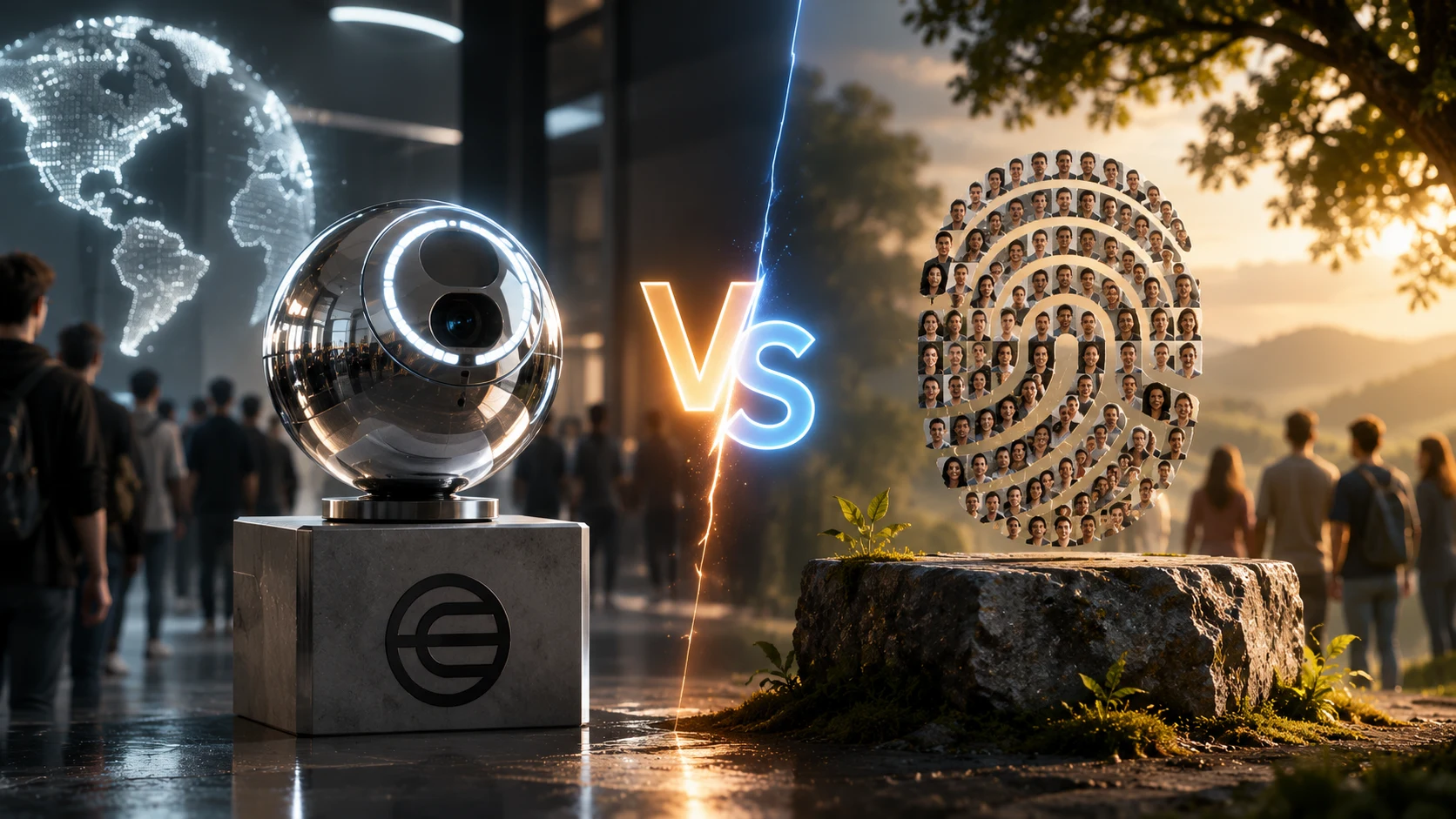
Underneath, the projects look nothing alike. Worldcoin is built by Tools for Humanity, a Berlin and San Francisco company founded by Sam Altman, and it relies on a custom hardware device called the orb that scans your iris and converts the scan into a short numeric code called an IrisHash. You receive a World ID, a zero-knowledge credential that says "this action was performed by a unique human" without revealing who that human is.
RAIN, by contrast, is built around a data network. Users contribute behavioral data, location signals, and survey-style inputs, and earn token rewards for doing so. The "proof" is that the network has validated that a wallet is backed by a real, repeat participant rather than a single farmed account. The framing is closer to a decentralized data layer than a biometric passport.
So when a reader sees "WLD vs RAIN," the honest framing is not "which one wins." It is "which definition of personhood are you actually buying, and what does each project hand to a regulator if one shows up?"
The risks every reader should see first
Identity-adjacent crypto carries risks that are easy to miss because the technology sounds abstract. Here are the failure modes that hit hardest.
Biometric data is forever. A leaked password can be rotated. An iris scan cannot. If Worldcoin's central IrisHash database is ever compromised, de-anonymization becomes a real possibility even if hashes are not raw images. Tools for Humanity claims IrisHashes cannot be reversed, but this is an engineering claim, not a mathematical proof, and the project has already faced investigations in multiple jurisdictions.
Regulator attention is not theoretical. Worldcoin has been probed or temporarily banned in countries including Kenya, Spain, Portugal, Germany, South Korea, Brazil, Argentina, and Hong Kong. Concerns range from biometric data collection under GDPR to operating without proper registration as a digital identity provider. RAIN, since it does not collect biometrics, has so far attracted less direct scrutiny, though its data-rewards model touches consumer protection rules in the EU and US.
Centralization lives in the supply chain. Worldcoin orbs are produced by a small set of suppliers, and orb operators are the gatekeepers who verify real humans. If the orb fleet becomes obsolete, gets sanctioned, or its firmware stops being maintained, the entire identity layer stalls. RAIN's centralization risk sits lower in the stack: in the oracle and data-validation layer that scores contributions.
User counts and token holders rarely match. Both projects love to quote cumulative sign-ups. Worldcoin has claimed tens of millions of World ID verifications. RAIN and similar projects quote wallets or accounts. In both cases, the on-chain active token-holder count is a small fraction of the headline number. Treat any "X million users" figure as a marketing metric until you see the MAUs and the token distribution.
Tokens are not equity. Holding WLD does not give you ownership of Tools for Humanity, and holding RAIN does not entitle you to a share of platform revenue. Both tokens are utility and governance instruments within ecosystems that the core team still controls. If the team pivots or stops shipping, the token can lose relevance fast.
How Worldcoin's iris-orb model actually works
The user flow is the easiest place to start. You visit a verification site, get your iris scanned by an orb held by an operator, and your device receives a World ID credential. The orb generates an IrisHash, a 12,800-bit code derived from the scan, and checks against a server-side database to confirm you have not enrolled before.
Once you have a World ID, you can use it across integrations. The largest real consumer surface is World App, Tools for Humanity's wallet. You can also use your World ID to log into partner apps like Reddit, Discord, or various DeFi front-ends to claim that an action came from a unique human rather than a bot.
Privacy claims rest on three pillars. First, the orb is supposed to delete the raw image locally and only store the IrisHash. Second, the IrisHash itself is designed so that two scans of the same eye produce the same code, but the code cannot be inverted to recover an image. Third, when you sign an action with your World ID, you generate a zero-knowledge proof that says "someone with a verified World ID did this" without revealing which World ID.
The trade-off is structural. To deliver those guarantees, Worldcoin depends on a closed hardware supply chain, a centralized verification backend, and a small group of orb operators. Tools for Humanity has been publishing more of the orb's software and moving parts of the stack on-chain, but the orb itself remains a black box you have to trust.
How RAIN's data-contribution model works
RAIN reframes the problem. Instead of proving you are a unique human through biology, it proves you are an active, contributing human through data you feed the network. Users install a client, share behavioral data such as app usage patterns, location, or survey responses, and receive token rewards.
The "proof of humanity" comes from the aggregation layer. Patterns that look like bot farms, single-account farms, or sybil attacks get filtered out by oracles and reputation scoring. Over time, a wallet builds up a history that is hard to fake, and that history becomes the credential other apps can read.
This design has practical appeal. There is no iris scan, no physical device, no operator in the loop. Any internet user can join. For AI agent economies, the pitch is that RAIN's data layer can feed models with verified human data, creating a marketplace where agents pay for proof-of-human contributions.
The trade-offs are equally real. You are trading biometric privacy for behavioral privacy. The data you contribute is often the kind of data that data brokers and ad networks already collect, but now there is a token attached, which can pull in consumer protection regulators. And the data itself, not just your identity, becomes the asset the network monetizes.
What the tokens actually do
WLD is the native token of the Worldcoin network. It is used for transaction fees in World App, for governance over the Worldcoin protocol, and as the incentive orb operators and verifiers receive. The total supply is capped at 10 billion WLD, with emissions spread over many years, and a meaningful share held by Tools for Humanity and the team.
RAIN's token mechanics are simpler on the surface. Contributors earn RAIN for sharing data, and applications that want access to the network pay in RAIN or in tokens that get swapped into RAIN. The token also serves as the staking and governance asset for the validation layer.
The practical difference is what each token gates. Holding WLD does not get you a World ID. Holding RAIN does not get you a higher reputation score. The tokens sit on top of their respective identity stacks rather than inside them. That is worth keeping in mind when you see price charts treating them like pure speculation vehicles.
Liquidity and exchange access also differ. WLD trades on major centralized exchanges and has deep perpetual futures markets, which means price moves can be amplified by leverage. RAIN has thinner liquidity, which can mean bigger swings on small volume but also slower price discovery and more slippage for larger orders.
User counts vs token holder counts
Both projects lean on user metrics, and both deserve scrutiny. Worldcoin has reported tens of millions of World IDs created, with verifications spread across dozens of countries. Tools for Humanity publishes verification numbers, app downloads, and active wallet counts. The gap between "people who got scanned once" and "people who transact in WLD every week" is large.
RAIN's headline numbers tend to focus on contributors and data submissions. On-chain, the active wallet count for the RAIN token is a small fraction of those contributors. Many participants earn small balances and never transact further. That is normal for reward networks, but it means "adoption" is not the same as "demand for the token."
When comparing the two, the honest question is not who has more users. It is who has more users who repeatedly use the identity or data layer for something other than claiming an airdrop. Neither project has published strong numbers on that question, which is itself a signal.
The agent-economy angle, honestly assessed
The strongest pitch for both projects is the same: as AI agents proliferate, they need a way to interact with humans without spam and Sybil attacks collapsing every incentive system. Worldcoin argues that a biometric, one-person-one-ID credential is the cleanest primitive. RAIN argues that a behavioral, data-rich network is more useful for training and paying agents.
In practice, both are early. World ID integrations outside the World App ecosystem are limited. RAIN's data marketplace is still being built, and the agent integrations that depend on it are even earlier. Neither token is yet a critical piece of internet plumbing, even if both teams are working hard to make them one.
The risk for buyers is that the narrative runs ahead of usage. "Proof of personhood for the AI era" is a real problem, but the project that solves it at scale may not be either of these. Treating both WLD and RAIN as bets on the category rather than guarantees of dominance is the most honest frame.
How to follow proof-of-personhood projects the smart way
Identity projects like Worldcoin and RAIN move on three signals that matter more than price: regulatory news, integration announcements, and real user growth. Zippfeed surfaces proof-of-personhood and AI-crypto headlines with sentiment scoring (bullish, neutral, or bearish) and an importance rating, so you can spot which news actually shifts the thesis versus which is just noise.


 Crypto News