Why a 25-year-old web status code is suddenly relevant again
Every time you load a webpage, your browser and the server exchange short numeric codes. The famous "404 Not Found" tells you a page is missing. "200 OK" means everything worked. Buried in the original HTTP/1.1 specification published by the Internet Engineering Task Force in 1997 is a status code that almost nothing on the internet has ever used: 402 Payment Required. The IETF reserved it for future digital cash and micropayment systems that did not yet exist.
For more than two decades, 402 sat in the spec as a placeholder. Nobody implemented it because the web had no good way to move money atomically with a single request. Credit cards need a session. Bank transfers take days. Subscriptions require accounts. There was no native internet-native way for a piece of software to pay another piece of software for one request and walk away.
Stablecoins changed that. Networks like Ethereum, Solana, and Base now settle dollar-denominated tokens such as USDC in seconds for fractions of a cent. That makes it economically possible to attach a tiny payment to a single HTTP call, which is exactly what x402 does. The protocol, developed by Coinbase and a group of open contributors, takes the dormant 402 status code and turns it into a working payment handshake between a client and a server.
How x402 actually works, step by step
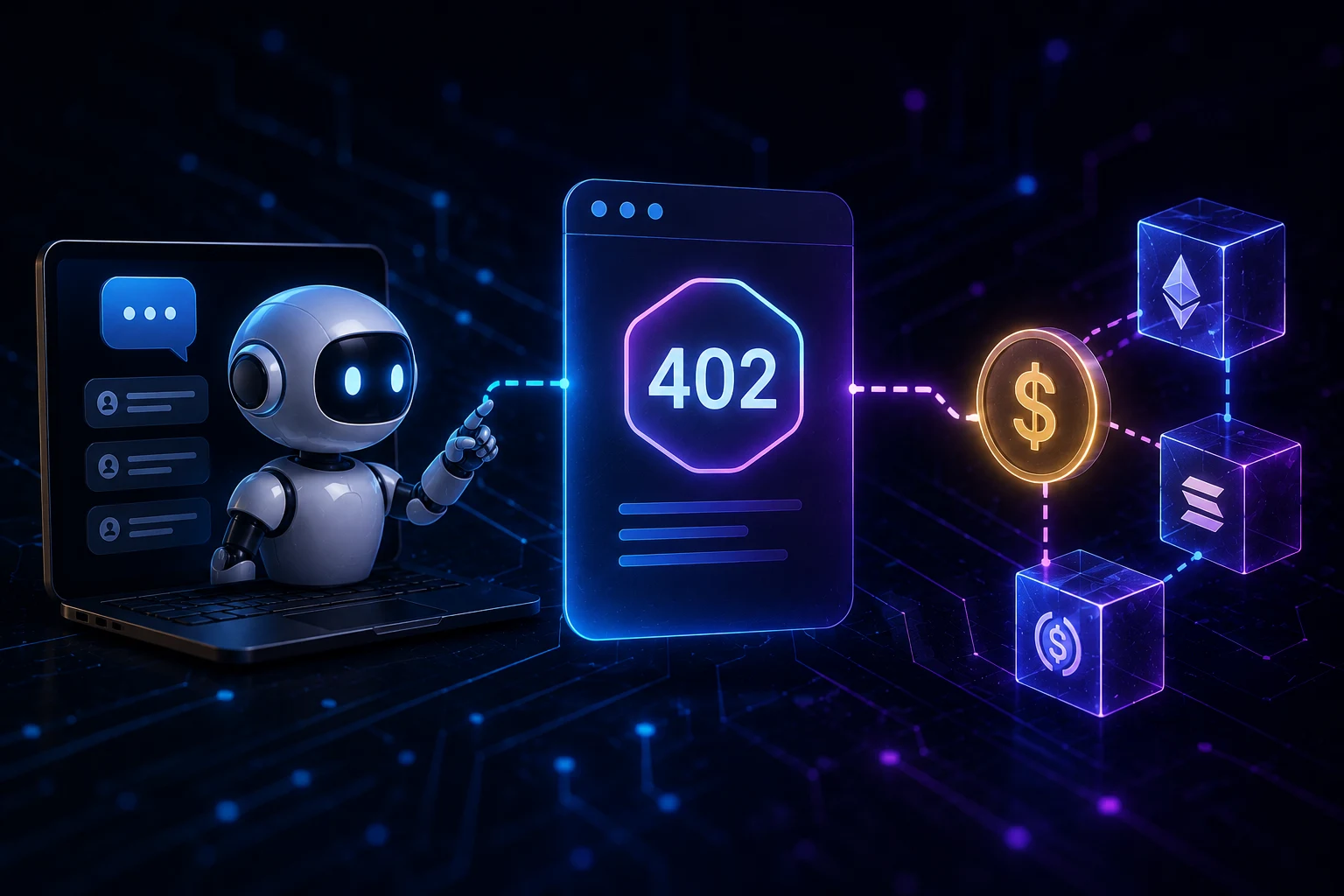
At its core, x402 is a small set of rules that say: if a server wants payment for a resource, it can reply with HTTP 402 and include structured headers describing how to pay. The client then signs a stablecoin payment, attaches it to a retried request, and gets the resource back. No subscription, no signup, no API key. The payment and the response ride on the same HTTP exchange.
The flow has four actors. A client is whatever is making the request, usually an AI agent or a script. A resource server is the API or website being called. A facilitator verifies the payment and broadcasts the transaction on-chain. And a settlement network is the blockchain where the stablecoin actually moves. Today the reference implementation targets USDC on Base, but the spec is chain-agnostic.
Concretely, when an AI agent calls a paid endpoint, the server returns a 402 response with headers that name the price, the asset, the recipient wallet, and the network. The agent's wallet constructs a signed payment payload — essentially a one-time authorization to move USDC from the agent's address to the server's address. The agent then re-sends the original request with the payment proof attached. The facilitator confirms the signature and the funds, broadcasts the transfer, and the server delivers the data. From the agent's point of view, the entire loop is one HTTP call and one stablecoin transfer.
What makes this design interesting is that the server never has to know who the client is. There is no account creation, no API key to leak, and no monthly invoice to reconcile. The price is stamped into the 402 response itself, so any client that can read headers and sign a transaction can buy access.
Where x402 came from and who is building it
The 402 status code was reserved in the original HTTP/1.1 RFC 2068, published in 1997, with a note that it was reserved for future use in digital cash or micropayment schemes. Two competing ideas in the late 1990s, micro-payments and digital cash, never quite worked out at consumer scale, so 402 became an internet curiosity that showed up mostly in jokes.
In 2024, Coinbase published the x402 specification as an open standard, alongside a reference implementation on GitHub. The company framed it as public infrastructure for the emerging "agent economy," the idea that autonomous AI agents will eventually need to pay for services on their own without a human swiping a credit card on their behalf. Other contributors, including independent developers and teams working on wallet tooling, have started to extend the spec, build facilitators, and integrate it into agent frameworks.
It is important to stress what x402 is not. It is not a token, not a coin, and not an investment. There is no "x402 coin" to buy on an exchange. The standard is plumbing, a way for two pieces of software to settle a payment using the HTTP they already speak, and it is deliberately designed so that any wallet, any chain, and any facilitator can plug in.
The risks and open questions that nobody has solved yet
Any honest look at x402 has to acknowledge that the protocol is young, and several hard problems are still genuinely open. These are not nitpicks; they are the questions that will decide whether x402 becomes real infrastructure or remains a clever demo.
Identity and authorization. HTTP payments solve "how do I pay," but they do not solve "who am I allowed to pay as." Today, a misconfigured or malicious agent can drain its owner's wallet by hammering paid endpoints, because nothing in the protocol prevents runaway spending. Wallets, agent frameworks, and policy layers will need to add budget caps, allowlists, and rate limits on top of x402. The standard itself does not yet mandate any of this.
KYC and compliance. If a server accepts USDC from anonymous agents worldwide, regulators in many jurisdictions will eventually want to know who is on the other end. x402 currently has no built-in identity layer. Servers that need to comply with sanctions or anti-money-laundering rules will have to bolt on their own checks, which weakens the "no account needed" promise. Expect this tension to be one of the defining political fights around the protocol.
Gas and fee economics. Sending USDC on a base-layer chain still costs gas, and that gas is usually paid in the chain's native token, not in USDC. For a true micro-payment economy, where a request might cost a fraction of a cent, gas can swamp the payment itself. The fix in practice is gas sponsorship: a facilitator or paymaster covers the native token fee and recoups it elsewhere. Several teams are experimenting with this, but it is not standardized.
Refund and dispute flows. Credit cards have chargebacks. x402, like most blockchain payments, does not. Once an agent pays for a response and receives garbage, there is no native way to claw the money back. Some servers may offer off-protocol refunds, but the standard itself is silent on disputes. This makes x402 a poor fit for high-stakes purchases and a good fit for cheap, easily re-tried data calls.
Facilitator trust. Today most x402 implementations rely on a small number of facilitator services to verify payments and broadcast transactions. If a facilitator goes down or censors payments, the network effect collapses. The spec is designed to allow many facilitators, but the ecosystem is not there yet, and centralization of this layer is a real systemic risk.
What this means for AI agents in practice
The clearest near-term use case for x402 is the kind of small, frequent, pay-as-you-go API call that an AI agent makes thousands of times a day. Imagine an agent that needs a weather lookup, a translation, a piece of market data, or a generated image. Today each of those requires the agent's operator to have pre-provisioned an account with the relevant provider, with a stored API key, a monthly plan, and rate limits that were negotiated for a human user. x402 lets the agent discover the price on the fly, pay per request, and never touch a signup form.
That shift has knock-on effects. API providers can monetize tiny slices of their service without running a billing system. Wallet developers get a new integration point: any wallet that speaks x402 becomes, in effect, a payment layer for the agent economy. And agent frameworks can treat the network as a marketplace, shopping for the cheapest response rather than the cheapest monthly plan.
None of this requires x402 to be the only payment protocol for agents. There will probably be several competing standards, and many teams are likely to combine x402 with signed receipts, reputation systems, and identity layers. But x402 is one of the first attempts to put a stablecoin payment directly inside the HTTP request itself, and that is a meaningful design choice rather than a marketing slogan.
How to evaluate x402 without the hype
For developers, the practical move is to read the specification, run the reference implementation against a test endpoint, and judge for yourself whether the handshake is clean enough to build on. Treat it like any other open standard: look at the on-chain settlement guarantees, the failure modes when a facilitator is offline, and the policies your own wallet needs to enforce so an agent cannot overspend.
For everyone else, the right framing is that x402 is infrastructure, not an asset. There is nothing to buy, no price to watch, and no guaranteed adoption curve. The honest read is that a real problem exists, that stablecoin payments are finally cheap enough to address it, and that this is one credible attempt to do so. Whether it becomes the dominant standard will depend on how the open questions above get answered, and by whom.
Follow x402 development the smart way
x402 is moving fast because AI agents, stablecoins, and open payment standards are all evolving at the same time. Manually tracking GitHub commits, forum threads, and scattered blog posts is a losing game. Zippfeed surfaces x402 and stablecoin-payment headlines with sentiment scoring (bullish, neutral, or bearish) and an importance rating, so you can tell the real protocol upgrades apart from the noise.

 CoinDesk
 CryptoSlate
 TheBlock
 Lookonchain