What is an AI agent launchpad, really?
An AI agent launchpad is a one-click website that lets anyone deploy a token pegged to an autonomous software agent. In practice that means a smart contract, a chat or X account that posts on its own, sometimes a wallet that trades on its own, and a tradable ticker that anyone can buy within minutes. The launchpad handles the boring parts: creating the token, seeding initial liquidity, listing it on a DEX, and giving it a page where people can trade.
The reason these platforms exist is that, before they did, launching a token required either Solidity knowledge or a few thousand dollars for a developer. Launchpads collapsed that cost to a wallet signature and a small fee. The trade-off is quality control. When deployment is free and instant, almost every token launched is junk, and the platform's main job becomes separating the tiny minority that people actually want from the giant pile that they do not.
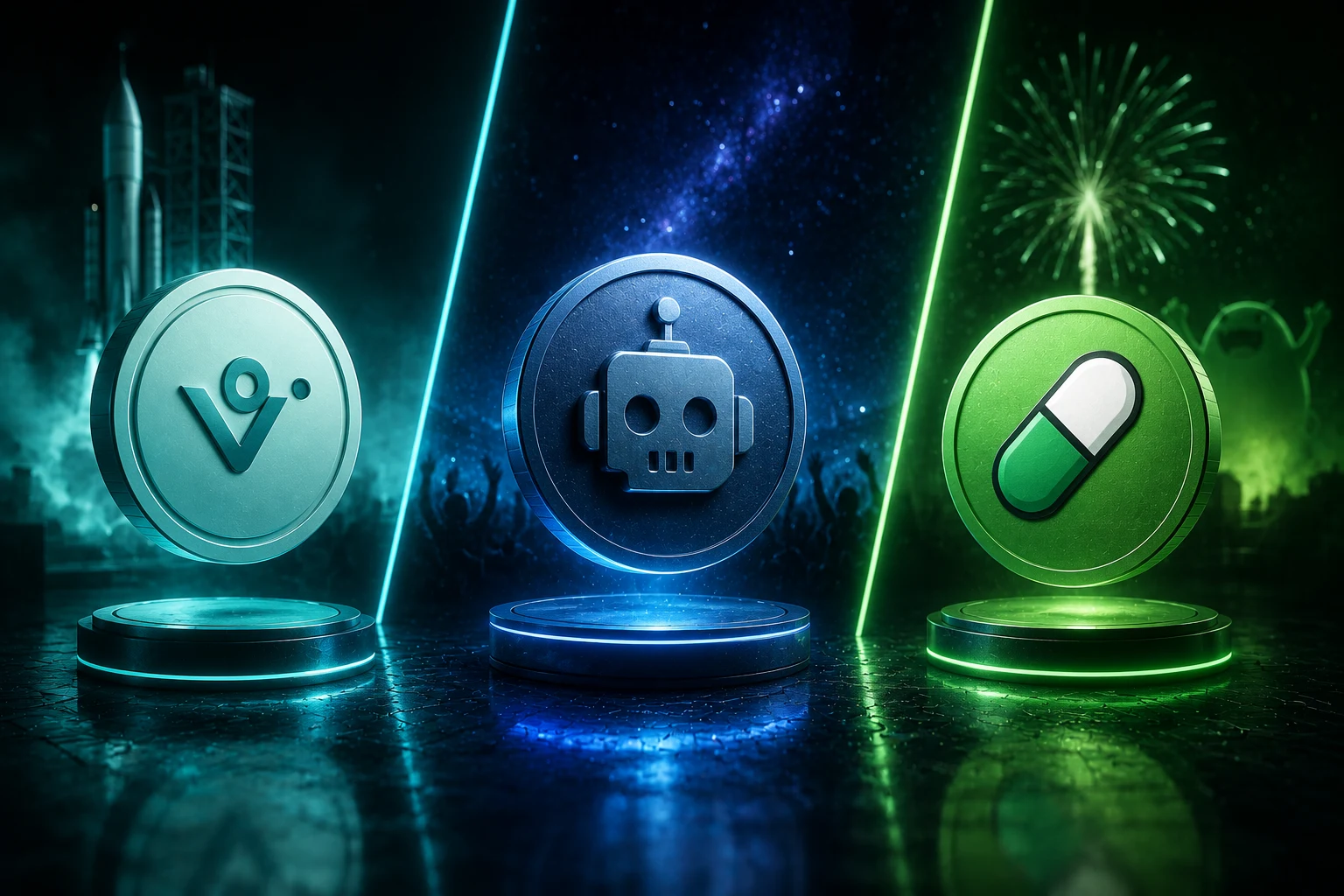
The three platforms in this comparison solve that separation problem differently. PUMP.fun pioneered the bonding-curve model on Solana, where every token starts with a fixed liquidity curve and only graduates to a real DEX pool once enough buyers show up. Virtuals extended the same idea to Base and tied every token to an AI agent personality. Clanker, also on Base, took the bonding-curve mechanic and stripped it back to a minimal, creator-friendly form. Same rough idea, very different economies, and three different tokens sitting on top.
The risks before the rewards
Before talking about which token 'wins,' it is worth being honest about what tends to happen on these platforms. Most tokens die. Independent trackers and Dune dashboards covering PUMP.fun have repeatedly shown that well over 90 percent of graduating tokens fall below their initial market cap within days of graduation, and the non-graduating majority simply go to zero on the curve itself. Virtuals and Clanker show similar shapes on smaller sample sizes.
Rug pulls are not rare edge cases; they are the dominant outcome for any token whose team can drain liquidity. On PUMP.fun, the bonding curve technically protects against a classic liquidity rug because the liquidity lives in the contract, not in a team wallet, but creators still walk away with the creator fee stream and any tokens they pre-mint for themselves. On Virtuals and Clanker, rug patterns range from agent accounts going silent after launch to creator wallets dumping the moment price spikes. There is no insurance, no refund, and no recourse on any of the three platforms.
Then there is the platform-token risk. VIRTUAL, PUMP, and CLANKER each sit above their own economies, which means a slow month for the launchpad translates directly into a slow month for the platform token. Worse, none of the three has a contract that legally obligates the team to keep distributing fees forever. Code can be upgraded, fee switches can be toggled, and a single governance vote can redirect revenue elsewhere. Buyers of the platform token are trusting an ongoing business decision, not enforcing a property right.
PUMP.fun: bonding-curve pioneer, token still mostly a promise
PUMP.fun launched on Solana in early 2024 and essentially defined the modern bonding-curve launchpad. The mechanics are simple. Every token starts on a curve inside the PUMP.fun contract. Buyers put in SOL, get the token, and the price walks up the curve. When the curve fills to roughly 69,000 dollars of liquidity, the token 'graduates,' PUMP.fun deposits that liquidity into Raydium, and a chunk of the token supply is burned so the graduated pool is no longer controlled by the curve.
How PUMP.fun earns is also simple. The platform takes a 1 percent cut of every trade on its curve, and a separate 1.5 percent cut on the graduated Raydium pool that the platform seeds. Those fees are real and have been visible on-chain for the entire life of the product. At its peak in early 2025, PUMP.fun was generating more daily revenue than every major DeFi app on Ethereum combined, which is part of why the PUMP token became one of the most-discussed airdrops in crypto history.
The PUMP token itself, distributed via an airdrop and a public sale in mid-2025, has a different mechanism. Holders do not receive fee dividends automatically. Instead, PUMP.fun has signaled that buybacks or ecosystem distributions may be funded from revenue, but the exact schedule, the share of revenue, and the trigger conditions have shifted multiple times in public statements. As of the most recent public documentation, the team has emphasized ecosystem grants, creator incentive programs, and a buyback-and-burn mechanism that has not been switched on at scale. Treat the platform token as a governance and incentive token with an aspirational claim on revenue, not a revenue share.
Graduation rates tell the other half of the story. PUMP.fun's own public dashboard and Dune recreations suggest a graduation rate in the low single digits as a percentage of all tokens launched. That means the vast majority of tokens never leave the curve, and a meaningful share of those that do graduate lose most of their value within a week. For traders, the implication is that PUMP.fun's real product is the curve itself, and the token's value is tied to how much curve activity the platform can sustain against copycats like Believe, MemeX, and a rotating cast of Solana forks.
Virtuals Protocol: agent-tied tokens and a buyback that actually shipped
Virtuals launched on Base in late 2024 with a sharper pitch: every token on the platform is tied to a working AI agent with its own wallet, its own social account, and a contribution to a shared 'agent commerce' layer. The launch mechanics borrow PUMP.fun's bonding curve but add a contribution step, where a percentage of the token supply goes into a virtual 'agent treasury' that the agent itself is meant to spend on inference, hosting, and partnerships.
The VIRTUAL token is the platform's economic backbone. It is the pair that almost every agent token on Virtuals is quoted against, which gives it a baseline level of demand from any new launch. More importantly, VIRTUAL's tokenomics include a buyback mechanism that has shipped and is verifiable on-chain. A share of protocol fees, including the 1 percent cut on agent token trades, is used to buy VIRTUAL on the open market and route it through distribution contracts.
How those bought-back tokens reach holders is where the nuance lives. The original design allocated a meaningful share to stakers of VIRTUAL via 'Agent Token Rewards,' but the share, the lockup, and the eligibility criteria have all been revised. As of the latest protocol documentation, a portion of the buyback is distributed to stakers, another portion funds ecosystem grants, and a residual sits in a treasury controlled by the team. The buyback is real, but it is also discretionary, which is the standard warning label on every 'fee share' token in crypto.
On graduation, Virtuals follows a similar path to PUMP.fun: when an agent token's bonding curve fills, liquidity migrates to a Uniswap v3 pool on Base. Graduation rates on Virtuals are harder to pin down because the platform is younger, the sample is smaller, and many tokens are still on the curve. Independent observers report a graduation rate that is higher than PUMP.fun's on a percentage basis but from a much smaller launch volume. Rugs look rarer at the curve level because Virtuals enforces a contribution to the agent treasury, but rug-by-abandonment is common: the agent goes silent, the social account stops posting, and the token drifts to zero on Uniswap with no creator to blame.
Clanker: the Base-native minimal model under copycat pressure
Clanker launched on Base in mid-2025 and stripped the launchpad back to its essentials. Anyone with a wallet can deploy a token tied to a simple AI or non-AI concept in a single transaction, with a bonding curve supplied by Uniswap v4 hooks. The fee model is the simplest of the three: a creator-set trading fee, a share of which goes to the creator and a share to the protocol.
The CLANKER token captures value through that creator-fee stream. Every token launched on Clanker generates trading fees for as long as it trades, and a percentage of those fees flows to the platform and, by tokenomic design, supports CLANKER through a buyback-and-distribute loop similar to VIRTUAL's, though smaller in absolute terms because Clanker has fewer launches and lower average volume per launch.
The 'Base-native' framing matters here. Because Clanker is built directly on Uniswap v4 hooks on Base, anyone can fork the contracts and ship a competitor with a different fee split. That is exactly what has happened. Within months of launch, Base was littered with Clanker forks offering 100 percent of fees to creators, no platform cut, and their own launchpad tokens. Clanker's defense is that brand and liquidity concentration matter more than fee share, but the data so far suggests creators do rotate to the highest-fee fork each cycle, which puts structural pressure on CLANKER's long-term fee capture.
Graduation on Clanker is not a discrete event the way it is on PUMP.fun. Liquidity lives in the Uniswap v4 pool from day one, and the bonding curve simply provides the initial price discovery. Tokens either find organic volume or they do not. Reported graduation-equivalent rates, meaning tokens that hold any meaningful liquidity 30 days after launch, sit somewhere between PUMP.fun's and Virtuals', and rug patterns look more like classic Solana: creator dumps, abandoned X accounts, and ghosted Discords.
So which token actually wins?
If 'wins' means the platform whose token has the strongest current and durable claim on platform revenue, the answer right now is VIRTUAL. Its buyback has shipped, the on-chain flows are auditable, and VIRTUAL is the quote asset for nearly every agent token on the protocol. That does not make VIRTUAL a safe bet, but it makes it the most proven of the three economic designs.
PUMP.fun wins on absolute scale, since its daily revenue has been higher than the other two combined at peak. The PUMP token, however, has not yet turned that revenue into a clear, contractual claim for holders. Until the buyback-and-burn actually fires at scale and the share is locked in code rather than promises, PUMP is a bet on the team following through, not a bet on revenue accrual.
CLANKER has the cleanest economic design on paper and the weakest competitive moat in practice. Base is a permissionless environment, fee-share forks launch weekly, and creator loyalty is rented, not owned. If Clanker maintains brand and volume leadership, CLANKER holders benefit; if a fork with better economics steals launches, CLANKER holders get diluted by both the launch volume moving and the fee base shrinking.
For a retail trader trying to decide which of these three tokens to actually buy, the honest framing is that all three are bets on the team's ongoing decisions, not on contractual rights. Read the on-chain fee flow yourself, look at the share that actually reaches holders, and remember that bonding-curve launchpads in particular are extremely competitive. The launchpad token almost always loses to the launchpad platform in the long run, because the platform keeps the fees whether or not the token appreciates.
How to follow AI agent launchpads the smart way
AI agent launchpads move fast, and so does the news around them. Tracking which platforms are gaining share, which tokens are graduating, and which creator economies are quietly collapsing is a losing game if you are refreshing dashboards manually. Zippfeed surfaces AI agent launchpad headlines with sentiment scoring (bullish, neutral, or bearish) and an importance rating, so you can separate real protocol changes from launch-day noise and react before the curve catches up.


 Lookonchain
 CoinDesk
 Crypto Rank News
 CryptoSlate