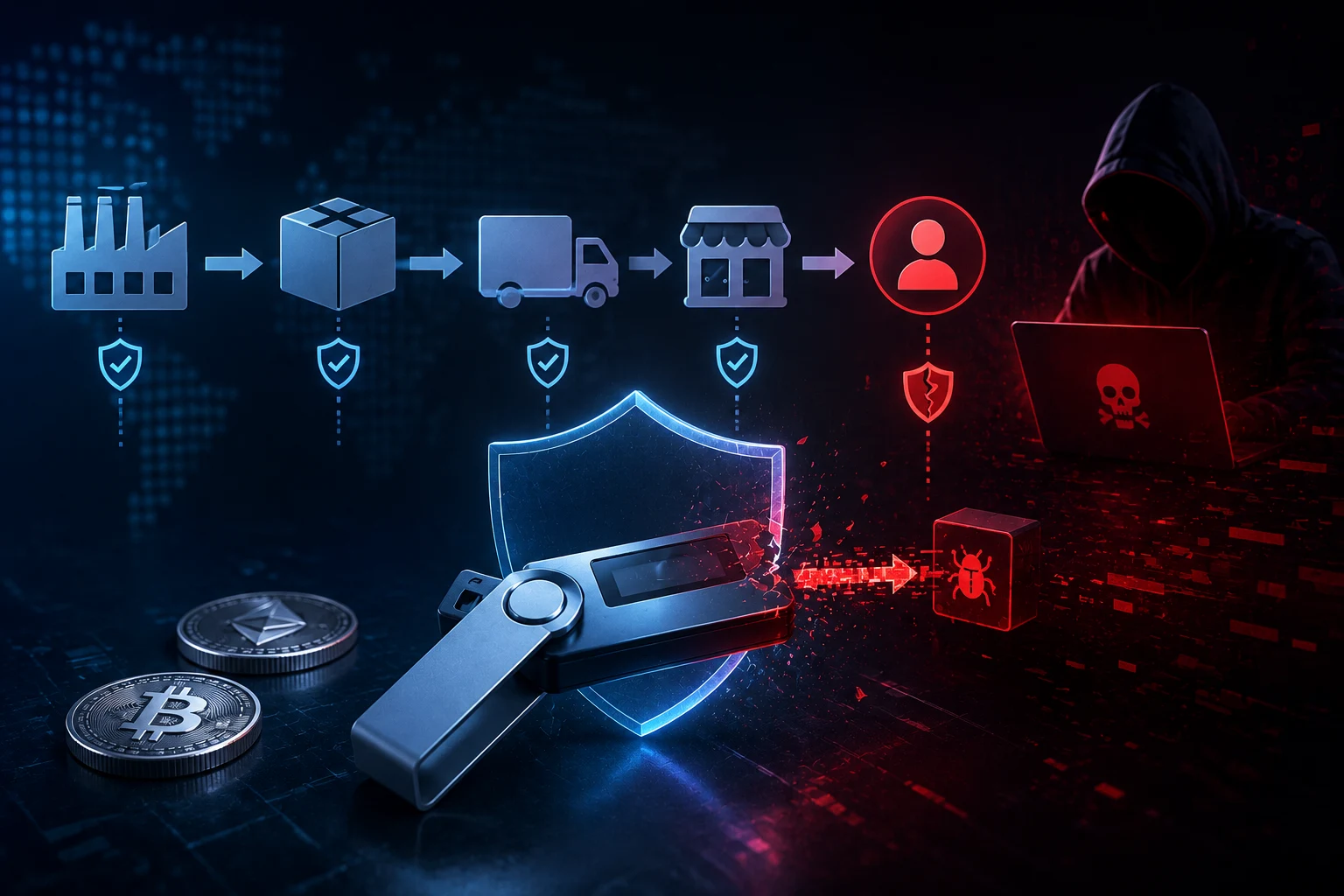
What is a supply chain attack on a crypto wallet?
A supply chain attack is a compromise of a piece of software that you did not write, do not run yourself, and probably have never read the source code of, but that your wallet relies on. Instead of attacking your device directly or breaking the cryptography underlying Bitcoin, Ethereum, or Solana, the attacker poisons something further up the chain: a dependency, a plug-in, a build tool, an update server, or even a hardware-wallet vendor's signed firmware.
In traditional software, a supply chain attack might steal passwords, plant ransomware, or siphon customer data. In crypto, the stakes are sharper. A wallet's job is to take a transaction, sign it with a private key, and broadcast it. If any component along that path can subtly alter the bytes being signed, the attacker does not need your seed phrase. They only need you to click approve on something that looks routine.
This is why security researchers treat crypto wallets as a worst-case target for supply chain compromise. The user interface usually shows a clean, abbreviated summary of what they are signing. The actual transaction can be redirected in ways the user has no technical ability to detect. And once a signed transaction hits the network, there is no customer support line, no chargeback, and no way to recall it.
Why crypto wallets are uniquely exposed to this threat model
To understand why attackers bother with the software supply chain at all, it helps to compare the threat model of a crypto wallet to that of, say, a banking app. A banking app talks to a central server. If the server is compromised, the bank can roll back transactions, freeze accounts, and reissue cards. A non-custodial wallet talks to a public blockchain. Once a transaction is confirmed, it is final, often within seconds on chains like Solana, or within a few minutes on Ethereum L1.
This irreversibility cascades into the supply chain. In a normal software project, a compromised dependency might let an attacker exfiltrate data from a developer's machine, and the developer would notice odd behavior, roll back changes, and rotate secrets. In a wallet project, a compromised dependency can be used to swap destination addresses, increase approvals, or wrap a legitimate-looking dApp interaction around an attacker-controlled contract. The victim sees a familiar UI, clicks through, and the funds move before the screen finishes updating.
There is also a structural trust problem. Most wallet users cannot read the source code of the libraries their wallet imports. They cannot verify, byte for byte, that the firmware on their hardware wallet matches the open-source repository. They rely on the wallet vendor, the maintainer of a transitive dependency, and the integrity of a software distribution chain that may have dozens of separate organizations in it. Each of those is a potential point of compromise, and the attacker only needs to find one weak link.
How attackers actually compromise the supply chain
There are several distinct techniques, and serious incidents in the crypto space have used all of them. Understanding the categories helps you reason about which ones your personal setup might be exposed to.
Malicious or compromised dependencies in package managers
Modern software is built on dependencies, pre-built code packages that developers pull in to avoid reinventing common functionality. A typical Ethereum or Solana wallet pulls in hundreds of these, often indirectly. If an attacker can publish a malicious package under a name that gets auto-imported, or take over the account of a maintainer of a popular package, they can ship hostile code to thousands of downstream projects in a single update.
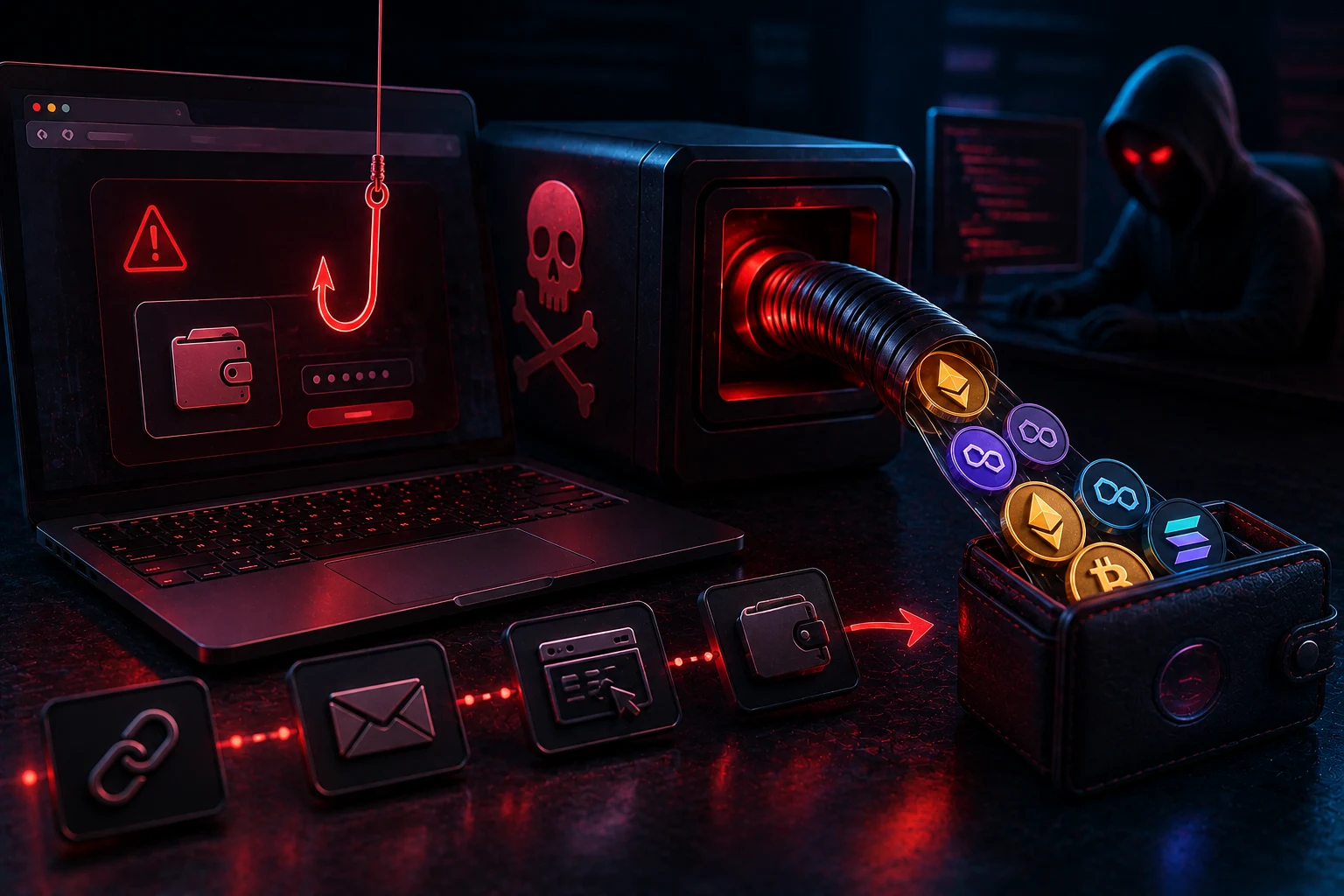
The crypto ecosystem has seen multiple close calls and at least one direct hit. Researchers have repeatedly found typosquatted packages (packages named almost identically to legitimate ones, designed to be imported by mistake) targeting popular wallet and web3 libraries. In some cases, the malicious code was designed to scan environment variables and config files for seed phrases and private keys, and to exfiltrate them to attacker-controlled servers the moment a developer's machine ran a build.
Compromised browser extensions and injected front-ends
Browser-based wallets, including popular ones for Ethereum and Solana, run as extensions. Extensions themselves are part of the supply chain: they ship updates silently, they have access to the content of every webpage you visit, and they can inject JavaScript into pages you think are controlled by a trusted dApp. If an extension is compromised, or if a malicious extension masquerades as a legitimate wallet, it can rewrite what the user sees and what they sign.
There have been multiple cases of fake or hijacked wallet extensions appearing in browser stores. Some impersonate real wallets with similar names and icons. Others are legitimate extensions that are later sold to a third party who pushes a malicious update. The user keeps the extension installed, sees no visual change, and from that point on every transaction they approve is filtered through attacker code.
Tainted hardware-wallet firmware
Hardware wallets like Ledger and Trezor are often described as the most secure option because the private key never leaves the device. That is true, but only if the firmware itself is trustworthy. Firmware is software, and it is shipped over a supply chain that includes the vendor's build infrastructure, the signing keys used to authenticate updates, and the user's own process of verifying (or not verifying) that what they installed matches the published source.
If a vendor's signing infrastructure is compromised, an attacker can push firmware that looks legitimate to the device, generates keys the attacker already knows, or exfiltrates seeds under specific conditions. The user would see a normal update prompt, install it, and the device would still appear to work. This is a lower-probability scenario than dependency or extension attacks because it requires breaching hardened vendors, but the impact is catastrophic and the historical record of supply chain incidents in adjacent industries shows it is not theoretical.
Dependency confusion in wallet repositories
Dependency confusion exploits the way many build systems prefer internal, privately-named packages over public ones. An attacker registers a package on a public registry (such as npm or crates.io) with the same name as a private internal package used by a wallet team. If the build system is misconfigured, it pulls the public, attacker-controlled package instead of the internal one. The malicious package then runs during build, often with access to production secrets, signing keys, or release infrastructure.
Dependency confusion has been demonstrated against major technology companies and is not specific to crypto, but wallet projects are an especially attractive target because compromise of a build machine can lead directly to compromise of released wallet binaries, which are then distributed to millions of users.
CDN and library compromises at the dApp layer
Even if your wallet software is clean, the decentralized application you connect it to loads JavaScript from content delivery networks and third-party libraries. The 2023 Ledger Connect Kit incident is the canonical example. A widely used JavaScript library that dApps embed to connect to Ledger hardware wallets was compromised. For several hours, anyone using a dApp that pulled in the affected version of that library was served a transaction designed to drain their wallet. The users had done nothing wrong. Their hardware wallet was genuine. The malicious code lived in a front-end library, not in the wallet itself.
This category blurs the line between supply chain attack and front-end hijack, but the structure is the same: trust in a piece of software you did not audit, distributed through a channel you do not control.
Real incidents that shaped the current threat model
Looking at concrete cases is more useful than abstract descriptions, because the patterns repeat and the failures are instructive.
Ledger Connect Kit (December 2023)
Ledger's Connect Kit is a JavaScript library that websites use to let visitors connect a Ledger hardware wallet. In late 2023, an attacker compromised the Ledger team's account on a code distribution platform and published a malicious version of the library. For roughly five hours, dApps that loaded the affected version served a transaction prompt that asked the user to "connect" a wallet but actually triggered a fund-draining contract. Estimates of losses varied, with on-chain researchers tracking several hundred thousand dollars in drained assets and a small number of six-figure losses.
The incident is the textbook example of why "I use a hardware wallet" is not, by itself, a complete defense. The hardware wallet signed what it was asked to sign. The malicious logic lived in the dApp's front end, and the user had no way to tell that the bytes being signed did not match what the dApp's UI described. The official post-mortem from Ledger and subsequent analyses are publicly available and worth reading in full.
Browser extension hijacks and impersonators
Multiple browser stores have hosted fake wallet extensions that mimic popular wallets, sometimes appearing in search results above the real one. In other cases, legitimate but lower-traffic extensions have been sold to third parties who then pushed updates with credential-stealing or transaction-rewriting code. The pattern is consistent: the extension is the supply chain, and once it is compromised, the user's trust in the brand is repurposed against them.
Compromised developer accounts and typosquatted packages
Security firms have documented cases of malicious npm and Rust (crates.io) packages targeting web3 developers. Some were typosquats, packages with names one or two characters off from a popular library. Others relied on compromised maintainer accounts, where a developer who had not enabled strong multi-factor authentication lost control of their publishing credentials and saw a malicious version of their own package ship under their name. In several cases the malicious code searched for wallet seed phrases, private keys, and environment variables on developer machines, then exfiltrated them. The downstream risk to users is significant: a developer whose laptop is compromised during a release can ship a backdoored wallet build to millions.
What defense actually looks like
There is no way to eliminate supply chain risk entirely. The honest answer is that you are trusting a long chain of software, and the attacker only needs to find one weak link. What you can do is reduce the number of links, raise the cost of each one, and design your habits so that a single compromise does not become a total loss.
Reduce your trust surface
Fewer extensions, fewer browser-based wallets, fewer "always connected" setups means fewer pieces of software that can rewrite what you sign. Many security-conscious users keep their main holdings on a hardware wallet that is used only for signing, with the wallet's own software running on a dedicated device, and interact with dApps through a separate, expendable hot wallet. This is not paranoia, it is compartmentalization, the same principle that keeps a coffee spill from destroying a year's work.
Treat updates with the same suspicion as new software
An update to a wallet, an extension, or a hardware-wallet firmware is a new piece of code running on your machine or your device. Ask, before installing: was this update expected, is the source verifiable, and is there a way to delay a day or two to see if the community notices anything? The 2023 Ledger Connect Kit incident was caught within hours partly because users and researchers were watching, and dApps that delayed rolling out the affected version avoided most of the impact.
Verify what you are actually signing
Hardware wallets exist precisely to give you a trustworthy display of transaction details. Read those details. If you are approving a token approval, look at the spender, the amount, and the contract. If you are sending funds, look at the destination. Modern wallets increasingly show human-readable warnings, such as "this approval grants unlimited access to your USDC" or "you are interacting with a contract that has not been verified." Those warnings exist because the underlying risk is real.
For developers and security teams: pin, attest, and segregate
If you build wallet software, the burden is heavier. Pin dependency versions, use lockfiles, verify checksums, prefer reproducible builds, and treat publishing credentials with the seriousness of a production database password. Separate the machines that build release artifacts from the machines developers use for daily work. Use hardware security modules or multi-party signing for release keys. And assume that any single maintainer account can be compromised, then design the system so that a single compromise is not sufficient to ship hostile code to users.
What this means for you as a user
If you take only one thing away from the threat model, let it be this: a crypto wallet is a signing device, and the entire security story depends on what it is asked to sign. Supply chain attacks do not break the cryptography. They change the question. A compromised library or extension does not need your seed phrase. It needs you to keep behaving normally while it quietly rewrites the answer.
Practical implications start with hygiene. Use a hardware wallet for meaningful balances. Keep the smallest possible amount in a hot wallet. Audit your browser extensions and remove anything you do not actively use. Be skeptical of dApp prompts that ask for broad token approvals. When a wallet or extension update drops, give it a day if you can. And remember that no UI is trustworthy just because you recognize the logo, because the 2023 Ledger Connect Kit incident was a JavaScript library, not a wallet binary, and the victims were on legitimate dApps.
For developers and security teams, the practical implication is that defending the supply chain is not optional. The threat is not hypothetical, the incidents are documented, and the asymmetry favors the attacker: they only need to win once, while you need to win every time. The good news is that the defensive playbook is well understood, even if it is not always followed: pin dependencies, verify signatures, separate build environments, monitor for anomalies, and design systems so that a single compromised account cannot ship a hostile release to millions.
Follow supply chain incidents the smart way
Crypto wallet supply chain attacks move fast, often unfold over hours, and rarely make sense without context. Tracking the right signals manually, which libraries were updated, which extensions were flagged, which hardware-wallet advisories were issued, is a losing game. Zippfeed surfaces crypto security headlines with sentiment scoring (bullish, neutral, or bearish) and an importance rating, so you can spot emerging supply chain incidents before they reach your wallet.



 CoinDesk
 TheBlock
 Benjamin Cowen
 Altcoin Daily
 WuBlockchain