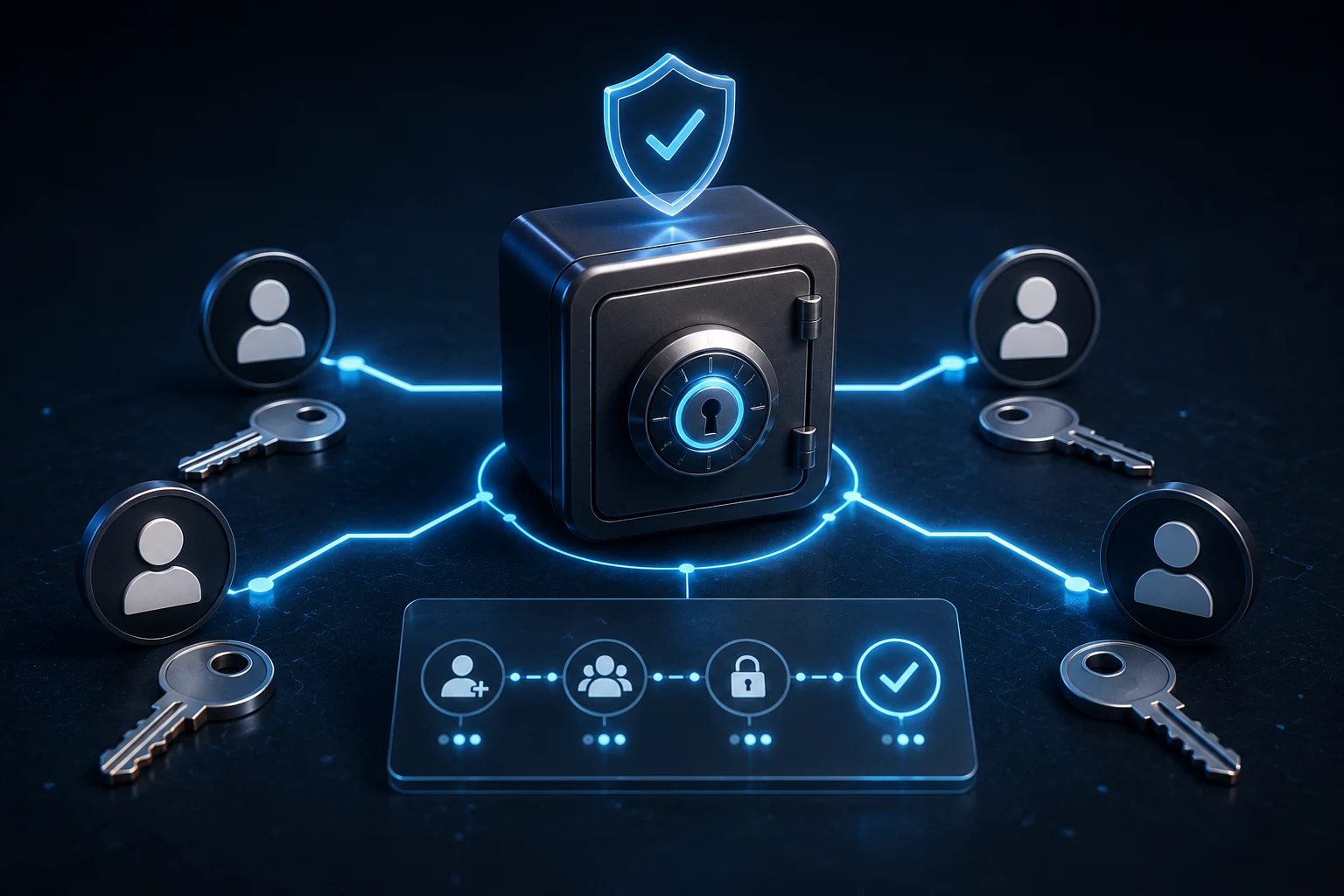
What a multisig wallet actually does, and why one key is rarely enough
A standard crypto wallet is a single private key that signs every transaction. Whoever controls that key controls the funds, full stop. Lose it and the money is gone; have it stolen and the money is gone. There is no support line, no password reset, no fraud department. For a few hundred dollars of personal holdings, that trade-off is acceptable. For a DAO treasury, an exchange's hot reserves, a fund's operational wallet, or a family office's long-term cold storage, it is not.
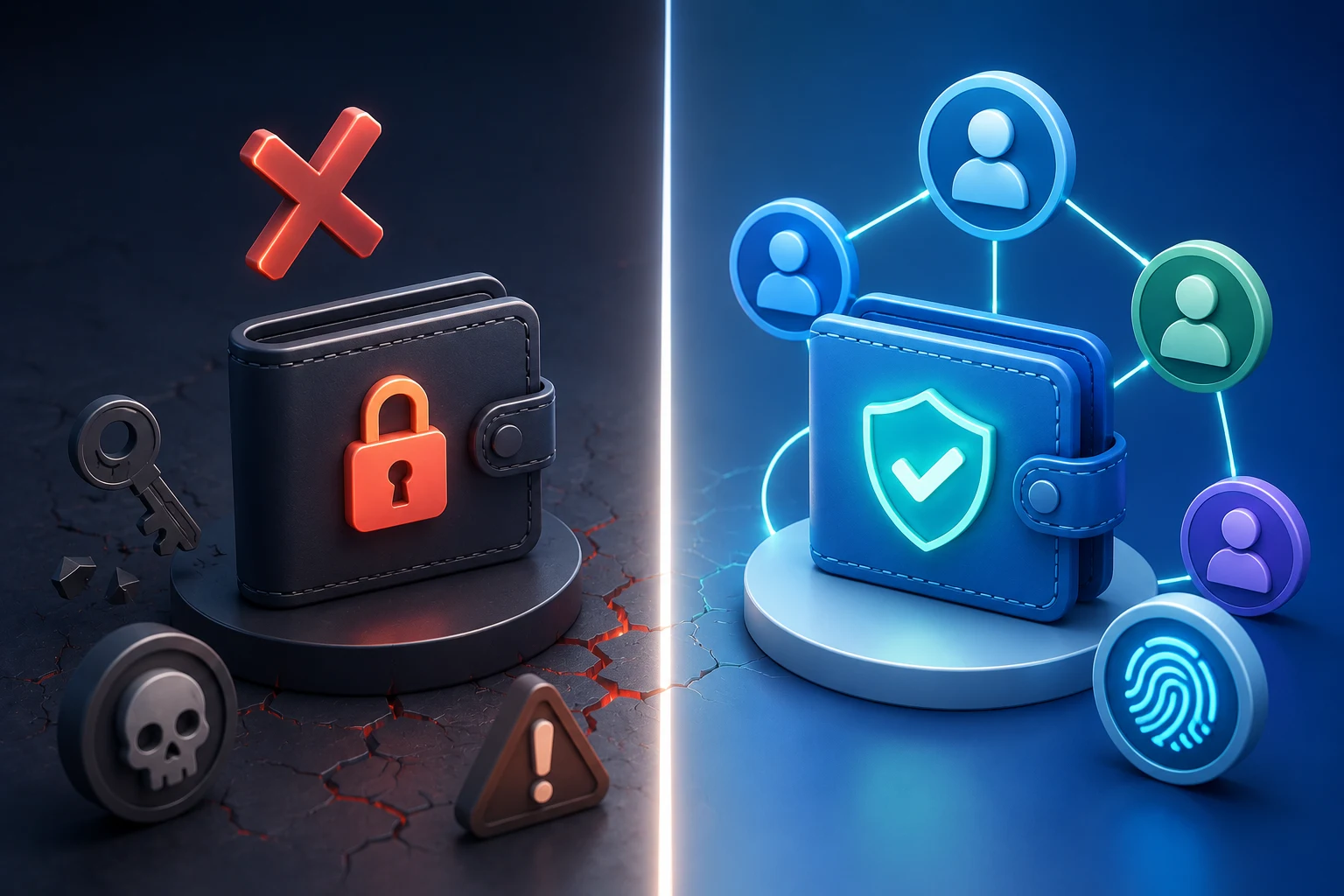
A multisig wallet splits that authority across N independent keys and demands M of them to sign any transaction. A 3-of-5 setup, for example, needs any three of five signers to approve before funds move. Lose two keys and the wallet is still spendable. Have one key stolen and the thief cannot move anything alone. The design is older than crypto; it shows up in bank escrow accounts, corporate treasury systems, and even two-factor authentication schemes. On-chain, the logic lives inside a smart contract rather than a bank.
The core insight is that multisig is not a feature you toggle on; it is an operational system you run. The smart contract enforces the M-of-N rule at the protocol level, but the people, devices, locations, and habits you wrap around it determine whether it actually protects you. A 3-of-5 where all five keys sit on devices in one office, signed by one person who happens to know everyone's passwords, is barely safer than a single-key hot wallet. A 2-of-3 where the three signers are scattered across three continents on hardware wallets from three different vendors is meaningfully harder to attack, even though both wallets technically pass the 'is it multisig?' test.
The real risks before you start (read this twice)
Multisig introduces risks that a single-key wallet does not. The first is the lockout risk: if you set 3-of-5 and three signers lose their keys simultaneously, the funds are mathematically unrecoverable. There is no backdoor. Search the web for 'parity wallet frozen' and you will find a 2017 incident where a bug in a multisig library accidentally locked more than 500,000 ETH in a single contract. The bug was a coding mistake, not a hack, and the money is still there. The lesson is that smart contract risk is real even on audited, widely used code.
The second risk is the people problem. Multisig assumes your signers will not collude, will not get phished at the same time, and will not all be in the same airport when customs decides to image their laptops. If two of your three signers are co-founders who travel together, you have a 2-of-3 in name and a 1.5-of-3 in practice. The third risk is operational: every signer must run the same procedure every time. One signer who 'just clicks through' the transaction details is a single point of failure for the entire wallet.
The fourth risk is contract upgradeability. Some multisig implementations, including certain versions of Safe, allow the contract logic to be upgraded by a vote of the signers themselves. That is convenient for bug fixes but it means a hostile majority of your signers can change the rules. If you want immutability, you must verify the version you deploy is non-upgradable. The fifth risk is chain-specific: most of this guide applies to EVM chains (Ethereum, Arbitrum, Base, Optimism, Polygon, BNB Chain), where Safe dominates. Bitcoin multisig exists but works differently and is not covered here. Solana and other non-EVM chains have their own multisig standards, each with its own quirks.
Step 1: define who the signers are, where they live, and what they hold
Before you open any software, write down the answer to four questions on a single page. First, how many signers total (N)? Second, how many must sign each transaction (M)? Third, where is each signer physically located? Fourth, what device and what vendor does each signer use?
N is usually between 3 and 7. Below 3, you have too little redundancy. Above 7, coordination overhead grows and the probability that any single signer is missing at a critical moment rises. M is the harder number. A common pattern is 3-of-5, which tolerates two lost or compromised signers but still requires three people to act for normal operations. A 2-of-3 is faster to operate but only tolerates one failure. A 4-of-7 is conservative and common in larger DAOs but slow. The math is unforgiving: with N keys, you can lose up to N minus M keys and still operate, but you lose more than that and you are frozen forever.
Geography matters because of correlated risk. A signer in Singapore, a signer in Lisbon, a signer in Buenos Aires, and a signer in Toronto are unlikely to be hit by the same hurricane, the same internet shutdown, or the same law enforcement action at the same time. Hardware vendor matters for the same reason: a vulnerability discovered in one vendor's firmware should not compromise all your signers simultaneously. Mix Ledger, Trezor, GridPlus, and Keystone if you can; do not run five signers on five identical devices from the same batch.
Finally, decide who the people actually are. For a personal wallet, you might use your own keys on devices you control in different physical locations. For a DAO, signers are usually a subset of the core team plus potentially a security advisor. For a family office, signers might be the principal plus a trusted operations lead plus a third-party custodian's key. Whoever they are, every signer must understand they cannot lose their device, share their seed phrase, or sign transactions without reading them.
Step 2: deploy a Safe on the chain you intend to use
Safe (formerly Gnosis Safe) is the most widely deployed multisig on EVM chains. It has been live since 2018, holds billions of dollars in treasury funds across thousands of DAOs and teams, and has been audited and forked many times. For most EVM users, Safe is the default reference. That said, 'most used' is not the same as 'safe for your specific case.' Read the audit reports, check the current version, and verify the contract address you are deploying from matches the official one published by Safe.
Open the official Safe app at app.safe.global (do not trust links from emails, tweets, or search ads). Connect a read-only wallet first to browse; you do not need to connect a signing wallet until you actually deploy. Pick the network you want. Ethereum mainnet is the most secure but expensive for setup; Layer 2 networks like Arbitrum, Base, and Optimism are cheaper and still inherit Ethereum's security for settlement. Choose the chain that matches where your treasury actually operates.
Click 'Create new Safe.' Choose your threshold (M) and add the addresses of your N signer wallets. These are regular EVM addresses generated by MetaMask, Rabby, Frame, hardware wallets, or any other EVM wallet; the Safe does not care how the underlying key was made, only what address it has. Confirm. Sign the deployment transaction with the connected signer and pay the network fee. Safe will deploy a new smart contract wallet at a fresh address; that address is your multisig.
Write down the Safe address. Send a tiny test transaction (a small amount of the native token, like 0.001 ETH) to confirm the address is correct. Test a transaction from the Safe back to your own address. Sign it with the required number of signers and execute it. Only after this end-to-end test passes should you consider sending real treasury funds.
Step 3: distribute the signer keys across devices, vendors, and locations
Now that the Safe exists, you need to make sure each signer is actually prepared. A signer is not just an address; it is a person with a device, a backup, and a process. For each signer, generate the key on a hardware wallet (Ledger, Trezor, GridPlus, Keystone, or another reputable vendor). Write the seed phrase on paper or metal; do not store it in a password manager, cloud drive, email, or photo. Store the backup in a physically separate location from the device.
Geographic distribution has two layers. Layer one is where the device normally lives: a home safe, an office safe, a bank safe deposit box. Layer two is where the backup lives. These should not be the same building. A fire, a flood, or a burglary that takes the device should not also take the recovery phrase.
Vendor diversity is non-negotiable for serious treasuries. Do not run three Ledger devices, two Trezors, and one GridPlus, because that is still three of one vendor. The goal is to make a single firmware bug or supply chain attack unable to compromise M of your N signers. Two or three vendors is a sensible minimum. Note that vendor diversity is not just paranoia; it is also a hedge against the day a vendor is found to have a deliberate backdoor, as some Ledger users feared after the 2020 data breach and subsequent product feature debates.
Document each signer with a one-page record: address, hardware wallet model and firmware version, physical location of device, physical location of seed backup, primary contact, and a designated alternate who knows how to recover that signer if the primary is unreachable. Store this document in an encrypted location that each signer can access but that is not on the same device as any signer.
Step 4: write the recovery plan before you fund the Safe
Recovery is the part people skip, and it is the part that determines whether a multisig is a safety system or a slow-motion time bomb. Three scenarios need explicit plans: a single signer loses their device, a single signer's seed phrase is compromised, and two or more signers are simultaneously unreachable.
For a single lost device, the answer is straightforward: the remaining N minus 1 signers are still above the threshold, so the wallet keeps working. The lost signer needs to be replaced. That means generating a new key on a fresh hardware wallet, and adding the new address to the Safe while removing the old one. This is a Safe transaction itself, signed by M of the existing signers, and it is the most important recovery operation you will run. Practice it on a test Safe before you do it for real.
For a single compromised seed, the situation is more urgent. Move funds out of the Safe immediately to a new Safe with new signers, signed by the uncompromised signers. Time matters because the attacker now has one of the M required keys. If your threshold was 3-of-5 and only one signer is compromised, you can still move funds, but you must do it before the attacker gathers the other two. Treat seed compromise as a fire.
For two or more unreachable signers, you are testing the limit of your N minus M redundancy. If your threshold is 3-of-5 and two signers are gone, the wallet still works using the remaining three. If three are gone, the wallet is frozen. That is why the recovery problem is really a pre-launch design problem. Either you chose an M that gives you enough redundancy to survive realistic losses, or you did not. No software can fix this after the fact.
Some teams add a 'guardian' or social recovery layer on top of multisig, where a separate set of trusted parties can help recover access after a delay period. This is a different design and worth considering for personal wallets, but for organizational treasuries the discipline of pure multisig usually beats the complexity of hybrid schemes.
Step 5: build an operational runbook and practice signing
Multisig protects you only if your signers actually do the right thing every time. That requires a written runbook that covers: how a transaction is proposed, how it is reviewed, how each signer verifies it on their device, how they sign, how it is executed, and how the result is recorded. Every signer should read the runbook before their first transaction and re-read it annually.
Transaction review is the most underrated step. Every signer should look at the actual on-chain destination, the actual amount, the actual contract being called, and the actual function selector. Most Safe exploits of the past few years have not been protocol hacks; they have been social engineering attacks where a signer approved a malicious transaction because they trusted the proposer or skimmed the wallet interface. Hardware wallets display destination addresses and amounts on their own screens, which is the single most useful security feature for multisig: the device itself, not the laptop, is the source of truth.
Run signing drills. Propose a no-op or a small test transaction every quarter and walk the full M-of-N flow. This sounds pedantic but it surfaces issues you would otherwise discover during an emergency: a signer whose device firmware is out of date, a signer who is travelling without their hardware wallet, a signer who never learned the procedure. Drills also build the muscle memory so that under stress (a hack in progress, a market crash, a deadline) the team can execute quickly without mistakes.
Pre-launch checklist: everything that must be true before you fund the Safe
- Threshold and signer set: M and N are chosen, written down, and agreed by every signer.
- Signer independence: each signer is a different person, on a different hardware vendor, in a different physical location, with backups in a different building.
- Seed storage: each signer's seed phrase is on paper or metal, not in any digital system, with at least one off-site copy.
- Safe deployment: the contract address is verified against Safe's official deployment list for the chosen chain and version.
- End-to-end test: a small deposit and a small withdrawal have been signed by the required M signers and executed successfully.
- Recovery drill: a test Safe has had a signer replaced via the standard Safe procedure, proving the team can rotate signers without drama.
- Runbook written: a single document describes how to propose, review, sign, and execute transactions, and every signer has read it.
- Compromise plan: the team has agreed in advance how to react to a single compromised seed, including the address of a pre-deployed 'escape hatch' Safe.
- Communication channels: secure out-of-band channels (Signal, Keybase, in-person) are agreed for emergency coordination, so a compromised email cannot be used to social-engineer signers.
How to follow multisig news the smart way
Multisig setups are long-lived but the ecosystem around them changes fast: Safe ships upgrades, hardware vendors push firmware updates, new contract vulnerabilities get disclosed, and DAO governance practices evolve. Tracking all of this manually is a losing game. Zippfeed surfaces multisig and self-custody headlines with sentiment scoring (bullish, neutral, or bearish) and an importance rating, so you can catch governance changes, audit findings, and major exploits before they affect your treasury.