Why a seed phrase is unusually fragile
A seed phrase, also called a recovery phrase or mnemonic, is a list of words from which compatible wallet software can recreate a wallet's private keys. Those private keys authorize transactions. Anyone who obtains the complete phrase can often restore the wallet on another device and move its assets without the owner's permission.
This creates an uncomfortable mismatch. A wallet may use strong cryptography, yet its recovery can depend on handwriting, paper, ink, memory, and a hiding place. The mathematics might survive for decades while the physical backup is destroyed by a leaking pipe, discarded during a move, photographed by a visitor, or forgotten after the owner dies.
A standard 12- or 24-word list is therefore a single point of failure. Losing the only readable copy may make the wallet unrecoverable after a device failure. Exposing one complete copy may give a thief everything needed to take control. Making more identical copies improves availability but also creates more places where the secret can leak.
There is no universally best storage medium. The practical question is which combination of materials, locations, access controls, and instructions addresses your realistic threats without becoming too complicated to use. For context on why recovery words control funds, see how self-custody wallets and private keys work.
How seed phrase backups actually fail
The first risk is environmental damage. House fires can consume paper and deform some low-melting materials. Firefighting water, floods, humidity, mold, and chemical contamination can erase ink or make words unreadable. Even a backup inside a safe is not automatically protected, since safes have different fire ratings and may admit water or moisture.
The second risk is unauthorized discovery. A curious family member may photograph a phrase without understanding its importance. A contractor, guest, roommate, landlord, employee, or burglar may recognize it immediately. Unlike a bank password, a stolen seed phrase usually cannot be reset while preserving the same wallet. The owner must create a new wallet and transfer assets before the attacker acts, assuming the theft is noticed in time.
Human error is equally serious. Common failures include misspelled words, incorrect order, faint impressions, missing pages, ambiguous handwriting, and an undocumented BIP39 passphrase. People also hide backups so well that they cannot find them later. After death or incapacity, heirs may discover a wallet device but never locate the recovery information, producing the very real no one can find it failure mode.
Digital copies introduce a different set of threats. Malware can read the clipboard, capture keystrokes, scan screenshots, or steal files. Cloud accounts can be breached, locked, deleted, or inherited through account-recovery procedures. Encryption helps only when it is implemented correctly and its password remains both secret and recoverable.
Failure modes worth planning for
- A fire destroys the home, the wallet device, and every backup stored there.
- A phone automatically uploads a seed phrase photo to cloud storage.
- An encrypted file survives, but nobody remembers its password or format.
- A family member mistakes an unlabelled paper or metal plate for rubbish.
- A thief finds a complete phrase and restores the wallet before the owner notices.
- The owner becomes incapacitated without leaving usable recovery instructions.
Paper, metal, and digital backup methods compared
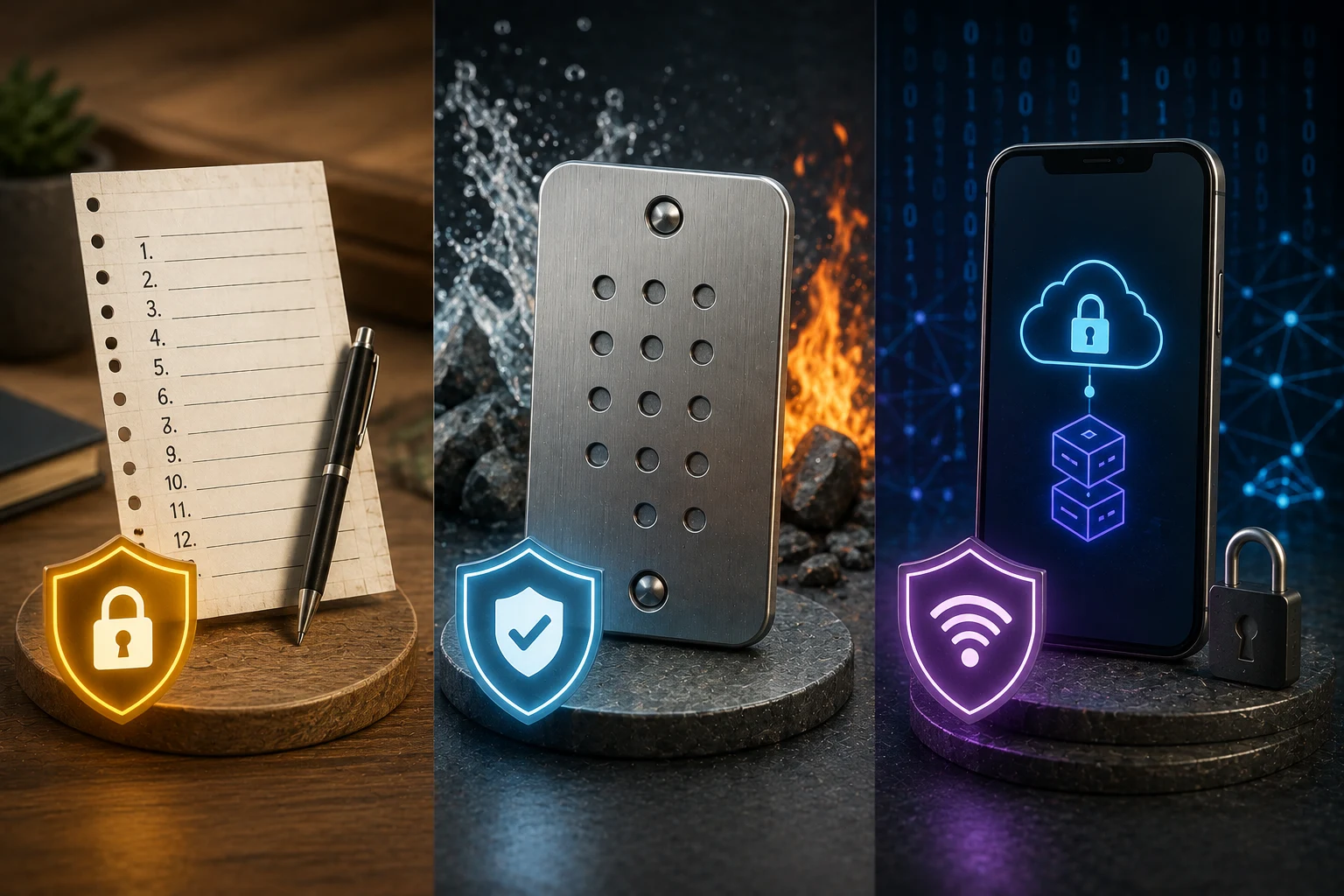
Paper is inexpensive, available, and readable without electricity or special software. It can work when stored privately in a stable environment and checked periodically. Its weaknesses are physical: paper burns, tears, fades, absorbs water, grows mold, and can be accidentally discarded. Lamination may reduce ordinary moisture damage, but it does not make paper fireproof and can trap moisture if applied badly.
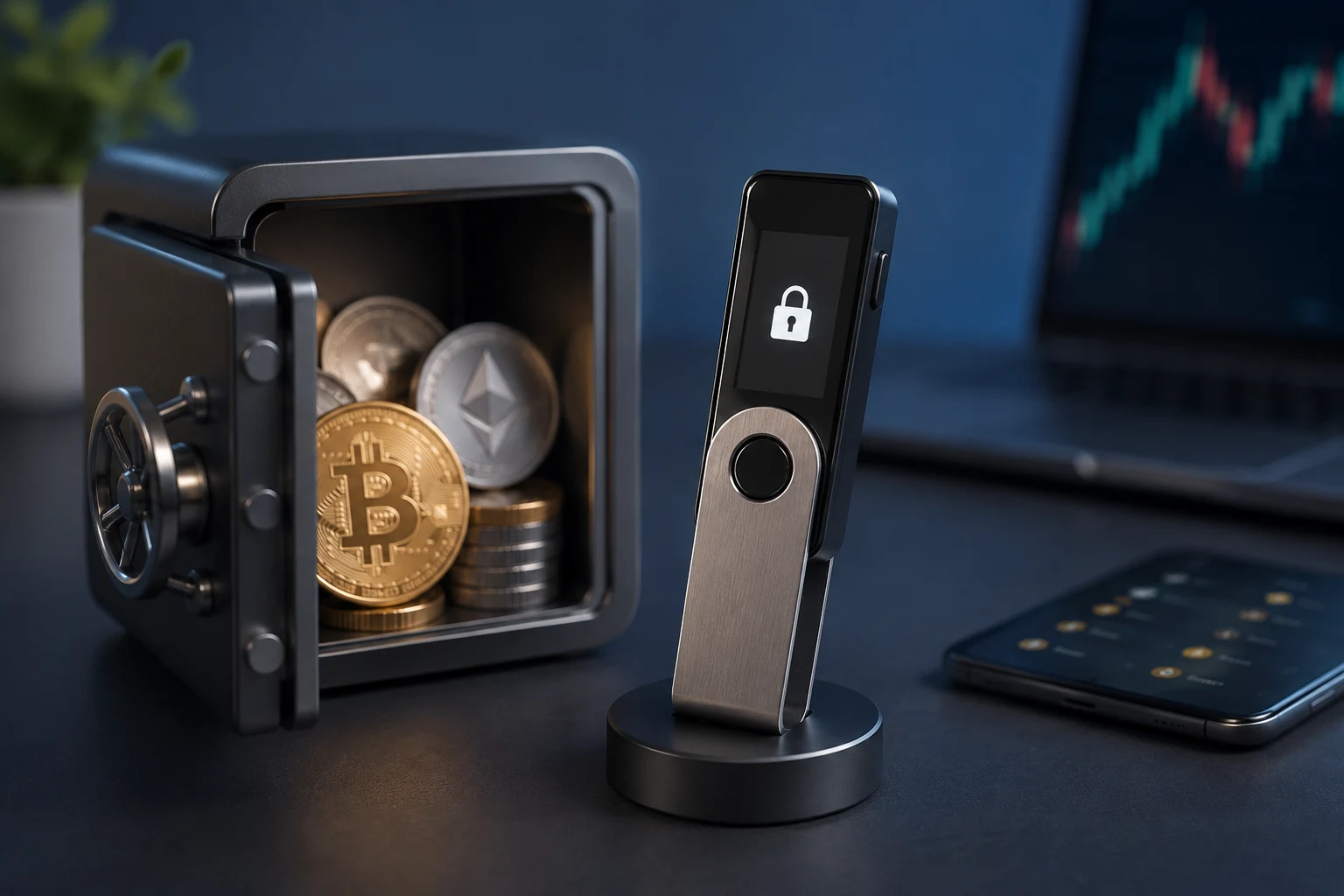
Stamped or engraved metal generally provides better resistance to fire, water, insects, and long periods of storage. Stamping creates recessed characters, while engraving removes material to form them. Either can fail if the marks are too shallow, the metal corrodes in its environment, heat deforms it, or the chosen format leaves characters ambiguous. A durable plate is also conspicuous to someone who recognizes a word list, so physical toughness is not the same as secrecy.
An encrypted USB drive can store a protected digital copy and may be easy to duplicate across locations. It can also fail through flash-memory degradation, controller damage, lost passwords, incompatible software, malware, or accidental formatting. A USB drive should not be treated as an archival object that can sit untouched for decades. It needs periodic testing, migration to supported media, and instructions explaining how to decrypt it.
An encrypted cloud copy can survive a local disaster and remain reachable from another location. However, it depends on account security, service continuity, encryption practices, recovery credentials, and the device used to decrypt the file. Uploading a plain photo, screenshot, note, email, or unencrypted document is especially risky because copies may spread through syncing, backups, thumbnails, and account access logs.
What happens in a house fire
- Ordinary paper is likely to be destroyed unless its enclosure provides effective fire protection.
- Metal may preserve stamped information, but performance depends on material, thickness, heat, debris, and corrosion after firefighting.
- A USB drive stored in the same building may melt or suffer internal damage even if its casing looks intact.
- A properly encrypted remote copy may survive the building loss, but only if the account and decryption credentials remain recoverable.
No medium solves every problem. Paper is simple but physically weak. Metal is durable but still readable by anyone who finds it. Digital storage can provide geographic redundancy but adds software and credential dependencies. A sensible design often uses more than one medium or location, provided each extra copy has a clear purpose and does not create an unmanaged exposure.
How to create and verify a readable backup
Create the backup in a private setting where cameras, voice assistants, shared printers, and untrusted devices are absent. Follow the wallet's displayed word order exactly. BIP39, a common seed phrase standard, uses words from a fixed list, but that does not mean a partial or misspelled record is safe or easily repaired. Record all words clearly and preserve their sequence.
Numbering the words can prevent order mistakes. Distinguish similar letters, avoid cursive if it reduces clarity, and use materials suited to the chosen medium. With stamped metal, confirm every character before making a permanent mark. Some storage formats record only the first four letters of each English BIP39 word because those prefixes are unique, but full words are easier for beginners to interpret and may reduce confusion about standards.
Verification matters because a backup that has never been checked is only an assumption. Compare the completed record against the wallet's recovery screen before storing it. Some wallets offer a built-in backup check that asks for selected words. A full recovery test on a separate trusted device can provide stronger evidence, but it also creates exposure if the device, software, or environment is compromised.
Never type a seed phrase into a website, support chat, form, browser extension, or application merely because it claims to verify the backup. Wallet support staff do not need the phrase. Fake recovery services, phishing pages, and impersonated support accounts routinely ask for it. For related warning signs, see how crypto wallet phishing steals recovery phrases.
A practical verification checklist
- Confirm the word count, spelling, sequence, and wallet standard.
- Check that the writing or stamping is readable under ordinary lighting.
- Record any required recovery context without placing extra secrets beside the phrase.
- Use only trusted wallet software and an offline environment for a recovery test.
- After testing, confirm that no temporary photo, note, clipboard entry, or file remains.
Passphrases, Shamir backups, and multisig are different tools
A BIP39 passphrase is optional text combined with a seed phrase to derive a different wallet. It is often called a 25th word, although it can be longer than one word and a 12-word seed can use it too. Every passphrase produces a valid wallet, so entering the wrong one may open an empty wallet rather than display an error. The feature can limit the damage from a stolen seed phrase only if the passphrase is strong, kept separately, and recoverable.
The passphrase also creates another way to lose access. If heirs find the seed phrase but not the passphrase, they cannot restore the intended wallet. Storing both together removes much of the separation benefit. Relying on memory alone is dangerous because illness, stress, time, and death can erase information that once felt unforgettable. Before using this layer, read what a BIP39 passphrase changes during wallet recovery.
Shamir backup is a form of secret sharing. It splits recovery information into shares and sets a threshold, such as requiring a chosen number of shares to reconstruct the secret. One lost or stolen share may then be insufficient on its own. Compatibility is a major limitation: implementations and standards differ, and a future wallet may not restore shares produced by a particular device. Share locations, labels, and recovery instructions also need careful management.
Multisig, short for multi-signature, is a wallet policy requiring multiple independent keys to authorize transactions. Unlike Shamir backup, which reconstructs one underlying secret from shares, multisig keeps separate keys and enforces the signing threshold during normal wallet use. It can reduce dependence on one device or seed phrase, but adds setup, transaction, backup, coordination, and inheritance complexity. Wallet configuration data may also be needed to reconstruct the policy even when the individual keys survive.
When complexity becomes a risk
- A passphrase is useless if it is forgotten or stored beside the seed phrase.
- Shamir shares can fail if the recovery software, threshold, or share locations are misunderstood.
- Multisig can fail when keys survive but the wallet configuration and derivation details do not.
- Any scheme can become unrecoverable when only its creator understands it.
Build a backup plan that another person can execute
Start with a threat model, meaning a short list of the events you are actually preparing for. Consider fire, flood, burglary, household access, travel, device failure, memory loss, incapacity, and death. A renter sharing a home has different risks from someone with controlled access to multiple secure locations. The amount at risk also matters because complexity and maintenance should be proportional.
A basic plan may pair a clearly written paper backup for immediate verification with a more durable metal copy stored separately. A digital copy may add off-site resilience, but only if encryption, passwords, device security, and account recovery are understood. Avoid keeping every wallet device, phrase, passphrase, and instruction in one bag, safe, building, or cloud account.
Inheritance requires a path between secrecy today and access later. Trusted people may need to know that a recovery plan exists, where instructions can be found, and what events allow access. They do not necessarily need every secret immediately. Legal documents, secure storage arrangements, and professional estate advice may help, but crypto recovery details should be reviewed for local legal and tax consequences.
Revisit the plan after moving, changing wallets, replacing devices, changing relationships, or altering an estate plan. Periodically check that physical records remain legible, digital media still works, software remains available, and trusted contacts understand their role. Do not repeatedly expose the phrase for casual inspections. Verify the container and process with the least secret exposure possible.
Questions your plan should answer
- What survives if the home and wallet device are both destroyed?
- What prevents one discovered copy from becoming an immediate wallet compromise?
- Who can locate the instructions after incapacity or death?
- Can that person identify the correct wallet, passphrase process, and recovery software?
- How will damaged media, discontinued software, or changed contact details be handled?
- When was the backup last verified without exposing it to an online device?
Read wallet security news critically with Zippfeed
Wallet threats change as phishing tactics, malware, recovery tools, and custody practices evolve. Manually separating useful warnings from promotional noise is difficult. Zippfeed organizes wallet-security headlines with bullish, neutral, or bearish sentiment scoring and an importance rating, helping you spot consequential developments while still checking the underlying evidence before changing your backup plan.