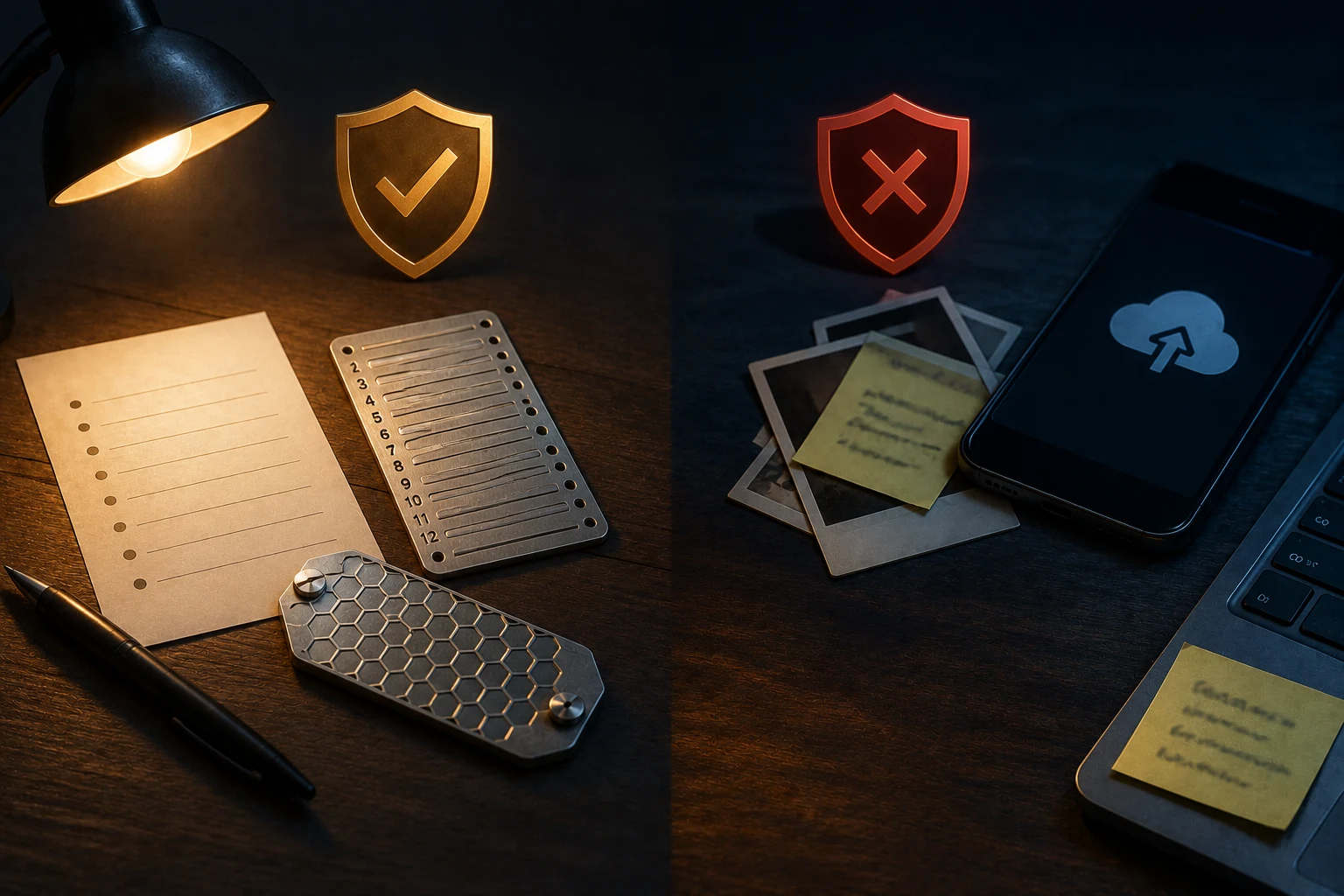
What a seed phrase actually is, and why its storage decides everything
A seed phrase, also called a recovery phrase or mnemonic, is a sequence of 12 or 24 simple English words generated by a self-custody wallet such as MetaMask, Trust Wallet, Ledger, or Trezor. The words are not random. They encode, in a human-readable form, the single private key from which every address in the wallet is derived. Anyone who reconstructs that private key can sign transactions and move every asset the wallet controls, regardless of which app or hardware device they use.
This is why the storage question is not a footnote. The seed phrase is the wallet. The hardware device, the phone app, the browser extension: each of those is just a convenient way to use the key. Lose the phrase and the wallet becomes a locked box with no key. Leak the phrase, even once, and a thief can sweep the balance from anywhere in the world within minutes, with no way to reverse it.
There is no customer support line for a self-custody wallet. No bank can freeze a transaction. The crypto industry uses the phrase "not your keys, not your coins" to describe this exact trade-off, and the same logic applies in reverse: if you do hold the keys, you alone are responsible for keeping them safe. That responsibility is what the rest of this article is about.
The real risks of a bad backup (and what "safe enough" looks like)
Most guides treat backup security as a checklist. The more useful framing is to ask what, exactly, you are protecting the phrase against, because each threat calls for a different defense.
Fire and heat. A house fire reaches temperatures that reduce paper to ash in minutes. The most common paper-backup mistake is keeping the only copy in a bedside drawer or a fire-resistant safe that is not actually rated for the contents, and assuming the safe is a magic box. Safes are rated for time and temperature. A paper wallet inside a cheap safe can still scorch, and inkjet prints fade within a few years even indoors.
Water and humidity. Floods, roof leaks, and basement damp destroy paper and the cardboard boxes people often store it in. Humidity alone yellows paper and, over a decade, can make ink flake off.
Curious relatives and visitors. A surprising number of losses are not from hackers but from a partner, a house cleaner, a curious child, or a contractor who finds a slip of paper with 24 words on it. Some read the words out loud at a dinner party. Some type them into a phishing site to "check if there's any crypto here" and lose everything. The threat model is not just remote; it is also the people with physical access to your home.
Time. A seed phrase stored only on paper is on a slow clock. Thermal printouts fade in months. Ballpoint pen on cheap paper smudges if it ever gets damp. Even pencil graphite can be erased by friction over years. If you intend to hold the wallet for a decade or longer, durability matters.
Theft and coercion. A single copy in one obvious place is a target. A small but real risk is someone learning you own crypto and pressuring you, physically or legally, to hand over the backup.
"Safe enough" therefore means: resistant to fire, water, fading, theft, and time, with no single point of failure. The rest of this article is about reaching that bar in a way that matches your situation.
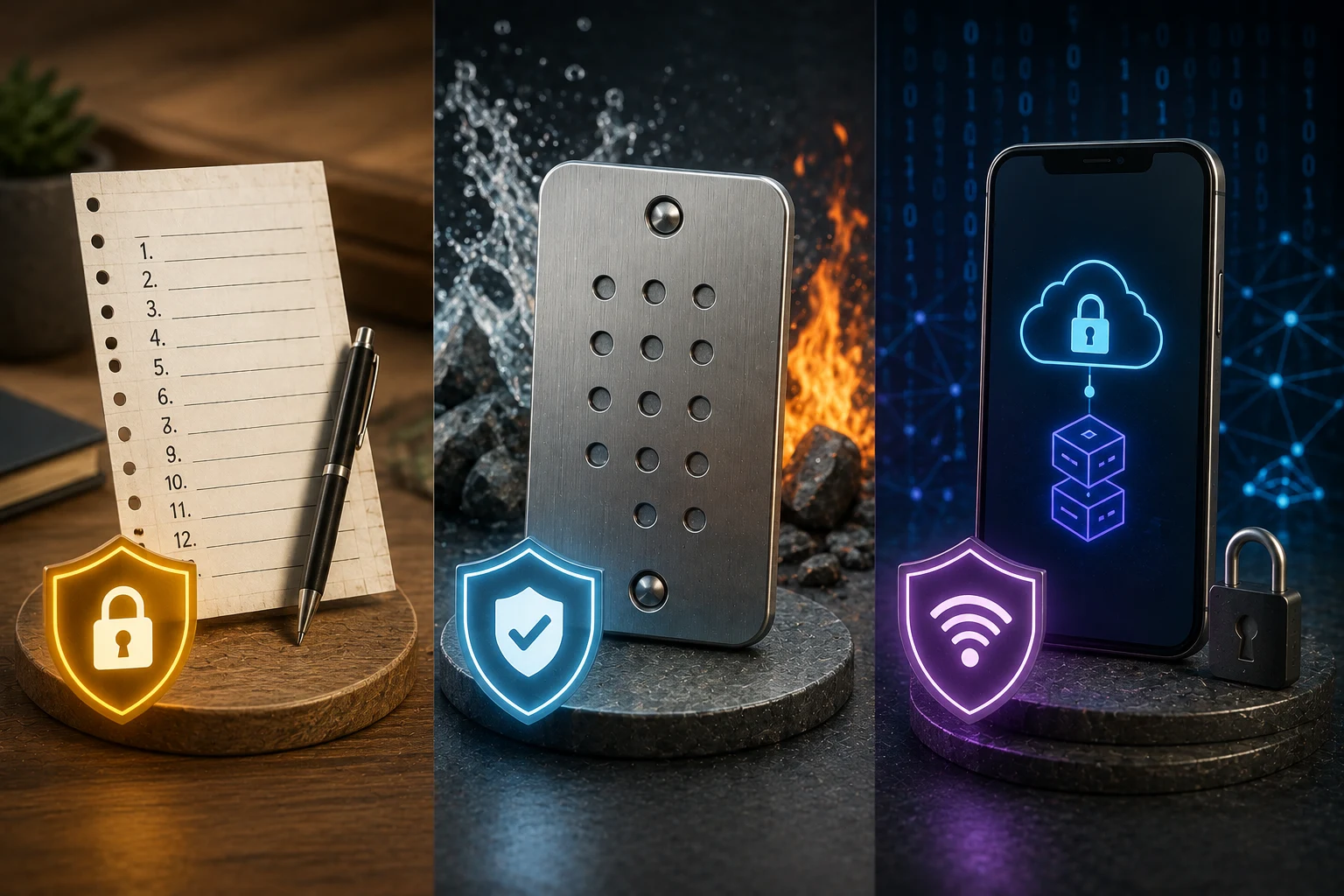
Paper backups: a legitimate option, if you know their limits
Paper is the default that every wallet manufacturer prints onto the card in the box, and it is a legitimate backup, not a punchline. The phrase is short, it is human-readable, and paper costs nothing. The trick is to treat paper as a first draft, not a forever home, or to commit to replacing it on a schedule.
What goes wrong with paper. Standard copy paper discolors in sunlight. Inkjet ink is water-soluble. Thermal receipt paper fades within months, which is why the cheap "write your seed on the back of a receipt" advice is dangerous. Even pencil can be smudged by moisture or erased with the right eraser. A fire-resistant home safe rated for documents (usually 30 minutes at around 840°C) buys time but is not a permanent solution, and a safe itself is a target during a burglary.
How to do paper well. Use a ballpoint pen, ideally with archival ink, on a sturdy card. Write clearly, double-check every word against the device screen, and consider writing the word number alongside the word ("3 staple") so a faded letter can be reconstructed from context. Store the card in a sealed zip bag with a desiccant sachet to fight humidity, then place it inside the fire-resistant document safe.
What to avoid on paper. Never laminate the card. Lamination melts in a house fire and fuses to the paper, making the words unreadable. Do not staple or paperclip the card. Do not fold it into a tiny origami square. Do not write the words in a code or substitution cipher; if you die and your heir cannot decode it, the phrase is gone. Plain text, in order, in English, is the only format with a real chance of being useful to a future person.
Metal seed plates: the durable choice for long-term holders
Metal solves the fire, water, and decay problems in one stroke. A stamped or engraved metal plate survives house fires, floods, and decades in a drawer. The market offers a few mature options, plus a strong DIY route that costs almost nothing.
Commercial metal backups. The most discussed products are Cryptosteel, Billfodl, and BlockPlate, alongside similar devices from Seedsteel and Trezor's own metal seed. The common design is a small steel plate with letter tiles that you slide into grooves, or a plate that you stamp letter by letter. The premium tier uses 304 or 316 stainless steel, resists corrosion, and is rated to survive temperatures well above a typical house fire. The downside is cost: most commercial metal backups run from around 50 to 150 USD, which is significant for a beginner. That money is worth it if the wallet holds more value than the plate costs, and is meaningless if it does not.
Stamping and engraving techniques. The most popular DIY method is a set of steel washers from a hardware store, stamped with a low-cost letter-and-number punch set (a "metal stamping kit"). Each washer holds four letters; 24 words means six washers. Use a sturdy workbench, a center punch to start each hole, and a hammer. The result is a stack of stamped steel washers on a bolt, with a copy that will outlast the owner. A variation is to stamp directly onto a flat stainless steel plate sold for the purpose. The visible imprint can be disguised as a piece of workshop clutter to a casual observer, which is a quiet form of security through obscurity.
Engraving tools. A rotary tool (a Dremel-style engraver) with a diamond or carbide bit can etch the words into a steel plate, but the result is shallower than a stamp and can wear smooth over decades of handling. Stamping is more durable; engraving is quieter and looks neater. Either is fine if the letters are deep enough to read without squinting.
What to avoid on metal. Do not use a regular ballpoint pen or marker on a metal surface; ink on bare metal wipes off. Do not rely on acid etching alone, because the etched groove is shallow. Do not store the only copy in a place a burglar would look first, like a bedroom drawer next to a hardware wallet. Treat the metal plate the same way you would treat a bar of gold of equal value, because in practice, that is what it is.
Splitting the phrase: locations, Shamir, and the inheritance problem
Single-copy, single-location is fragile. The next level of resilience is to make sure that no single event can destroy the phrase, and no single thief can steal it. That is where splitting, geographically and cryptographically, comes in.
Geographic splits. Keep one copy at home in a fire-resistant safe, and a second copy at a trusted family member's house, in a bank safe deposit box, or in a climate-controlled secondary location. The risk of both copies being destroyed in the same event (fire, flood, tornado, civil unrest) drops sharply the further apart the two locations are. The trade-off is that a second location is also a second attack surface: a relative can be pressured, a safe deposit box can be sealed by a court order, and a bank can fail.
Splitting the words themselves. A common pattern is the 12-of-24 scheme: write down words 1 through 12 at home, and words 13 through 24 at a second location. The two halves cannot reconstruct the wallet on their own, so a thief who steals only one half learns nothing. If either half is destroyed, the surviving half is also useless. This is a real trade-off, and the right answer depends on whether theft or loss is your bigger fear. For most beginners, the bigger fear is loss, and full copies in two locations are safer than a split that cannot be reconstructed from a single surviving half.
Shamir backup. A Shamir backup, supported on Trezor's "Shamir Backup" model and a few other wallets, splits the master key into multiple shares using a threshold scheme. A common setup is a "2-of-3" share split: three shares exist, any two of which can reconstruct the wallet. Any single share is worthless on its own. This elegantly protects against both theft (one share is meaningless) and loss (one share can be destroyed without losing access). The trade-off is that the wallet must support Shamir, and the recovery process is a few steps more involved than typing 24 words into a fresh device. Most beginners do not need Shamir; anyone holding a meaningful fraction of their net worth in self-custody should at least understand it.
What NOT to do: the digital copy trap
This section is short on purpose, because the rule is short. The moment a seed phrase touches anything connected to the internet, it becomes a permanent liability. The list of bad ideas is long because attackers are patient.
Phone photos and cloud backups. A photo of the seed phrase is automatically synced to iCloud, Google Photos, or the phone maker's cloud. Those clouds are breached regularly. The seed sits in those breach datasets forever, and an attacker who finds it can drain the wallet months or years later, often the day a meaningful deposit lands.
Password managers. 1Password, Bitwarden, LastPass, and similar tools are excellent for passwords. They are a poor fit for a seed phrase because the entire security model collapses to a single master password, and password manager breaches have happened (LastPass in 2022 being the textbook case). The seed phrase should not be in the same category of secrets as your email login.
Email drafts and notes apps. Email is stored on a server, and notes apps sync to a cloud. The same logic applies: one breach exposes everything. Some people email the phrase to themselves "just in case" and forget about it. The phrase sits in an inbox for years, vulnerable to any compromised email account.
"Just the first four words." A surprisingly common tip in online forums is to photograph only the first four words of the phrase as a "decoy" or "memory aid." Four words from a 12-word BIP-39 phrase is enough to narrow a brute-force search to a tiny fraction of all possible wallets, especially if the attacker can see on-chain activity. Treat the phrase as atomic: either all of it stays offline, or the safety model is broken.
Screenshots in chat. Sending the phrase over Telegram, Discord, WhatsApp, or SMS is equivalent to publishing it. End-to-end encryption protects the message in transit, but it does not protect the screenshot already on the recipient's phone, which itself is a cloud-backed device.
If a digital copy exists anywhere, the offline backup is a backup of nothing. The rule: zero digital copies, period.
Practical next steps for a real-world setup
Pulling the threads together, a workable setup for a beginner with a meaningful self-custody balance looks like this.
First, write the phrase on a paper card with a ballpoint pen as you set up the wallet, because paper is fast and verifiable. Second, transfer the same phrase to a metal plate, either commercial or DIY, as a durable copy. Third, store the metal plate in a fire-resistant safe at home, and a sealed paper copy in a second location such as a bank safe deposit box or a relative's safe. Fourth, write a short, sealed "if I am incapacitated" letter for a trusted person that explains where the backups are and how to use them, without ever writing the words themselves in the letter. Fifth, do a recovery drill: every year or so, restore the wallet from the backup onto a fresh device, confirm the balance matches, then wipe the test device. A backup you have never tested is not a backup.
For a setup holding a smaller amount, the same logic applies in a cheaper form: paper in two locations, with a plan to upgrade to metal if the balance grows past a threshold that makes the cost worth it.
Stay ahead of self-custody mistakes
Self-custody is the most empowering and the most unforgiving corner of crypto. A seed phrase stored the right way is effectively unhackable from the outside; stored the wrong way, it is one breach away from gone. The news cycle around wallet exploits, physical thefts, and recovery scams is constant, and the warnings are easy to miss until they happen to someone you know. Zippfeed surfaces crypto headlines with sentiment scoring (bullish, neutral, or bearish) and an importance rating, so you can hear about new wallet vulnerabilities and recovery scams the same day they hit the timeline, not the same week a relative calls in a panic.