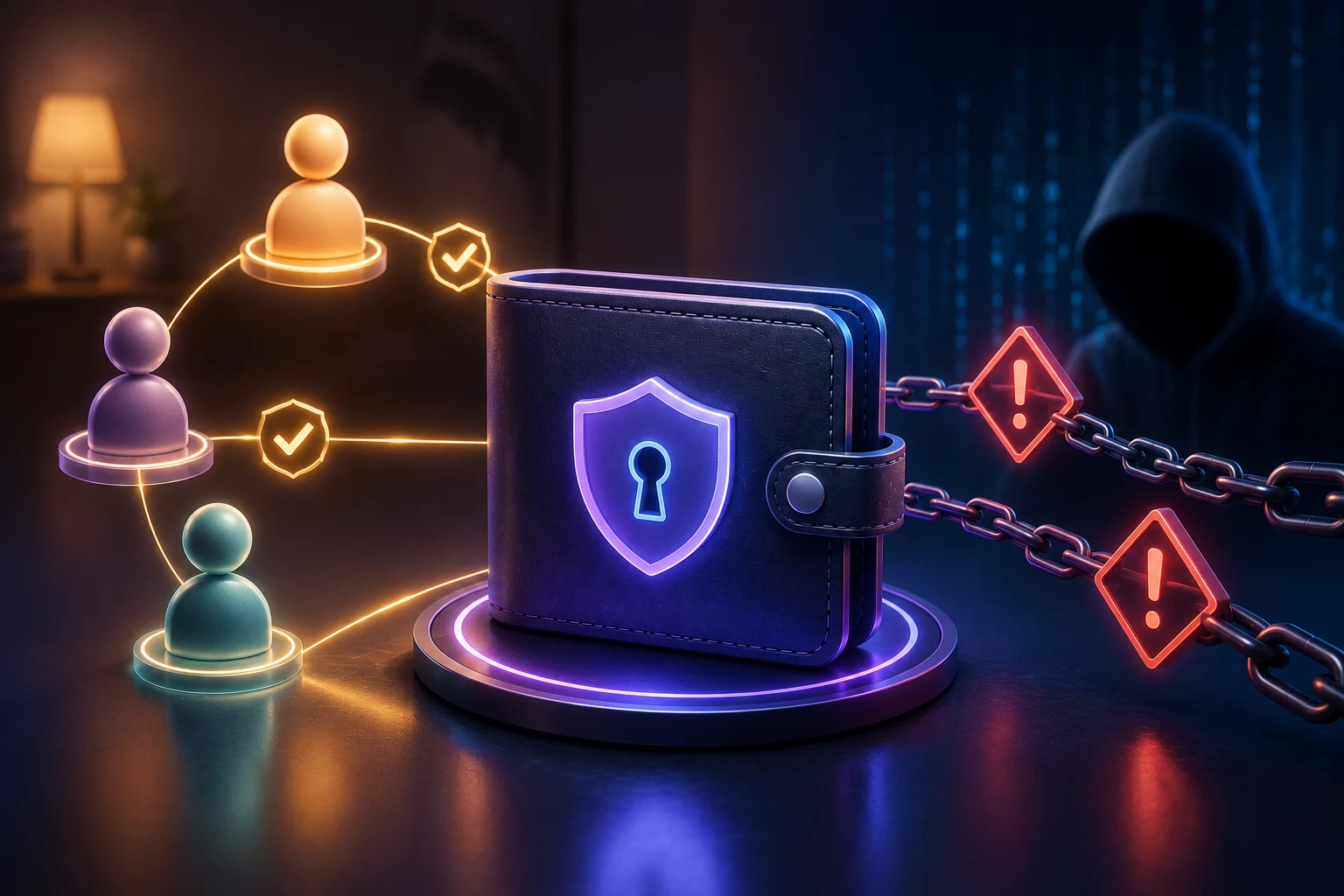
What problem social recovery is trying to solve
The dominant way to own crypto is to hold a seed phrase: a list of 12 or 24 English words that derives every private key in your wallet. Lose it, and you lose every address and token it controls. There is no support desk, no "forgot password" link, and no court order that can bring it back. For a generation raised on cloud backups, this is a genuine usability disaster.
People respond in predictable ways. They store the seed phrase in a password manager that gets hacked, or they split it across a photo in iCloud and a note in their email, or they write it on a piece of paper that lives in the same drawer as the laptop it backs up. Each of these reintroduces the very centralization that crypto was built to escape. The seed phrase, in practice, is the single point of failure for nearly every self-custody loss.
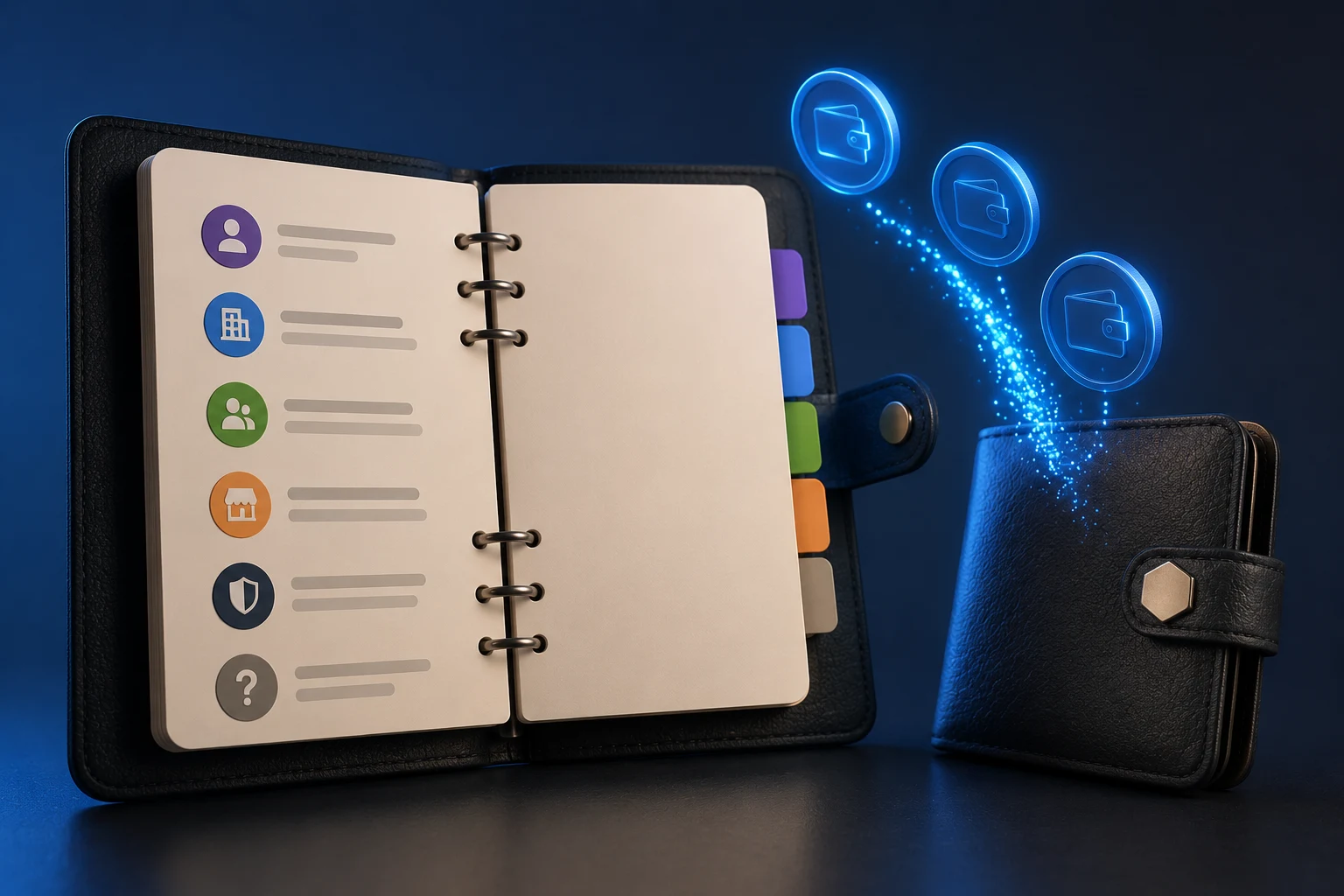
Social recovery wallets attack this problem from a different angle. Instead of asking one human (you) to protect one secret forever, they split recovery authority across a group of people or devices, so that losing any one of them doesn't lock you out. The original developer of the idea, Vitalik Buterin, framed it as a way to bring wallet UX closer to the "I forgot my password" experience of Web2, while still keeping the user as the ultimate signer.
How social recovery actually works
Mechanically, a social recovery wallet is built on a smart contract account (sometimes called a smart account or account abstraction wallet) rather than a plain externally owned address. The contract holds your funds, and it has been programmed with two distinct roles: a single "signer" key that approves transactions day to day, and a list of "guardians" who can vote to rotate that signer if it is lost.
The day-to-day flow is identical to a normal wallet. You sign transactions with your signer key from your phone or browser extension, and the smart contract verifies the signature before executing the transfer. You almost never think about guardians. They only matter in one situation.
The recovery flow is what makes the design interesting. If you lose your device, you install the wallet on a new phone, generate a fresh signer key, and submit a "recover this account" request to the contract. The contract doesn't trust you immediately. Instead, it starts a waiting period (often 24 to 72 hours) during which your guardians must affirmatively confirm the recovery. Once a threshold of guardians has confirmed (commonly a majority, such as 3 of 5), the contract rotates the signer key to your new device and the old, lost key becomes useless. The funds never moved; only the authority to move them changed.
The waiting period is not a polite delay. It is the security feature. If a thief somehow tricked your guardians into confirming a recovery, you have a window of hours or days in which you, from your still-working original device, can submit a counter-recovery that cancels the attack. The longer the period, the safer the wallet against coercion, and the more annoying it is for a user who genuinely lost their phone.
The trust assumption you're really making
Marketing copy describes social recovery as "non-custodial" because the user still owns the funds and the contract, not a third party, holds them. That framing is technically accurate and dangerously incomplete. The real question is not "who holds the keys" but "who can change who holds the keys," and the answer is: a quorum of your guardians.
This creates a category of risk that pure seed storage doesn't have, called guardianship collusion. If a majority of your guardians decide to act together (or are tricked by a phishing attack into acting together), they can rotate your signer key and drain your account. They never need your seed phrase. They never need your device. They need only the social or technical ability to coordinate.
There is also a quieter failure mode: guardians going dark. The recovery flow requires affirmative confirmation. If three of your five guardians have changed phone numbers, moved countries, or simply lost interest in crypto, your legitimate recovery request will time out. You are not locked out forever, because the contract lets you propose a fresh guardian set after the original waiting period, but each retry costs time and assumes you can still reach some guardians at all.
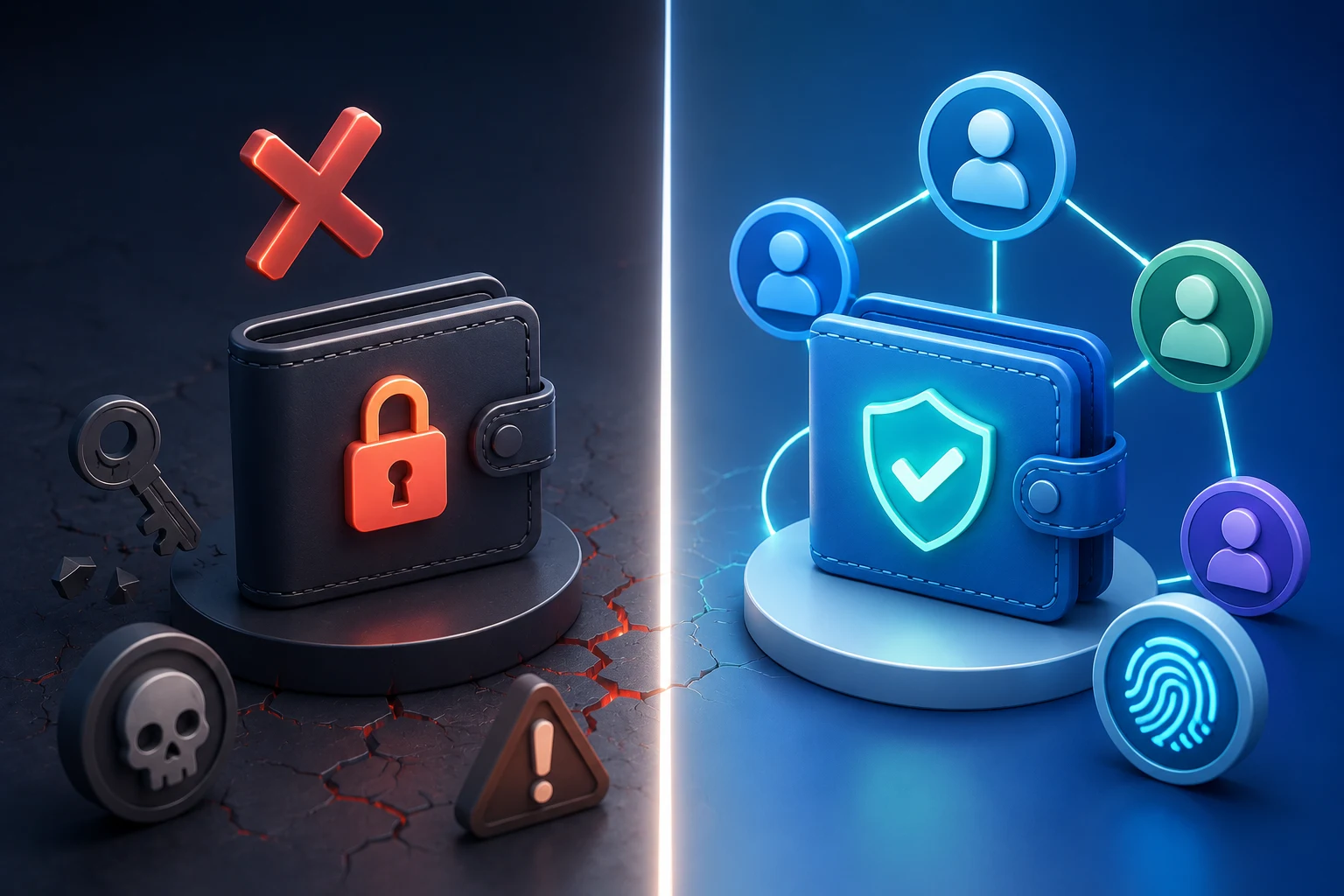
The cleanest way to think about it: social recovery does not eliminate the need for trust. It relocates trust from "yourself with a secret" to "a small group of entities you believe will behave predictably under pressure." Whether that relocation is a net win depends almost entirely on which entities you choose.
Which guardian set is actually safe
The most important decision in setting up a social recovery wallet is not which wallet you pick. It is who (or what) you appoint as a guardian. Most of the well-publicized risks in this design trace back to a poorly chosen guardian set, not to a bug in the wallet software.
The danger pattern is choosing three or five friends. Friends gossip. Friends lose phones. Friends get divorced and one ex becomes very interested in your crypto. Friends can be socially engineered with a phone call that sounds plausibly like you. The same social graph that makes them good friends makes them a correlated risk: a single well-targeted phishing campaign, a single break-in, or a single custody dispute can compromise several of them at once.
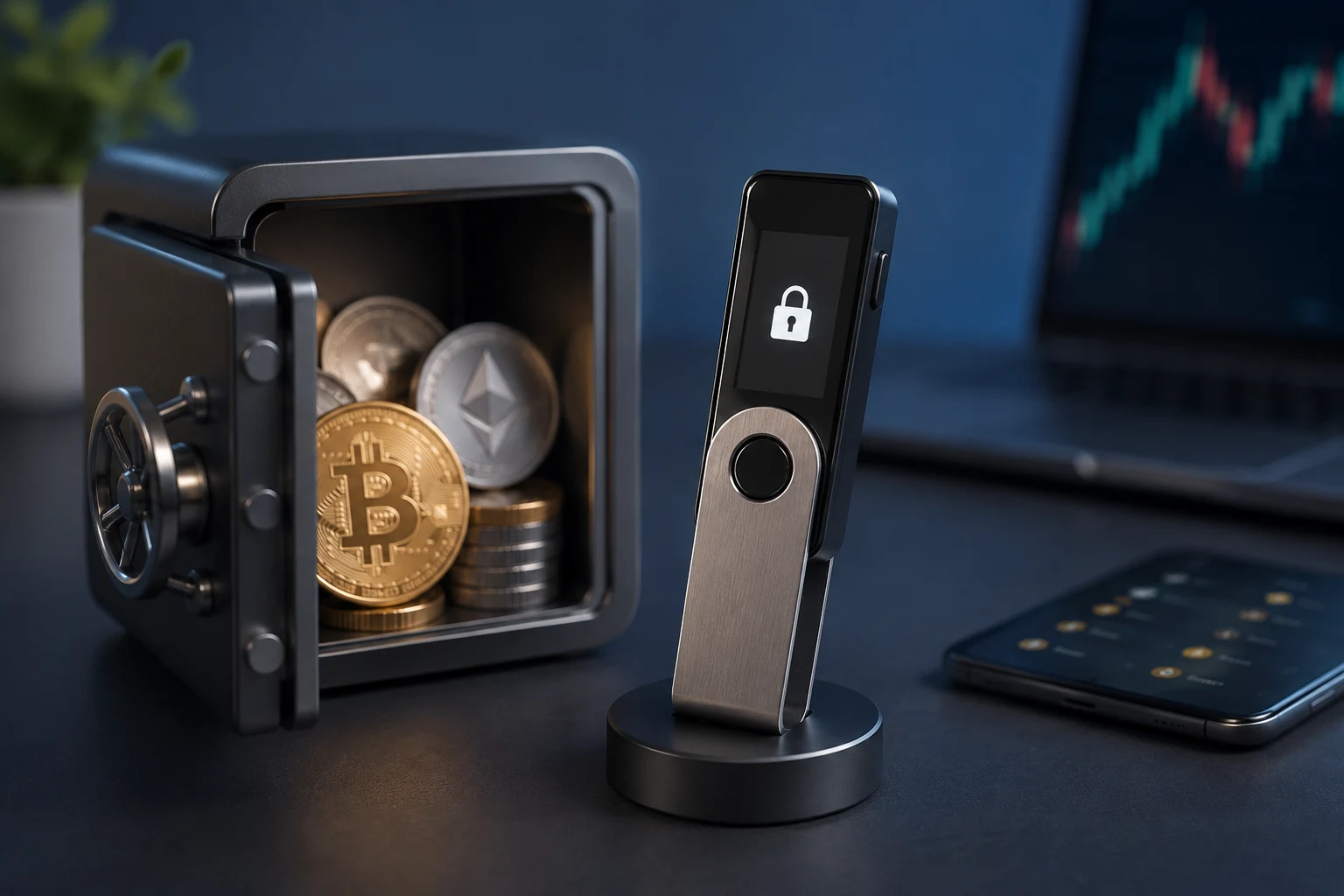
The widely recommended safer pattern is to use devices you control, held in different physical and digital contexts, as your guardian set. A common configuration is three hardware wallets or old phones, each stored in a different location (one at home, one in a bank safe deposit box, one with a family member who doesn't know what it is) and each holding only a guardian key, not a signer key. Two of those devices is enough to recover; a thief who breaks into one location gets one vote, not three. The trade-off is operational: you now have three things to manage instead of one piece of paper.
A hybrid arrangement is also reasonable: two hardware devices you own plus one or two human contacts whose judgment you trust under pressure. Human guardians add a recovery path if every device fails simultaneously, which is rare but not impossible (a house fire, for example). Pure device-only setups are more secure on paper but can leave you with no recovery path in low-probability, high-impact scenarios.
Whatever you choose, two rules hold across the board. First, no guardian should ever hold more than one role: a guardian's wallet should be a dedicated address with no other funds or permissions, so a compromise of that wallet is bounded. Second, you should rehearse the recovery flow with a small test amount before you trust the design with your main balance. Most users discover configuration problems only when they need recovery, which is the worst possible time.
How social recovery compares to seed backup and to multisig
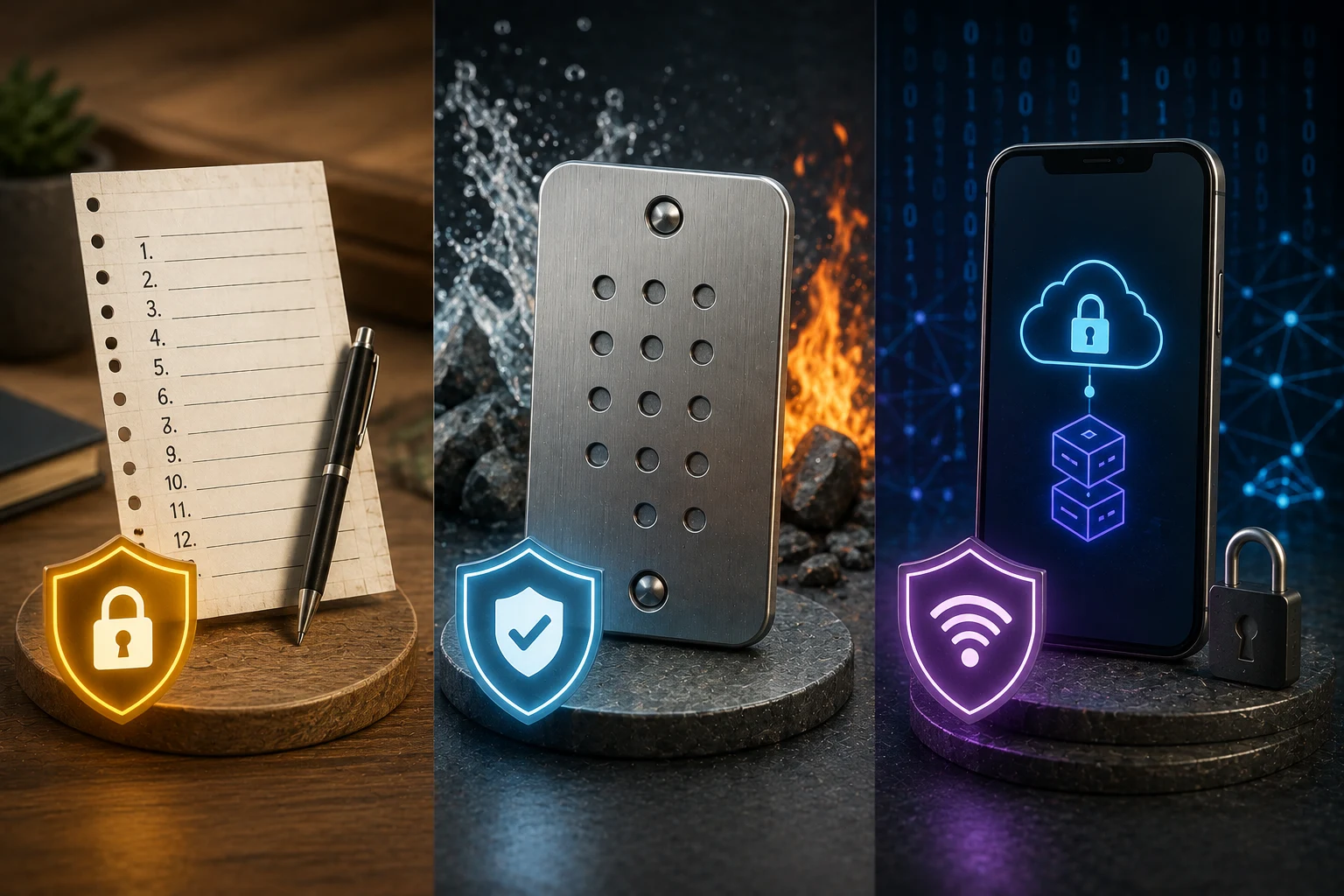
Three approaches to self-custody now coexist, and they answer different questions. A seed phrase backup asks, "How do I make sure I can always reconstruct my keys?" A multisig wallet asks, "How do I require multiple parties to approve a transaction?" A social recovery wallet asks, "How do I let a trusted group restore access if I disappear?" Conflating these is the source of most beginner confusion.
Against seed backup, social recovery is more forgiving and less private. You no longer have a single secret that, if leaked, drains the account, but you do have a public on-chain identity (the smart contract address) and a list of guardian addresses that an observer can correlate. If you rotate guardians frequently to protect privacy, you pay gas and add operational friction on every change.
Against multisig, social recovery is cheaper and more flexible but weaker at preventing active theft. A 2-of-3 multisig requires two signatures to move funds at all, which is excellent protection against a single compromised device but expensive (it requires multiple on-chain signatures per transaction) and rigid (changing the signer set means moving all funds to a fresh multisig wallet). Social recovery only needs one signature in the normal case, and guardian rotation is a contract call rather than a fund migration, which is much cheaper and cleaner. The cost is that the guardian set can rotate the signer, which a multisig cannot do without explicit holder cooperation.
A useful mental model: multisig protects a wallet from its signers; social recovery protects a wallet from its signers disappearing. They overlap, but they aren't substitutes.
Wallets that implement social recovery well
The most established implementation is Argent, which popularized the model on Ethereum and remains one of the few wallets where the recovery flow is the default rather than an advanced setting. Argent requires two-factor confirmation from guardians and enforces a mandatory waiting period, with no way for the user to shorten it. This is deliberately conservative, and some users find it annoying, which is the right trade-off for a default-on safety feature.
Safe (formerly Gnosis Safe) is the dominant multisig wallet and also offers a "Safe Modules" extension that adds social recovery behavior on top of a standard multisig. This hybrid approach is closer to enterprise use: a 2-of-3 multisig with a recovery module that can rotate signers under guardian control. It is more powerful than pure social recovery but also more complex to set up correctly.
More recently, wallets built on the ERC-4337 account abstraction standard, including ZeroDev's stack, Stackup, and Biconomy, have made it cheaper and easier to deploy custom smart accounts with social recovery modules. These are more flexible but require the user to understand that they are interacting with a smart contract that has been audited, not a canonical wallet, and the quality of audits varies.
Two cautions apply across all of these. First, "social recovery enabled" in marketing copy does not always mean the same thing in code: some implementations let guardians unilaterally recover, others only confirm a user-initiated request, and the security implications are very different. Second, every implementation depends on a smart contract, and every smart contract has a bug surface. Even well-audited contracts have suffered exploits in adjacent areas (such as signature replay or cross-chain replay), so the wallet you pick should have a long public track record and a clear incident history.
Legal and inheritance dimensions of choosing guardians
One of the least discussed aspects of social recovery is that guardianship is an entirely off-chain, social role. There is no legal contract in any major jurisdiction that codifies what a guardian is allowed to do, what they are not allowed to do, or what happens if a guardian acts in bad faith. The smart contract trusts them; the law does not.
This creates four practical problems. Inheritance is the first. If you die, your family cannot recover your wallet by going to a court, because the court has no standing to compel your guardians to act, and your guardians have no obligation to act. The wallet works only as long as someone you trust notices that you have died and chooses to recover it for your heirs. Many users leave a sealed letter with instructions, but letters can be lost, ignored, or unread for years.
Divorce and partnership disputes are the second. A partner who was a guardian at the time of a relationship remains a guardian afterwards. There is no automatic mechanism to revoke their role, and depending on the implementation, even an explicit revocation may need a threshold of other guardians to confirm, which can be hard to assemble in a hostile situation.
Corporate and DAO contexts are the third. A multisig or a social recovery wallet used by a small organization can become a legal asset of the company, which means the guardians hold, in effect, custody of corporate funds with none of the fiduciary duties a custodian would normally have. This is fine for informal teams but creates real exposure if the organization is later sued or dissolved.
Jurisdiction and law enforcement is the fourth. If a guardian is tricked into recovering the wallet to a fraudulent signer, the legal recourse is unclear. Crypto-native losses are often unrecoverable, and social recovery losses fall into the same bucket. No mainstream consumer protection covers this case, and even reporting it to law enforcement rarely produces results.
How to follow self-custody news the smart way
Self-custody design is moving fast: account abstraction standards, new guardian schemes, and high-profile exploits that change the threat model. Tracking the difference between a real wallet upgrade and a marketing announcement is a losing game if you rely on Twitter alone. Zippfeed surfaces wallet and custody headlines with sentiment scoring (bullish, neutral, or bearish) and an importance rating, so you can see which stories actually shift the trust assumptions behind your setup and which are noise.