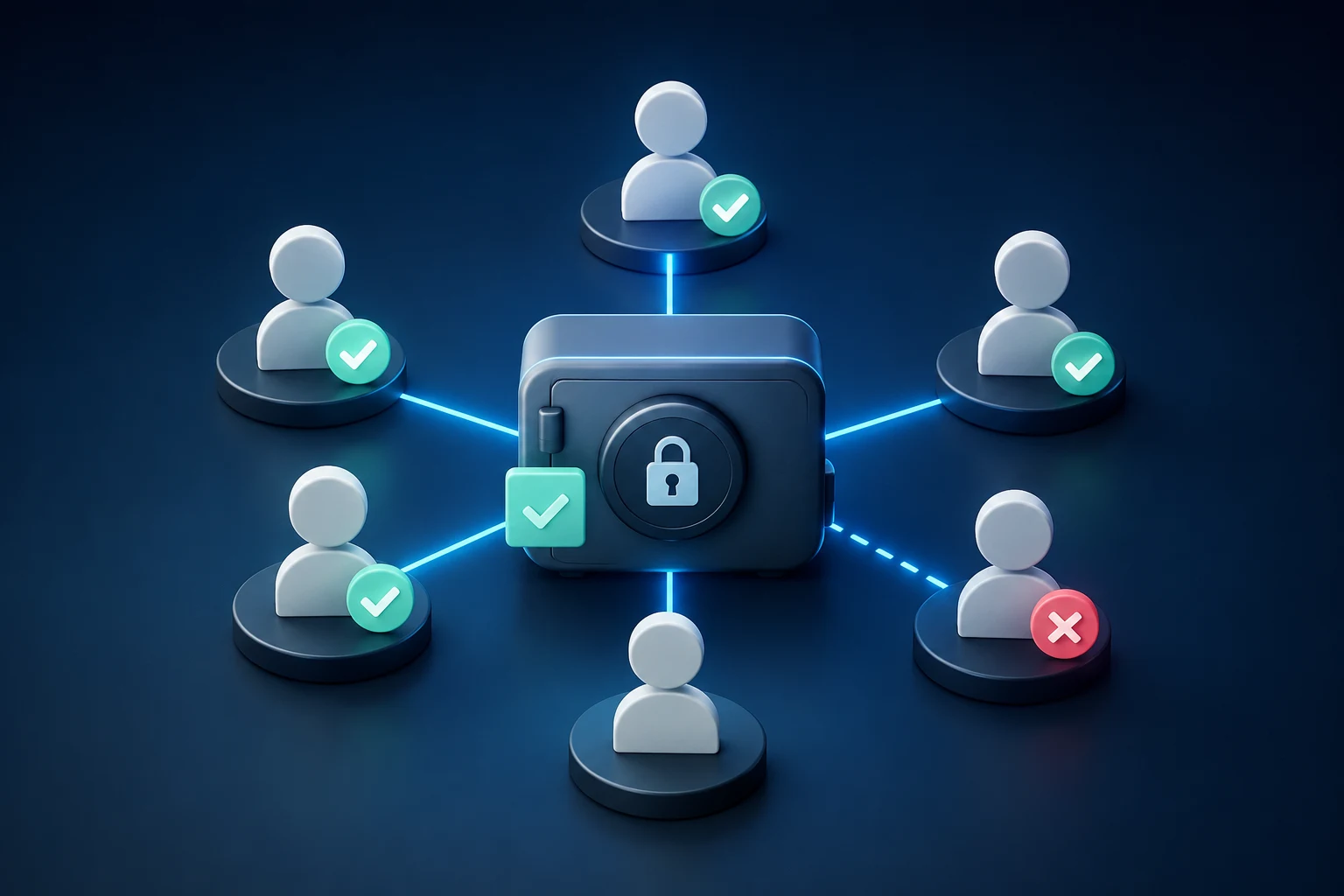
What a multisig quorum actually controls
A multisig wallet is a Bitcoin, Ethereum, or EVM-chain address whose spending rules are encoded into the chain itself rather than into a single private key. Instead of one signature being enough, the on-chain script (Bitcoin) or smart contract (Ethereum, often a Safe) requires a minimum number of distinct signatures from a fixed set of approved signers. That minimum is the quorum, usually written M-of-N, where N is the total number of authorized signers and M is the threshold that must sign before any transaction is valid.
Think of N as the roster and M as the rule for what counts as a valid decision. A 2-of-3 means any two of the three roster members can move funds. A 3-of-5 means any three of five. A 4-of-7 means any four of seven. The interesting part is not the M itself, it is what happens to M when the roster shrinks in real life, because people lose hardware wallets, forget seed phrases, get hospitalized, die, or simply stop responding to messages.
This is why quorum choice is a survival problem disguised as a security setting. If three of your seven signers disappear, your wallet still works because 4-of-7 only needs four live signers. If two of your three signers disappear, your 2-of-3 is permanently frozen, because no combination of one remaining signer can hit a threshold of two. The threshold is not a static property of the wallet, it is a moving target that depends on who is still alive, lucid, and willing to sign.
Key loss math: binomial survival for a signer set
The cleanest way to reason about quorum choice is to model each signer as independent and ask: "what is the probability that at least M of my N signers are still able to sign after some loss event?" That is a binomial tail sum, and you can do it by hand for the small N values that matter in practice.
The formula is straightforward. For each possible number of lost signers k (from 0 up to N minus M), you compute the chance that exactly k signers are lost and M or more are still available, then add those chances up. A workable approximation for rare, independent loss events is: survival probability equals the sum of binomial terms where the number of surviving signers is greater than or equal to M.
Concrete numbers make this less abstract. Assume each signer has a 5% annual chance of becoming permanently unable to sign, whether through key loss, death, or going offline permanently. Those are independent events, which is an idealization you will relax later, but it gives a baseline.
- 2-of-3, one signer lost: probability that exactly one signer is lost is about 13.5%, and with one lost, you still have two live signers, so the wallet survives that year.
- 2-of-3, two signers lost: probability that two or more are lost is about 0.36% per year, but in that case the wallet is frozen because one live signer cannot hit a threshold of two.
- 3-of-5, three signers lost: probability that three or more are lost is about 0.6% per year under the same assumption, and three lost still leaves two, which is below threshold, so the wallet is frozen.
- 4-of-7, three signers lost: probability that three or more are lost is about 1.2% per year, but because threshold is four, you can lose three and still sign, so the wallet is far more resilient.
Over a five-year horizon, those per-year chances compound. A 2-of-3 has roughly a 1.8% chance of being frozen within five years under independent loss, which sounds small until you remember that frozen means irrecoverable without the missing signer returning. A 3-of-5 has roughly a 3% chance of falling below threshold over the same period, paradoxically worse than 2-of-3 for the same N increase, because the threshold scales too. A 4-of-7 has roughly a 6% chance of losing three signers but stays usable because threshold is four. That asymmetry is the heart of M-of-N design: raising N without also raising M can shrink your usable window.
2-of-3 vs 3-of-5 vs 4-of-7: real trade-offs
Most teams pick a threshold by gut feel. That is fine for small amounts, but the trade-offs are concrete enough that you should make the choice deliberately.
2-of-3 multisig
A 2-of-3 is the classic "personal treasury" setup, popular for solo holders and small DAOs. It tolerates the loss of exactly one signer without freezing, which gives it a nice property: any single hardware wallet failure, lost seed, or unresponsive co-signer is recoverable. The downside is that an attacker or a coercer only needs to compromise two signers, and the attack surface of two devices, two people, or two cloud backups is small.
For a single individual using three signer slots, a common pattern is one signer on a hardware wallet kept at home, one on a hardware wallet kept in a bank safe deposit box, and one held by a trusted family member or attorney. That gives geographic and device diversity with a low coordination cost. The risk is that the trusted third party can be socially engineered, subpoenaed, or simply change their mind.
3-of-5 multisig
A 3-of-5 is the workhorse for serious treasuries. It tolerates the loss of up to two signers, which is meaningful redundancy against both accidental loss and one compromised signer colluding with another compromised signer. The threshold of three also raises the cost of an attack: an adversary now needs to compromise three distinct signer environments.
The trade-off is coordination. Five people, five devices, five backup plans, five points where someone is on holiday, sick, or unreachable. If your quorum is three and you regularly have only two signers available on short notice, the wallet feels unusable in practice even though it is technically live. This is where M-of-N stops being math and starts being operations.
4-of-7 multisig
A 4-of-7 is institutional territory. It tolerates three lost signers, which is a generous buffer for long-lived treasuries, employee turnover at a small foundation, or family offices where generations change. The cost is that getting four signatures in a hurry is hard, and the political dynamics of "who is in the seven" become a real governance question.
For larger N, the temptation to "just add another signer" is strong, and it is the design mistake this article keeps warning about. Raising N from five to seven while keeping M at three does increase loss tolerance, but it also widens the surface area for compromise and slows coordination. The right adjustment when you add a signer is usually to also raise M, otherwise the wallet becomes easier to attack relative to its resilience.
Risks that the math alone does not capture
Binomial survival assumes independence, and in real crypto setups, signer failures are highly correlated. That is the part most guides skip, and it is where wallets actually die.
Geographic and vendor concentration
If all five of your signers use Trezor devices, a single supply-chain attack or firmware bug can compromise all five. If all five signers live in the same country, a natural disaster, political crisis, or legal regime change can take out the quorum at once. If all five backups are stored in iCloud, one Apple ID compromise exposes the lot.
The fix is diversity along at least three axes: device vendor, physical location, and ideally legal jurisdiction. Two signers with Ledger, two with Trezor, one with a Keystone air-gapped device, all in different cities and ideally different countries, is more resilient than five identical setups in the same office, even though the math treats them identically.
Single-point coordination tools
A surprising number of "distributed" multisigs collapse into a single point of failure through their coordination layer. If your 3-of-5 treasury uses a shared Telegram group for signing decisions, and the group admin's phone is seized, the remaining signers may not even know there is a pending transaction. If your Safe uses a single Relayer or a single RPC endpoint, that endpoint becomes a soft point of failure even though the keys are split.
The practical rule is that coordination channels should be at least as distributed as the signers themselves, and ideally more so. Email plus Signal plus in-person plus a paper fallback is the kind of overkill that pays off the day one channel breaks.
Software bugs in the wallet interface
Safe, Sparrow, Electrum, Nunchuk, and other multisig front-ends have all had bugs at some point that affected how they displayed transactions, derived addresses, or counted signatures. A signer does not need to be compromised for the wallet to misbehave: the UI can lie about what is being signed, or the wallet can require a different threshold than the chain enforces. Multisig users should treat the wallet interface as part of their trust model, pin specific versions, and verify transaction details on at least two independent devices before signing.
Inactivity recovery and the dead-man switch problem
The single most under-planned failure mode in multisig is not theft. It is the slow, boring disappearance of a signer, often the most important one, and the way it freezes everyone else out.
Why "just add another signer" can break things
When a signer becomes unreachable, the instinctive response is to migrate to a new wallet with an expanded signer set, but most on-chain multisigs do not let you add signers. Bitcoin multisigs are typically locked at setup, and even Safe on Ethereum, which does support threshold changes through its contract, requires the existing threshold to be met to authorize the change. If your 2-of-3 has lost one signer and the remaining two can still meet threshold, you can in principle migrate. If your 2-of-3 has lost two signers, no one can sign anything, including a migration transaction.
This is why "just add another signer" is the right instinct at the wrong time. The time to expand your signer set or change threshold is while everything works, in scheduled migrations, not in the middle of a crisis when one signer is missing and the rest are panicking.
Building a dead-man switch
A dead-man switch, in this context, is a pre-arranged plan that activates if a signer has been silent for a defined period. Practical implementations include:
- A written and notarized instruction set that names an executor and specifies what should happen if the signer has not signed anything for, say, 90 days. The executor does not get the key, but they get the authority and the contacts to convene the remaining signers for a scheduled migration.
- An inactivity-based smart contract wrapper around the Safe that, after a timeout, allows a reduced-threshold transaction to swap signers. This is delicate, because it reintroduces a single point of failure by giving one mechanism the power to act without the missing signer, but for long-lived treasuries it can be the difference between continuity and lockout.
- A scheduled "sign-alive" ceremony every quarter, where every signer signs a tiny no-op transaction. The chain records the last-active timestamp for each signer, and a designated reviewer notices when one stops showing up.
The honest truth is that most crypto estates do not have any of this, and the result is exactly what you would expect: wallets that worked fine for years become permanently inaccessible when the original holder dies or becomes incapacitated. The cost of building a dead-man switch is low. The cost of not having one is total loss.
Practical implications for setting up your multisig
Pulling the math and operations together, here is a decision sequence that works for most readers in the archetype of this article.
Step 1: define your loss tolerance
Decide how many signers you can afford to lose without freezing the wallet, and pick M as that number plus one. If you need the wallet to survive two simultaneous losses, set M at three. If you only need to survive one, M at two is fine. Resist the temptation to set M equal to N, which gives you a single-signer wallet with extra steps.
Step 2: size N with margin
Pick N at least M plus two for small setups and M plus three for serious treasuries. That gives you room to absorb a loss while still being able to migrate, and to onboard a successor signer without immediately raising threshold. Under the 5% annual independent loss assumption from earlier, a 3-of-5 survives two signers lost, and a 4-of-7 survives three lost, with a comfortable margin for correlated failures.
Step 3: diversify along three axes
Spread signers across at least two device vendors, two physical locations, and ideally two legal jurisdictions. Avoid putting more than one signer backup on the same cloud, the same password manager, or the same hardware lineage. Treat any common dependency as a hidden signer that counts against your effective N.
Step 4: write the recovery playbook
Document, on paper and in a format your executor can find, exactly what happens if each individual signer is unreachable. Include the recovery wallet address, the chain and wallet software in use, the locations of backups, and the contact information for the other signers. Store this in at least two places that do not depend on the same person being alive to retrieve them.
Step 5: schedule migrations before you need them
Plan to migrate the wallet to a new signer set every one to three years, not because the old one is broken, but because rotation is cheap when nothing is wrong and impossible when something is. Treat each migration as a fire drill for the real thing.
How to follow multisig security the smart way
Multisig design moves slowly, but the threats around it move fast: new wallet software, new Safe modules, new chain-level bugs, and new social-engineering patterns aimed at co-signers. Tracking all of that manually is a losing game. Zippfeed surfaces multisig and self-custody headlines with sentiment scoring (bullish, neutral, or bearish) and an importance rating, so you can spot real risks early and ignore the noise.