What actually separates one meme coin from another
Every meme coin borrows the same pitch: a funny mascot, a community, and a story that the next buyer will arrive. The pitch is identical. The tokenomics underneath are not, and those differences are the only thing that can be measured before you put money in.
Tokenomics is the full set of rules a token lives by: total supply, how new tokens are created, how old tokens are destroyed, who got them first, and how freely they trade. For a meme coin, the rules are the project. There is usually no product, no cash flow, and no legal claim on anything, so the supply and distribution schedule is the entire investment thesis.
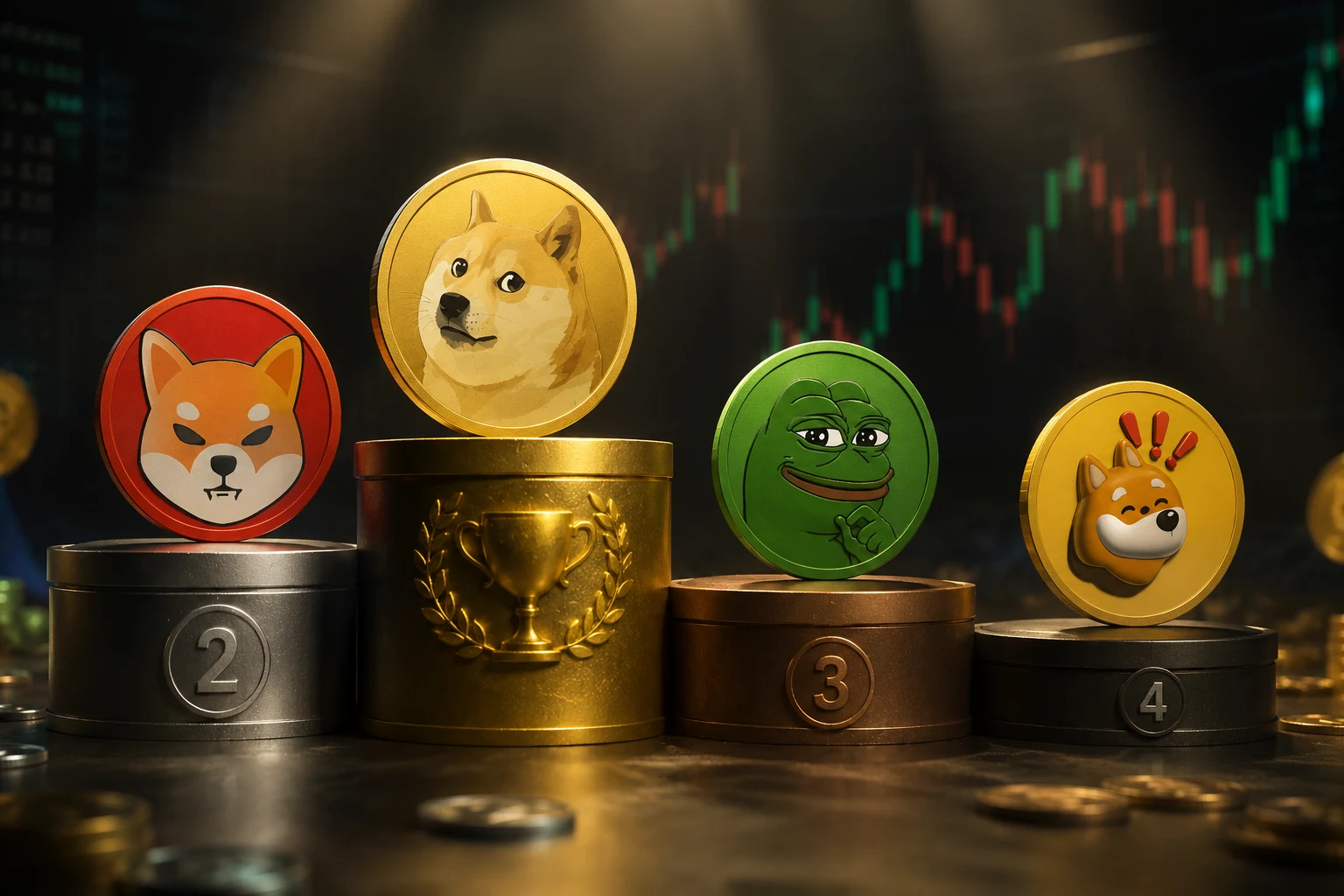
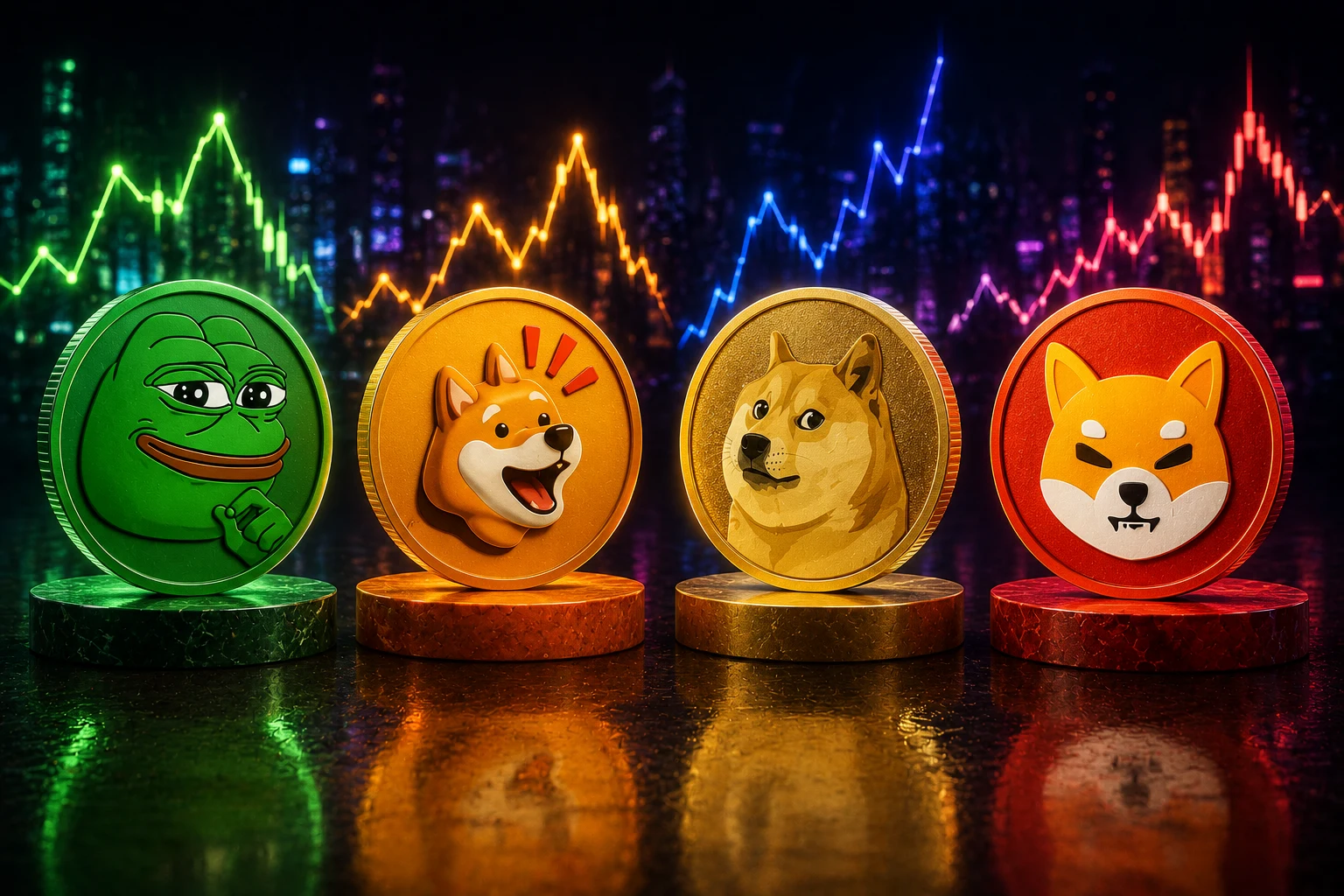
That makes a head-to-head like PEPE vs BONK vs DOGE vs SHIB a useful exercise, because the four tokens span almost the full range of meme-coin designs. DOGE is the oldest, an inflationary coin with a 1-minute block time. SHIB tried to build a DeFi treasury around a meme. BONK is a Solana-era airdrop coin. PEPE is a 2023 fair launch that copied SHIB's supply but skipped the treasury experiment entirely.
The core risk: most meme coins go to zero
Before comparing supply schedules, it is worth being honest about the category. Multiple studies, including a 2023 Chainalysis report on token lifespans, have found that the majority of new tokens lose most of their value within months of launch, and a large share trade to effectively zero. The four coins in this article are unusual survivors, not the norm.
There are three failure modes a meme-coin buyer should know. The first is the slow bleed: price drifts down as early holders sell into thin liquidity. The second is the unlock cliff: tokens held by founders, teams, or treasuries become tradeable and flood the market. The third is the rug pull, where a small group of wallets dumps its allocation and abandons the project.
Concentration in the top wallets is the single best proxy for all three. If 1% of holders control 90% of supply, you have a small bag of paper hands with deep incentive to sell. If the top wallets are locked in vesting contracts with public on-chain schedules, the risk is smaller but still real, because vesting contracts can be renegotiated, governance can be captured, or the team can simply disappear.
None of this is financial advice. The point of comparing tokenomics is to size risk, not to find a winner.
PEPE tokenomics: a 2023 fair launch with no frills
PEPE launched in April 2023 on Ethereum with a stated total supply of 420.69 trillion tokens, a deliberate copy of SHIB's 1 quadrillion-era playbook. There was no presale, no venture round, and no team allocation. The entire supply was minted to a deployer wallet and then seeded into a Uniswap V2 liquidity pool against ETH, with the LP tokens burned so the pool could not be pulled.
The initial distribution sent roughly 93% of the supply to the Uniswap pool, with the rest split between a multi-sig treasury used for exchange listings and marketing, and a small staking pool that has been criticized for its terms. The big design choice was honesty: PEPE made no claims about burns, buybacks, or utility, and that plainness is part of why the market took it seriously in 2023.
There is no emissions schedule. No new PEPE will ever be created. The only supply change comes from explicit burns, of which there have been a few modest ones, plus a small, ongoing burn tied to the project's staking interface. Total burns are real but small in the context of 420 trillion, on the order of single-digit trillions, not the kind of burn that changes the supply story.
Risks are concentrated, not structural. Because there was no vesting, early snipers and sniping bots accumulated large bags in the first block, and on-chain data has shown dozens of wallets holding 1%+ of supply. There is no cliff unlock in the future, which removes one risk, but it also means there is no future dilution, which removes the only mechanism that might tempt whales to hold longer.
BONK tokenomics: a Solana airdrop and an emissions war chest
BONK launched on Solana in late December 2022, framed as a community airdrop to push back against the dominance of SBF-era Solana insiders. The supply is 100 trillion tokens, and a substantial portion was distributed to individual wallets in a snapshot airdrop based on holding Solana NFTs, using specific DEXes, or being active in Solana Discord communities.
Distribution was broader than most meme coins, but it was not perfectly even. About 16% went to the public airdrop, 16% to a treasury controlled by a multi-sig of community figures, 5% to early contributors, and the rest to a mix of Solana-based projects, NFT communities, and liquidity pools. The team allocation was comparatively small, but the treasury allocation is meaningful, and a treasury can be voted into selling.
BONK's emissions differ from PEPE's. The airdrop dropped most of the supply on day one, but several ecosystem grant programs continue to drip tokens into the market, and the treasury can vote to release more. That makes BONK less a one-shot fair launch and more a slow-motion distribution that any holder should track via the treasury's on-chain transactions.
DEX vs CEX distribution is where BONK is most interesting. Unlike PEPE, which was almost purely a Uniswap-fair-launch story for its first year, BONK launched on Solana, where the dominant venue is the on-chain AMM (mostly Raydium and Orca). Centralized exchange listings came later, often after community pressure. That kept more of the float on-chain, where anyone can audit it, and reduced the CEX-driven wash-trading risk that has plagued older meme tokens.
DOGE tokenomics: the original inflationary meme
Dogecoin launched in 2013 as a fork of Litecoin, with a 1-minute block time and no hard cap on supply. The total supply has grown every year and will keep growing. Roughly 5 billion new DOGE are mined annually, and the rate only falls when miners' rewards drop in a fixed schedule of periodic adjustments. There is no scenario in which DOGE becomes deflationary without a code change.
That makes DOGE the odd one out in this comparison. It is the only coin in the group that prints new tokens forever, and that single fact changes the bull and bear cases. The bull case is that miners are always paid, so the network is always secured. The bear case is that every holder is diluted every year, which is structurally bearish for price absent a faster rise in demand.
Distribution has been highly dispersed over time but was not a fair launch. In 2014, the Jackson Palmer / Billy Markus era ended with the founders selling their stakes and stepping away. The coin then drifted through years of low activity before the 2021 retail wave concentrated it again, this time around a small number of very large wallets, including ones associated with early mining and with Musk-era endorsements.
There is no treasury in the way SHIB has one. There is no burn mechanism. The closest thing to deflation is lost coins: wallets whose keys are forgotten remove DOGE from effective circulation. Estimates vary, but on-chain researchers have suggested double-digit percentages of DOGE may sit in dormant addresses. That is a slow-motion burn, but it is incidental, not designed.
SHIB tokenomics: the hybrid DeFi treasury play
Shiba Inu launched in August 2020 with a 1 quadrillion token supply, of which roughly half was sent to Ethereum co-founder Vitalik Buterin's wallet. The other half was split between a Uniswap liquidity pool against ETH and a treasury wallet held by the developer, Ryoshi. The price was below a fraction of a cent for most of 2020, until the Buterin burn episode in May 2021.
Buterin received 10% of supply as a gift from the project, then publicly burned roughly 90% of it and donated the rest to charity. He also moved 10% of the original Uniswap allocation into a separate liquidity contract, further tightening effective supply. The result was a one-time supply shock that SHIB's marketing has leaned on ever since, but it is a historical event, not a recurring mechanism.
SHIB's other big experiment is the SHIB treasury and ecosystem. Roughly 23% of the original supply was reserved for an ecosystem treasury, used to fund projects like the ShibaSwap DEX, the LEASH token (later reworked), the BONE governance token, the Shibarium L2 chain, and various NFT and metaverse efforts. This is the closest a meme coin has come to building a real DeFi treasury, and it is also why SHIB's tokenomics are the most complex of the four.
Real vs claimed burns matter here. SHIB publishes a burn tracker, but the on-chain flow is dominated by tiny sends from individual holders and a small number of protocol-level burns tied to Shibarium activity. The cumulative burn is in the hundreds of trillions of shiba, a real number, but still a small slice of the original 1 quadrillion. Treat burn dashboards as marketing until the on-chain math checks out.
Comparing emissions, unlocks, and dilution
Putting the four on one timeline makes the differences obvious. DOGE is inflationary by design, with new supply added every block. SHIB is capped but has a treasury and ecosystem programs that can release tokens in waves. BONK is mostly distributed already, with a treasury multi-sig that can vote new emissions. PEPE is fixed supply, so dilution is zero and unlock risk is zero.
Unlocks are where most meme coins break, and three of the four have unlock exposure. SHIB's treasury unlocks are governed by the project's own decisions and have been gradual. BONK's treasury can move tokens, and historically has done so for ecosystem grants. PEPE's treasury has been the source of controversy, with a multi-sig that has moved tens of trillions of tokens at a time into CEX listings, a fact that has fueled accusations of insider selling.
DEX vs CEX distribution rounds out the picture. DOGE and SHIB both rely heavily on centralized exchange order books for price discovery, which means a single CEX market-maker can move the tape. PEPE was Uniswap-native for its first year, and BONK remains predominantly on Solana AMMs, which gives them more transparent on-chain liquidity and fewer centralized chokepoints.
For real vs claimed burns, the honest summary is: DOGE has none, SHIB has small and real ones, BONK has had a few large program-driven burns, and PEPE has a few modest one-off burns plus a low-rate burn tied to its staking interface. None of these burns are large enough to be a price driver on their own.
How to follow meme coinomics the smart way
Memecoin supply and unlock schedules can change with a single proposal, a treasury vote, or a multi-sig signature. The four coins here span the design space, and any new meme coin should be measured against them: Is supply fixed or inflationary? Who controls the treasury? How concentrated are the top 100 wallets? Are unlocks visible on-chain or hidden in vague promises?
Tracking those signals manually is a losing game, because unlocks, treasury moves, and large-wallet activity happen continuously and often in the dead of night. Zippfeed surfaces meme coin headlines with sentiment scoring (bullish, neutral, or bearish) and an importance rating, so you can spot treasury sells, unlock announcements, and CEX listing drama in context instead of after the fact.




 Crypto News
 CoinDesk
 WuBlockchain