Why a meme coin tier list is a different kind of ranking
Most 'top 10 meme coins' lists rank by market cap, social media mentions, or whatever project paid for placement. That kind of ranking tells you almost nothing about whether a coin is a sensible trade. A meme coin has no revenue, no product, no balance sheet, and often no usable blockchain beyond the one it launched on. The only things that matter are how easily you can get in and out, how durable the community is, and how likely the token is to survive the next sentiment swing.
This is why a sober DOGE vs SHIB vs PEPE vs BONK comparison has to start by admitting a hard truth. Every meme coin in this article is, at its core, a coordinated attention bet. The 'thesis' is simply that other people will keep paying attention later. Once you accept that, the ranking stops being about which coin is 'best' and becomes about which coin gives you the cleanest, least-rigged exposure to that bet.
There is also a category problem worth naming. DOGE, SHIB, PEPE, and BONK are not really competing for the same job. DOGE is closer to a payments-themed cultural artifact with its own blockchain tooling. SHIB has built an actual ecosystem around it, including a layer-2 network called Shibarium. PEPE is a deliberately minimal meme with no roadmap. BONK is a community token that helped revive Solana's retail narrative. Lumping them together is useful for comparison, but you should know you are comparing four different bets wearing the same costume.
What 'liquidity' actually means for a meme coin
Liquidity is the single most important number most beginners ignore. Liquidity is the size of the pool of buyers and sellers sitting on exchanges and automated market makers right now. When you hear that a coin 'has $200 million in volume,' that is the trading activity, not the liquidity. A coin can show huge volume on a single exchange and still be impossible to sell without crashing the price by 20 percent.
For a meme coin, the real liquidity check is a mix of three things: how many major centralized exchanges (CEX) list it, how deep the order books are on those exchanges, and how thick the on-chain pools are on decentralized exchanges (DEX). DOGE clears that bar on all three. It trades on essentially every major CEX with deep books, and it has been around long enough that its DEX pools are meaningful. SHIB is also listed on most major CEXs, although its order books are shallower than DOGE's during quiet periods.
PEPE started on Ethereum and is now listed on many large CEXs, but its liquidity still thins out fast during low-volume weekends. BONK lives on Solana, where liquidity is concentrated on a handful of Solana-native CEXs and the main on-chain automated market makers like Raydium. Solana meme-coin liquidity can disappear in a single network congestion event, which is a risk the other three tokens on this list do not face.
There is also a hidden liquidity cost called slippage. Slippage is the difference between the price you expect and the price you actually get because your trade eats into the order book. On DOGE, slippage on a normal retail-sized trade is tiny. On SHIB, it depends on the venue. On PEPE and especially on Solana-based BONK, slippage can spike during news events, which means your 'perfect entry' becomes a much worse fill than the chart suggested.
The risk profile every buyer has to internalize
Before getting deeper into the comparison, it is worth being explicit about the failure modes that apply to every coin in this tier list, including the 'safest' one. None of these assets has cashflow, so price is set purely by supply meeting demand. That sounds obvious, but it has consequences beginners often miss.
The first risk is concentration of holders. If a small number of wallets control a large slice of the supply, those wallets can move the price by simply selling. DOGE's supply is more spread out than most meme coins, SHIB has a known burn address but also a known treasury, PEPE had a notorious team-controlled multisig in its early days, and BONK was airdropped widely at launch, which spread it out but did not eliminate insider bundles.
The second risk is the exchange and infrastructure dependency. DOGE runs on its own chain, which has had quiet periods of low developer activity. SHIB's value proposition increasingly depends on Shibarium working as advertised. PEPE depends on Ethereum layer-2 rollups staying cheap. BONK depends on Solana staying up during retail-driven congestion. Any of these dependencies failing shows up in the price before it shows up in a status page.
The third risk is the rug pull, which is the catastrophic failure mode specific to newer meme coins. A rug pull is when developers drain the liquidity pool, abandon the project, or sell a large insider allocation into a thin market, leaving retail buyers holding tokens that suddenly trade at near zero. DOGE, SHIB, PEPE, and BONK are too large and too widely watched to rug pull in the classic sense. The tokens surrounding them on any 'trending' list are not. A 2024 Chainalysis report estimated that rug pulls and similar scams still account for a meaningful share of all new tokens launched, and most of those are meme coins launched on Solana and Base.
The fourth risk is the one that hurts even careful buyers: narrative decay. A meme coin lives or dies on whether people keep telling the joke. DOGE's joke is durable because of cultural inertia. SHIB's joke is broader but more dependent on its ecosystem staying interesting. PEPE's joke is internet-native and stateless. BONK's joke is tied to a specific chain. When a narrative fades, liquidity leaves before price does, which is the worst possible order of events.
DOGE: the deep, weird, oldest meme coin
Dogecoin was created in 2013 as a joke based on the Shiba Inu 'doge' meme. It launched on its own blockchain, which is a fork of Litecoin. That origin matters: DOGE is one of the very few meme coins with its own independent chain, its own mining community, and a block time that has effectively become part of its identity. When people say DOGE is 'too established to go to zero,' that is not because of any product, it is because of the network effects around mining, tipping, and cultural integration.
The community around DOGE is large but more diffuse than SHIB's. There is no single DOGE foundation with the kind of aggressive marketing budget that SHIB's team has historically deployed. The community instead shows up around moments: the 2021 Reddit-fueled surge, the Elon Musk era, periodic merchant integrations, and a steady diet of tipping culture on platforms like X and Reddit. The community is also famously price-sensitive and prone to sell rallies.
On the risk side, DOGE has a few quirks. Its inflation schedule means new coins are mined every block, so the supply is technically inflationary, which is unusual for a meme coin and which most beginners do not realize. It also has no formal development roadmap in the way that SHIB does. DOGE is, in practice, a macro-sentiment asset that occasionally grabs the spotlight and then goes quiet for months.
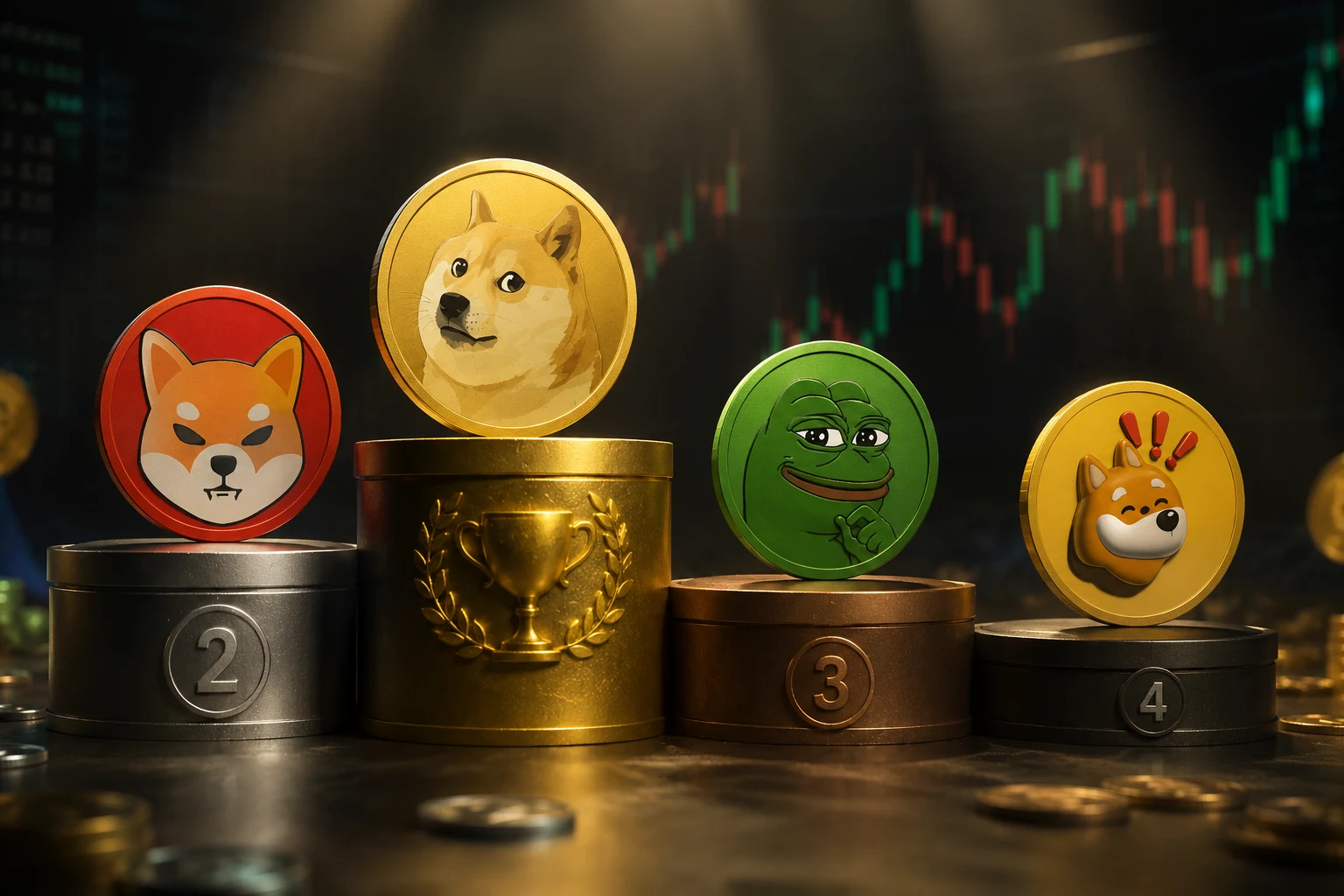
On the tier list, DOGE lands in the top tier for liquidity and durability, and in the middle of the pack for community engagement per dollar of market cap. It is the meme coin you would pick if your only goal was 'cleanest possible exit' and you accepted that upside catalysts are rare and tied to external celebrity events.
SHIB: the largest community, the most moving parts
Shiba Inu launched in 2020 and explicitly framed itself as the 'DOGE killer.' The framing was clever because it forced a comparison that SHIB could mostly win on metrics like community count, even if DOGE kept winning on liquidity. SHIB is an ERC-20 token, meaning it lives on Ethereum, which gives it access to Ethereum's tooling and DEXs but also exposes it to Ethereum gas fees whenever someone tries to move it.
SHIB's signature mechanic is the burn. A token burn is the deliberate destruction of tokens sent to an unrecoverable wallet address, which reduces total supply and, in theory, increases scarcity. SHIB has a public burn address, a burn portal, and periodic community burn events. There is also an automatic burn built into the Shibarium layer-2 network, where a portion of gas fees is sent to the burn address. Whether these burns move the price is a different question; the supply is so large that even a multi-trillion token burn is a rounding error in percentage terms.
SHIB's community is the largest of any meme coin by raw social metrics. There is a dedicated army of community-run burn accounts, regular engagement campaigns, and a real effort to build an actual product stack: the Shibarium network, a decentralized exchange called Shibaswap, and various NFT collections. The ecosystem is real in the sense that it exists and has users, and aspirational in the sense that none of it has produced meaningful cashflow.
On the tier list, SHIB is top tier for community size, mid tier for liquidity (shallow books on quiet days, deep books during news events), and uniquely complex on supply mechanics. The honest description is: SHIB is the meme coin for people who want a community to be part of, with the caveat that you are betting on that community staying organized for years.
PEPE: the cleanest pure-meme trade
PEPE launched in 2023 with a deliberately minimal pitch. There is no team doxx, no roadmap, no ecosystem, and no burn engine. The token is a fixed-supply ERC-20 on Ethereum with a max supply of roughly 420 trillion tokens, and the entire value proposition is 'the Pepe the Frog meme, on-chain.' That minimalism is the point. PEPE does not promise anything, so it cannot fail to deliver on a promise.
The community around PEPE is internet-native and relatively stateless. PEPE holders do not coordinate around burns or roadmap items; they coordinate around the meme itself and around trading momentum. This makes PEPE the most 'pure' sentiment trade in the tier list, which is both a positive and a negative. The positive is that there is no roadmap to fail. The negative is that there is no roadmap to succeed either, and when the meme cycle moves on, there is nothing structural to keep attention anchored.
On the supply side, PEPE is fixed. There is no inflation and no burn engine. This is a sharp contrast to SHIB, which has both a massive circulating supply and a burn narrative, and to DOGE, which is mildly inflationary. Fixed supply means PEPE's price is a pure function of demand, which is what most retail traders want but which also means there is no automatic pressure on supply to help the chart.
On the tier list, PEPE lands in the upper half for simplicity, in the middle for liquidity (improving fast as more CEXs list it, but still thinner than DOGE or SHIB on quiet days), and high on narrative risk. PEPE is the meme coin to pick if you specifically want exposure to a clean, no-roadmap meme with no cashflow story, accepting that the price will move entirely on attention.
BONK: the face of the Solana meme-coin era
BONK launched in late 2022 as a community airdrop aimed at revitalizing Solana after the FTX collapse damaged the network's retail narrative. The launch was, by meme-coin standards, unusually well-distributed: a meaningful share of the supply was airdropped to Solana wallets, NFT communities, and Solana-based developers. That distribution gave BONK a real base of small holders on day one, which is rare for a meme coin.
BONK is an SPL token on Solana. SPL stands for Solana Program Library, which is roughly Solana's equivalent of Ethereum's ERC-20 standard. The technical difference matters because Solana has very different cost and congestion characteristics from Ethereum. Transactions are cheap, but the chain can clog during viral events, and meme-coin launches have repeatedly pushed Solana's mempool and validator infrastructure to its limits.
BONK's community is tied to Solana in a way the other three tokens are not tied to their chains. There is a real overlap between 'Solana believer' and 'BONK holder,' which is part of why BONK kept relevance through 2023 and 2024 even as dozens of new Solana meme coins launched and died. The community also benefits from integrations with Solana-native DeFi protocols, NFT marketplaces, and tipping tools, which give BONK utility beyond pure holding.
On the supply side, BONK has a fixed max supply with a portion allocated to ecosystem airdrops and liquidity. There is no formal burn engine in the SHIB sense, but the large initial airdrop means a meaningful chunk of supply is effectively locked or lost in early wallets. The risk is that Solana meme-coin attention is volatile, and the PUMP platform and similar launchpads have made it cheap to launch competing tokens that cannibalize attention from BONK on any given week.
On the tier list, BONK is top tier for community distribution at launch, mid tier for liquidity concentrated in a smaller set of venues, and uniquely exposed to chain-level risk. BONK is the meme coin to pick if you want Solana exposure with a real holder base, accepting that the Solana meme-coin cycle can be brutal and that newer tokens like PENGU or copycats can siphon attention fast.
Practical implications if you actually trade this tier list
For a retail trader, the practical takeaway is that tier lists in this category are not 'buy signals.' They are maps of exit risk. The honest use of a DOGE vs SHIB vs PEPE vs BONK comparison is to decide which of these four bets you are most comfortable holding during a 70 percent drawdown, because every meme coin has had one, and most have had several.
Position sizing matters more than coin selection. Meme coins are sentiment trades, and the responsible position size is the one where a total loss will not change your life. If a position is large enough to make you anxious, it is too large, because anxiety in a meme coin position is almost always a leading indicator that you are about to sell at the worst possible moment.
Use limit orders, not market orders, especially on PEPE and BONK. Liquidity is thinner than the charts suggest, and a market order during a news event can fill at 5 to 10 percent worse than the displayed price. Limit orders let you name your exit in advance, which is the only real protection against your own emotions during a fast tape.
Finally, ignore the 'next 100x' framing entirely. None of the four coins in this tier list is going to do a clean 100x from here, because they are all already too large for that math to work. The realistic upside is a multi-x move in a hot cycle, paired with a realistic downside of an 80 to 95 percent drawdown in a cold cycle. If that risk profile does not fit your plan, the correct answer is not to pick a different meme coin, it is to pick a different asset class.
How to follow meme coins the smart way
Meme coins move fast, and so does the news around them. Tracking which narrative is hot, which community is active, and which token is gaining or losing CEX listings manually is a losing game. Zippfeed surfaces meme coin headlines with sentiment scoring, marked bullish, neutral, or bearish, and an importance rating, so you can see when DOGE, SHIB, PEPE, or BONK is actually moving the news cycle instead of just trending on a chart.







 WuBlockchain
 TheBlock
 CoinDesk