What "tokenomics" actually means for a meme coin
The word tokenomics is shorthand for token economics: the rules that decide how many coins exist, who got them first, when more can be created, and who can change those rules later. For a regular token like a stablecoin or a staking asset, those rules are usually tied to a real cash flow, a reserve, or a network use case. For a meme coin, the rules are mostly aesthetic. There is no treasury backing the price, no fee switch funding development, and usually no roadmap that produces a product you can plug into.
That does not mean tokenomics is meaningless for memes. It just means the variables that matter are different. You are not asking "will this protocol accrue value from fees?" You are asking three narrower questions: how concentrated is the supply, how was the token launched, and what happens to the float over time. Everything else is narrative.
This framing is important because most beginners approach meme coins with the same checklist they would use for a serious project. They look for a whitepaper, a roadmap, a doxxed team. Memes are designed to look that way on the surface so they pass those filters. The honest read is that on-chain supply mechanics and wallet distribution are doing the work that a balance sheet would do for a normal company.
The structural risks most buyers never read about
Before comparing specific coins, it is worth naming the failure modes that are common to almost every meme token. These are not edge cases. They are the default.
Rug pulls and abandoned contracts. A rug pull is when insiders drain the liquidity pool (the shared pot of tokens and base currency that lets traders swap in and out) and leave holders with a token nobody will buy. The honest version is that any meme coin contract whose admin keys were never renounced can be upgraded, paused, or have extra supply minted. Even with renounced ownership, a team can still control a large wallet of pre-mined tokens and dump them quietly.
Soft rugs and slow decay. Not every failure is sudden. A soft rug is when a project stops getting attention, liquidity thins out, and the chart drifts sideways for months until holders give up. Most meme coins end this way rather than via a flashy exit. The contract works, the team does not disappear, the price simply bleeds because the narrative faded.
Concentrated supply and insider timing. A token can be technically fair-launched and still have most of its supply in a handful of wallets. The first 100 to 1,000 buyers on any fair launch almost always end up with a disproportionate share. When the price rises, those wallets often sell into the new demand. That is not a scam, it is math, but the result feels the same to a late buyer.
No price floor by design. A meme coin has no floor unless someone is willing to buy it at a given price. There is no collateral, no earnings yield, no redemption value. The price is whatever the next trade says it is. This is true of every token, but memes are the cleanest example because there is no other story to fall back on.
Launch methods: fair launch, presale, airdrop, and the bonding curve
The way a meme coin is born is the single biggest predictor of who wins and who gets stuck holding the bag. The four methods you will see most often behave very differently.
Fair launch via public mint or contract deploy. A fair launch means anyone can buy at the same time from block one. PEPE was deployed to Ethereum in April 2023 with no presale, no team allocation, and a fixed total supply. The contract was renounced (the deployer handed over the ability to change the rules) shortly after launch. The plus side is that there is no presale insider to dump on you. The minus side is that the very first wallets to interact with the contract often accumulate large positions simply by being fast.
Airdrops to an existing community. Airdrops give tokens away for free to wallets that already hold or use another asset. BONK was airdropped to Solana wallets in late December 2022, distributed across DeFi users, NFT holders, and active traders. The launch was designed to spread the token as widely as possible and create immediate liquidity on Solana DEXs (decentralized exchanges, peer-to-peer trading venues with no central operator). The risk is that many recipients treat airdrops as a payday and sell quickly, which is exactly what happened in BONK's first weeks.
Presale and insider allocation. A presale sells tokens to early buyers at a discount before public listing, usually to fund a treasury and reward early believers. FLOKI's original presale in 2021 followed this pattern, with portions of supply allocated to a treasury controlled by the team. Presales can fund real ecosystem development, but they also concentrate supply with insiders who bought at a steep discount to the eventual listing price.
Bonding-curve launches via Pump.fun. A bonding curve is a math formula that prices a token based on how many have been bought so far: the more people buy, the higher the price goes, automatically. Pump.fun, a launchpad on Solana, made this model the default for new meme coins. Anyone can deploy a token, it starts trading immediately on a curve, and if the curve fills (meaning enough SOL was raised) liquidity is migrated to a public DEX. The trade-off is that bonding-curve launches reward speed and attention above all else, and the first wave of buyers captures most of the supply at the lowest prices.
PEPE, BONK, FLOKI, and PENGU: a structural comparison
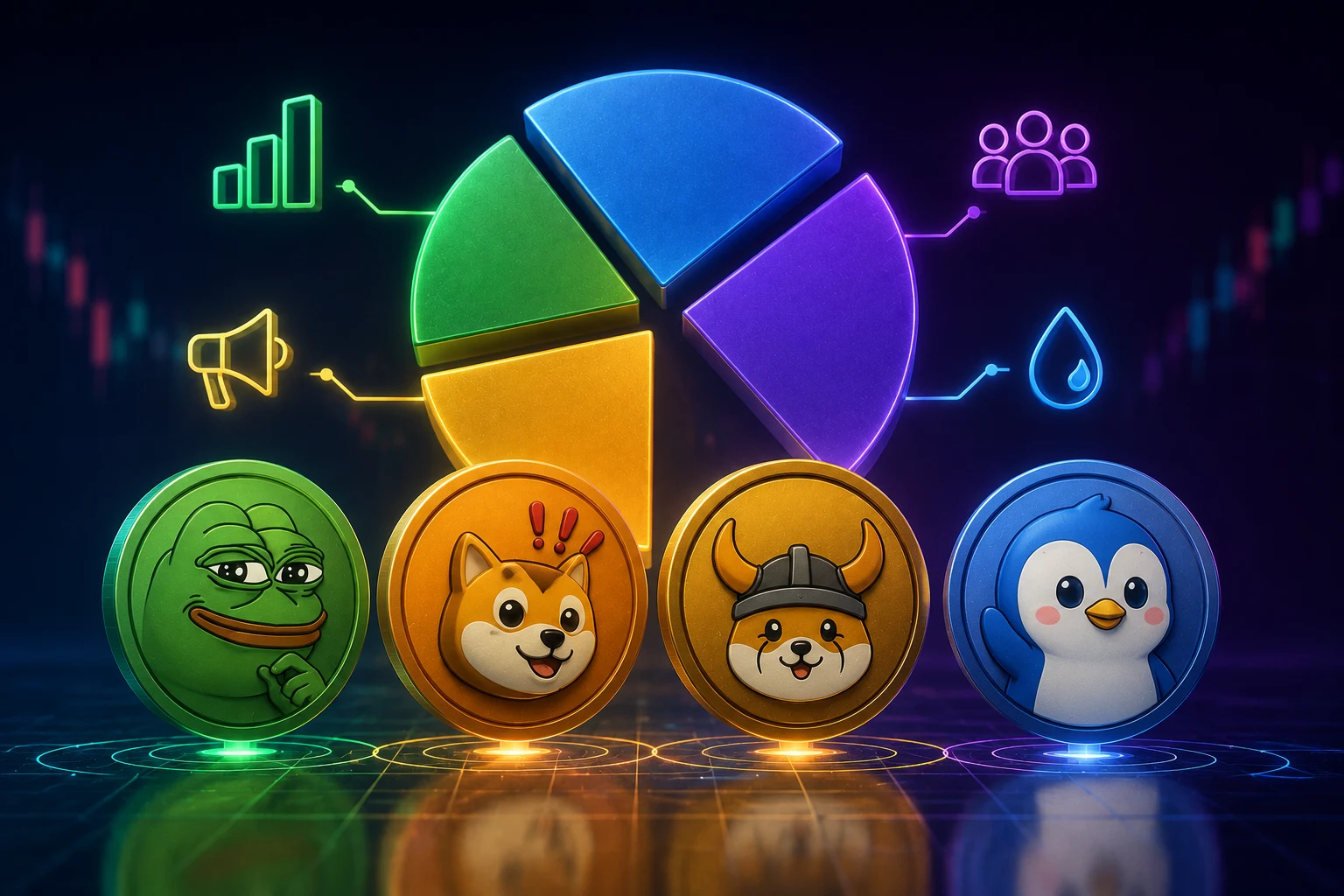
Each of the four coins in this comparison uses a different supply and launch recipe, which is why a price chart comparison without context is misleading. Here is what is actually on chain.
PEPE: the textbook fair launch
PEPE launched on Ethereum in April 2023 with a fixed supply of 420.69 trillion tokens, no presale, and the deployer wallet burning a large share of the supply to a dead address early on. There is no team allocation in the contract and no mint function. The thesis is purely cultural, leaning on the long-running Pepe the Frog meme. Because there is no burn mechanism and no deflationary function, the supply is fixed and the only variable is demand. That makes PEPE a clean example of a meme whose value is 100 percent attention-driven. If interest fades, the price will too, because nothing structural is buying tokens back.
BONK: a community airdrop on Solana
BONK launched in December 2022 as an airdrop distributed across the Solana ecosystem. Total supply is around 93 trillion tokens, with a meaningful share burned at launch and portions allocated to developers, NFT communities, and validators. The interesting feature is that BONK was designed to be "the people's coin" of Solana: it is integrated into dapps (decentralized applications), tipped to users, and used in NFT communities. That gave it more functional touchpoints than a pure fair launch, but it also means early airdrop recipients could dump at any time, which they did in the first weeks. Today, BONK's price still tracks Solana-wide attention cycles more than any internal token mechanic.
FLOKI: fixed supply plus an ecosystem war chest
FLOKI launched in 2021 with a presale and a fixed supply of 10 trillion tokens. What makes it different from PEPE is the explicit ecosystem layer: the team built a treasury (the FlokiFi product suite, a planned metaverse, and an education platform) funded by portions of the supply. The narrative is that FLOKI is a "movement" with real products behind the meme, and the tokenomics include scheduled token burns tied to the project's activity. The honest read is that ecosystem treasuries can fund genuine development, but they also mean a large share of supply is controlled by the team and sold over time to fund operations. Whether that selling shows up as inflation or as a treasury reserve depends on execution, which is hard to verify from a price chart.
PENGU: meme token tied to an NFT IP
PENGU is the utility token of the Pudgy Penguins ecosystem, launched in late 2024. Pudgy Penguins is a 10,000-piece NFT collection, and PENGU is meant to extend that brand into a broader consumer brand (toys, licensing, content) and to reward the existing NFT community. Total supply is intentionally large (around 88 billion tokens at launch), with portions allocated to the team, the NFT treasury, and the public. The reason PENGU is structurally different from PEPE or BONK is that it is tied to a real intellectual property (IP) that has a multi-year track record and a community that already exists. That is not a guarantee of price success, but it does mean PENGU's narrative is not purely speculative; there is a brand to grow or fail on. The risk is that if the parent NFT collection loses cultural relevance, the token has no independent floor.
How supply concentration changes the picture
The cleanest way to evaluate a meme coin is to look at where the tokens actually sit. A token with 100,000 holders and a top 10 wallet share of 5 percent is a very different bet than a token with 5,000 holders and a top 10 wallet share of 60 percent. Both can launch fairly, both can look decentralized on the surface, but the second one is fragile.
On-chain tools like Etherscan, Solscan, and BscScan let you inspect the top holders of any contract. The pattern across most meme coins is similar: a small number of wallets hold a large share, often through a few clustered addresses that may or may not be the same entity. This is not necessarily malicious. Early buyers are early buyers, and they earned those bags by being first. But it does mean that a single coordinated sale by a small group can move the price by 20 to 50 percent, which is the actual risk most buyers are taking on.
Locked liquidity (when the team deposits tokens into a smart contract that prevents withdrawal for a set period) helps, but only for the portion of liquidity that is locked. Many projects lock only 50 to 80 percent of the initial pool, leaving the rest removable. Burned liquidity (tokens sent to an unrecoverable address) is the only true commitment, and even that does not protect against the team dumping a separate treasury allocation.
Setting realistic expectations
The honest version of the meme coin thesis is that most of them go to zero, a small minority pump and dump, and a tiny number become durable cultural assets. DOGE and SHIB are the historical examples everyone points to, but they are survivor cases, not the base rate. For every DOGE there are thousands of dead tokens with similar launches and similar communities that simply did not catch.
If you are going to participate, the realistic framing is that you are buying attention, not equity. That means sizing the position so that a 100 percent loss does not affect your life, and being honest about whether you are trading the chart or buying the meme. Trading the chart is a different game from holding a thesis, and memes punish people who confuse the two. A position you cannot afford to lose is the one that will be sold at the worst moment.
The other honest expectation is that even on winning memes, most of the gain happens in a compressed window. If you were not early to PEPE, BONK, or PENGU on the first major move, you are often buying the post-peak distribution. That is not always true, but it is the default, and it is why the comparison between these four coins is really a comparison of narratives and supply mechanics, not a comparison of price targets.
How to follow meme coin tokenomics the smart way
Meme coin launches happen daily, and the difference between catching one early and arriving after the move usually comes down to information speed. Tracking supply schedules, launch mechanics, top-wallet concentration, and bonding-curve fills across PEPE, BONK, FLOKI, PENGU, and the next dozen tokens is not realistic to do by hand. Zippfeed surfaces meme coin headlines with sentiment scoring (bullish, neutral, or bearish) and an importance rating, so you can spot which narratives are gaining real attention and which are already past their window before you size a position.








 CoinDesk
 CryptoSlate