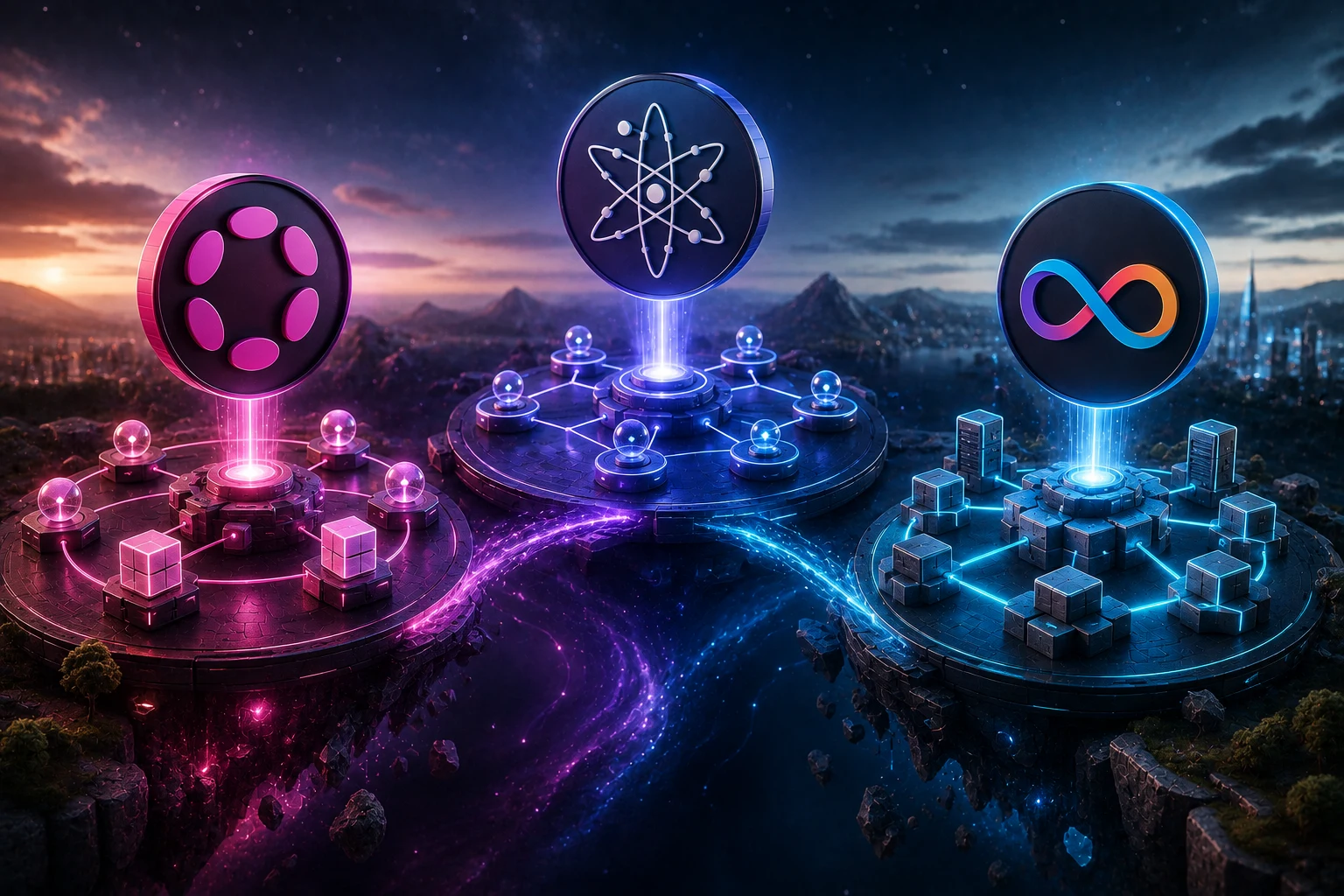
Why these three get compared at all
If you read crypto Twitter in 2020, you saw a clean story: Polkadot, Cosmos, and ICP were the 'multi-chain' alternatives to a then-Ethereum-dominated world. Each pitched interoperability. Each had a token that briefly ranked in the top ten. The narrative has softened since then. Ethereum's layer-2 (L2) rollup ecosystem absorbed much of the developer mind share that once flowed toward multi-chain frameworks, and Solana pulled in the high-throughput app crowd. That context matters, because the comparison these three deserve in 2026 is not whether they 'beat Ethereum.' It is whether they remain useful for specific jobs that rollups and Solana do not do.
The shared framing survives mainly because all three reject the idea of one chain to rule them all. They each assume future value will sit on many chains that need to talk. From there they diverge sharply. Polkadot wants those chains to share a security layer. Cosmos wants them to remain independent and connect through a standard (IBC, the Inter-Blockchain Communication protocol). Internet Computer wants a meaningful share of general-purpose compute to run inside the network itself, not just settle transactions on it. Treating them as interchangeable alternatives is the single most common mistake new users make when they encounter the comparison.
This article walks through what each platform is genuinely good at, what each one has actually shipped, and what each one has lost along the way. It is aimed at advanced readers: developers sizing a deployment, investors sizing an allocation, or researchers comparing architectures. None of this is financial advice. Token prices in all three ecosystems have round-tripped multiple cycles, and the gap between whitepaper promises and shipped reality is wide in every case.
Polkadot: shared security, parachain economics, and the slot problem
Polkadot is a relay chain (the central coordinating chain) that produces blocks and provides shared security to parachains connected to it. Parachains are independent blockchains that lease a slot on the relay chain via auction. In return, they inherit the validator set and economic security of the relay chain instead of bootstrapping their own. From a developer perspective the appeal is clear: you build a custom chain in Substrate (Parity's blockchain-building framework) and you do not need to incentivize thousands of validators from scratch.
The architecture that produces this benefit also creates the constraint. Slots are scarce. The original auction model crowdloaned DOT from retail into parachain lease slots, locking tokens for up to 96 weeks. If the parachain's token did not outperform DOT during that period, holders effectively donated their DOT for the duration. Acala, Moonbeam, Astar, and Parallel were among the headline winners in 2021 and 2022. Several of them are still live; their token prices relative to DOT have been weak across most of the post-2022 period.
Polkadot 2.0, rolled out across 2024 and 2025, replaced the slot auction model with Agile Coretime, a system where projects buy core time (compute blockspace on the relay chain) on demand rather than locking in multi-year leases. That fixes the worst part of the old system. It also signals an implicit admission that the auction design was holding the ecosystem back. For builders, the takeaway is that Polkadot remains a shared-security environment with excellent Substrate tooling and a real cross-consensus message format (XCM) for parachain-to-parachain calls, but the economic model now rewards ongoing usage more than long lease commitments.
On DeFi, Moonbeam still functions as an EVM-compatible parachain for EVM (Ethereum Virtual Machine) developers who want Polkadot security. Acala continues to position itself as a DeFi hub. Hydration (formerly HydraDX) runs an order-book-style AMM (automated market maker, a smart contract that holds pooled tokens and prices them by formula instead of a traditional order book). None of these has matched the volume of Ethereum or Solana DeFi in 2025. Polkadot's DeFi footprint is real but modest, and a reader building on it should size ambitions accordingly.
Cosmos: IBC composability, sovereign zones, and the validator problem
Cosmos is best understood as a stack rather than a chain. Tendermint (now CometBFT) provides a fast-finality consensus engine. Cosmos SDK is a Go framework for building chains on top of it. IBC is the standard those chains speak to each other over. The Cosmos Hub (ATOM) is the most prominent chain in the ecosystem, but is in no way the product. Most of the action lives in app-chains: Osmosis (decentralized exchange), Celestia (data availability), Injective (order-book derivatives), Sei (trading-focused chain), dYdX v4 (perpetuals), and dozens more.
The architectural advantage is sovereignty and modularity. A Cosmos chain picks its own validator set, its own token, its own fee token, and its own execution environment. A Cosmos chain can run a custom EVM, CosmWasm (a smart contract framework for Cosmos written in Rust or other compiled languages), Move, or a completely bespoke VM (virtual machine) that suits the application. That flexibility is real and used in production at scale.
The architectural cost is security. Every Cosmos chain is responsible for its own validator set. A small chain with a low inflation rate and modest staking has thin security, full stop. Bridges between Cosmos chains have been exploited several times, often via compromised validator keys or compromised third-party relayer infrastructure, not via IBC itself. IBC is a clean transport layer; the trust still flows through whoever runs the endpoints.
Cosmos's DeFi track record is stronger than Polkadot's by most measurable criteria. Osmosis remains one of the deepest non-EVM/Solana DEXs. Osmosis, Neutron, and others share enough of an IBC-connected composability surface that you can route a trade from one chain's token through another chain's pool and back without leaving the trust model of IBC. dYdX's move from Ethereum L2 to a Cosmos chain was a meaningful vote of confidence in 2023, even though dYdX chose its own application-specific chain rather than living inside an existing Cosmos DEX.
The hard question for Cosmos in 2026 is governance fragmentation. Each zone (individual Cosmos chain) doing its own thing is also the value proposition and the foot-gun. There is no shared upgrade path, no shared economic backstop, and no Cosmos-equivalent of Polkadot's relay chain safety net. A protocol that relies on a Cosmos chain inherits the choices that chain's validators make, which is a meaningful caveat for capital allocators.
Internet Computer: on-chain compute, canisters, and closed governance
ICP's premise is genuinely different from the other two. Bitcoin and Ethereum primarily settle transactions. Solana settled transactions faster. ICP's claim is that the network can host computation in a verifiable, replicated way, including web serving, file storage, and full-stack application logic, with canister smart contracts running on every node in a subnet (a smaller group of ICP nodes that together run a set of canisters to a higher replication factor).
In practice this means ICP can host static front-ends, backend APIs, and data, all from a single canister. Fleek, a hosting platform built on IC, lets you deploy a full Next.js or HTML site where the served HTML, JS, and assets live inside a canister rather than on AWS or Cloudflare. A few projects have shipped real consumer apps this way. The ceiling on a single canister's compute is real: per-canister instruction budgets have to be respected, and IC's messaging model is fundamentally asynchronous (operations return results via callbacks rather than synchronously), which forces a different programming model than EVM or Solana.
The NNS (Network Nervous System), ICP's on-chain governance system, controls the network's parameters, node admission, and economic policy through staked neurons that vote. Adoption metrics used to be heavily questioned; in 2022 a broader sample of internet-facing services from CanCan and others did not hold up, and the project spent the subsequent period rebuilding credibility with a more restrained developer-facing narrative. By 2025, the rebuilt positioning (hosting, AI inference, verifiable web backends) is narrower but more defensible than the original 'end the cloud' framing.
DeFi on ICP has not been a real story. IC is built around HTTP-out calls, https_outcalls, where a canister can fetch external data through the network's consensus rather than relying on an oracle service, but the resulting DeFi offerings are thin and liquidity is shallow. Anyone looking for composable on-chain finance is looking at ICP for the wrong reason. The chain is best judged on its compute thesis, not its DEX depth.
Where each one breaks: failure modes and risk surface
Polkadot's risk surface is concentrated in its economic model and its relay-chain dependency. Coretime pricing matters. If the relay chain suffers a serious liveness failure, parachain composability with it stalls. The validator set is large but is smaller than Ethereum's. Adoption outside the core DeFi and identity parachains has been slow, and DOT's valuation has spent multi-year stretches below its 2021 high without a clear catalyst in sight.
Cosmos's risk surface is per-chain. A validator compromise on a small zone is enough to drain a bridge. Governance attacks on low-stake chains are feasible. The economic model also bleeds: many Cosmos chains issue subsidies to validators to keep them staking, which spends tokens and pressures valuations over time. The ATOM token itself has been a disappointment relative to its 2021 narrative, in large part because value accrues to the zones rather than to the hub. A move toward interchain security (where one chain rents validator security from another, conceptually similar to Polkadot's model) has gained traction but has not solved the central problem.
ICP's risk surface is governance and hardware. The NNS can change parameters, including economic policy, with staked neuron votes. A large enough stake could meaningfully influence protocol direction. The node hardware is proprietary, and the data-centers that operate them are concentrated; despite being decentralized in principle, the operational footprint is narrower than Ethereum's. ICP also carries the reputational risk of an inflated 2021 launch; many readers will remember the cycle of 'world computer' claims followed by multi-year under-delivery, and they should evaluate the project on the current shipping product rather than on the original pitch deck.
Cross-chain composability: who actually talks to whom
All three ecosystems claim interoperability, but the models differ. Polkadot's XCM allows parachains to send messages through the relay chain, and to do trust-minimized asset transfers via Cross-Consensus Bridging. Liquidity and message-passing happen inside the relay chain's trust model. Bridges to outside chains (Ethereum, Bitcoin, etc.) exist but are not a primary design point.
Cosmos's IBC is light-client based and runs in both directions between IBC-enabled chains. Assets, packet data, and arbitrary messages flow natively. The strength is the breadth of chains that have adopted it (Cosmos Hub, Osmosis, Celestia, Injective, Stride, Neutron, dozens more). The weakness is on the edges: bridges from IBC into Ethereum, especially, rely on external verifiers and have been exploited in the past.
ICP does not natively bridge to EVM chains in the same trust-minimized way. Interoperability with Ethereum typically runs through threshold cryptography (a setup where a group of parties collectively hold key shares so no single one controls the signature) or through centralized components. Chain-key ECDSA (the cryptographic scheme ICP uses to sign transactions for other chains directly from the protocol layer) is a real technical achievement, but the bridges on top of it are still relatively young compared with IBC's track record.
The practical implication: if your project genuinely needs to compose with five other chains inside a single trust model, IBC is the most mature option. If you primarily want one hub to talk to several parachains all under one validator set, XCM is the cleanest fit. If you want your application logic to live on a single network that can also fetch external data, IC's model starts to make sense.
Developer tooling and ecosystem signals in 2026
Polkadot's Substrate is genuinely mature and remains one of the more pleasant blockchain frameworks to build a custom chain in. Polkadot.js, ink! (a smart contract language for Substrate), and the parachain templates have aged well. The ecosystem signal you should weigh is the ratio of new projects launching parachains versus app-specific chains in Cosmos or rollups on Ethereum. That ratio shifted toward Cosmos and Ethereum L2 between 2023 and 2025.
Cosmos tooling is excellent for chain builders and uneven for application developers. Cosmos SDK and Ignite (the scaffolding tool) produce production-ready chains quickly. Building CosmWasm contracts is reasonable but feels slower than building on a mature EVM chain where every library, oracle, and indexer already exists. dYdX v4 being written in Go on Cosmos SDK rather than CosmWasm points to a real trade-off: app developers sometimes want full custom control rather than contract-level composability.
ICP's developer experience has improved meaningfully with Motoko (IC's native language) and canister tooling that can deploy from a browser. Rust is also well-supported through a CDK (canister development kit). The honest assessment: deploying a canister feels different in a way that is initially frustrating for EVM developers and rewarding for those who want to keep an entire stack inside one network. IC's documentation is genuinely good by crypto standards, which is a meaningful signal of project health.
A caveat: developer tooling maturity does not equal ecosystem adoption. All three ecosystems have been out-shipped by Solana and by L2 rollups on raw user and developer counts. Each retains a meaningful niche, but a builder who picks one of these three today should know they are choosing a niche product, not the consensus default.
How to compare DOT, ATOM, and ICP as allocations
None of this is financial advice, and you should treat token price discussion in this space as a study in narrative cycles more than fundamentals. That said, three structural observations are worth keeping in mind.
First, token value accrual in each ecosystem is uneven. DOT accrues value through coretime demand and staking economics, but parachain token holders have historically been diluted or flat. ATOM has struggled to capture value from the zones that ride on top of it, even though ICS and other shared-security schemes are improving that. ICP's value capture relies on cycles being burned when canisters execute; whether that conversion rate scales with broader developer demand is an open question.
Second, the narrative cycle matters. Each of these tokens had a peak narrative moment (Polkadot in 2021, ATOM in 2021, ICP in 2021), and each has spent multi-year stretches in a relative cold patch. Buyers today should be evaluating the current shipping product, not the historical roadmap.
Third, correlation among the three is high. They tend to move together when risk-on flows rotate into 'alt L1' baskets and to drop together when those flows reverse. That correlation cuts both ways: it limits the diversification benefit of holding all three, and it also means each one's drawdowns are usually larger than Bitcoin or Ethereum's drawdowns in the same window.
For portfolio construction, the more honest framing is that each token represents a bet on a specific architectural bet rather than a generic crypto allocation. If you think shared-security corridors are undervalued, look at DOT. If you think app-chain sovereignty plus IBC composability is undervalued, look at ATOM, knowing that value accrues to specific zones more than the hub. If you think on-chain verifiable compute is undervalued as a primitive, look at ICP with eyes open about the governance model.
Follow these ecosystems without drowning in the noise
Polkadot, Cosmos, and Internet Computer each move on their own timelines and their own catalysts: parachain coretime sales, IBC upgrades, NNS proposals. Tracking them manually across governance forums, X feeds, Discord channels, and dev repositories is a losing game, and the signals worth acting on are usually buried under speculative posts. Zippfeed surfaces these ecosystems' headlines with sentiment scoring (bullish, neutral, or bearish) and an importance rating, so you can spot what actually moved the chain versus what is just noise.