Why stablecoin rankings usually mislead beginners
Most "top stablecoins" lists online are ordered by market capitalization and stop there. That is convenient for the writer and misleading for the reader, because a $100 billion stablecoin with opaque reserves and infrequent attestations is not safer than a $5 billion coin that publishes monthly audits and holds cash at a regulated US bank. Market cap tells you how many people hold a coin; it tells you almost nothing about whether those holders can actually redeem it for a dollar.
This ranking uses market cap as a starting point, then reorders by three factors that determine what happens if an issuer gets into trouble: reserve composition (cash and short-dated US Treasuries are safer than commercial paper and corporate bonds), audit and attestation cadence (a monthly third-party attestation is meaningfully better than a yearly audit), and regulatory status (a coin issued under a US or EU framework faces stricter oversight than one issued from a Caribbean trust). When a coin scores well on all three, it climbs the list; when it scores poorly, it falls, even if it is one of the biggest by volume.
Two coins on this list (TUSD and USDS) have traded meaningfully below $1 for extended periods. We have kept them on the list because they remain in the top 10 by circulating supply, but we have explained the depegging history honestly, because a stablecoin that cannot reliably hold its peg is not stable in any meaningful sense, regardless of what its marketing says.
The risks that come with every stablecoin, no matter the issuer
Before the list, the failure modes every holder should understand. Stablecoins are not insured. If the issuer's reserves lose value, get frozen by a regulator, or turn out to be misrepresented, the holder becomes an unsecured creditor of an offshore entity. There is no FDIC or SIPC equivalent for crypto dollars, and the legal recovery process varies dramatically by jurisdiction.
Reserve risk is the headline. The 2008-style failure of SVB in March 2023 briefly threatened Circle's USDC because roughly $3.3 billion of USDC reserves sat at the failed bank. USDC depegged to about $0.87 before recovering once the FDIC confirmed uninsured deposits would be made whole. That episode is the clearest recent demonstration that "backed 1:1 by cash" is not the same as "safe" if the cash is concentrated at one institution.
Depegging risk is real and recurring. USDT traded at $0.95 during the TerraUSD collapse in May 2022. TUSD slipped below $0.97 for weeks in early 2024. USDS (formerly USDP) traded below $0.97 for parts of 2023. None of these are theoretical risks; they are recent history.
Counterparty and jurisdictional risk sits underneath everything. USDT is issued by Tether Limited, a company incorporated in Hong Kong and historically opaque about its banking relationships. DAI is governed by a DAO and backed by crypto collateral, which introduces liquidation-cascade risk that cash-backed coins do not have. Offshore issuers are also subject to fewer disclosure rules, which is why the GENIUS Act and MiCA both target this exact gap.
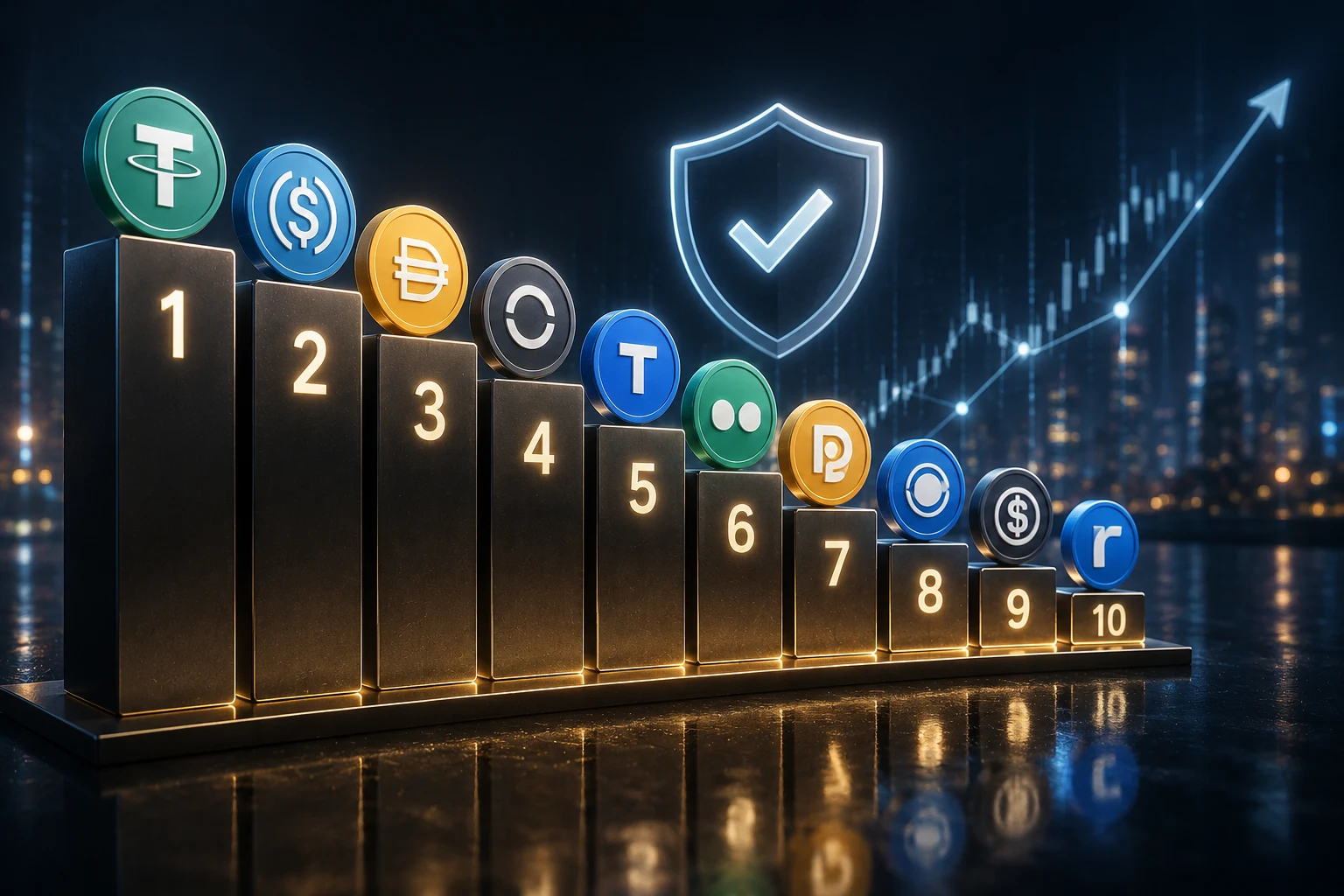
The top 10 stablecoins in 2026, ranked
1. USDC (Circle)
USDC sits at the top of this list because it combines the largest US-regulated market cap with the most rigorous disclosure regime. Circle reserves are held primarily in cash and short-dated US Treasuries at regulated US institutions (including BlackRock as a primary manager), and Circle publishes a monthly attestation from a Big Four accounting firm (currently Deloitte) along with regular SOC 1 Type 2 and SOC 2 Type 2 reports. USDC is now issued under US state money transmitter frameworks, with Circle pursuing a US trust bank charter and a GENIUS Act-compliant status.
USDC's main caveat is concentration risk (a single bank's failure can move the peg, as SVB proved) and the fact that Circle freezes addresses on law enforcement request, which is a feature for compliance teams and a drawback for users who value censorship resistance.
2. USDS (Sky, formerly MakerDAO / DAI)
USDS is the rebranded version of DAI, issued by Sky (the renamed MakerDAO ecosystem). It earns the second slot because of its long regulatory track record: it has held a New York Department of Financial Services BitLicense-style oversight path via the MKR/Sky governance framework, and its reserves are disclosed in real time on-chain. The reserves have shifted significantly in 2024 and 2025 toward tokenized US Treasuries through partnerships including Coinbase and custodians aligned with traditional finance.
The honest caveat: USDS/DAI has depegged. In March 2023, during the SVB crisis, DAI traded around $0.90 because a meaningful portion of USDC collateral sat at the failed bank. USDS has traded below $0.99 multiple times since the rebrand. Also, USDS still uses crypto-collateralized vaults for a portion of its supply, which means liquidation cascades during sharp crypto selloffs remain a structural risk that fully fiat-backed coins do not have.
3. PYUSD (PayPal)
PYUSD ranks third because it is issued by a major US-regulated payments company (PayPal), reserves are held in cash and short-dated Treasuries, and Paxos (the issuer) is a New York DFS-regulated trust. Attestations are published monthly. For US consumers, PYUSD has the additional advantage of being natively integrated into PayPal and Venmo, which lowers the operational friction of holding and transacting in a regulated stablecoin.
The trade-off is liquidity and third-party integration. PYUSD is not yet as widely supported on DeFi protocols or non-US exchanges as USDC or USDT, and adoption outside PayPal's ecosystem remains modest.
4. USD1 (World Liberty Financial)
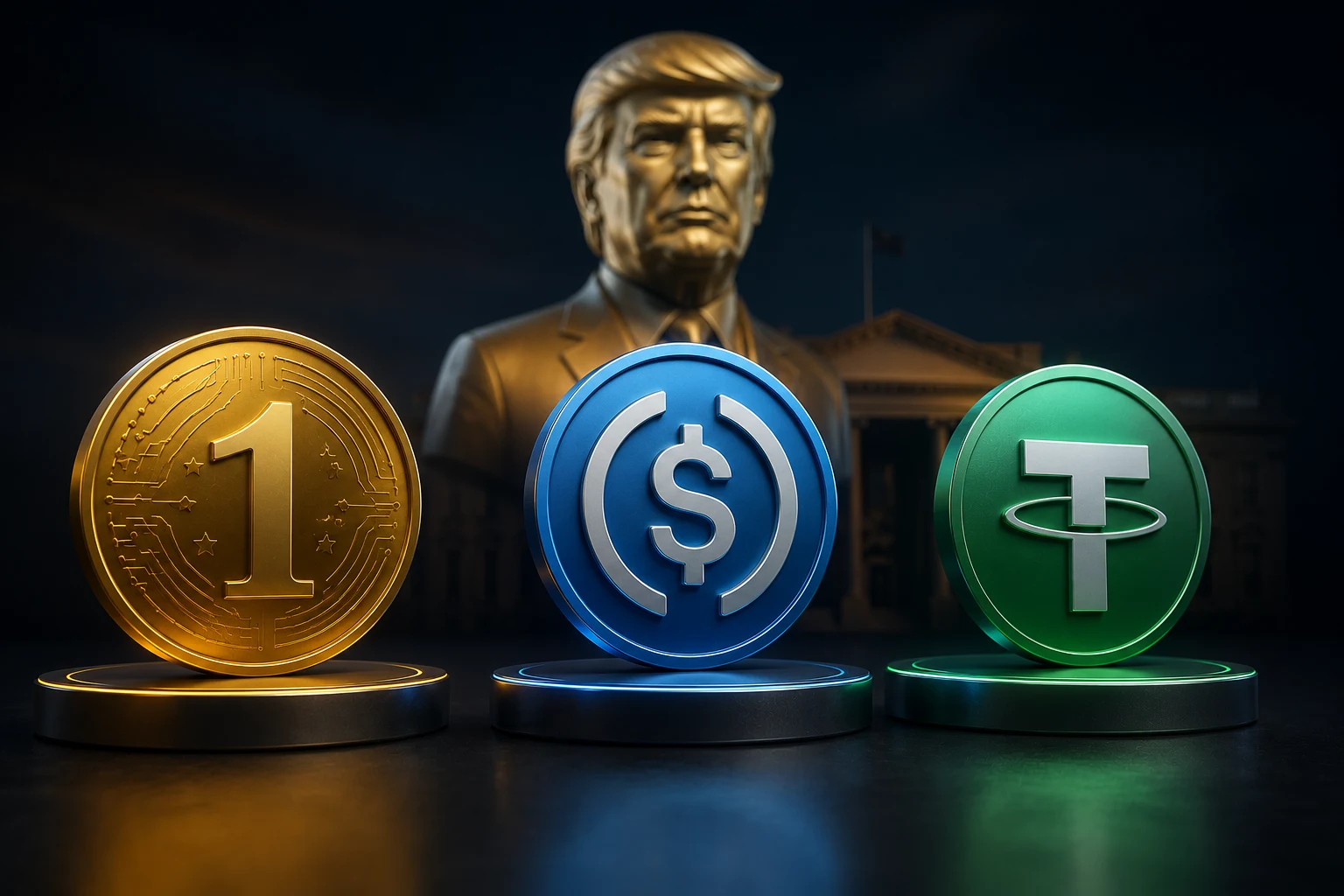
USD1 is the newer entrant from World Liberty Financial, the Trump-family-linked crypto venture. It is issued via a BitGo trust structure, reserves are held in cash and US Treasuries, and BitGo provides monthly attestations. Its rapid rise into the top 10 in 2025 came from institutional distribution deals rather than retail adoption.
The reason it sits fourth and not higher is governance and concentration risk. USD1's reserve custody is concentrated with a single custodian, and its political associations introduce reputational and regulatory uncertainty that more neutral issuers do not carry.
5. RLUSD (Ripple)
RLUSD is Ripple's USD stablecoin, issued under a New York DFS trust charter with reserves in cash and Treasuries and monthly third-party attestations. It benefits from Ripple's existing institutional relationships and is being positioned for cross-border payment use cases where Ripple's XRP Ledger and RippleNet already operate.
The caveat is that RLUSD is still building distribution and liquidity outside Ripple-affiliated venues. As with PYUSD, adoption outside the issuer's own rails will determine whether it stays in the top tier.
6. USDT (Tether)
USDT is the largest stablecoin by market cap and trading volume, and that is genuinely useful: it is the coin you can actually move on almost every exchange and on most cross-border corridors. USDT publishes attestations (currently from BDO), reports its reserves breakdown regularly, and has shifted heavily toward US Treasuries in its reserve composition.
The honest problem is regulatory and structural. USDT is issued by Tether Limited, which is not regulated by a US or EU financial supervisor, has a long history of legal and regulatory settlements (including a $41 million CFTC fine in 2021 for misrepresenting reserves), and remains under scrutiny from the DOJ and Treasury. Tether is not authorized under MiCA for EU retail distribution, and major US exchanges have at times considered delisting it for US customers. For users in jurisdictions with strong stablecoin frameworks, USDT is increasingly a professional-trader tool rather than a long-term savings vehicle.
7. FDUSD (First Digital)
FDUSD is issued by First Digital Labs in Hong Kong, reserves are held in cash and Treasuries, and attestations are published. It became a top-10 coin largely through Binance distribution and trading-fee rebate programs in 2023 and 2024.
The reason it ranks seventh rather than higher is regulatory posture. FDUSD is not a US-regulated coin, has had episodes of redemption friction, and its distribution is heavily concentrated on a single exchange, which is itself a single point of failure.
8. USDe (Ethena)
USDe is a synthetic dollar that uses a delta-neutral hedging strategy: it holds spot crypto as collateral and shorts the equivalent perpetual futures position, capturing the funding-rate spread. Reserves disclosures include backing composition, and Ethena publishes third-party attestations.
The risk is structural and different from the rest of this list. USDe is not backed 1:1 by cash and Treasuries; it depends on functioning derivatives markets and positive funding rates. During extreme market stress or exchange outages, the peg can break in ways cash-backed coins would not. The Ethena Insurance Fund mitigates but does not eliminate this risk.
9. TUSD (TrueUSD)
TUSD has had a turbulent 2024. It was acquired by a new ownership group (linked to Justin Sun via Archblock), which triggered multiple banking relationships to end, leaving TUSD unable to mint or redeem through traditional rails for extended windows. TUSD traded around $0.96 to $0.99 during periods of 2024 and has not consistently held parity.
TUSD remains on this list because its circulating supply still places it in the top 10, but it is the clearest example of why market-cap rankings mislead: a coin with broken mint and redeem is functionally not a stablecoin, regardless of its ticker.
10. DAI (legacy MakerDAO)
Legacy DAI still circulates alongside USDS during the migration period. The Dai Savings Rate and older vaults continue to operate. Its rank reflects ongoing circulation, but most new issuance is now USDS, and users with a choice should prefer USDS for new positions.
GENIUS Act and MiCA: how the regulatory map differs by region
The GENIUS Act in the United States, signed into law in 2025, creates a federal framework for payment stablecoins. It requires issuers to hold reserves 1:1 in cash and short-dated Treasuries, publish monthly reserve disclosures, undergo regular audits, and meet strict AML and sanctions requirements. Crucially, it allows only US-regulated entities (insured depositories, non-bank issuers under OCC supervision, or state-regulated issuers meeting federal standards) to issue stablecoins to US retail users. That is why USDC, PYUSD, RLUSD, and USDS are positioned to benefit, and why USDT is increasingly treated as an offshore product.
MiCA (Markets in Crypto-Assets Regulation) in the European Union took full effect in 2024 and requires stablecoin issuers to be authorized as electronic money institutions or credit institutions, hold reserves under strict rules, and meet capital and governance requirements. USDT was effectively pushed out of EU-licensed venues in 2024 because Tether chose not to pursue MiCA compliance. USDC, USDS, and EURC (Circle's euro coin) are available to MiCA-compliant EU users.
For readers, the practical rule is straightforward. If you are a US user, prefer GENIUS-compliant issuers for any meaningful holding. If you are an EU user, use only MiCA-authorized stablecoins through compliant venues. Offshore coins (USDT in particular) still have a place in cross-border trading and DeFi liquidity, but they are no longer a safe default for long-term holding.
US-issued vs offshore: where each coin actually fits
The cleanest mental split is US-issued versus offshore. US-issued coins (USDC, USDS, PYUSD, USD1, RLUSD) operate under US regulatory supervision, hold reserves at US-regulated banks and custodians, and are subject to US law enforcement cooperation. They are the right choice for US-based users, US-tax-compliant reporting, and any holding that needs predictable redemption.
Offshore coins (USDT, FDUSD, TUSD) offer better liquidity on global exchanges and cross-border corridors, often lower friction in DeFi, and faster listing on new chains. They are appropriate for active trading, international transfers, and DeFi users who prioritize liquidity over regulatory clarity. They are a poor choice for long-term savings or for users in regulated jurisdictions who want clean reporting.
Synthetic and crypto-collateralized coins (USDe, legacy DAI vaults) sit in a third category. They are useful for specific strategies (yield, delta-neutral exposure, on-chain credit) but carry structural risks (funding-rate flips, liquidation cascades) that fully fiat-backed coins do not. Treat them as protocol tokens, not cash equivalents.
How to verify reserves yourself and spot red flags
Do not take an issuer's homepage at face value. There is a real verification workflow that takes about ten minutes per coin. First, find the most recent attestation (not a marketing summary) and confirm it is from a reputable accounting firm; BDO, Deloitte, KPMG, and EY are credible; smaller regional firms deserve more skepticism. Second, read the attestation's reserve breakdown line by line: look for cash, US Treasuries, and reverse repurchase agreements on Treasuries, and flag commercial paper, corporate bonds, secured loans, or "other" categories that often exceed 10% of reserves.
Third, check the cadence. Monthly attestations are now table stakes for any top-tier issuer. Quarterly is acceptable for mid-tier coins. Yearly only is a red flag. Fourth, confirm the auditor changes sign-off date within the stated cadence; stale attestations are a warning sign that something has stalled. Fifth, look for a real-time on-chain proof-of-reserves feed if the issuer claims one (USDC and USDS publish reserve data, while some offshore issuers only publish PDF statements months later).
Red flags worth taking seriously: attestation from an obscure firm with no financial-services reputation; reserves concentrated in commercial paper or "digital tokens"; repeated changes in auditor without explanation; difficulty finding the legal entity name and jurisdiction; and any history of unexplained delays or withdrawals at the issuer's banking partners.
What this ranking means for you in practice
If you are holding stablecoins as a savings substitute, restrict yourself to US-regulated issuers (USDC, PYUSD, RLUSD, USDS) and split across at least two so a single-issuer problem does not freeze your funds. Avoid offshore coins for any holding you cannot afford to lose access to for an extended period, because that is exactly what happens when an offshore issuer hits a banking or legal problem.
If you are an active trader, you will inevitably use USDT for liquidity on global exchanges, and that is reasonable, but treat your exchange balance as transactional, not as savings. Move long-term holdings to self-custody in a regulated stablecoin in a hardware wallet where you control the keys.
If you are a DeFi user, weigh the protocol-level yield against the underlying stablecoin risk. Earning 12% APY on a stablecoin that depegs 5% in a stress event is a net loss. The synthetic coins (USDe) and crypto-collateralized coins (USDS vaults) deserve extra scrutiny because their peg risk is structural, not just operational.
Finally, remember that the list changes. Stablecoin issuers fail, get acquired, lose banking partners, and face new regulation. Re-check the audit and regulatory status of any stablecoin you hold at least quarterly.
How to follow stablecoin news without getting misled
Stablecoin news moves fast, and the headlines usually emphasize market cap, partnerships, or celebrity endorsements rather than the boring reserve and audit updates that actually determine safety. Zippfeed surfaces stablecoin headlines with sentiment scoring (bullish, neutral, or bearish) and an importance rating, so you can separate genuine regulatory and reserve updates from marketing noise. Set up a watchlist for USDC, USDT, and any GENIUS Act developments, and you will not miss the issuer-level events that move the peg.








 WuBlockchain
 CoinDesk
 TheBlock