What it really is
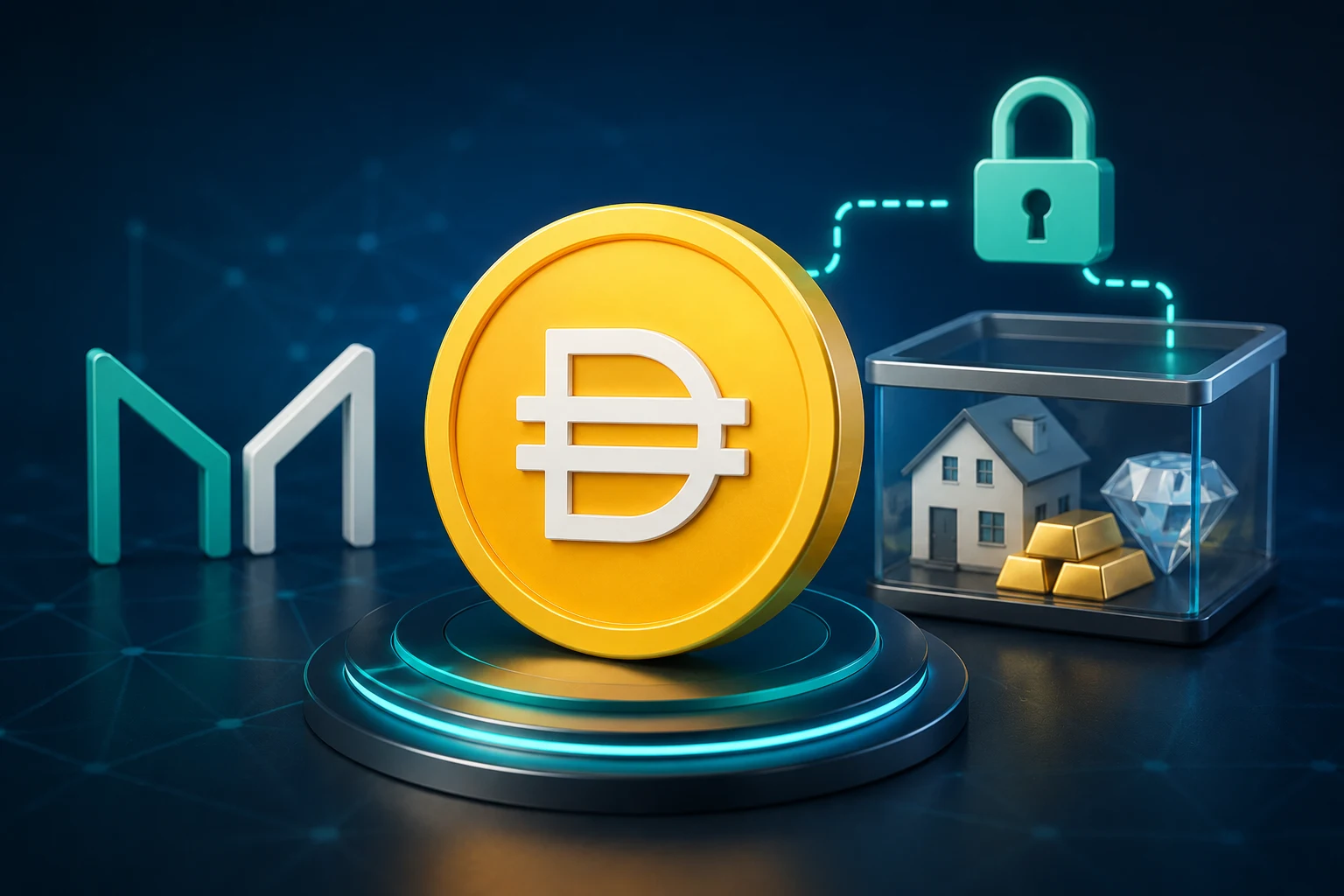
DAI is the original decentralized stablecoin. Launched in 2017 by MakerDAO, it was the first stablecoin to achieve durable scale without a central issuer holding dollars in a bank account. Instead, DAI is created by users who deposit crypto (originally only ETH; today ETH, wBTC, several LSTs, USDC, and RWA-backed tokens) into MakerDAO smart contracts and mint DAI against it as a loan. The system is designed so the total collateral always exceeds the total DAI in circulation by a safety margin.
The pitch was "crypto without the volatility, without trusting a company." The reality is more nuanced — DAI did achieve durable decentralization, then progressively shifted toward USDC and real-world assets in its collateral base to maintain peg stability through stress events. By 2024, the MakerDAO project renamed itself Sky and introduced USDS as a parallel upgrade path, while DAI continues to operate. "Pure DeFi stablecoin" has become "DeFi-native stablecoin backed by a hybrid collateral base." That is honest progress, not failure.
For background on the broader category, see what is a stablecoin; for comparison with the dominant centralized stablecoins, see USDT vs USDC.
How it actually works
The basic mechanic of DAI is a collateralized debt position (CDP), renamed Vault in modern Maker docs:
- You deposit an accepted collateral asset (ETH, wBTC, an LST, USDC, RWA tokens, etc.) into a MakerDAO Vault smart contract.
- You can mint DAI up to a certain ratio of your collateral — for example, 70% of the value of your ETH (giving you ~143% collateralization).
- You pay an annual "stability fee" (interest rate) on the DAI you mint, set by MakerDAO governance per collateral type.
- If the value of your collateral falls and your position approaches the liquidation ratio (e.g. 130% for ETH), the system liquidates it: a keeper bot pays off your DAI debt, takes your collateral, and you lose the liquidation penalty.
- You can repay your DAI any time to unlock your collateral and close the position.
Multiply this by thousands of users across many collateral types, and you get a pool of DAI in circulation that is always over-collateralized in aggregate. That over-collateralization is what allows DAI to hold its peg even when individual positions get liquidated.
How the peg is maintained
MakerDAO uses several mechanisms in parallel to keep DAI close to $1:
1. Liquidations and over-collateralization
Every DAI is backed by more than $1 of collateral. When collateral prices fall, undercollateralized Vaults are liquidated and their collateral is sold to repay the DAI debt. The system shrinks if needed, but the total collateral never falls below the total DAI outstanding under normal conditions.
2. The Stability Fee and Dai Savings Rate (DSR)
If DAI trades above $1, MakerDAO can lower the Stability Fee (cheaper to mint, more DAI supply, peg pushed down). If DAI trades below $1, it can raise the Stability Fee (more expensive to hold debt, users repay DAI, supply shrinks, peg pushed up). The DSR — the rate paid to DAI holders who lock DAI in a savings contract — works similarly: raising the DSR creates demand for DAI, pushing the peg up.
3. The Peg Stability Module (PSM)
The PSM is a smart contract that lets anyone swap USDC for DAI 1:1 (and back) at no slippage. This creates an arbitrage ceiling and floor: if DAI trades to $1.01, someone deposits USDC into the PSM, mints DAI, sells for $1.01, repeats; if DAI trades to $0.99, someone buys DAI for $0.99, redeems via PSM for $1 of USDC. The PSM made DAI dramatically more peg-stable — but also made it dependent on USDC for a meaningful chunk of its backing.
4. RWA-backed Vaults
Since 2022, MakerDAO has accepted RWA collateral — tokenized US Treasuries, private credit pools — as backing for DAI. The yield from these RWAs flows into MakerDAO's surplus buffer and funds the DSR. By 2024-2025 RWA backing made up a meaningful share of DAI's collateral and a majority of its revenue. This is what allowed MakerDAO to pay competitive DSR rates and absorb USDC depeg events.
Simple example with numbers
Suppose ETH is at $4,000 and you have 1 ETH you do not want to sell.
- You deposit 1 ETH ($4,000) into a Maker Vault and mint 2,000 DAI against it.
- Your collateralization ratio is 200%. The liquidation ratio for ETH is, say, 130%, so you have buffer.
- You owe 2,000 DAI plus an annual stability fee (e.g. 5%) on the debt.
- You can spend or deploy the DAI as you would any stablecoin. You retain exposure to ETH price movements.
- If ETH falls to $2,600, your collateral value is $2,600, your debt is 2,000 DAI, your ratio is 130% — right at the liquidation threshold. Below that, the Vault gets liquidated.
- To close the position, you repay 2,000 DAI plus accrued stability fee and the contract releases your 1 ETH.
Most active Maker users either: (1) farm leveraged ETH exposure by minting DAI, swapping for more ETH, depositing again; (2) use DAI as on-chain working capital while retaining their collateral asset's upside; (3) provide liquidity to PSM-style routes for fees.
The 2024 Endgame rebrand: DAI, USDS, and SKY
In 2024, MakerDAO completed its "Endgame" reorganization, renaming the project Sky and introducing two new tokens:
- USDS: a new stablecoin meant to be the modern flagship, with the same peg mechanics as DAI but a new technical foundation and governance role. Users can convert DAI to USDS at 1:1 via the official upgrade module.
- SKY: a new governance token replacing MKR, at a fixed exchange rate.
DAI did not get sunset. It continues to operate, can still be minted, held, and used in all the same DeFi venues. USDS exists as a parallel option for users who want the new model. The split is roughly: integrations and protocols that have been on DAI for years stay on DAI; new integrations and users who want the latest governance and yield structure use USDS. Both stablecoins target $1 and are issued by the same underlying system.
How DAI compares to centralized stablecoins
Compared to USDT vs USDC:
- Issuer model. USDT and USDC are issued by companies (Tether, Circle) that hold dollars in banks. DAI is issued by a protocol against crypto collateral. There is no Tether-equivalent corporate balance sheet behind DAI.
- Custody. Your USDT/USDC sit in a database mapping to fiat reserves. Your DAI is backed by crypto in smart contracts (plus USDC in the PSM, plus RWA tokens). The on-chain collateral is verifiable; the off-chain RWA collateral relies on regulated custodians.
- Regulation. USDC is regulated under multiple US and EU frameworks. DAI/USDS is issued by a protocol; the governance entity Sky is not a regulated bank. Some jurisdictions treat decentralized stablecoins differently from issuer stablecoins.
- Liquidity. USDT and USDC dwarf DAI in global liquidity. DAI is deep in DeFi but thinner on centralized exchanges.
- Peg history. DAI has held its peg through every major stress event since 2018 — including the SVB-induced USDC depeg in March 2023 (DAI briefly followed USDC because of PSM exposure, then recovered). It has never permanently depegged.
The risks worth knowing
- Collateral concentration risk. A large share of DAI backing is USDC via the PSM. A USDC depeg event hits DAI directly until the system rebalances. The RWA backing partially decoupled this risk but did not eliminate it.
- RWA collateral risk. The RWA Vaults rely on regulated custodians and traditional financial counterparties. A failure there propagates to DAI.
- Smart contract risk. The Maker / Sky contracts are heavily audited and have run for years, but they are still software. A critical bug in the core system would be catastrophic.
- Governance risk. Sky governance can change collateral types, debt ceilings, stability fees, and the PSM. Decentralized governance is not always fast or coherent during stress.
- Liquidation cascades. In a sharp crypto market drop, ETH-backed Vaults get liquidated en masse. The system has mechanisms (Maker Buffer, MKR/SKY backstop) to absorb shortfalls but in extreme scenarios it has had to mint new MKR (Black Thursday, March 2020).
- USDS migration risk. The Endgame split adds a second token, additional governance complexity, and integration questions for protocols. Most resolved smoothly but anyone touching DAI/USDS infrastructure should understand both tokens.
None of this is financial advice. The honest summary: DAI is a remarkable, durable piece of DeFi infrastructure that has earned its trust through years of operation — but it is not as "pure DeFi" as the original 2017 pitch suggested, and the trade-offs around USDC backing and RWA collateral are real.
Who it actually suits
Suits: DeFi users who want a stablecoin issued by a protocol rather than a centralized company; users who interact with DeFi protocols where DAI is canonical (it is in many Aave, Maker-adjacent, and older DeFi markets); users who like the option to mint DAI against their own collateral; users who want the DSR or USDS savings rate as a passive yield.
Does not suit: users who need maximum liquidity on centralized exchanges (USDT dominates there); users who require strict regulated-issuer status (USDC fits better); users who want a stablecoin with the simplest possible mental model ("company holds dollars" is easier to explain than "protocol manages a basket of crypto and RWAs").
Watch the collateral, watch the news
DAI's stability depends on its collateral base and the regulatory environment around its USDC and RWA backing. Zippfeed tracks DeFi, regulation, and major-token headlines with sentiment and importance scoring, so you can see USDC issues, RWA stress, governance decisions, and Maker / Sky upgrades early — useful whether you hold DAI as on-chain dollars, run a Maker Vault, or are evaluating which stablecoin best fits your DeFi strategy.

 CoinDesk
 CryptoSlate
 TheBlock