What is USD1 and why does it exist?
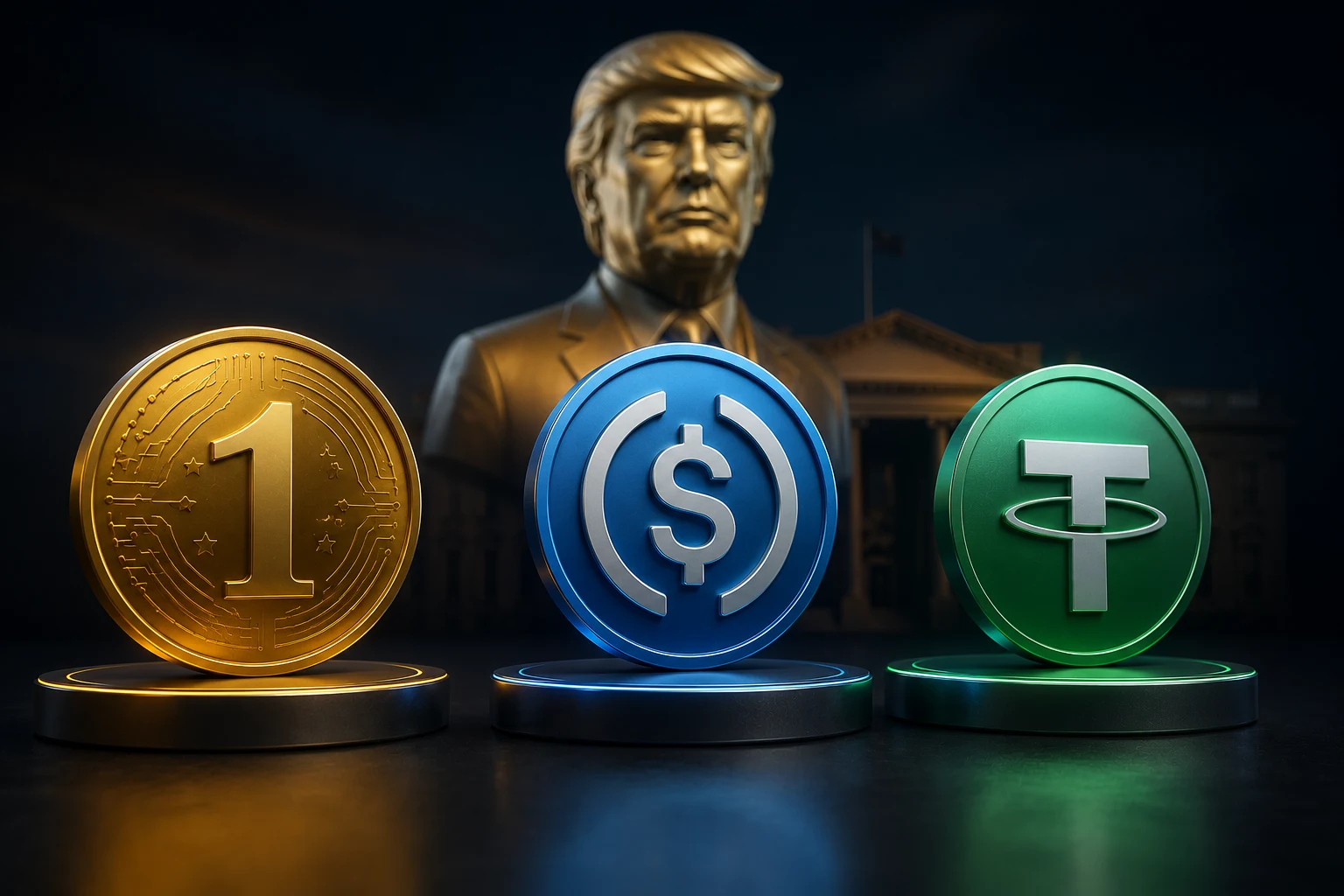
USD1 is a US dollar-pegged stablecoin launched in March 2025 by World Liberty Financial (WLFI), a crypto venture co-founded by Donald Trump and his sons. Within days of launch, the token reportedly had a $2 billion initial mint, which made it the largest stablecoin debut on record and pushed it onto several aggregator dashboards almost overnight.
The pitch is straightforward. USD1 is marketed as a fully reserved dollar token, pegged 1:1 to the US dollar, with reserves supposedly held in short-dated US Treasuries, cash, and cash equivalents. It launched on Ethereum and BNB Chain, with claims of multi-chain expansion to follow. BitGo, a regulated trust company that already custodies billions in institutional crypto, was named as the primary custodian and reserve manager.
The reason USD1 matters, regardless of your politics, is that it is the first major US dollar stablecoin with a direct political brand attached to a sitting or recent US president. That alone makes it a different kind of risk from USDC and USDT, and it is why a clean comparison has to start with the issuer, not the technology.
The risks of USD1 that you should know first
Before looking at reserve composition, it is worth naming the risks USD1 carries that USDC and USDT do not, because most marketing material will not.
No operating history. USDC has been live since 2018, and USDT since 2014. Both have processed tens of billions of dollars in real redemptions across multiple market crises, including the March 2020 crash, the Terra/LUNA collapse in May 2022, and the November 2022 FTX bankruptcy. USD1 has not yet lived through a single stress event. Any new stablecoin's real risk profile only emerges after a redemption queue forms, and that test has not happened for USD1.
Political and reputational risk. USD1 is associated with the Trump family and a venture that holds direct equity in WLFI. That creates a few real risks. A future US administration could investigate, sanction, or restrict the issuer. Foreign holders, especially in jurisdictions sensitive to US sanctions policy, could face frozen wallets. Payment partners, exchanges, and custodians may de-list the token if compliance costs rise. None of these risks exist for USDC and USDT in the same form.
Custody and counterparty concentration. USD1's reserve setup depends heavily on BitGo and a small group of named banking partners. If any of those counterparties fails, gets sanctioned, or terminates the relationship, USD1's redemption path narrows quickly. There is no long public record showing how this stack has held up under pressure.
Regulatory ambiguity. The GENIUS Act, signed in 2025, sets new federal rules for US payment stablecoins, including reserve, audit, and licensing requirements. USD1's compliance pathway under the act is still being worked out, and until the issuer has a clean, ongoing attestation cadence, there is a real chance the token is treated as more restricted by major exchanges and payment rails than USDC.
USDC vs USDT: the bar USD1 has to clear
To judge whether USD1 deserves a place alongside USDC and USDT, it helps to look at how those two incumbents are actually run, because that is the standard the market already accepts.
USDC, issued by Circle. USDC reserves are held primarily in short-dated US Treasuries and cash held at regulated US banks, including BlackRock as a primary reserve manager. Circle publishes monthly third-party attestations from a Big Four accounting firm, currently Deloitte, that show reserve composition as of a specific date. Circle has a regulated US state trust company charter and is registered with FinCEN as a money services business. In March 2023, during the Silicon Valley Bank collapse, USDC briefly lost its peg because $3.3 billion in reserves were stuck at SVB. Circle resolved this within days once FDIC receivership clarified the situation, and USDC holders were made whole. That episode is now part of USDC's track record rather than a stain on it.
USDT, issued by Tether. USDT is the largest stablecoin by circulating supply, with well over $100 billion outstanding at any given time. Tether publishes attestations rather than full audits, and has historically faced criticism for delays, gaps in reporting, and a 2021 settlement with the New York Attorney General and CFTC over reserve misstatements. Tether has gradually increased its Treasury bill holdings and now reports that the majority of reserves are in US Treasuries and cash equivalents. USDT has redeemed tens of billions of dollars in real time across multiple crises without a single solvency failure, which is why it remains dominant despite a weaker disclosure record than USDC.
The relevant comparison is not that USDC and USDT are risk-free. They both have real failure modes. The point is that each has been tested, audited, redeemed, and litigated in ways that USD1 has not.
USD1's reserve claims and what they actually mean
World Liberty Financial has stated that USD1 reserves are held in cash, cash equivalents, and short-dated US Treasuries, with BitGo acting as qualified custodian. On paper, that is very close to USDC's structure. The practical difference is what has not yet been proven.
Audit vs attestation. Circle publishes monthly attestations, which are point-in-time reports from a Big Four firm. A full audit, which audits internal controls and tests transactions, is a higher bar. Tether publishes attestations with delays. USD1 has published limited third-party reports so far and has not committed to a monthly cadence. Until it does, USD1 reserve claims cannot be compared to USDC's on like terms.
Custody setup. Naming BitGo is meaningful, because BitGo is a New York trust company that holds client assets in segregated accounts. That gives USD1 a stronger starting position than many new stablecoins. The question is how BitGo interacts with the issuer, whether reserves are legally segregated from WLFI's corporate assets, and what happens if WLFI itself enters bankruptcy.
Redemption terms. USDC and USDT both allow qualified holders to redeem directly with the issuer for US dollars, with daily cutoff times and minimum sizes. USD1's redemption mechanics, KYC requirements, and minimums have not been published in detail. That is a real gap. A stablecoin that does not have a clear, public, and tested redemption path is functionally a different product from one that does.
What the GENIUS Act actually changes for USD1
The GENIUS Act, passed in 2025, created the first federal framework for US-issued payment stablecoins. The law requires issuers to hold reserves in cash and short-dated Treasuries, publish regular reports, and obtain either a federal banking license or a state-level qualified charter. It also limits yield payments to holders and restricts non-compliant foreign stablecoins from being distributed by US-based intermediaries.
For USDC, the act mostly formalizes practices Circle already followed. For USDT, the act creates friction at US exchanges and custodians, which is part of why Tether's market share in the US has been gradually eroding. For USD1, the act is the first major test of whether WLFI can run a stablecoin under formal regulatory scrutiny.
If USD1 obtains a qualified charter, maintains monthly attestations, and proves out a working redemption process, the act becomes a tailwind, because USDC and USDT will face the same rules and USD1 will be on equal footing. Until that happens, USD1 sits in a gray zone where some exchanges will list it freely and others will restrict or refuse it.
Geopolitical risk: the foreign holder problem
Stablecoins are global. Most USDT and a meaningful share of USDC flow through exchanges and wallets based outside the US. For those holders, political association is not abstract. It translates into concrete risk.
A holder in a country sensitive to US sanctions policy, or one whose government has tense relations with the current US administration, faces a real chance that USD1 holdings become harder to off-ramp if political conditions change. An exchange in that jurisdiction may preemptively delist USD1 to avoid secondary sanctions exposure. A bank in the correspondent chain may refuse to process a USD1 redemption for the same reason.
USDC and USDT are not immune to sanctions risk, but their risk is generic, tied to the issuer's compliance posture rather than to a named political brand. USD1's risk is specific, and that is why some global liquidity providers have already treated it as a different category of asset.
Where USD1 might actually fit
This is not an argument that USD1 has no use case. There are legitimate places where a US-domiciled, politically connected stablecoin could be useful. Treasury management for a Trump-affiliated business, settlement between counterparties that want to support a US-domestic brand, or specific DeFi integrations that want exposure to WLFI's ecosystem could all be rational reasons to hold a small amount.
The mistake to avoid is treating USD1 as a direct substitute for USDC or USDT in everyday holding, payments, or savings. The risk profile is not the same. Until USD1 has at least twelve months of monthly attestations, a documented redemption track record, and clear regulatory status under the GENIUS Act, it should be treated as a high-risk position regardless of how it is marketed.
If you do hold USD1, keep it small, hold it on a chain and wallet you control, and do not park funds you might need to liquidate in a hurry in a token that has not yet proven it can handle a redemption queue.
Read USD1 critically with the right signal
USD1 will keep making headlines, partly because of its issuer and partly because of how much capital has already flowed into it. The hard part for any individual holder is separating the noise from the operational signal. What matters is not the next announcement but the next monthly attestation, the next redemption queue test, and the next GENIUS Act compliance milestone.
Zippfeed tracks USD1, USDC, and USDT headlines with sentiment scoring (bullish, neutral, or bearish) and an importance rating, so you can see which stories actually move redemption terms and which ones are just volume. USD1 stablecoin vs USDC coverage is updated in real time on the platform.



 CryptoSlate
 CoinDesk
 Crypto News
 CoinTelegraph