Why this matters now
Pump and dumps are not a crypto invention. They are one of the oldest scams in finance, going back to penny stocks and boiler-room phone rooms a century ago. What is new is the speed and the surface area. A coordinator can spin up a Telegram channel in minutes, push a "signal" to tens of thousands of members, and watch a tiny token's chart go vertical inside an hour. By the time the chart looks exciting on your screen, the organisers are usually already selling.
Understanding how the pattern actually works is the strongest defence. Once you have seen the mechanics, the same shape will become recognisable everywhere — and you will stop confusing manipulation for opportunity. This is educational, not financial advice.
How the pattern actually works
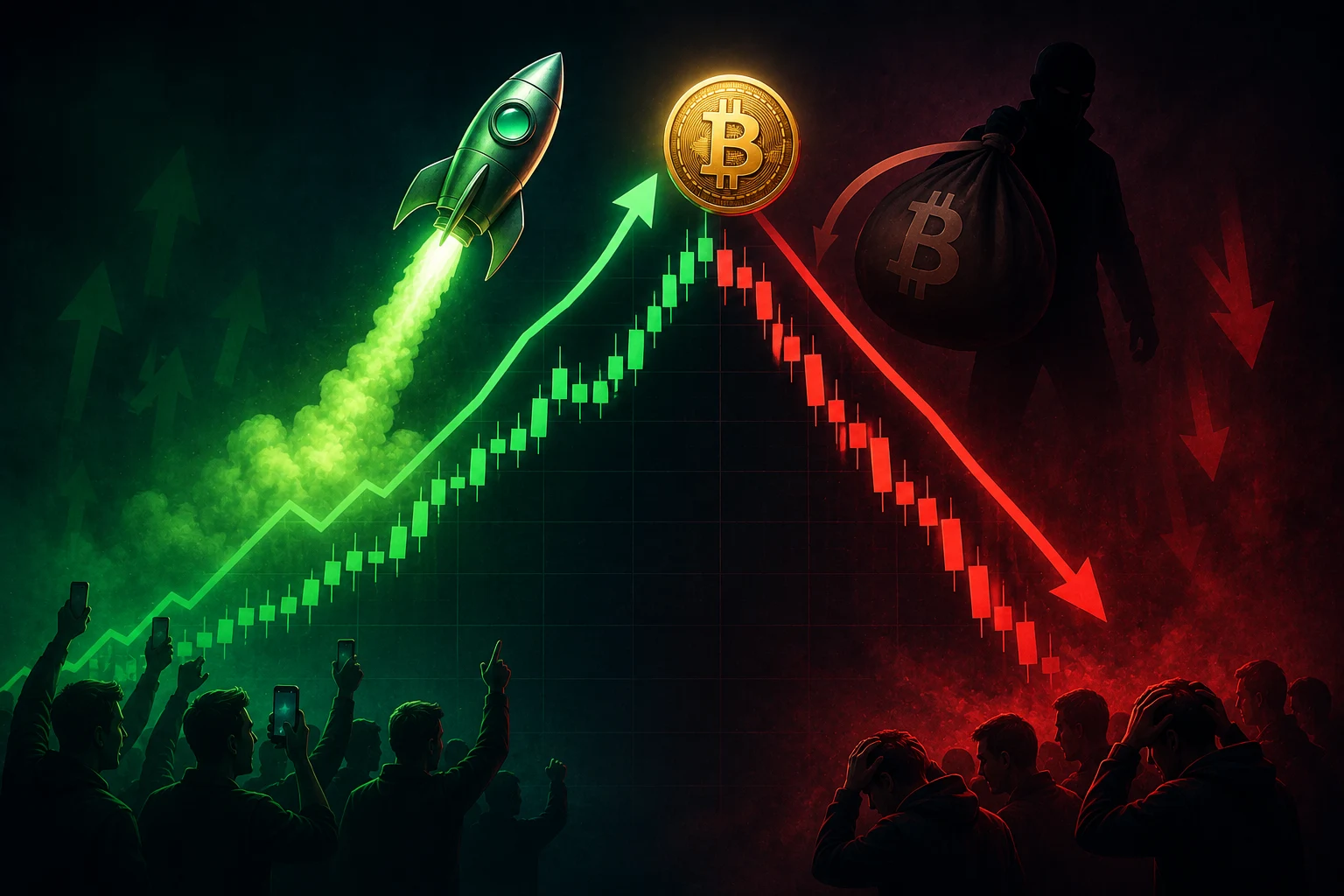
A textbook pump and dump has four phases:
- Quiet accumulation. Organisers pick a thinly traded token — usually a small, illiquid meme coin or obscure altcoin where a few thousand dollars of buying meaningfully moves the price. They accumulate over hours or days while the chart is still flat.
- Hype the room. A "pump signal" goes out to a Telegram group, X account, Discord, or paid newsletter. The pitch is usually "we're pumping this token at X:00 UTC — be ready." The framing always implies that members are the inside crowd.
- The wave. Members rush in, often within minutes. Price spikes, the chart goes vertical, and screenshots of the move fan out across crypto X — which pulls in a second wave of outsiders who think they have spotted a genuine breakout.
- The dump. The organisers sell into all that fresh demand. Price collapses, usually almost as fast as it rose. The members who joined late and the outsiders who chased the chart are left holding a token worth a fraction of what they paid.
The dirty secret of "pump groups" is that the people running them are not pumping with the members. They are pumping into the members. The free or paid Telegram seat you bought puts you near the back of the line, not at the front.
Where you will see it
The pattern shows up in a few recognisable settings:
- Telegram and Discord "pump groups." Open invitations, countdowns to a coordinated buy, leaderboards of past "winners." Almost always organised against tiny, low-volume tokens.
- Paid signal channels. A monthly subscription buys you "alpha" — which is often just the privilege of being one of the first members notified about a coordinated move. The organisers still sell first.
- Influencer-led pumps. A large account quietly buys a token, posts about it enthusiastically, then sells into the followers it drew in. This shades into undisclosed paid promotion and is one of the most common modern shapes of the scam.
- Low-float new listings. Brand-new tokens with very small public float and a heavy insider allocation often spike on launch and then collapse — sometimes organically, sometimes by design.
Red flags to spot it early
You do not need to be inside the scheme to recognise the shape. Some recurring signs:
- The promise itself. Anyone publicly inviting you to a "coordinated pump" is recruiting exit liquidity. There is no version of this where retail members reliably win.
- Unusual volume on a tiny token, with no news, no shipping update, no listing announcement to explain it.
- Vertical price action with no fundamental story. Healthy rallies usually have something to point at. A pure "number go up" candle on a microcap, without context, is the classic shape.
- Heavy promotion across many fresh accounts at once. Coordinated X threads, new Telegram channels, identical talking points, a flood of "don't miss this" replies.
- Concentrated supply. A handful of wallets hold most of the token. On-chain data tools make this checkable in seconds, and the answer is often damning.
- FOMO-engineered framing. Countdowns, "last chance," "the next 100x," "only insiders get this" — language designed to short-circuit your judgement is itself a red flag.
The legal picture
In regulated equity markets, pump and dumps are clearly illegal — market manipulation and securities fraud. In crypto the law is less uniform but pointed in the same direction. The SEC crypto regulation stance treats coordinated manipulation of tokens deemed securities as fraud, and similar frameworks exist in other jurisdictions. Even where a specific token's legal status is unsettled, the act of coordinating to mislead other buyers is broadly recognised as fraudulent conduct.
The practical reality is that enforcement is uneven. Many scheme organisers operate from jurisdictions that make prosecution difficult, and most retail losses are never recovered. "Probably illegal but rarely punished" is not the same as "safe to join." If anything, weak enforcement is exactly why the schemes are so common.
What to do if you got caught
If you bought into a pump near the top, a few things help more than panic:
- Accept the lesson early. The most expensive mistake after a pump is averaging down into a dying chart in the hope of "breaking even." That usually deepens the loss.
- Decide based on conviction, not sunk cost. Ask whether you would buy the token today at this price with fresh money. If not, holding is not a strategy, it is hope.
- Document and report. Save the messages, screenshots, and addresses. Local financial regulators and exchanges sometimes act on patterns even if individual cases stall.
- Update your filters. The same organisers run the same play repeatedly. Mute the channel, unfollow the account, and treat any further "signals" as confirmation, not invitation.
Best practices to avoid the trap
- Stay away from coordinated pump signals, free or paid. The model is structurally rigged against late members.
- Be sceptical of vertical microcap charts with no news or product reason behind the move.
- Check token holders on-chain before buying anything small. Heavily concentrated supply is a structural risk on its own.
- Treat influencer enthusiasm as marketing, not analysis. Assume undisclosed positions until proven otherwise.
- Size positions so a manipulation loss does not damage you. Sound crypto portfolio habits — small, deliberate position sizes on speculative bets — are what makes recovery from one bad call possible.
- Slow down. Every layer of FOMO framing — countdowns, "last chance," "only insiders" — is designed to stop you from thinking. The simplest defence is the pause.
Stay ahead of manipulation
Pump and dumps thrive on speed and on the gap between what insiders know and what everyone else sees. Zippfeed is built for exactly that gap: it tracks crypto headlines — listings, hacks, scams, regulator actions — across many sources with sentiment and importance scoring, so suspicious moves and the news context around them show up together. The earlier you can connect a vertical chart to the story behind it, the easier it is to step around the trap instead of buying into the top of it.