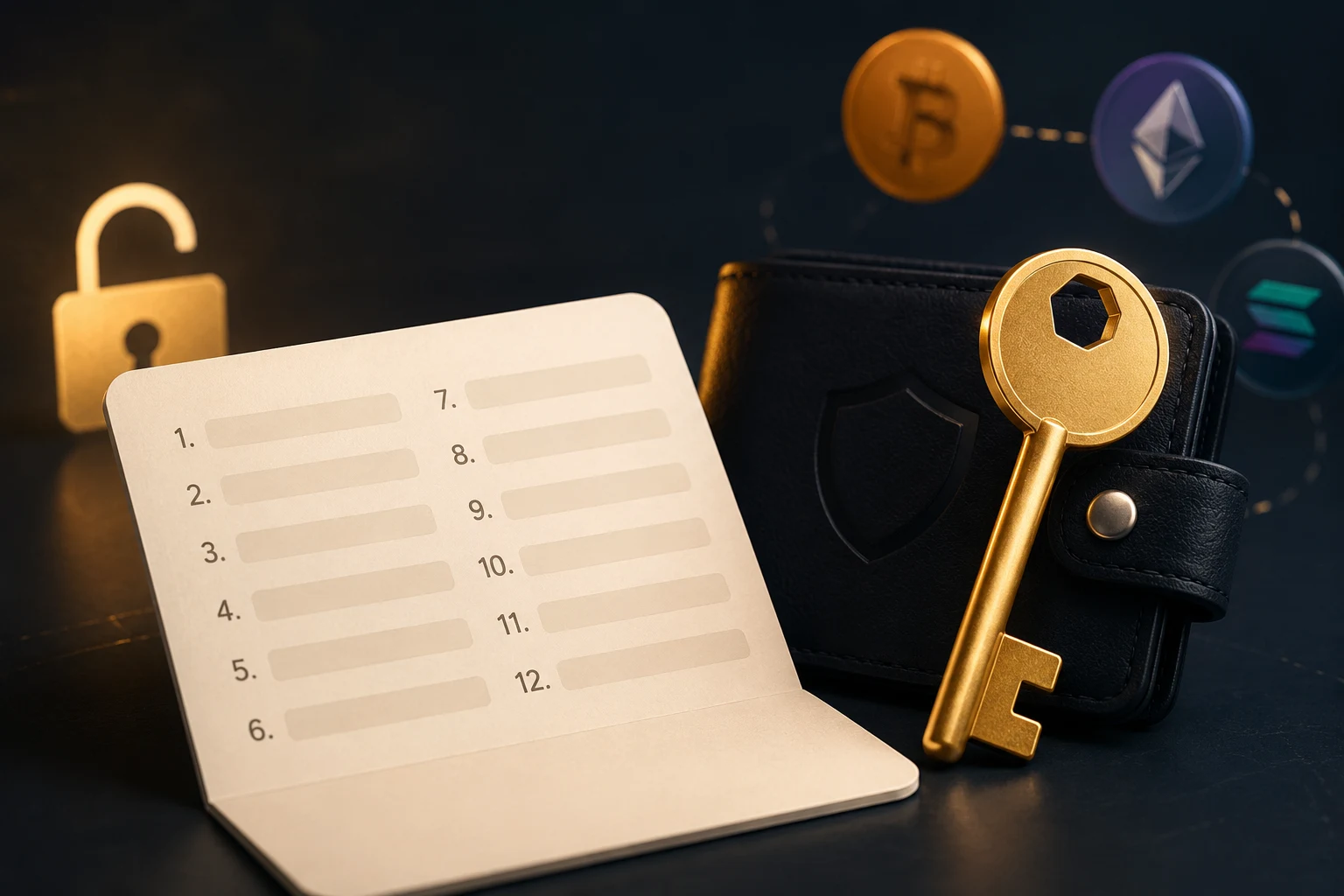
A seed phrase in one sentence
A seed phrase is the human-readable backup of every private key your crypto wallet will ever generate, written as 12 or 24 ordinary words from a fixed dictionary. Anyone who has the words can recreate your wallet and spend every coin in it, on any device, anywhere — and there is no way to undo that. Almost every beginner-level catastrophe in crypto comes back to one of three mistakes with this phrase.
The mental model: a regular password protects an account at a company. The company can reset it, freeze it, or rebuild it for you. A seed phrase is not a password — it is the keys themselves, expressed as words you can read aloud. There is nobody to ask for help. That is the whole point and the whole risk.
How a seed phrase actually works
Behind the friendly words is a precise technical machine. Understanding it once removes most of the mystery.
BIP-39: the dictionary that makes it work
The list of words is not random English. It comes from a standard called BIP-39, which defines a fixed dictionary of exactly 2048 carefully chosen words. They were picked to be short, unambiguous, and clearly different from each other so a single typo cannot silently turn one word into another. The same dictionary is used by almost every major wallet (Ledger, Trezor, MetaMask, Phantom, Coinbase Wallet, and many others), which is why a seed phrase generated on one wallet can be restored on another.
From words to a seed to keys
The words are turned into a long number called the seed. That seed is then fed through a key-derivation function (BIP-32) that can generate effectively unlimited private keys from it, all in a deterministic way. So the same 12 or 24 words always produce the same set of accounts, in the same order, on every wallet that follows the standard. That is the whole reason this scheme exists: one short list of words, infinite keys, perfectly reproducible.
The checksum
The last word of your phrase is not a free choice. It encodes a checksum of the words before it, so most typing errors fail loudly instead of silently restoring a different wallet. This is also why you cannot just invent twelve random English words and use them — the checksum almost certainly will not match.
12 words vs 24 words: does it matter?
Both are common; both are safe. The mathematical difference is the size of the underlying randomness.
A 12-word phrase carries roughly 128 bits of entropy. A 24-word phrase carries roughly 256 bits. Both numbers are so far beyond what any computer or constellation of computers can ever brute-force that the difference is academic. If someone steals your phrase, they steal it as a phrase — they do not guess it. So in practice, 12 words is enough for any real threat model.
People still pick 24 words for two soft reasons. First, hardware wallets default to 24 by convention. Second, there is a tiny psychological comfort in a longer backup. Neither matters for security. Pick what your wallet defaults to and move on.
How to back up a seed phrase correctly
The single most important section of this guide. Almost every story of a beginner losing thousands ends with a violation of one of these rules.
Write it down on paper, by hand
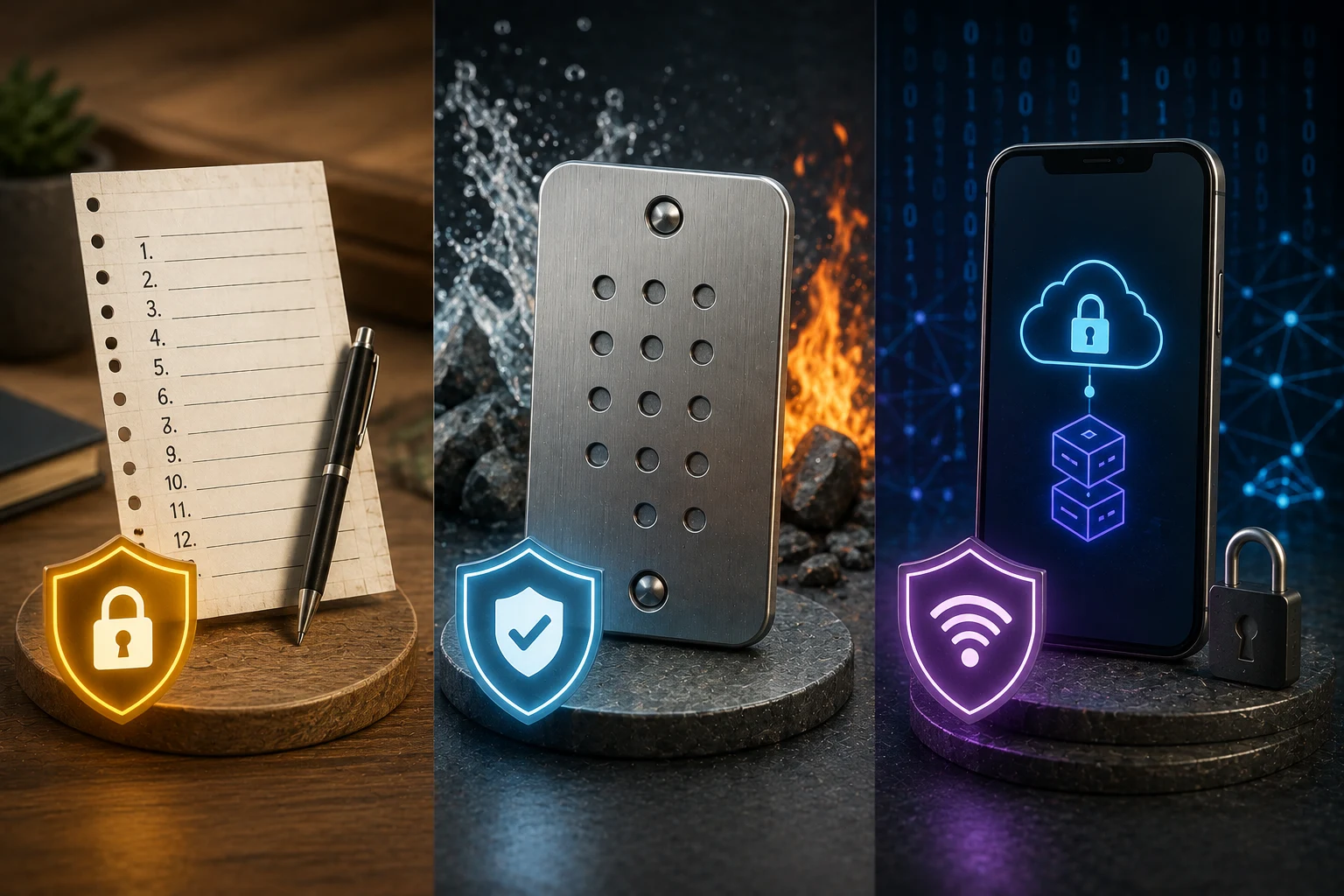
This is the default backup. Buy a small notebook or a dedicated metal seed-phrase plate, write the words in order with a pen, and store it somewhere only you have physical access to. Make sure the handwriting is legible — a sloppy seed phrase is functionally a lost one.
Do not photograph or screenshot it
A photo on your phone is a photo in your cloud (iCloud, Google Photos) is a photo on every device synced to that cloud. One account compromise drains everything. The same applies to OCR-friendly handwriting visible behind you on a video call.
Do not type it into anything connected to the internet
This is the rule that gets violated most often. A real wallet will only ask for your seed phrase when you restore it from scratch on the wallet's own interface, never in a popup, never via a support chat, never to claim an airdrop, never to validate your wallet. Anyone asking for it anywhere else is stealing it. There is no exception.
Store a duplicate in a different physical place
If your only copy is in your apartment and there is a fire, the funds are gone. Most serious holders keep at least two copies in geographically separate locations — your home and a relative's house, or a safe deposit box. The trade-off is more potential exposure if one location is compromised, so think about who has access to each.
Consider a metal backup for serious amounts
Paper burns, smudges, fades. Stainless-steel plates with the words stamped or etched onto them survive fire and water. For a six-figure holding, a metal backup is a reasonable purchase.
What can go wrong, in order of frequency
The honest list. Almost all real losses fall into one of these buckets.
Phishing. You receive an email, DM or popup pretending to be from a wallet, exchange or support agent and you paste the phrase. Every time, the funds are gone in seconds. Real wallets never ask. Treat any request as an attack — even ones that look very official.
Screenshot or photo. A friend takes a photo of your screen, you screenshot it for safekeeping, a cloud-synced clipboard captures it. Once it is digital, assume it is everywhere.
Family or roommate access. Your seed phrase is in a notebook on your desk. Someone living with you photographs it, knowingly or not. Quiet drains often trace back to physical access.
Loss. You stash the phrase somewhere clever and then forget where. You move house and the paper does not come with you. You burn an old notebook. This is silent and final.
Wrong wallet on restore. You restore the phrase into a wallet that expects a different derivation path and see a zero balance, panic, and broadcast the phrase trying to fix it. If a fresh restore shows zero, do not type the phrase anywhere else — read the wallet's documentation or ask in a public forum (without the phrase).
Seed phrase vs private key vs password
People mix these three up constantly. They are not the same thing.
A password protects an account at a service. It can be reset by the service.
A private key is a single number that controls a single address. Anyone with the key can move that address's funds. Most modern wallets hide private keys from you and generate many of them from your seed. We go deeper in our what is a private key guide.
A seed phrase is the human-readable backup that generates every private key your wallet will ever have. It is one level above private keys: lose the seed and you can in theory still spend coins for which you exported the private key separately. Steal the seed and you steal the keys for everything in that wallet.
Special cases and modern variants
The standard 12 or 24 words from BIP-39 covers the vast majority of wallets. A few variations are worth knowing.
BIP-39 passphrase (the 25th word). Many hardware wallets let you add an optional extra word — really a passphrase — to the standard 12 or 24. The combined seed phrase plus passphrase opens a different wallet than the phrase alone. This is powerful (an attacker who finds your written phrase still cannot get the funds) and dangerous (forget the passphrase and your real wallet is gone forever). Treat the passphrase with the same seriousness as the words.
SLIP-39 / Shamir backup. Some hardware wallets support splitting the seed into a quorum of shares, e.g. three of five. Any three reconstruct the wallet; fewer than three are useless. This is useful for distributing risk across multiple locations or people, but adds complexity. Not necessary for most users.
Multisig. Instead of relying on a single seed, multisig wallets require signatures from several independent keys. A treasury holding might use three-of-five hardware wallets, each with its own seed phrase, in different locations. The right answer for institutions; usually overkill for individuals.
If you are starting today
The simple, conservative path:
- Install a wallet from its official site or your platform's official app store.
- Write the seed phrase down on paper as it is displayed. Verify by re-entering it when prompted.
- Store the paper somewhere physical that only you can access.
- For more than a few thousand dollars in value, buy a hardware wallet and a metal seed plate.
- Tell no one. Especially do not tell internet strangers.
Done well, this is enough security for most retail-sized holdings indefinitely.
Staying current as wallet security evolves
Wallet attack patterns shift over time — clipboard hijackers, fake browser extensions, signature phishing, cross-app integrations that quietly leak keys. The security advice that worked two years ago can be subtly wrong today. Zippfeed surfaces wallet-security headlines with a sentiment score (bullish, neutral or bearish) and an importance rating, so a real new exploit pattern reaches you before it reaches your wallet. This is education, not financial advice — but the people who keep their crypto safe over long timelines are the ones who notice when the threat model changes.