Solana in one sentence
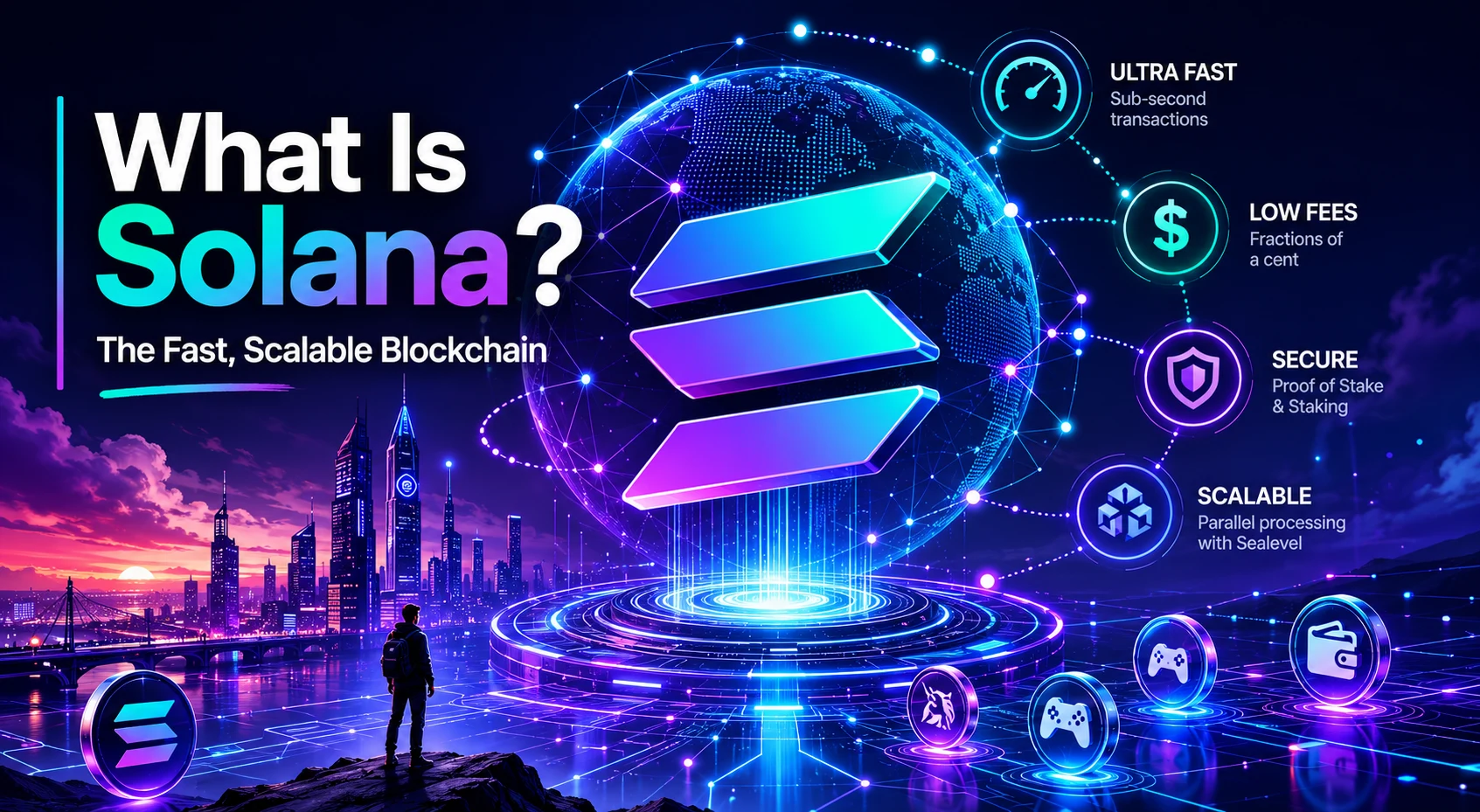
Solana is a public blockchain designed to settle transactions in well under a second while charging fractions of a cent in fees. That combination — speed plus near-zero cost — is the whole pitch, and it explains why so much trading, gaming, and consumer activity has migrated onto the network over the past few years.
If you have only ever used a slow, expensive chain, the first time you send something on Solana feels almost suspicious. The confirmation lands before you have finished reading the screen. That experience is the product.
How Solana actually works
Most blockchains agree on the order of transactions by having validators vote, back and forth, until they reach consensus. That voting is where a lot of the delay comes from. Solana's founders took a different angle.
Proof of History: a clock built into the chain
Solana's signature invention is Proof of History (PoH). Instead of validators arguing about what happened when, the network keeps a cryptographic timestamp — a kind of verifiable clock — that proves
one event came before another. Think of it as a tamper-proof stopwatch running underneath the whole system.
Because everyone already agrees on the *order* of events, validators spend far less effort coordinating. PoH is not a consensus mechanism on its own; it works alongside Solana's proof-of-stake layer. But it is the piece that unlocks the speed.
Proof of Stake on top
Validators stake SOL, the network's native token, to participate in producing and confirming blocks. Honest behavior earns rewards; dishonest behavior can cost a validator its stake. If you want the full picture of how this staking model works across chains, our explainer on what proof of stake is breaks it down.
Parallel processing with Sealevel
Ethereum-style chains generally process transactions one after another. Solana's runtime, Sealevel, runs non-overlapping transactions at the same time across multiple processor cores. That parallelism is a big reason throughput scales the way it does.
What SOL the token is for
SOL has three core jobs:
- Paying fees. Every transaction costs a tiny amount of SOL.
- Staking. Holders can stake SOL to validators (or run their own) to help secure the network and earn yield.
- Governance and ecosystem access. SOL is the reserve asset of the Solana economy — NFTs, DeFi positions, and apps all settle in or around it.
Solana vs Ethereum: the honest comparison
This is the question almost everyone arrives with. The short version: Ethereum optimizes for decentralization and a massive, battle-tested developer base; Solana optimizes for raw performance and cost.
Ethereum processes far fewer transactions per second at the base layer and leans on Layer 2 networks to scale. Solana pushes everything through one fast base layer. Each design has trade-offs — Solana's speed has historically come with periods of network instability, while Ethereum's decentralization comes with higher fees. We go deeper in our dedicated Solana vs Ethereum comparison.
What people build on Solana
The ecosystem is broad and consumer-facing:
- DeFi — decentralized exchanges, lending markets, and perpetuals platforms.
- Payments and stablecoins — fast settlement makes Solana attractive for moving dollars on-chain.
- NFTs and gaming — low fees make high-volume minting practical.
- Consumer apps — wallets, mobile experiences, and tokenized loyalty.
The risks worth knowing
No guide is honest without these. Solana has experienced network outages where block production stalled. It is also a younger, more concentrated system than Bitcoin or Ethereum, and SOL is a volatile asset. None of this is investment advice — it is context. Treat any crypto position as money you can afford to lose, and verify the network's current status before relying on it for anything time-sensitive.
How to follow Solana the smart way
Solana moves fast, and so does the news around it — protocol upgrades, outages, ETF speculation, and ecosystem launches can shift sentiment in hours. Tracking that flow manually is a losing game. Zippfeed surfaces Solana headlines with sentiment scoring (bullish, neutral, or bearish) and an importance rating, so you can see what actually matters instead of doom-scrolling ten sites. That is the difference between reacting to noise and reading the signal.

 Lookonchain
 WuBlockchain
 TheBlock
 CoinTelegraph